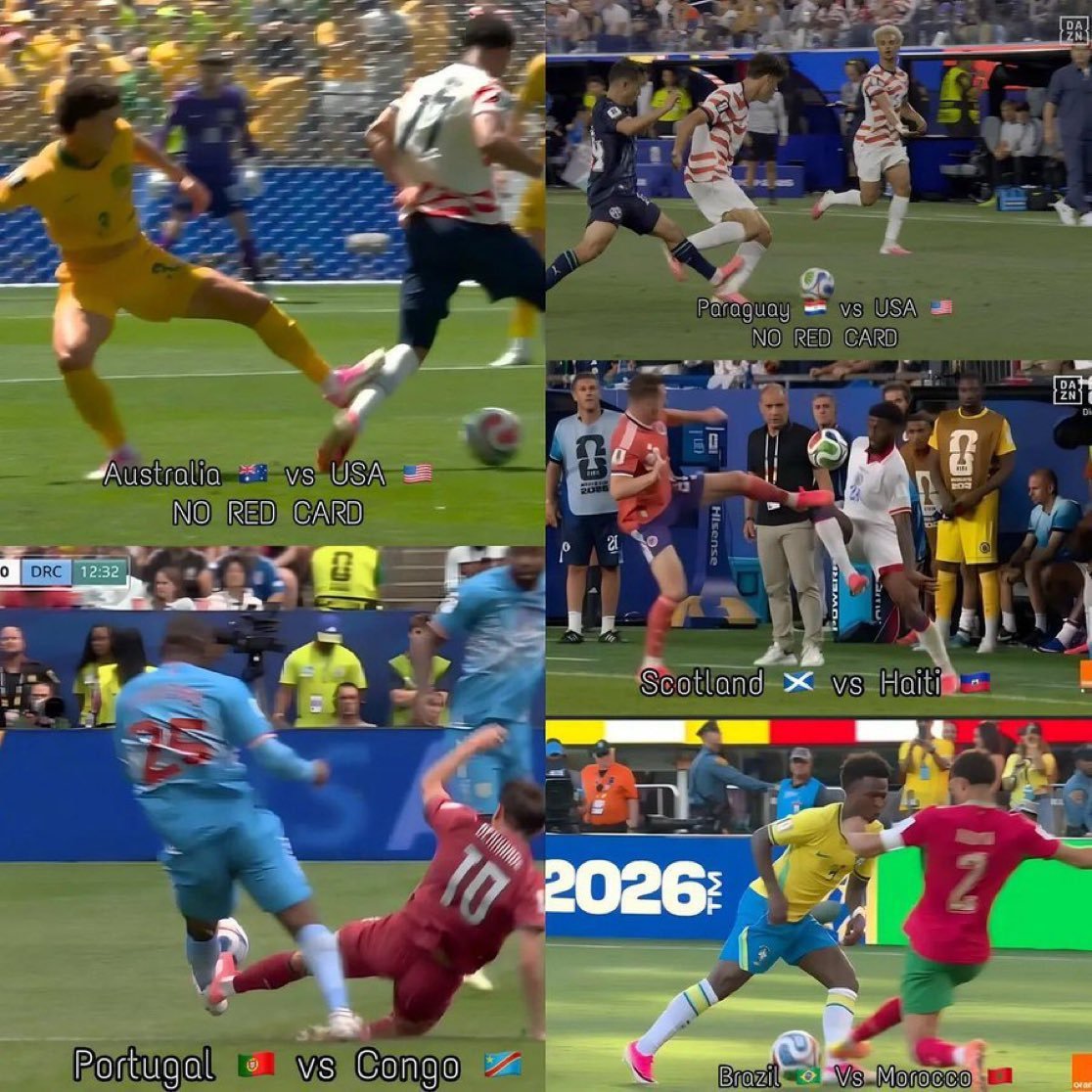
Folarin Balogun on his controversial red card against Bosnia, questioning the referee and VAR:
🗣️ “I cannot accept that decision. I've watched the replay over and over, and I know in my heart there was never any intention to hurt anyone. It was a football action, nothing more. To send me off for that is one of the harshest decisions I've experienced in my career.”
“What's frustrating isn't just the red card it's the inconsistency. Week after week, challenge after challenge, we've all seen similar incidents judged differently. Sometimes VAR says it's football, sometimes it becomes a straight red. How are players supposed to understand the rules when the standard changes every game?”
“The referee had one look. VAR had every angle, slow motion, every replay imaginable, and they still chose the harshest possible outcome. That's the part I cannot understand. Technology was introduced to remove obvious mistakes, not to create even bigger controversies.”
“This decision didn't just punish me. It punished my teammates, my coaches, every supporter wearing a USA shirt and everyone who travelled to support us. One whistle changed an entire World Cup night, and that's something impossible to forget.”
“If football wants players and fans to respect VAR, then VAR has to start respecting football. Consistency isn't optional it's the foundation of fairness. Right now, too many careers, tournaments and dreams are being decided by officials instead of the football itself.”
“I'll accept responsibility when I'm wrong. But I will never stay silent when I believe the game has been let down. Players deserve clarity, supporters deserve honesty, and this tournament deserves officiating that applies the same standard to everyone not different standards depending on the badge you wear.”
LASIK eye surgery cost $2,200 per eye in 2000. Today it's around $1,000 per eye despite 24 years of inflation. Meanwhile, an MRI that cost $1,200 in 2000 now costs $3,000+. The difference? LASIK operates in a free market with no insurance interference and minimal regulation.
When patients pay directly, providers must compete on price and quality. LASIK clinics advertise prices, offer financing, and constantly improve technology to attract customers. Compare this to hospital procedures where prices are hidden, patients never see bills, and insurance companies negotiate opaque rates that somehow always increase faster than inflation.
Cosmetic surgery follows the same pattern. Breast augmentation, rhinoplasty, and other elective procedures have become more affordable and safer over decades. Surgeons invest in better techniques and equipment because they must satisfy paying customers, not insurance bureaucrats or hospital administrators focused on maximizing reimbursements.
The lesson is clear: remove third-party payment systems and excessive regulation, and you get Austrian economics in action. Prices fall, quality rises, and innovation accelerates. Healthcare costs aren't rising because of aging populations or new technology—they're rising because we've destroyed the price mechanism that makes markets work.
I’ve had so many people asking me about Ben that I wanted to let you know-Ben had a 2nd chemo injection on October 23rd and from that day has been getting worse and worse. He has lost use of his back legs-almost like they’re paralyzed. He can barely walk. He hasn’t eaten in 3 days. I’m currently in Pennsylvania with a holistic Dr who is administering a 3 day Vitamin C IV hoping it will flush the toxics from his body and give him a chance. The next 24-48 hours will tell us if he has a chance or not. I’m so thankful for ALL the love so many have shown him over the last couple years. One of the hardest things I’ve gone through in my life. Ben is my best friend and companion. I love him with all of my heart. If you’re a spiritual person I’d love for you to pray for my boy. 🙏🏼 He’s currently in an ER hospital overnight and I’m picking him up tomorrow for another round of Vitamin C. Please pray for Ben and hope he pulls out of it.
Triple Strike at 1221am on Monday morning. Simultaneous lightning strikes on the Hancock, Trump Chicago and Sears Tower in Chicago. One image. #weather#news#ilwx#chicago#storm
New York City paid Mckinsey $4m to conduct a feasibility study on whether trash bins are better than leaving garbage on the street.
The deck is 95-slides long and titled “The Future of Trash”.
Some highlights:
▫️The official term is “containerization”, which is the “storage of waste in sealed, rodent-proof receptacles rather than in plastic bags placed directly on the curb.”
▫️Two main types of containerization: 1) individual bins for low density locales; 2) shared containers for high-density.
▫️NYC needs to clean up 24,000,000lbs of garbage a day
▫️Containerization has only become the norm worldwide in major cities in the past 15 years.
▫️New York City first considered containerization in the 1970s but never conducted a feasibility study until now (Mckinsey’s sales team has been dropping the ball)
▫️Key considerations for container viability:
• POPULATION DENSITY: NYC has 30k residents per square mile (more dense than comparable big cities)
• BUILT ENVIRONMENT: Few places to “hide” containers due to history of infrastructure development.
• WEATHER: Snow creates challenges for “mechanized collection” in the winter.
• CURB SPACE: Mostly taken up by bus stops, bike lanes, outdoor dining and fire hydrants.
• COLLECTION FREQUENCY: NYC needs to double frequency of pick-up for estimated speed of trash that bins would accumulate.
• FLEET: A new garbage truck will needs to be designed to collect rolling bins at scale.
▫️ The proposed solution (literally garbage bins and shared containers) covers 89% of NYC streets and 77% of residential tonnage.
▫️The three case studies — because you gotta have solid case studies — are Amsterdam, Paris and Barcelona.
▫️There is a slide called “Why containerization matters” and three reasons are “rats”, “pedestrian obstruction” and “dirty streets” (the 21-year intern that did this slide billed at prob $10k an hour is my hero).
The study is actually pretty interesting.
I have no idea if $4m is a rip-off to learn that “yeah, we should put garbage in bins so rats don’t eat it” but I would have happily done it for 10-20% of that budget (and come to a similar conclusion).