Simon Birch (1998)
"Time is a monster that cannot be reasoned with. It responds like a snail to our impatience, then it races like a gazelle when you can't catch a breath."
El segundo cruce interoceánico se trasladaron automóviles del #Pacífico al #GolfoDeMéxico a través del Ferrocarril Interoceánico, fortaleciendo la conectividad logística y el desarrollo del sur-sureste de #México.
@AlessandraRdlv Eres la mamada morra, al chile que bueno!
Ojalá y si te hubieran metido un vergazo no ese puto maquillaje de cagada. Deja trabajar a la gente, pinche señora privilegiada.
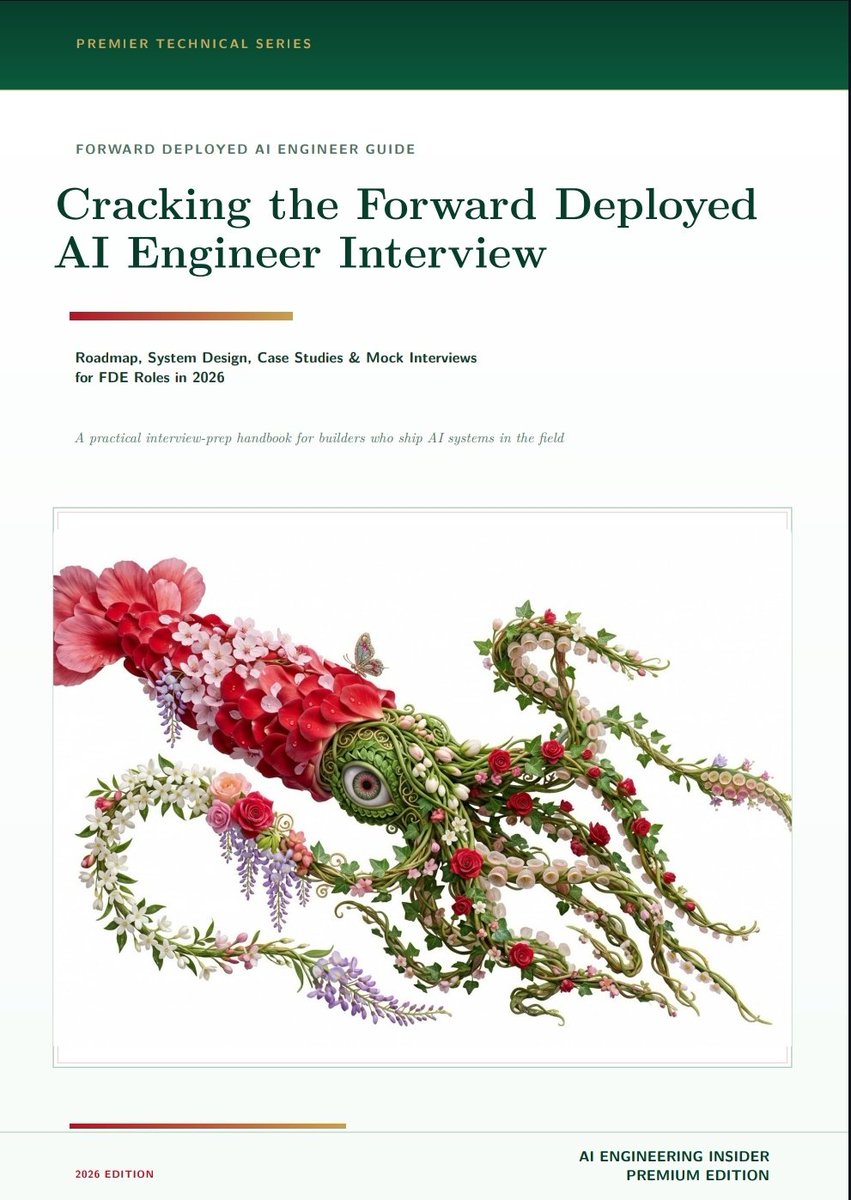
Cracking the Forward Deployed
AI Engineer Interview
Roadmap, System Design, Case Studies & Mock Interviews
for FDE Roles in 2026
https://t.co/emig4UcqqH
6 AI agent terms you need to know in 2026:
(Most developers still confuse #1 and #2)
𝟭. 𝗠𝗼𝗱𝗲𝗹 𝗖𝗼𝗻𝘁𝗲𝘅𝘁 𝗣𝗿𝗼𝘁𝗼𝗰𝗼𝗹 (𝗠𝗖𝗣)
Think of it as "USB-C for AI" - a universal standard that lets AI applications connect to external data sources and tools. Instead of building custom integrations for every tool, MCP provides one protocol that works everywhere.
𝟮. 𝗦𝗸𝗶𝗹𝗹𝘀
Basically, the agent’s job description. While MCP provides the connection and Tools provide the API, a Skill is the higher-level logic that orchestrates them. It encapsulates the domain-specific reasoning needed to turn a raw tool into a finished outcome.
Learn more about Agent Skills in our latest blog post: https://t.co/HAot10Wr1w
𝟯. 𝗦𝗶𝗻𝗴𝗹𝗲 𝗔𝗴𝗲𝗻𝘁 𝗔𝗿𝗰𝗵𝗶𝘁𝗲𝗰𝘁𝘂𝗿𝗲
One agent handles the entire pipeline - from understanding the task to planning steps, using tools, and generating responses. It's the simplest form of agentic system where one LLM orchestrates everything.
𝟰. 𝗠𝘂𝗹𝘁𝗶-𝗔𝗴𝗲𝗻𝘁 𝗔𝗿𝗰𝗵𝗶𝘁𝗲𝗰𝘁𝘂𝗿𝗲
Multiple specialized agents work together, each handling different parts of a task. One might retrieve information, another validates it, and a third generates the final response. This creates more robust and capable systems.
𝟱. 𝗔𝗴𝗲𝗻𝘁𝗶𝗰 𝗥𝗔𝗚
An AI agent-based implementation of RAG that goes beyond simple retrieval. The agent can route queries to specialized knowledge sources, validate retrieved context, and make dynamic decisions about what information to use.
𝟲. 𝗔𝗴𝗲𝗻𝘁 𝗠𝗲𝗺𝗼𝗿𝘆
Agents use two types of memory:
• Short-term: Stored in the context window for immediate use
• Long-term: Retrieved on demand from external storage (like vector databases)
This memory layer helps agents maintain context across interactions and learn from past experiences.
Which am I missing? 🤔
Introducing Hyperagents: an AI system that not only improves at solving tasks, but also improves how it improves itself.
The Darwin Gödel Machine (DGM) demonstrated that open-ended self-improvement is possible by iteratively generating and evaluating improved agents, yet it relies on a key assumption: that improvements in task performance (e.g., coding ability) translate into improvements in the self-improvement process itself. This alignment holds in coding, where both evaluation and modification are expressed in the same domain, but breaks down more generally. As a result, prior systems remain constrained by fixed, handcrafted meta-level procedures that do not themselves evolve.
We introduce Hyperagents – self-referential agents that can modify both their task-solving behavior and the process that generates future improvements. This enables what we call metacognitive self-modification: learning not just to perform better, but to improve at improving.
We instantiate this framework as DGM-Hyperagents (DGM-H), an extension of the DGM in which both task-solving behavior and the self-improvement procedure are editable and subject to evolution. Across diverse domains (coding, paper review, robotics reward design, and Olympiad-level math solution grading), hyperagents enable continuous performance improvements over time and outperform baselines without self-improvement or open-ended exploration, as well as prior self-improving systems (including DGM). DGM-H also improves the process by which new agents are generated (e.g. persistent memory, performance tracking), and these meta-level improvements transfer across domains and accumulate across runs.
This work was done during my internship at Meta (@AIatMeta), in collaboration with Bingchen Zhao (@BingchenZhao), Wannan Yang (@winnieyangwn), Jakob Foerster (@j_foerst), Jeff Clune (@jeffclune), Minqi Jiang (@MinqiJiang), Sam Devlin (@smdvln), and Tatiana Shavrina (@rybolos).
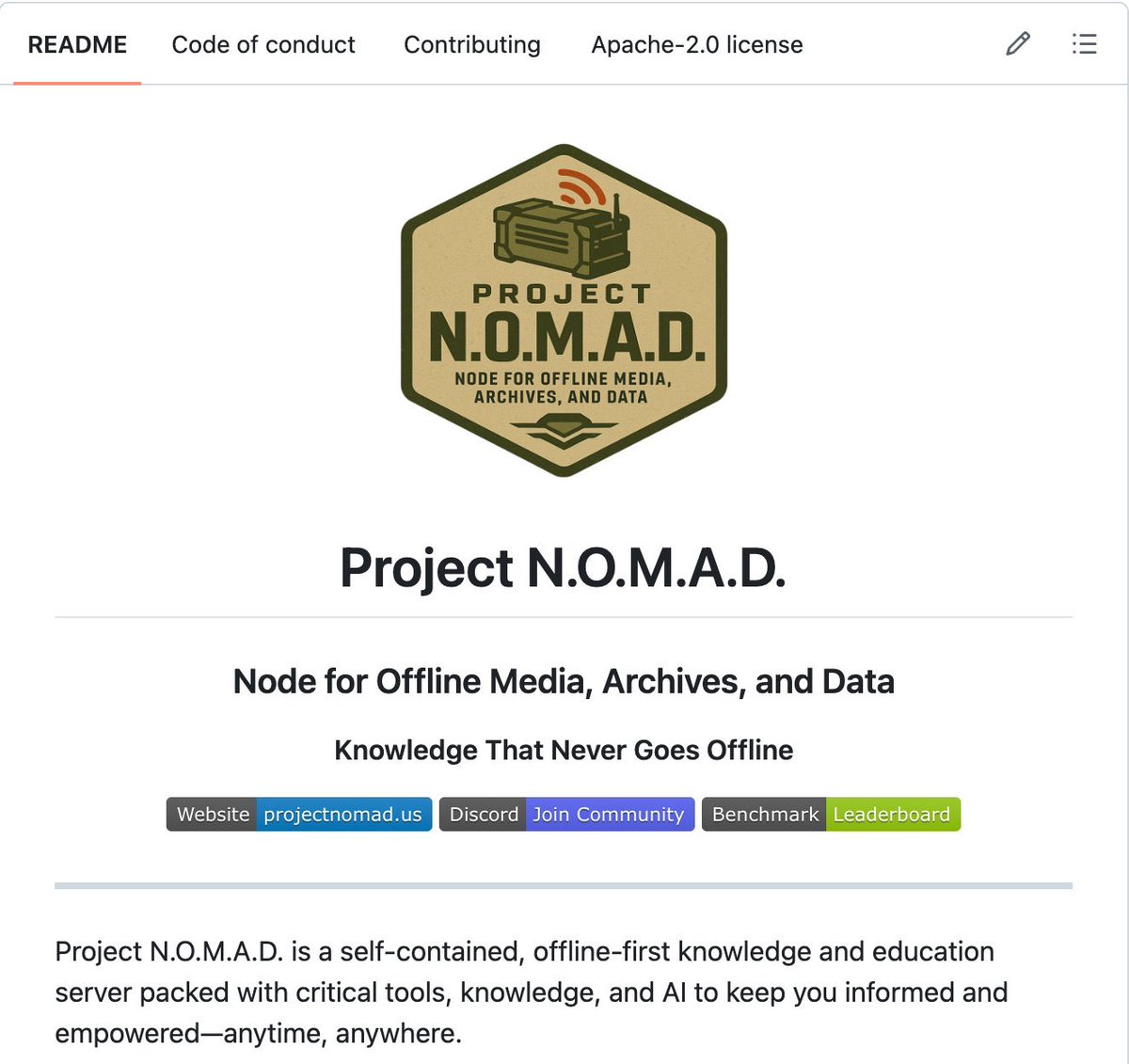
🚨 BREAKING: Someone just open-sourced a full offline survival computer with AI, Wikipedia, and maps built in.
Project N.O.M.A.D. is an open-source offline survival computer.
Self-contained.
Zero internet required after install.
Zero telemetry. Everything runs locally on your hardware.
What it includes:
→ Full Wikipedia archives via Kiwix
→ Offline maps via OpenStreetMap
→ Local AI models via Ollama + Open WebUI
→ Calculators, reference tools, resource libraries
→ A management UI to control
everything from a browser
One curl command installs the entire system on any Debian-based machine.
Runs headless as a server so any device on your local network can access it.
Minimum specs to run the base system: dual-core processor, 4GB RAM, 5GB storage.
To run local LLMs offline, you want 32GB RAM and an NVIDIA RTX 3060 or better.
No accounts.
No authentication by default.
No cloud dependency.
No phone-home behavior.
Built to function when nothing else does.
The grid, the cloud, the API you depend on. None of it is guaranteed.
The people building local-first systems right now are the ones who won’t be asking for help when access disappears.
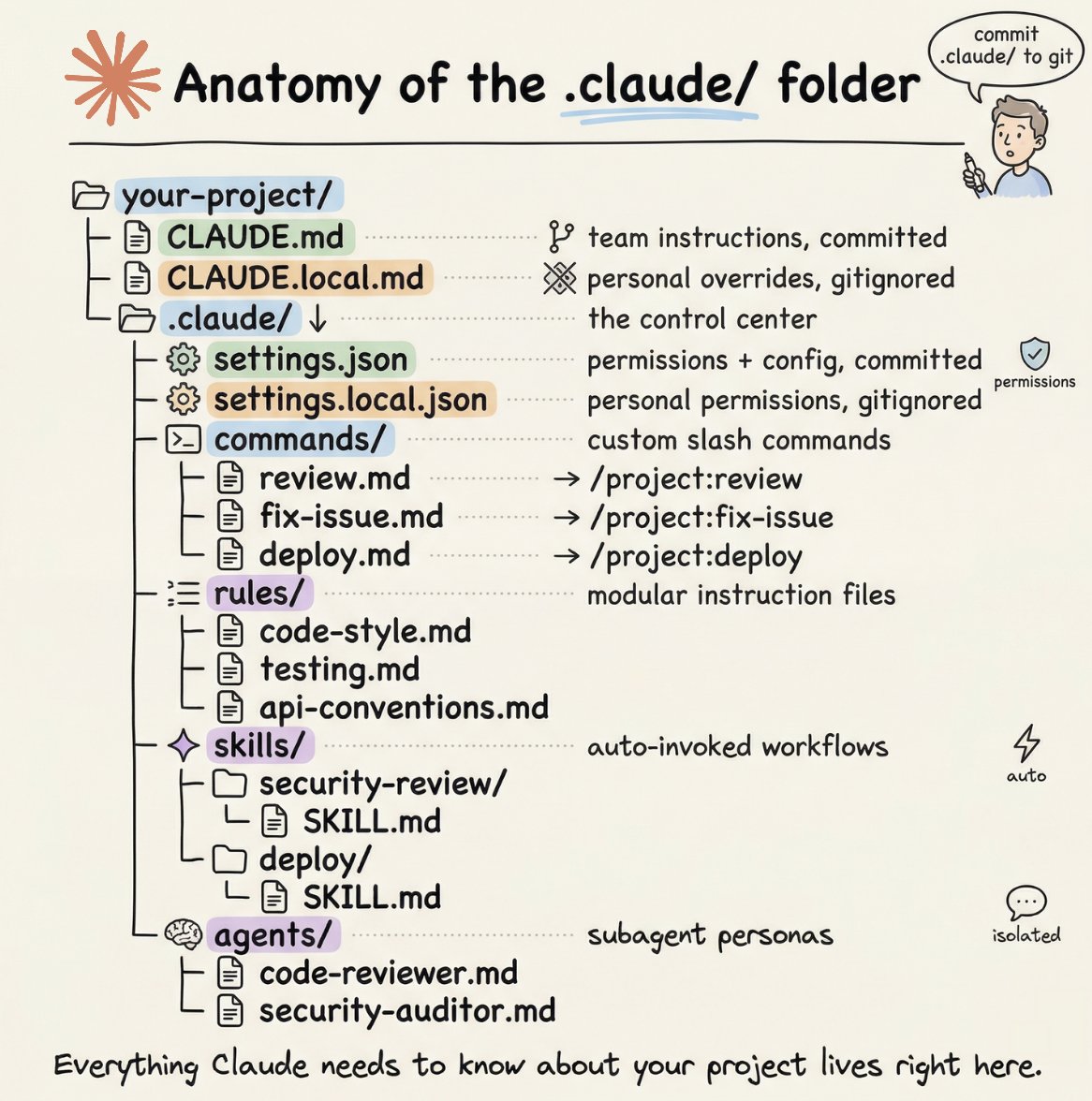
How to setup your Claude code project?
TL;DR
Most developers skip the setup and just start prompting. That's the mistake.
A proper Claude Code project lives inside a .𝗰𝗹𝗮𝘂𝗱𝗲/ folder. Start with 𝗖𝗟𝗔𝗨𝗗𝗘.𝗺𝗱 as Claude's instruction manual. Split it into a 𝗿𝘂𝗹𝗲𝘀/ folder as it grows. Add 𝗰𝗼𝗺𝗺𝗮𝗻𝗱𝘀/ for repeatable workflows, 𝘀𝗸𝗶𝗹𝗹𝘀/ for context-triggered automation, and 𝗮𝗴𝗲𝗻𝘁𝘀/ for isolated subagents. Lock down permissions in 𝘀𝗲𝘁𝘁𝗶𝗻𝗴𝘀.𝗷𝘀𝗼𝗻.
There are two .𝗰𝗹𝗮𝘂𝗱𝗲/ folders: one committed with your repo, one global at ~/.𝗰𝗹𝗮𝘂𝗱𝗲/ for personal preferences and auto-memory across projects.
The .𝗰𝗹𝗮𝘂𝗱𝗲/ folder is infrastructure. Treat it like one.
The article below is a complete guide to 𝗖𝗟𝗔𝗨𝗗𝗘.𝗺𝗱, custom commands, skills, agents, and permissions, and how to set them up properly.
🚨| Este ruso ha encontrado la manera de aprender cualquier cosa 10 veces más rápido con IA.
NotebookLM + Gemini + Obsidiana
Este es uno de los mejores videos que os traigo, dadle apoyo
🚨 ¿Entiendes lo que ha pasado en las últimas 24 horas?
> Zuckerberg ha cerrado el metaverso tras quemar 80.000 millones en avatares que nadie usaba.
> Powell dice que no va a cambiar la política monetaria por el conflicto en el Estrecho de Ormuz: “nadie sabe cuánto durará y no tomaremos decisiones basadas en especulación”.
> Sam Altman usó los 13.000 millones de Microsoft… y acabó vendiendo la nube de OpenAI a Amazon. Microsoft ha financiado a su propia competencia.
> Anthropic ha creado una IA que recibe órdenes desde tu móvil y hace tu trabajo mientras duermes.
> X lanzó botón de “no me gusta” y opción para silenciar países enteros en la misma semana.
> YouTube pide que se��ales el contenido de IA = Google usando a 2.000 millones de personas para entrenar gratis su próximo modelo.
> El 93% de los trabajos ya pueden ser parcialmente automatizados… y esa misma semana llegan las subidas salariales más bajas desde 2008.
> Micron tecnology (fabrica DRAM, NAND) presenta resultados y previsiones bestiales… y aun así cae un 4% al cierre.
> xAI está pagando a banqueros de Wall Street 100$/h para enseñar a Grok a reemplazarlos. Están aceptando.
> Aparece un modelo de IA misterioso que supera a todos en benchmarks. Todo apunta a que DeepSeek está probando algo en la sombra.
> Bloomberg pregunta si la burbuja de la IA está a punto de explotar… el mismo día que Nvidia dice que el mercado de chips irá a $1T. Uno de los dos está muy equivocado.
Y solo estamos a Jueves.