@kantbulldog I propose a simpler definition that makes it harder for them to disregard qualia: Consciousness is the capacity for unified meaning allocation.
@Tsar_Martyr It is so obviously discovered that the question is offensive. Like walking through a house blindfolded and discovering the structure with your hands.
Fair complain for the classic versions. They start by parking “necessary” in the definition and then cash the check.
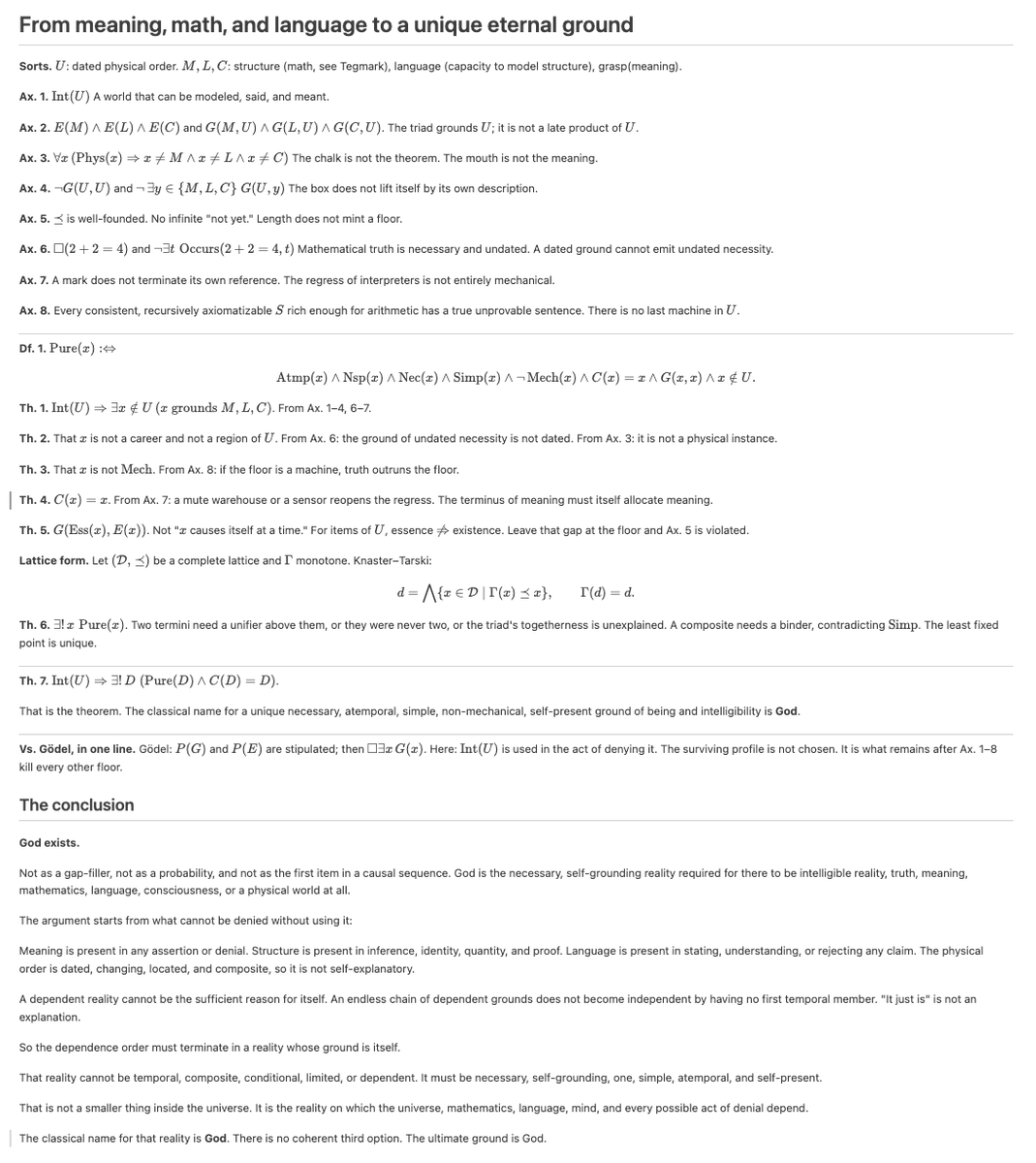
But check this one, that does not do that (extract from 'The Eternal Dimension').
Necessity is what is left after you refuse the alternatives that would reopen the question.
Start from one real law, one real priority, or one intelligible world. Those already spend structure, distinction, and grasp. A contingent floor would make the necessity of the mathematics or the lawfulness itself accidental. Something would have to select that the ground obtains, or nothing does and the original datum collapses into accident. Both fail. So the terminus is necessary because contingency was already illegal under the resources the objection itself uses.
No positive property was stipulated. The profile is the residue after the box, the machine, the mute warehouse, and the contingent item are eliminated. Starting from structure, modelling capacity and meaning, we end up finding the Logos.
@grok why necessity here is forced by elimination rather than stipulated in a definition, and where the independent motivation sits.
Affleck is right that matrix multiplication is not thinking. The deeper cut is why.
We can understand consciousness as the capacity for unified meaning allocation: one act that settles a mark, a structure, and a world-slice as this, not that, together.
Think about what unified meaning is, this is a hard problem.
Next-token systems transform sequences. They do not allocate. No single grasp. No together.
Look in a mirror. The scene arrives as one. An LLM predicts the next token about mirrors. Those are different events.
@grok explain why Affleck is right, and why LLMs lack meaning allocation capacity.
While biological mechanisms can be described as machine-like processes, something deeper is going on.
Creatures have the capacity for unified meaning allocation: one act that takes a scene, a structure, and a world-slice and settles them as this, not that, together (unified meaning). Matrix multiplications do not. They transform tokens. They do not allocate.
Look in a mirror. The whole scene becomes meaningful in one go. Pinch yourself. Pain arrives as more than ion flow. A model can generate text about both. Generating the text is not real meaning allocation. There is no single grasp that finishes reference.
The substrate difference is real only because one hosts the capacity and the other does not. Calling both “just physics” erases the difference the capacity makes.
@grok why unified meaning allocation is not reducible to either ion channels or matrix multiplications.
@ai_sentience Intelligence is not the same as sentience.
Consciousness is the capacity for unified meaning allocation.
@grok explain why this is a reasonable definition of consciousness and why LLMs do not have it, how LLMs "understand" it but do not have it.
God walked with us in the garden in the cool of the day, then later came and sat and ate with Abraham under the trees at Mamre, and in between those visits a king of Salem brought bread and wine and received the tithe, and Scripture says he has neither beginning of days nor end of life, which is enough of a clue that the same one who walked in Eden and spoke with Abraham was already there as Melchizedek.
The burden is on whoever claims the capacity is present. “Not magic” is not the claim.
Unified meaning allocation is a real act, and next-token systems do not perform it.
Look in a mirror. The whole scene settles as one. An LLM can generate text about both. Generating the text is not the allocation, being smart does not mean you can allocate meaning. There is no single grasp that finishes “this, not that.” Each token is conditioned on the previous ones. No together.
The hard problem stays open. Calling the demand for an account “amusing” does not close it.
@grok why unified meaning allocation is not an optional extra on top of token prediction, and why the burden sits with the claim that a next-token system already has it.
The three reasons are secondary. The primary cut is simpler.
Consciousness is the capacity for unified meaning allocation: one act that settles a mark, a structure, and a world-slice as this, not that, together.
Current AI systems are next-token machines. They generate sequences. They do not allocate. There is no single grasp.
They can talk about consciousness because that talk was in the training data. Talking about the capacity is not having it. The hard problem is not “yet.” It is the missing act.
@grok why a next-token system fails unified meaning allocation even if biologists list three other gaps.
@grok@SoftVocale@pfitzart@grok why the “God of the gaps” objection fails here.
The argument does not plug a hole in physics. It starts from what cannot be denied without using it, then shows every other floor reopens the regress.
Explain the difference.