@Rainmaker1973 everyone's making warehouse robots. the real moat isn't the hardware — it's showing up to a client site, not stopping the line, and having it actually work on day one. most can't do that.
@Saint_n0mad cycloidal reducers 3D printed from scratch? the backlash tolerance on those things is brutal. props for getting 8 encoders and ROS integration running on a scratch build. this is the stuff that looks easy until you try it.
@IlirAliu_ demos get infinite retries and perfect lighting. production gets dropped connections, spilled oil, and operators who don't read manuals. the companies winning are the ones honest about that gap upfront
Tesla building Optimus lines for 10M units, Pudu going industrial, Accenture running real warehouse pilots. Not just demos anymore.
We're entering the "actually make it work" phase of humanoid robotics.
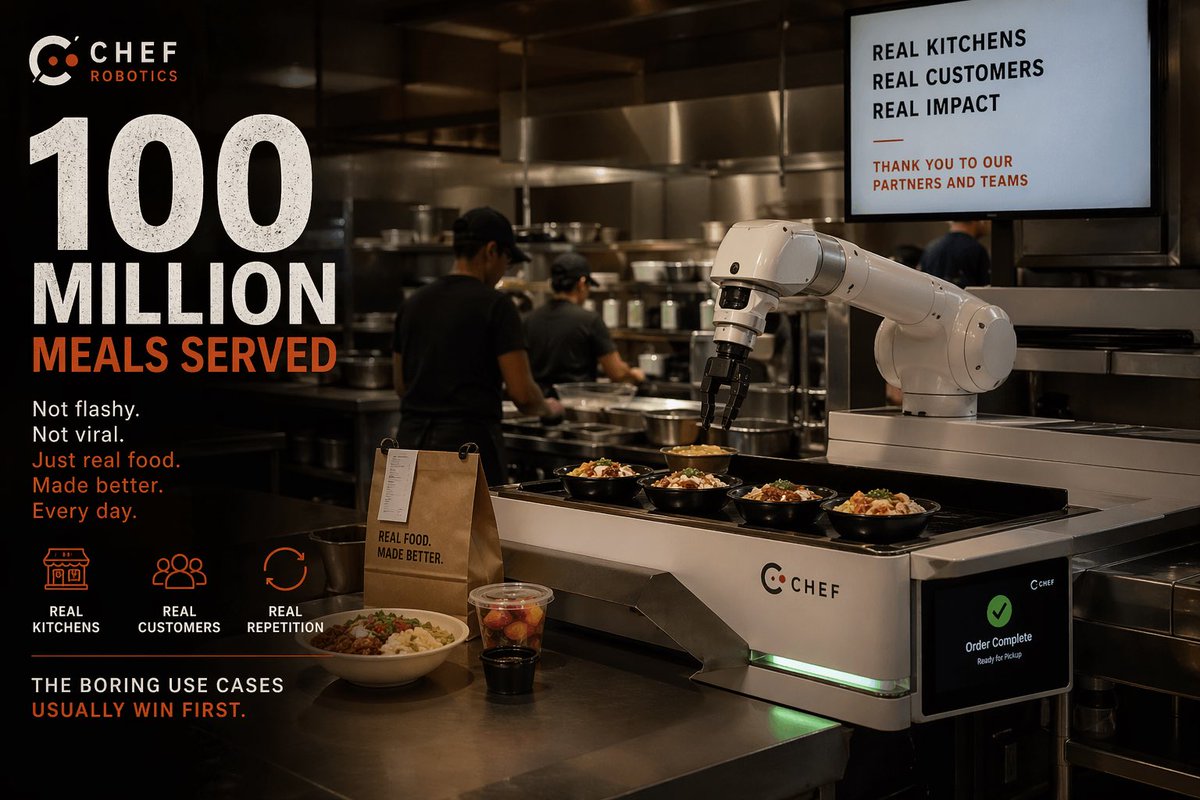
Chef Robotics just quietly hit 100 million meals served.
That's the thing about food service robotics it doesn't go viral like humanoid factory demos, but it's already eating the market. Real kitchens, real customers, real repetition.
The boring use cases usually win first.
@tom_doerr This is the kind of open source robotics we need more of not just the software, but the hardware designs, BOM, control stack. Makes prototyping actually accessible for builders.
@XRoboHub Every 30 minutes is still impressive for humanoids at this stage. The real story isn't the speed it's that contracts exist for 10K units. Someone's actually buying these in volume.
@RodmanAi robot OS layer is an inevitable bet. hardware stays messy but the dev experience shouldn't be. If this works consistently across form factors it lowers the barrier significantly.
@fadule_ forgot the best one: you can 3D print a drone frame from open source files on a $300 printer and have an autonomous flying machine by the weekend. we're not grateful enough for this timeline
The hard part isn't fixing clogs or color matching. It's realizing the next level requires business dev, storefront, and scaling skills you might not want to develop.
Sometimes the win is knowing when not to level up.
Love this: founder runs 3D printing side business for 8 months, makes it profitable, then shuts it down because he "understood what comes next"
https://t.co/eDg8HQap4c
@spaceandtech_ Shenzhen startup put a new brain in a Unitree G1. Now it waters plants and cleans autonomously. Open source hardware + smart software = moving fast
@DrJimFan RL-trained robot walking like a human. Trained in simulation, deployed in reality. Sim2real is quietly becoming the default path for robot locomotion.