@marcos_galperin@JMilei Pregunta honesta para un debate honesto (algo difícil en X, lo sé): Jeff Bezos postulaba algo hace pocos días 👇
Luego apareció Bernie Sanders a responder, dejando claro que no entienden nada.
Pero, ¿un modelo así es solo aplicable en EEUU?
Yes, the United States has the most progressive tax system in the world. The top 1% pay 40% of taxes, the bottom 50% pay 3% of taxes. We can make it even more progressive by zeroing out taxes on the bottom half. It’s a small amount of the total tax revenue but very meaningful to people in this group.
@brfootball@ChampionsLeague Counts as an assist for Busquets?
Reminds me of ‘El Negro’ Enrique in ‘86: “With the pass I gave to Maradona, if he hadn't scored, I would have killed him.”
https://t.co/Ll7LlCjoMg
i'm not satoshi, but I was early in laser focus on the positive societal implications of cryptography, online privacy and electronic cash, hence my ~1992 onwards active interest in applied research on ecash, privacy tech on cypherpunks list which led to hashcash and other ideas.
@dwarkesh_sp@collision@elonmusk Every time I see news about the Strait of Hormuz, I can't help but think of @elonmusk solving "bottlenecks" once and again in his enterprises.
This is your next challenge, Elon! This is a worldwide class bottleneck to be solved in the future...
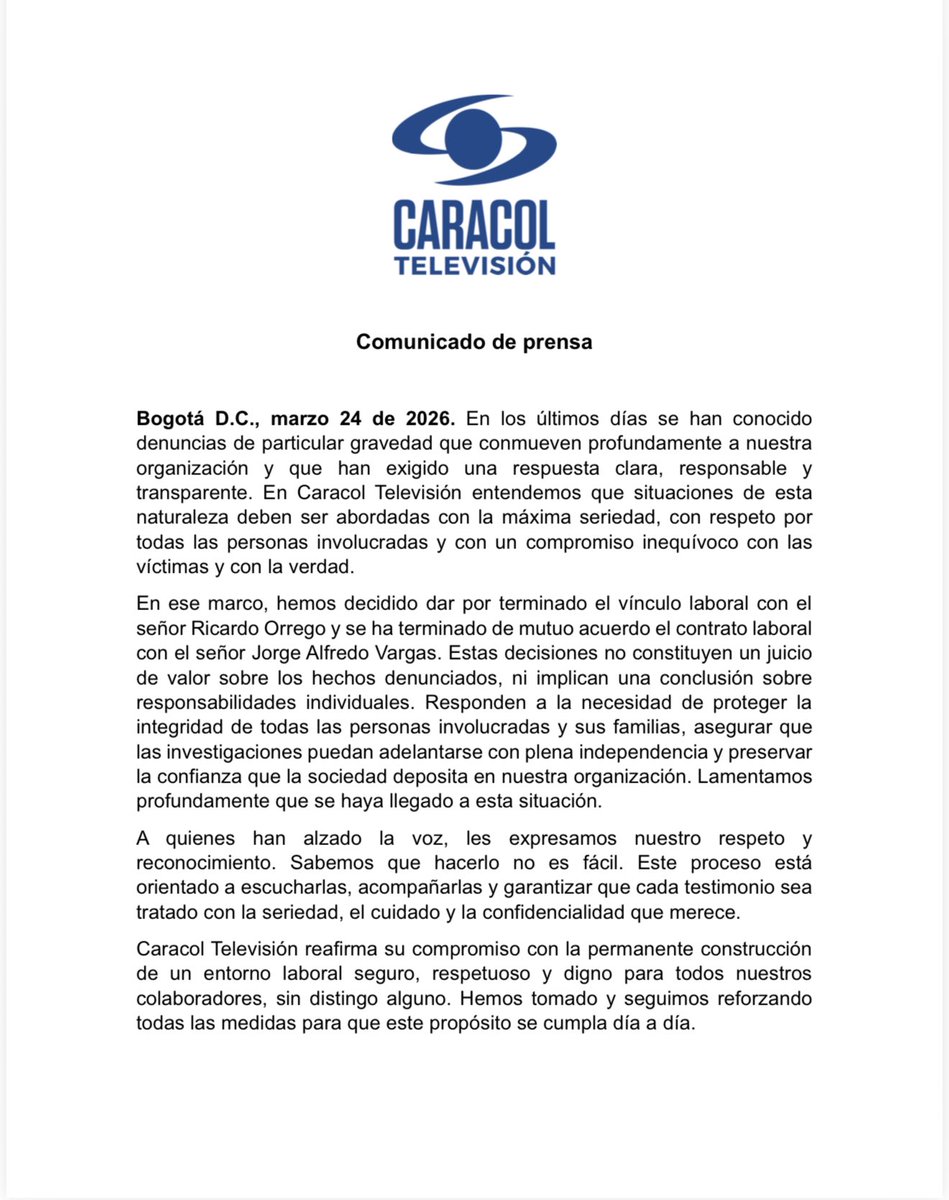
Caracol Televisión ( empresa para la cual trabajo) anuncia a través de esta comunicación que ha dado por terminado el contrato con Ricardo Orrego y Jorge Alfredo Vargas, con este último de mutuo acuerdo.
Instagram is reading DM’s now. They dropped encryption. This also means Instagram is allowing third parties to have access to them. Good time to delete them all. And to stop using them.
ECONOMÍA CIRCULAR EN LA INTELIGENCIA ARTIFICIAL.
Hoy me meto en un tema tecnológico, pero también económico. Lo hago con respeto y con buenas referencias.
Espero que lo aprovechen. En el segundo post va el link.
The technology behind this is wild. In 2000, it cost Ridley Scott $3.2 million to digitally paste Oliver Reed's face onto a body double for two minutes of Gladiator. In 2026, an indie film just recreated Val Kilmer's entire on-screen performance from family photos and voice recordings. He never filmed a single frame.
Kilmer was one of the first actors to get an AI voice clone. In 2021, he partnered with a startup called Sonantic to rebuild his voice after throat cancer destroyed it. They generated over 40 different versions of his voice before landing on one that worked. That voice showed up in Top Gun: Maverick.
Top Gun was just voice, though. Kilmer was alive, on set, his face on camera. "As Deep as the Grave" is a completely different problem. The production built his visual performance from family photos and footage of his final years, then layered an AI version of his damaged voice on top. All on an indie budget.
The cost drop is staggering. $1.6 million per minute in Gladiator. Rogue One spent 18 months of Industrial Light & Magic labor (the effects studio behind Star Wars) to resurrect Peter Cushing in 2016, inside a movie that cost over $200 million. Now, a small production company can pull off something comparable without that infrastructure.
SAG-AFTRA, the actors' union, negotiated rules in 2023 requiring consent for digital replicas of performers, and that consent still applies after a performer dies. The Kilmer team says they followed those guidelines and compensated the estate. But the legal side is barely keeping up. James Earl Jones proactively signed over his Darth Vader voice to a Ukrainian AI startup in 2022 because he wanted the character to outlive him. Last September, SAG-AFTRA publicly condemned an AI "actress" called Tilly Norwood, a computer-generated character trained on real performers' work without permission.
The Kilmer situation had consent at every step. He signed on for this role while alive. His daughter collaborated on the production. His estate got paid. About as clean as digital resurrection gets. The tools that made it possible, though, don't care about any of that. They just need photos and audio.
The backstory on Superpowers is wild.
Jesse Vincent created Request Tracker in 1994. It became the most widely used open-source ticket tracking system on Earth. Then he ran the Perl programming language for three years. Then he co-founded Keyboardio and shipped custom ergonomic keyboards to 78 countries. Then he co-founded VaccinateCA during COVID and helped millions of Americans find vaccine appointments.
Every single one of those projects was about the same thing: building systems that help people organize complex work they can’t hold in their heads.
Now look at what he built. Superpowers makes your AI agent stop, ask what you’re actually building, write a spec in chunks small enough to read, break implementation into 2-5 minute tasks with exact file paths, and delete any code written before tests exist.
91,000 GitHub stars in five months. That’s 18,000 stars per month. For a repo that is literally just markdown files telling your coding agent to slow down.
The growth rate tells you something the AI labs don’t want to admit. The bottleneck in AI-assisted development right now is not model capability. The models are smart enough. The problem is they have zero discipline. They guess at specs, skip tests, and produce code you spend the next hour babysitting.
A guy who spent 30 years building systems for how humans organize work just built the system for how AI agents organize work. The career arc makes perfect sense in retrospect.
Microsoft is about to sue its own golden child.
$14 billion invested. Exclusive cloud rights. The most important AI partnership in history.
And Sam Altman just went behind their back with a $50 billion Amazon deal.
Here's why they're betraying each other:
When Microsoft first invested in OpenAI in 2019, they locked in ONE rule above everything else...
ALL access to OpenAI's models must go through Microsoft's Azure cloud. No exceptions.
That deal made Azure the backbone of the AI revolution. Every company using ChatGPT's API was paying Microsoft for the privilege.
It was the smartest infrastructure play of the decade.
Then last month, OpenAI quietly signed a deal with Amazon.
$50 billion. AWS becomes the exclusive third-party cloud provider for Frontier, OpenAI's new enterprise AI agent platform.
$138 billion committed to Amazon cloud services.
Microsoft found out and got really angry....
A person familiar with Microsoft's position told the Financial Times today: "We know our contract. We will sue them if they breach it. If Amazon and OpenAI want to take a bet on the creativity of their contractual lawyers, I would back us, not them."
That's basically a declaration of war.
And here's where it gets crazy:
OpenAI and Amazon are trying to build a technical workaround. A system called the "Stateful Runtime Environment" that runs on Amazon's Bedrock platform.
Their argument is that the system "only" handles memory and context for AI agents using enterprise data on AWS. It doesn't technically "invoke" OpenAI's core models through Amazon.
Microsoft's response: Bullshit.
The workaround violates the spirit of the deal even if it technically dances around the letter.
Amazon knows they're on thin ice too. An internal memo leaked showing Amazon told employees exactly what language they can and can't use. They can say Frontier is "powered by OpenAI" or "enabled by OpenAI." But they CANNOT say customers can "access" or "invoke" OpenAI models on AWS.
When you're coaching employees on which verbs to avoid, you know you're in trouble.
But here's the thing everyone seems to forget:
OpenAI is planning an IPO this year.
They just closed a $110 billion funding round last month.
So if Microsoft sues, the IPO timeline is DEAD.
You can't go public while your biggest partner and investor is suing you for breach of contract.
Elon Musk is already suing OpenAI separately for abandoning its nonprofit mission.
Two active lawsuits from two of the most powerful people in tech. Against one company trying to IPO.
Good luck with that S-1 filing.
But WHY did Altman do this?
Microsoft gave OpenAI everything. Capital. Infrastructure. Distribution. Enterprise customers.
And Altman's response was to secretly build an escape route through Amazon...
Because he saw what was coming:
Microsoft launched Copilot. Their own AI product. Competing directly with ChatGPT.
Microsoft started building their own models. Hiring their own AI researchers. Reducing dependency on OpenAI.
So Altman did the same thing back. Found another cloud provider. Started building leverage.
Both sides were preparing for divorce while still living in the same house.
So the $50 billion Amazon deal was just an insurance policy against the day Microsoft decides it doesn't need OpenAI anymore.
And Microsoft caught him packing his bags.
What happens next:
The companies are still talking. Trying to resolve this before Frontier launches.
But Microsoft has made their position clear. Litigation is on the table.
If this goes to court, it sets a precedent for every AI partnership in the industry. Every cloud deal. Every exclusive licensing agreement.
The entire AI infrastructure map gets redrawn.
Sam Altman built OpenAI on Microsoft's money, Microsoft's cloud, and Microsoft's trust.
Then he signed a $50 billion deal with their biggest competitor.
In any other industry they'd call that what it is.
Meet the new Stitch, your vibe design partner.
Here are 5 major upgrades to help you create, iterate and collaborate:
🎨 AI-Native Canvas
🧠 Smarter Design Agent
🎙️ Voice
⚡️ Instant Prototypes
📐 Design Systems and DESIGN.md
Rolling out now. Details and product walkthrough video in 🧵