🚨 WARNING: SOMETHING EXTREMELY BAD JUST HAPPENED
Foreign nations pulled BILLIONS of gold OUT of the U.S.
→ The Netherlands pulled 86 tonnes
→ France pulled 129 tonnes
→ Germany pulled 300 tonnes
This has NEVER happened before.
But nobody is talking about what that means:
These are not retail investors.
These are NATIONS.
For decades, enormous quantities of foreign gold were stored outside national borders.
Including inside the United States.
Now the direction is changing.
Countries don't just want to HAVE their gold on paper.
They want to KNOW EXACTLY WHERE IT IS.
And they want direct control over it.
This is bigger than gold.
Because at the exact same time, foreign nations are reassessing their exposure to U.S. Treasuries.
Some are reducing holdings.
Others are diversifying reserves.
And China?
CHINA HAS BEEN BUYING GOLD NONSTOP.
Month after month, Beijing continues adding to its reserves while building alternatives to the existing dollar-based financial system.
This is the part most people are missing.
The global financial system isn't changing because countries suddenly stopped trusting one asset.
It's changing because governments are reducing their dependence on ANY single system.
The pattern is becoming increasingly clear:
→ Gold is being repatriated
→ Reserve diversification is accelerating
→ Biggest foreign holders are dumping U.S. Treasuries
→ Central banks are accumulating more gold
And the implications are enormous.
Because the United States has benefited for decades from one extraordinary advantage:
THE DOLLAR'S CENTRAL ROLE IN GLOBAL FINANCE.
Foreign governments accumulated dollars.
They bought U.S. Treasuries.
They stored reserves inside the Western financial system.
That created enormous demand for American assets.
But what happens when countries begin changing the structure of their reserves?
What happens when more governments decide that physical gold belongs INSIDE their own borders?
What happens when Treasury holdings become less concentrated?
What happens when China keeps accumulating gold while expanding alternative financial infrastructure?
That's not how major financial systems change.
It starts slowly.
Reserve managers diversify.
Gold gets moved.
Treasury exposure gets adjusted.
New payment networks emerge.
And China is sitting directly at the center of all this.
They are preparing for a world with MULTIPLE competing financial centers.
Meanwhile, other nations are bringing their own gold home.
It ca mean just one thing:
THE RULES OF THE GLOBAL RESERVE SYSTEM ARE CHANGING.
The question is no longer whether countries are diversifying.
They already are.
The real question is how far this goes.
Pay attention.
The biggest shifts in global finance are never obvious while they are happening.
Then suddenly, everyone realizes the world has changed.
I've spent more than a decade watching how these markets move.
And I've also called nearly every major market top and bottom.
Follow and turn on notifications now.
Many people will wish they had started paying attention sooner.
GLOBAL BOND MARKET IS IMPLODING.
🇺🇸 US 2Y bond yield hits 4.38%, a 19-month high.
🇺🇸 US 5Y bond yield hits 4.53%, a 20-month high.
🇺🇸 US 10Y bond yield hits 4.79%, a 20-month high.
🇯🇵 Japan 2Y bond yield hits 1.81%, a 31-year high.
🇯🇵 Japan 5Y bond yield hits 2.26%, a 31-year high.
🇯🇵 Japan 10Y bond yield hits 3%, a 30-year high.
🇯🇵 Japan 20Y bond yield hits 3.90%, a 31-year high.
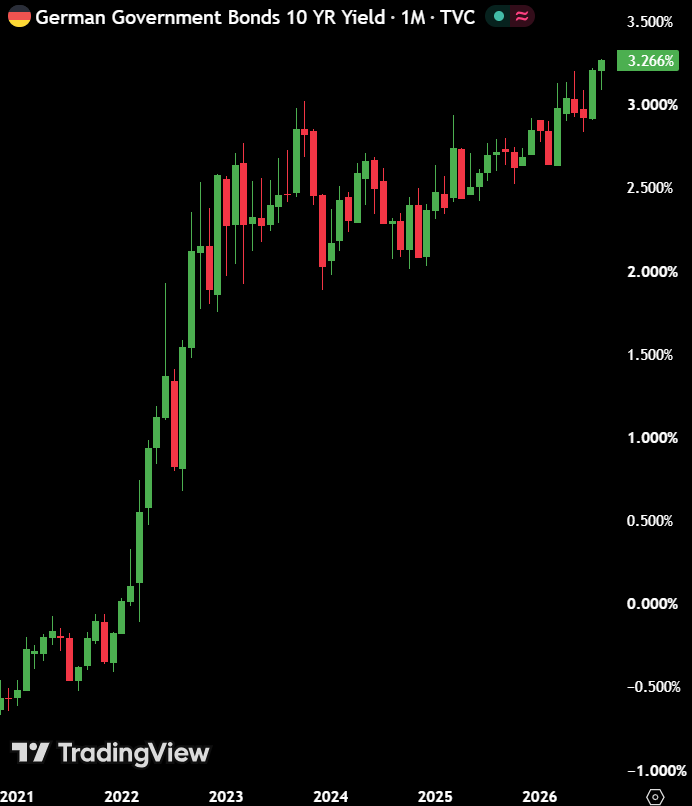
🇩🇪 Germany 10Y bond yield hits 3.36%, a 15-year high.
🇫🇷 France 10Y bond yield hits 4.22%, an 18-year high.
🇮🇹 Italy 10Y bond yield hits 4.21%, a 3-year high.
🇵🇹 Portugal 10Y bond yield hits 3.71%, a 3-year high.
And all these new highs have happened this week only.
When one country bond yields go parabolic, it's their problem.
We haven’t seen anything like this since the 2008 financial crisis.
BREAKING:
🇺🇸 US Treasury is projected to buy back $12.5 Billion of its own debt next week.
Treasury is trying to bring yields down, while the Fed is becoming hawkish, which is pushing yields higher.
JUST IN: 🇺🇸 U.S. PCE inflation comes in at 3.7%, above expectations of 3.6%.
Slightly hotter than expected, signalling persistent inflationary pressure.