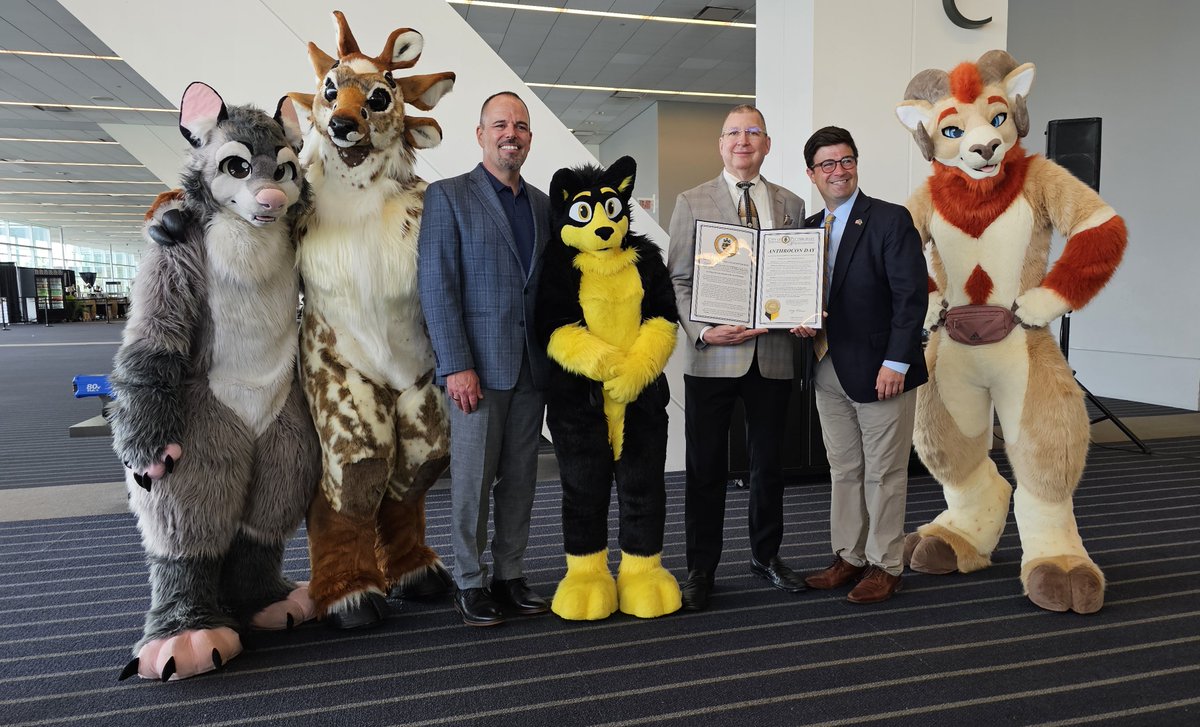
Today, July 1st 2026, has officially been designated as "Anthrocon Day" by the Mayor of Pittsburgh! We are deeply grateful for our partnership with the City of Pittsburgh, Allegheny County, and the numerous partners that helped make this happen for the past 20 years 💛🖤 #LovePGH
accidentally pulled out really fast in front of a car and i watched in my rearview mirror as a trans girl in the car behind me flipped me off and then slowly realized i was a sister because of my bumper stickers and started laughing
The trans bathroom issue is so funny because it’s the only issue in the world where people understand that ciis men are extremely rapey.
- Ask them about Me Too they go ‘women are liars’
- Ask them about sexual violence they go ‘what was she wearing’
- Ask them about rape culture they go ‘not all men’
But if you ask about trans people? Yeah they know exactly how bad ciis men truly are.
This law seeks to make your private medical information public, even if you aren't trans and were just questioning.
It's not an exaggeration to call this a government registry of trans people. The purpose is to out, shame, and harm trans people.
>be terf
>go to major trans event
>give trans people money for ticket
>have to be surrounded by people i hate all evening
>they're not even miserable they're having fun
>nobody assaults me in a bathroom
>nobody recognises me
>they all think i'm another trans woman
>tfw
The actual research is wild. Every time you push down a feeling, your brain has to choose between suppressing that emotion and recording what’s happening around you. It picks the suppression. The memory doesn’t get saved.
A 2000 Stanford study confirmed this: people told to hide their emotions while watching a film remembered far fewer details than people who just reacted naturally. Suppressing emotions uses up mental energy, and that leaves less brain power for saving new memories.
Brain scans show why. A 2012 study found that suppression quiets the hippocampus (your brain’s memory-recording center) right when it should be saving information. The two brain regions that normally team up to lock in memories stop talking to each other.
Over time it gets worse. Suppression keeps cortisol (the stress hormone) elevated, and cortisol shrinks the hippocampus. Chronically stressed people can lose 10 to 15% of its volume. Just three weeks of high cortisol can shrink the tiny connection points between brain cells by about 20%. The good news: studies show this shrinkage can partially reverse once stress levels drop. Not necessarily permanent.
A Finnish study of 1,137 older adults tracked over roughly a decade found that habitual emotion suppressors had nearly 5x the risk of developing dementia, even after controlling for genetics, smoking, obesity, and education.
There’s a better way to handle emotions that doesn’t cost you your memory. It’s called cognitive reappraisal: instead of bottling the feeling, you reframe what’s causing it. (“This meeting isn’t a threat, it’s practice.”) A 2003 Stanford/UC Berkeley study found reappraisers had more positive emotion, better relationships, and higher wellbeing. Suppressors got the opposite on every measure. And reappraisal carries zero memory cost.
The difference comes down to timing. Suppression kicks in after the emotion has already fired, so your brain is fighting its own response while simultaneously trying to record the moment. Reappraisal changes how you interpret the situation before the emotion fully activates. Same event, same person, but your hippocampus stays free to do its actual job: recording your life.