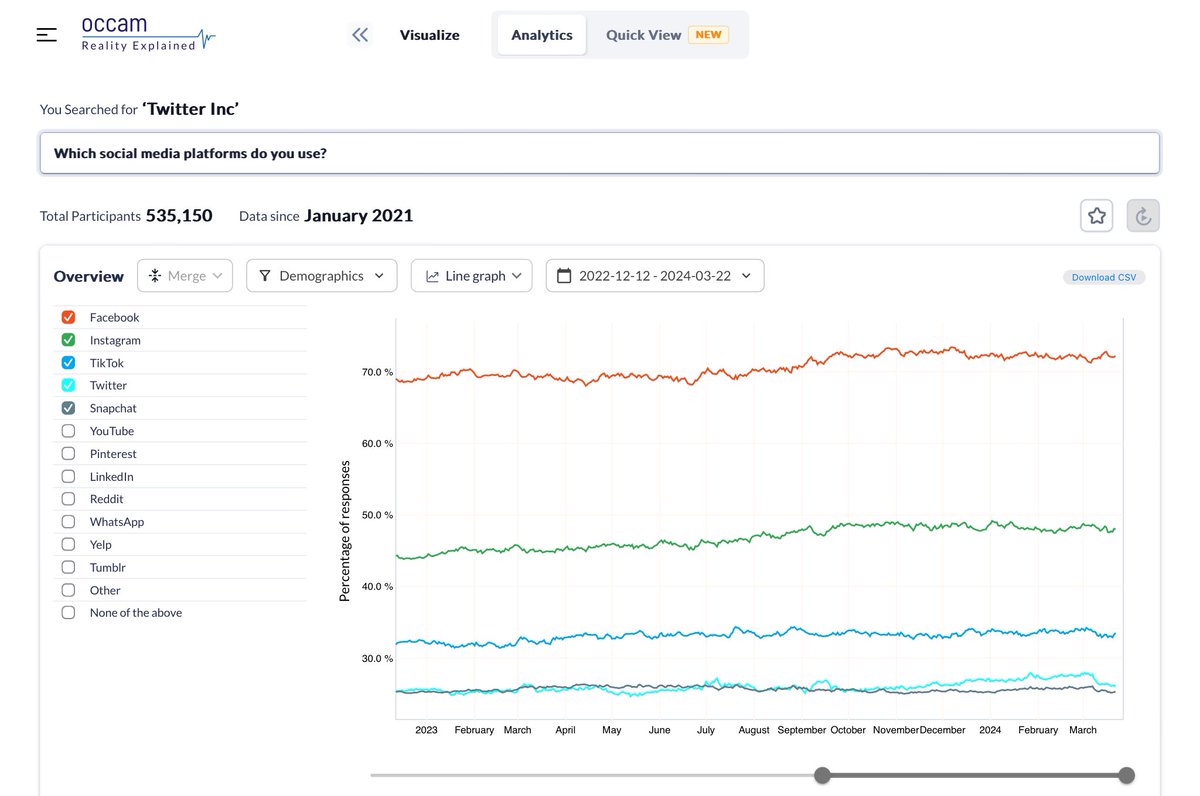
@StatisticUrban This polling data is bad and inaccurate. Probably from opt in surveys and probably mostly bots. Notice how all of the percentages, according to respondents, are almost the same.
$ASTS: 🚨RESEARCH SHOWS 66% OF SUBSCRIBERS ARE WILLING TO PAY EXTRA FOR SATELLITE CONNECTIVITY
AI data science research firm @AlphaROC_ai has been tracking consumer interest in satellite connectivity
Cumulative Proportion Willing to Pay $ / Month
50% = $5
35% = $10
15% = $15
Americans' net sentiment in the stock market is down over 50% from levels seen in Q4 '24.
Occam warned users of this potentially overextended euphoria in December. Details ⬇️
https://t.co/Lh4fwYG9Qm
@elonmusk If the USA was invaded - how long should people defend the country before giving up? Criticizing Ukraine for defending their country for too long seems insane. As Churchill said "We will never surrender..."
Americans anticipate price hikes from prospective new tariffs — especially for food. Across party lines, food tops the list, followed by electronics and cars. Notably, Independents' perspectives align more with Democrats than Republicans. Details ⬇️
https://t.co/FEf8QEPjhk
@sama I doubt that similarweb can distinguish between humans looking at google searches and embedded calls to google in other software. This distinction is very important for google’s business model
It is inherently human to search for causal relationships. All children who develop autism received vaccines - as all children receive vaccines. If a child didn’t receive a vaccine he/she is likely to not get autism since the incidence rate is very low. People are also bad at statistics- so there is a lay incorrect attribution of causal effect. The same would not occur with antibiotics - since the administration of treatment and occurrence of pathology are not correlated in time.
@LKrauss1 We need to get Scientific American back. I subscribed for over 25 years and had to cancel. The problem is that I am not yet convinced that it can recover.
Basic K-12 math and science is too often presented in a highly dogmatiic fashion. There has been a decades long degradation in the science and mathematics education in the US. This created a situation where the majority of Americans have little to no appreciation of science and, in particular, no understanding of the scientific method. New developments in science seem to appear out of nowhere and are therefore interpreted as hard to believe and arbitrary.
Cannot believe this finally happened! Over the last 1.5 years, we have been developing a new LLM architecture, with linear complexity and expressive hidden states, for long-context modeling. The following plots show our model trained from Books scale better (from 125M to 1.3B) than Mamba and Transformer, and our 1.3B model works better and better with longer context.
The idea, Test-Time Training (TTT), is something we have been working on for over 5 years. I still remember when I started as a postdoc, discussing with Alyosha what to work on, he asked me to talk to Yu Sun on TTT. And that is when everything begins.
Although this TTT is quite a different thing now. It is a network layer, replacing the hidden state of an RNN with a machine learning model. Instead of using a feature vector to represent a memory, our TTT layer maintains a small neural network to compress the input tokens. As each token comes in sequentially, the compression is done via gradient descent on this token to update the small neural network.
This is currently applied to language modeling, but imagine applying it to videos. In the future, when modeling long videos, instead sampling 1 FPS, we can sample the frames densely, and these dense frames would be a burden for Transformer but a blessing for TTT layer. As they are essentially just augmentations in time to train a better network inside TTT.
Please check: https://t.co/XNK1mlxpUQ