From 50k to $1 Million Trading Shares (No Options)
Hope you guys liked my Reddit post about the journey. Posting it in the replies here.
You don’t need weekly lotto calls to make serious money. Conviction, risk management, and patience matter more than most people think.
This is the best 2 hours on graph engineering ever recorded, Andrew Ng breaking down how to build agentic knowledge graphs from scratch:
9:14 - your first working agent
33:11 - how loops actually work
1:02:46 - turning loops into working graphs
1:30:15 - agents that improve their own code
1:49:05 - a system that runs the whole thing for you
I've seen $500 courses that teach less than this video alone.
Watch it, then take it further with my step-by-step guide on graph engineering below.
🚨 BREAKING: Google Gemini can now analyze any stock like a Wall Street analyst (for free).
Here are 10 insane Gemini prompts that replace $4,000/month Bloomberg terminals:
(Save this 🔖 you’ll need it later)
A mathematician who shared an office with Claude Shannon at Bell Labs gave one lecture in 1986 that explains why some people win Nobel Prizes and other equally smart people spend their whole lives doing forgettable work.
His name was Richard Hamming. He won the Turing Award. He invented error-correcting codes that made modern computing possible. And he spent 30 years at Bell Labs sitting in a cafeteria at lunch watching which scientists became legendary and which ones faded into nothing.
In March 1986, he walked into a Bellcore auditorium in front of 200 researchers and told them exactly what he had seen.
Here's the framework that has been quoted by every serious scientist for the last 40 years.
His opening line landed like a punch. He said most scientists he worked with at Bell Labs were just as smart as the Nobel Prize winners. Just as hardworking. Just as credentialed. And yet at the end of a 40-year career, one group had changed entire fields and the other group was forgotten by the time they retired.
He wanted to know what the difference actually was. And he said it wasn't luck. It wasn't IQ. It was a specific set of habits that almost nobody is willing to follow.
The first habit was the one that hurts the most to hear. He said most scientists deliberately avoid the most important problem in their field because the odds of failure are too high. They pick a safe adjacent problem, solve it cleanly, publish it, and move on. And because they never swing at the hard problem, they never hit it. He said if you do not work on an important problem, it is unlikely you will do important work. That is not a motivational line. That is a logical one.
The second habit was about doors. Literal doors. He noticed that the scientists at Bell Labs who kept their office doors closed got more done in the short term because they had no interruptions. But the scientists who kept their doors open got more done over a career. The open-door scientists were interrupted constantly. They also absorbed every new idea passing through the hallway. Ten years in, they were working on problems the closed-door scientists did not even know existed.
The third habit was inversion. When Bell Labs refused to give him the team of programmers he wanted, Hamming sat with the rejection for weeks. Then he flipped the question. Instead of asking for programmers to write the programs, he asked why machines could not write the programs themselves. That single inversion pushed him into the frontier of computer science. He said the pattern repeats everywhere. What looks like a defect, if you flip it correctly, becomes the exact thing that pushes you ahead of everyone else.
The fourth habit was the one that hit me the hardest. He said knowledge and productivity compound like interest. Someone who works 10 percent harder than you does not produce 10 percent more over a career. They produce twice as much. The gap doesn't add. It multiplies. And it compounds silently for years before anyone notices.
He finished the lecture with a line I have never been able to shake.
He said Pasteur's famous quote is right. Luck favors the prepared mind. But he meant it literally. You don't hope for luck. You engineer the conditions where luck can land on you. Open doors. Important problems. Inverted questions. Compounded hours. Those are not traits. Those are choices you make every single day.
The transcript has been sitting on the University of Virginia's computer science website for almost 30 years. The video is free on YouTube. Stripe Press reprinted the full lectures as a book in 2020 and Bret Victor wrote the foreword.
Hamming died in 1998. He gave his final lecture a few weeks before. He was 82.
The lecture that explains why some careers become legendary and others disappear is still free. Most people who could benefit from it will never open it.
My Trading Process, Tools, Routine, and Core Beliefs
A 60 pages of experience-based lessons and insights curated from 15 years of my tweets.
1. Glossary – Terms and Expressions I Use
2. Charting – My Approach Using TradingView
3. My Screeners – Workflow of Finviz & Tradingview
4. Process & Routine – Moving Ideas to the Focus List
5. Pre-Market Routine – Situational Awareness
6. Proficient Execution– Trade Design, Stops, % Risk
7. Post-Execution – Trade Management
8. Journaling – Fine-Tuning to Improve YoY % Return
9. Conviction – Internalizing These 6 Graphics
10. Full-Time Trading – What Does It Takes
11. Five Books I Highly Recommend To Everyone
12. Free Productivity Tools & Websites I Rely On
13. How I Delayed My Own Progress by 3 Years
14. Reflections and Experiences for You to Relate To
15. Closing Remarks – A Call to Inspiration
16. FAQ, Paired with Thought-Provoking Questions
17. Subtle Strategies to Attract Institutional Attention
https://t.co/0F5tgGM49z
Managed to finish this project early as a Christmas gift🎄for everyone — enjoy!
These are the setups of the best traders I’ve interviewed:
Catalyst Gaps
Base Breakouts
Mean Reversion Long
Mean Reversion Short
Pullback/Undercut & Rally
They allow you to manage risk versus a key level/turning point where you can expect significant expansion from your entry
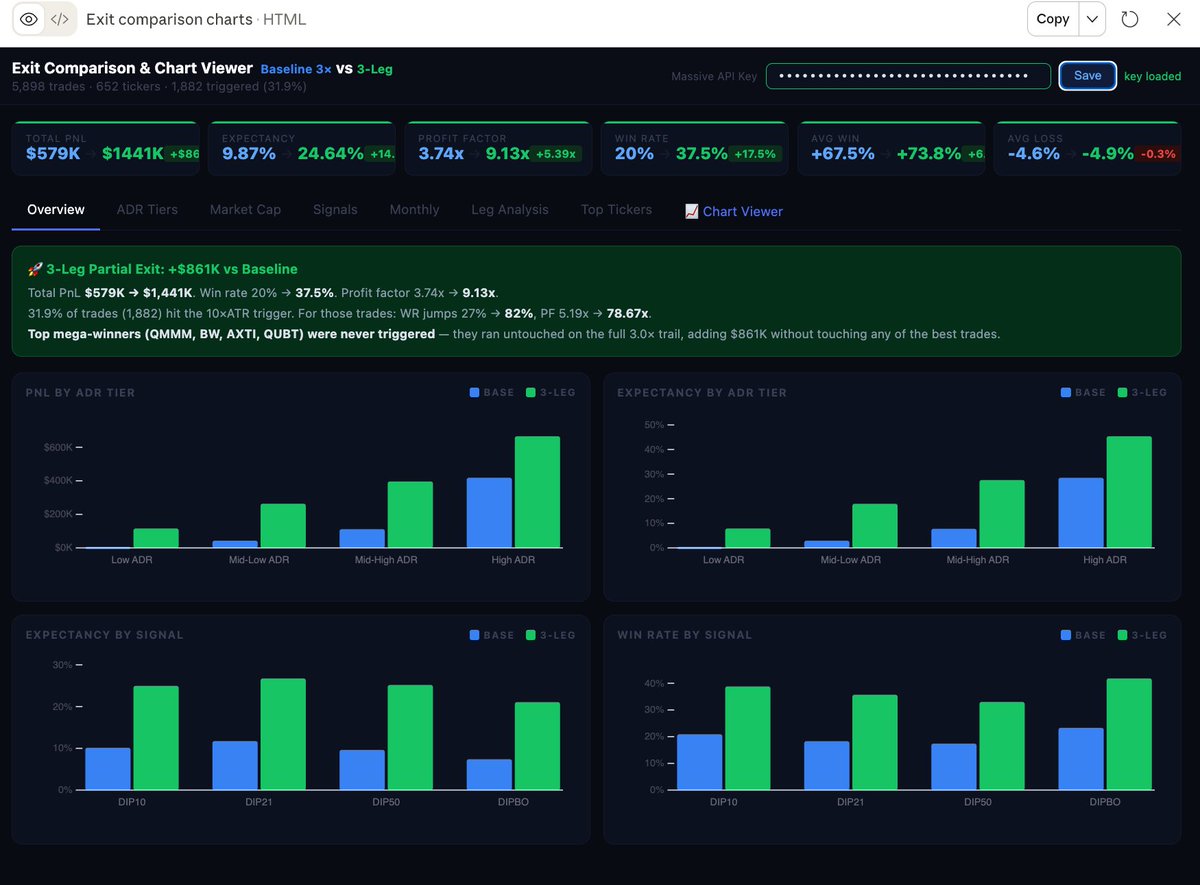
Claude is incredible. I was able to build a python screener, back test and analytics script over the weekend with Massive's API over the weekend.
I looked up all stocks in the last 2 years with a simple set of conditions:
1) >70% from 52 Week Low
2) >100M Market Cap
3) >3% ADR
4) >25M Average Dollar Volume
Entry types:
Pivot Breakout(buying on strength)
10EMA/21EMA/50SMA(buy on weakness)
*moving average buys only happen when the local pivot high >70% 52WL*
Stop Loss:
ATR Multiple based stop loss(0.5ATR)
Exit Methods:
1) ATR Multiple Trailing stop (3.0ATR)
2) Same as 1, but sell 20% if 10ATR Extension from 200SMA and set 40% to half the ATR Multiple Trailing stop of original. Remaining 40% keeps the original ATR Multiple trailing stop loss.
I got the number two exit idea from @jfsrev's substack and noticed that @denis__hamel ran a long term study and added the 20% partial at 10 ATR and trimmed the trailer.
"Base" in blue is exit idea 1
"3 Leg" in Green is exit idea 2
I am still learning this process and double checking my work, but just incredible how much faster ideas can be rigorously tested now.
GOODBYE, FUND MANAGERS. GOODBYE, BLOOMBERG TERMINAL.
No more $24,000/year subscriptions.
Claude just turned my laptop into a private quant analyst.
Here are 10 prompts to build your own hedge fund at home ↓
My favorite @perplexity_ai prompt I’ve made for traders.
Feel free to copy and use.
————————————————
Please analyze [TICKER] for me and provide the following, concise and clearly organized:
1. **Explain what the company does in like I'm 12 years old** - three short bullet points about what it does and any helpful relatable examples and analogies.
2. **Professional summary (max 10 sentences)** - industry, main products/services, primary competitors (list tickers), notable metrics or achievements, competitive advantage/moat, why they are unique and if they are a biotech provide if they have a commercial product or in clinical stages.
3. In a table, provide the follwoing:
* Any hot theme, narrative or story of the stock
* Any catalysts (earnings, news, macro)
* Any significant fundamentals (huge growth in earnings or revenues, moat, unique product or service, superior management, patents etc)
4. **Show all the main news/events for the last 3 months:** - Use a bullet-point table for: - Date (YYYY-MM-DD) - Event type (Earnings, Product Launch, Analyst Upgrade/Downgrade, etc.) - Short summary (max 1-2 sentences) - Direct source link - Mark any major price-moving events (surprise earnings, large guidance shift, top-tier analyst actions).
5. **Mention any recent insider buys/sells or institutional filings if visible.**
6. **Summarize how the stock is moving vs. main competitors and overall sector trend in past month (up/down).**
7. **Flag upcoming catalysts (earnings, product launches, regulatory events) in the next 30 days.**
8. **Note any changes in analyst price targets for this ticker during the period above.** - Format for easy review. If possible, use tables for events and peer moves. - Respond in clear, concise, easily readable style for use in trading decisions.
Overall, Focus on the reasons why the stock can make a big move in the future - earnings, sales, guidance, product launches, analyst upgrades/downgrades, insider buying especially from CEO/Founder and executive team, partnerships, and sector/news catalysts. I want to focus on stocks with catalysts and themes as catalysts are the cause of big moves in the stock market.
Finally, discuss and bring up any relevant previous perplexity queries and conversations.