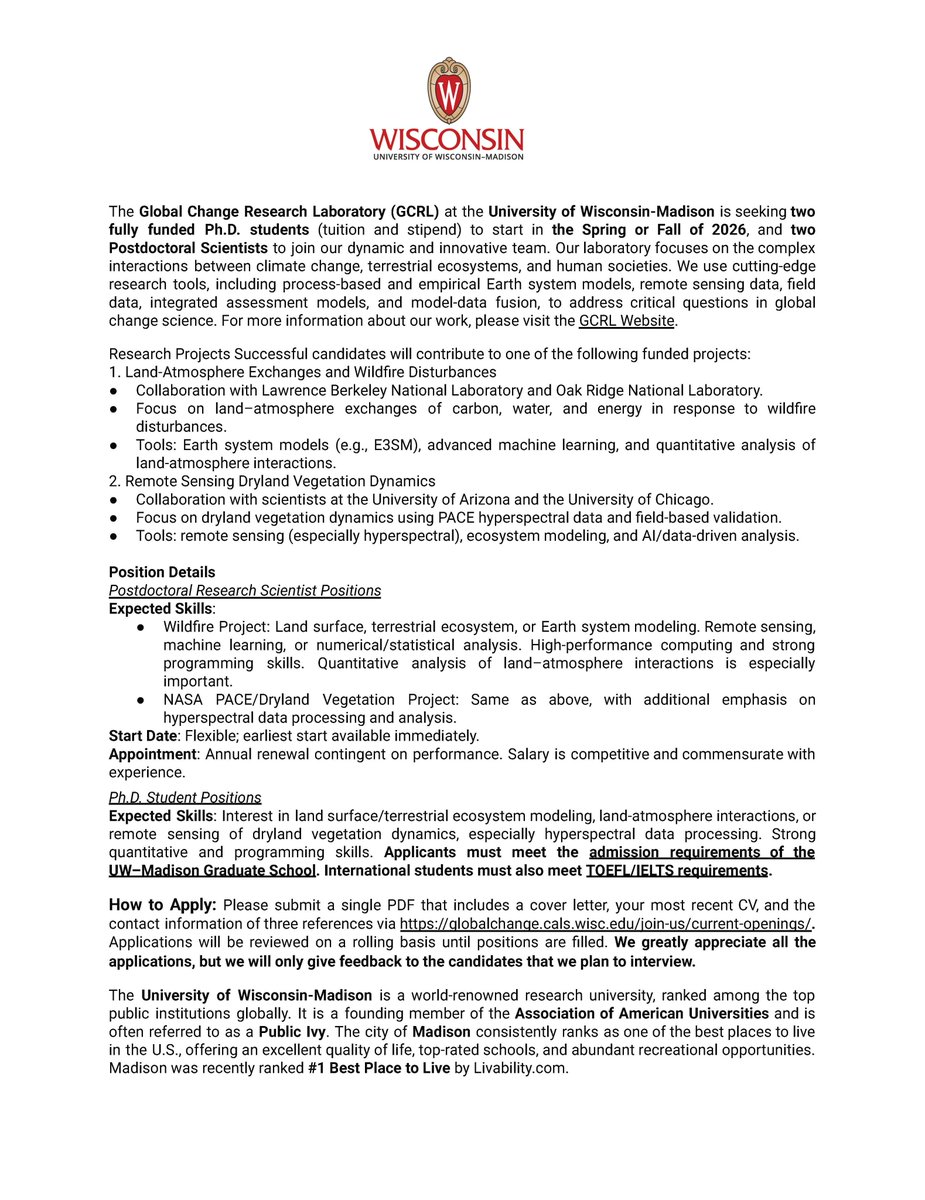
My group at UW–Madison is hiring Postdocs + PhD students! Projects: 1️⃣ Wildfire & land–atmosphere exchanges (remote sensing + E3SM) 2️⃣ Dryland vegetation dynamics (NASA PACE hyperspectral)
Details & apply: https://t.co/uLtHQ96sX8
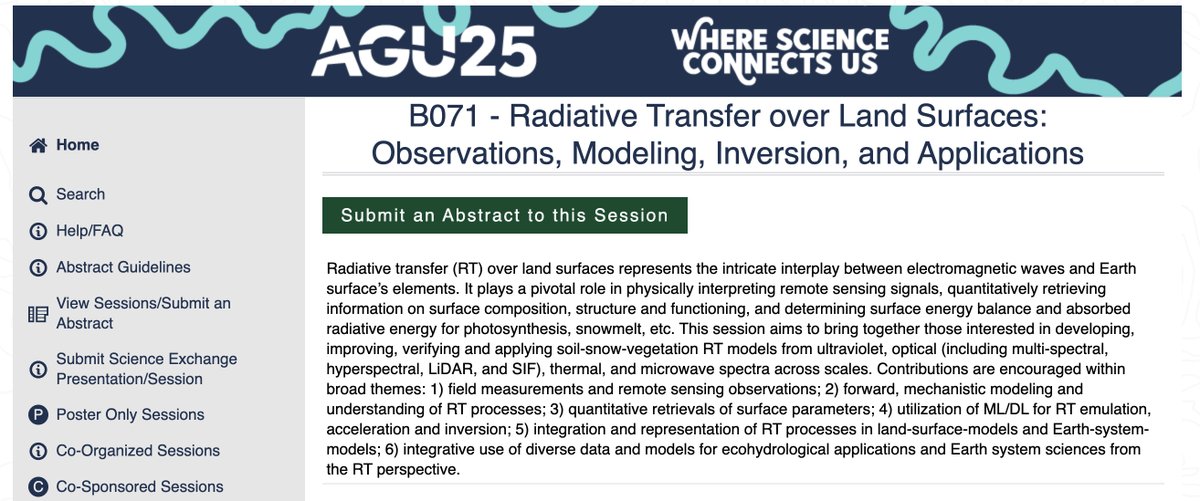
Call for abstracts 📣📣📣: I am delighted to invite you to submit an abstract to the Session "B071 - Radiative Transfer over Land Surfaces: Observations , Modeling, Inversion, and Applications" at the coming 2025 AGU Fall Meeting.
We have a new paper, “Canopy Structure Exhibits Linear and Nonlinear Links to Biome-Level Maximum Light Use Efficiency“, published in Ecology Letters. Authored by @hamid_dashti2 @DaleiHao @geoxiyang
@hamid_dashti2 @DaleiHao Together, originating from an idea that there must be some link between canopy structure and function, this study highlights the significance of canopy architecture in controlling global patterns of light use efficiency of carbon uptake.
@hamid_dashti2 @DaleiHao A key aspect was the introduction of a new metric, normalized near-infrared vegetation reflectance (NIRvN), which successfully separates the effects of leaf quantity from those of canopy architecture. We also found a strong negative linear correlation between ε_biome and NIRvN.
Excited to share our new paper, "Role of Forest Carbon Change in Shaping Future Land Use and Land Cover Change," 🌳 🌍 now published in Global Change Biology! 🔗https://t.co/4TvTHtmj9E
More fantastic results from Sadegh Ranjbar demonstrating the unique value of @NOAASatellites for understanding the earth system. All sky (clear & cloudy, night & day) estimates of land surface temperature using ML, GOES-R & Ameriflux meas. https://t.co/zofziCfgiI
cannot overstate how amazing @NOAASatellites are. In our new paper in RSE, Danielle Losos & team demonstrate an approach to use GOES-R, ML, and @AmeriFlux and @NEONInc eddy covariance data to estimate ecosystem carbon dioxide uptake in near-real time https://t.co/wDUiRs7HeV
Risky days for anthropogenic fires are growing faster than risky days for lightning-caused fires. Human-caused fires can occur in wetter conditions, as they ignite in dead grass or wood, rather than in the moist canopy where lightning strikes. Read now: https://t.co/eMfPpIL4FF
Biogeoscientists on X, please consider nominating early-career & underrepresented emerging leaders in biogeosciences for the JGR-B Special Issue, "Biogeosciences Leaders of Tomorrow"! Nomination due 7 Feb 2025. Details at https://t.co/tmFA9e4TAU
We figured out how much water is in all of Earth’s plants and how long it takes water to flow through them.
Answer: 786 km3 and 5-18 days.
@NatureWaterJnl@koen_hufkens@sciencebyAJ
I’m at AGU for the whole week. If you are interested in a postdoc position on wildfires and earth system modeling, or a PhD student opportunity, come talking with me!
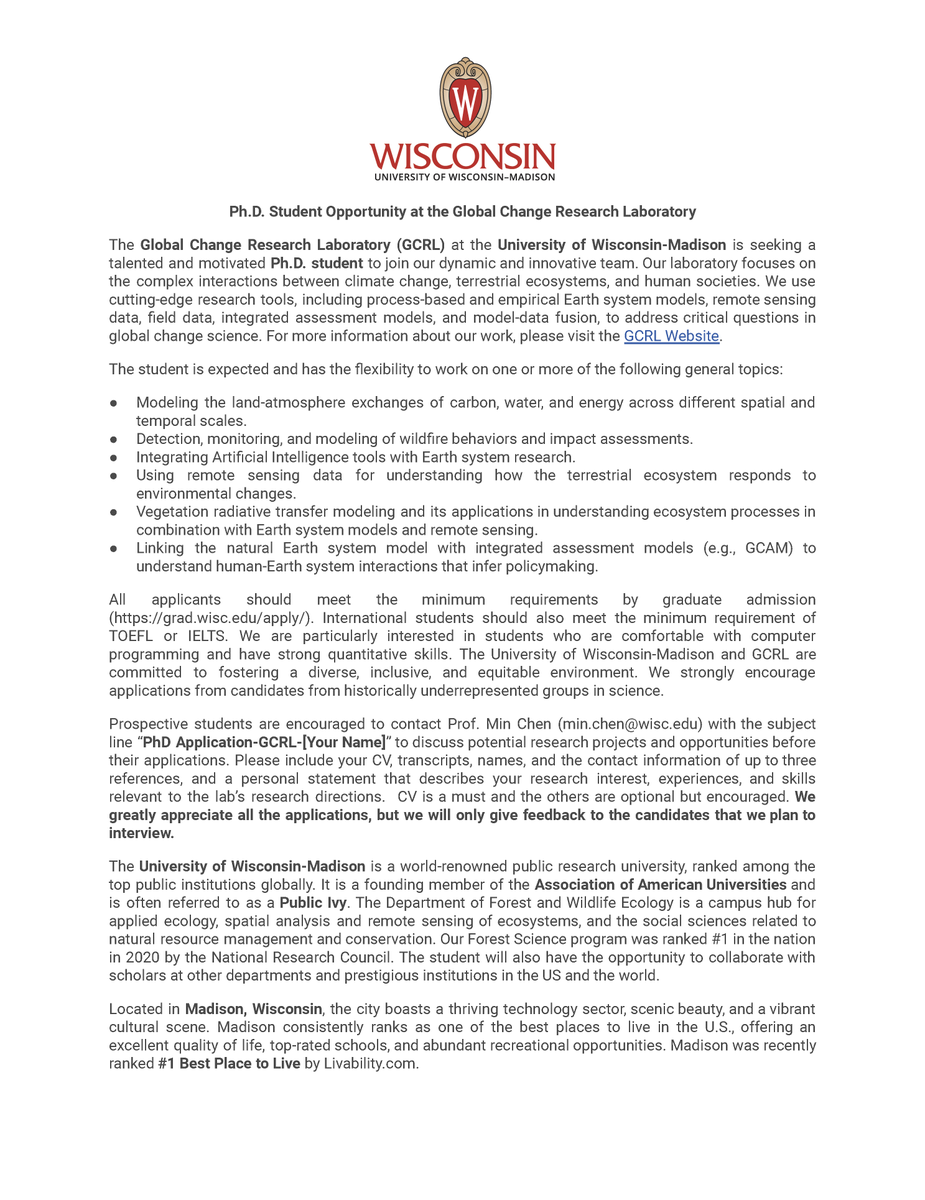
Our lab is looking for a Ph.D. student and a postdoctoral scientist to join us at @UWMadison. Check out details here: https://t.co/nQeY1Q7e7P We appreciate your RT!
Our lab is looking for a Ph.D. student and a postdoctoral scientist to join us at @UWMadison. Check out details here: https://t.co/nQeY1Q7e7P We appreciate your RT!
🚨Job Alert! Check out the RISE initiative at @UWMadison - https://t.co/tG38G6Judi. Listings within @UWMadisonCALS are below with multiple hires expected across listings. It's a wonderful University in a great place to live. Join us! https://t.co/NeunOUZkLE @DepartmentSoil