EVO ŠTA ZLOČINCI RADE U TAJNOSTI, MISLEĆI DA BAŠ SVE MOŽE DA IM PROÐE!!! Pre dve nedelje, krivično Veće Apelacionog suda u Novom Sadu odlučivalo je o zahtevu za preinačenje odluke Viseg suda, kojom je optužnica protiv Vesića i ostalih okrivljenih u predmetu “Nadstrešnica” odbijena, a oni, praktično, oglašeni nevinim. U veću Apelacionog suda bili su sudije Snežana Leković, Nikola Radanović i Bora Pap. Nakon što je tajnim glasanjem doneta odluka, pa potom prosleđena sudskoj praksi na objavljivanje, advokati Gorana Vesića i ostalih tražili su IZUZEĆE sudija Leković i Radanović. NAKON ŠTO JE DONETA ODLUKA! Sudiju Radanovića, primera radi, proglašavaju pristrasnim zato što se, prilikom nekog studentskog protesta, u jednom trenutku našao ispred suda dok je povorka prolazila ispred te institucije. Isti ti branioci tražili su izuzeće predsednika Apelacionog suda Darka Tadića, da se o predmetu “Nadstrešnica” UOPŠTE NE BI ODLUČIVALO U NOVOM SADU!!! U našem zakonodavstvu NE POSTOJI MOGUĆNOST izuzeća sudija NAKON ŠTO JE DONETA PRESUDA I ZAUSTAVLJANJA OBJAVLJIVANJA I STUPANJA NA SNAGU DONETE ODLUKE. Koliko znam, NIKADA NIGDE NA SVETU se nije dogodilo da se OBJAVLJIVANJE sudske odluke ZAUSTAVI i time spreči da stupi na snagu, KAO DA NIJE DONETA. Da se brutalno, prostački, siledžijski, protivustavno, protivzakonito, prosto NE OBJAVI!!!! Kao, puj pike ne važi, pravićemo se da odluka nije doneta, pa ćemo na silu da promenimo sudsko veće, pa će novo ponovo glasati. Ovo nije autoritarni režim, ovo je SVINJSKI FAŠIZAM!!!
U Novom Sadu upravo počinje Skupština grada na kojoj će Komisija za planove razmatrati primedbe građana na izmene takozvanog plana "Novi Sad na vodi". Na njoj su prisutni i građani koji se protive još jednom urbicidu u gradu.
Pre osam meseci, isti taj pojas Bogorodice bio je u Petrovaradinu. U pogledu posete i verskih emocija, ništa se famozno dogodilo nije. Da bi toliko mnogo ljudi negde došlo, bilo na celivanje pojasa ili na koncert Tompsona, svejedno, potrebno je da država i crkva zalegnu 100%.
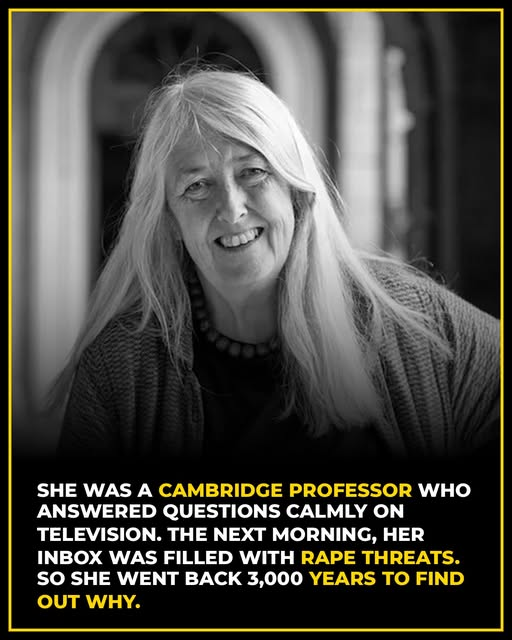
She was 57 years old.
White hair. No carefully managed image. No media training designed to make her more palatable. Just thirty years of accumulated knowledge and the calm, unhurried authority of a woman who had spent her life mastering her subject.
She sat on a BBC panel, answered questions about immigration and politics, cited evidence, made arguments — and then went home.
The next morning, her inbox looked like a crime scene.
Her name is Mary Beard — Cambridge professor, classicist, one of the most respected scholars of ancient Rome and Western civilisation alive. And the internet had decided that a woman speaking with quiet authority on television needed to be punished for it.
The messages were not criticism. They were not debate. They were rape threats. Death threats. Coordinated campaigns of personal destruction targeting her appearance, her age, her voice — anything that could be used to remind her that spaces like the one she had just occupied were not meant for her.
Most people would have gone quiet.
Mary Beard went further in.
She did what scholars do when they find a pattern that disturbs them: she followed it backward. Through decades. Through centuries. Through millennia. All the way back to some of the oldest texts in Western civilisation.
And she found it had always been there.
In Homer's Odyssey — one of the foundational works of Western literature, nearly three thousand years old — there is a scene that most readers pass over without registering its quiet violence. Penelope comes downstairs and asks the poet to sing a different song. Her own son, Telemachus, cuts her off. He orders her back to her room and tells her plainly: speech is the business of men.
She goes.
Mary Beard read that scene and recognized it immediately.
Not as ancient history. As a pattern.
In ancient Rome, women who dared to speak in public were not described as orators or thinkers. They were described as noise — disorderly sound, something that did not deserve to be called language or argument. Their voices were not speech. Their thoughts were not thoughts.
In the medieval world, women who claimed public authority were labeled as witches.
Elizabeth I — Queen of England, ruler of a nation — had to rhetorically reshape herself into something masculine just to be taken seriously as the leader of her own country.
The silencing of women who speak with authority was not invented by social media. It was not a modern pathology or a cultural accident. It was built deliberately, over centuries, into the very foundations of how Western civilisation defined who gets to speak, what authority sounds like, and who is allowed to take up space in public life.
Mary Beard had found something important.
In 2017, she published Women & Power: A Manifesto — short enough to read in an afternoon, substantial enough to reframe everything you thought you understood about why this keeps happening.
Her argument was precise and devastating.
The problem is not that women lack the ability to lead. The problem is that the model of leadership itself — the template for what public authority looks, sounds, and feels like — was built by men over centuries and has never been redesigned. When a woman enters public life and doesn't fit that template, she is not failing. The template was never built for her. It was built specifically to exclude her, and it has been doing exactly that, efficiently and continuously, for three thousand years.
The solution, Beard argued, is not to teach women to perform power the way men have always performed it. The solution is to dismantle and rebuild the very concept of what power is allowed to look like.
She kept teaching. She kept writing. She kept appearing on television — white-haired, unhurried, carrying her decades of authority without performing it, without packaging it for comfort, without apologizing for it.
The threats continued.
But other messages began arriving too. Letters from women and girls who had spent their entire lives feeling that every door was slightly too narrow, every table slightly too high, every room slightly reluctant to make space for them. Women who had spent years wondering what was wrong with them — why they couldn't quite fit, couldn't quite belong, couldn't quite be taken seriously no matter how much they knew or how hard they worked.
They read the book and understood, perhaps for the first time, that nothing had ever been wrong with them.
The room had been designed without them in mind.
That is not a personal failing.
That is a three-thousand-year-old architectural decision.
And one Cambridge professor with white hair and a calm voice — who refused to go quiet when the internet told her to — spent her career documenting it, naming it, and handing that knowledge to everyone who needed to hear it.
Telemachus told Penelope that speech was the business of men.
He was wrong then.
He is still wrong now.
And Mary Beard has three thousand years of evidence to prove it.
via The Inspireist
#FeministFriday #HERstory
Шта се десило прошли пут кад се „ујединила опозиција“?
- Сјахао курта, узјахао мурта.
Није потребна само промена власти, неопходне су дубоке системске промене.
Ogromna podrska za profesorku Mariju Vasic. Drustvo koje napada i progoni profesore zbog toga sto javno iznose naucne cinjenice i naucne definicije iz svojih oblasti, nema cemu da se nada. Ljudi poput Marije su posebno dragoceni u zajednicama koja zive u kolektivnoj deluziji.