🚨 ÚLTIMA HORA: Claude ahora puede construirte una página web ULTRA-PREMIUM en 30 minutos.
TOTALMENTE GRATIS.
Aquí tienes 8 indicaciones para CONSTRUIR TU PÁGINA WEB soñada:
CURSO COMPLETO DE CLAUDE DE 4 HORAS
Esta es la guía más detallada de Claude que he visto hasta el momento.
Guarda esta página antes de que se te olvide.
Construye herramientas.
Automatiza el trabajo.
Aprende cómo las personas construyen bots y sistemas.
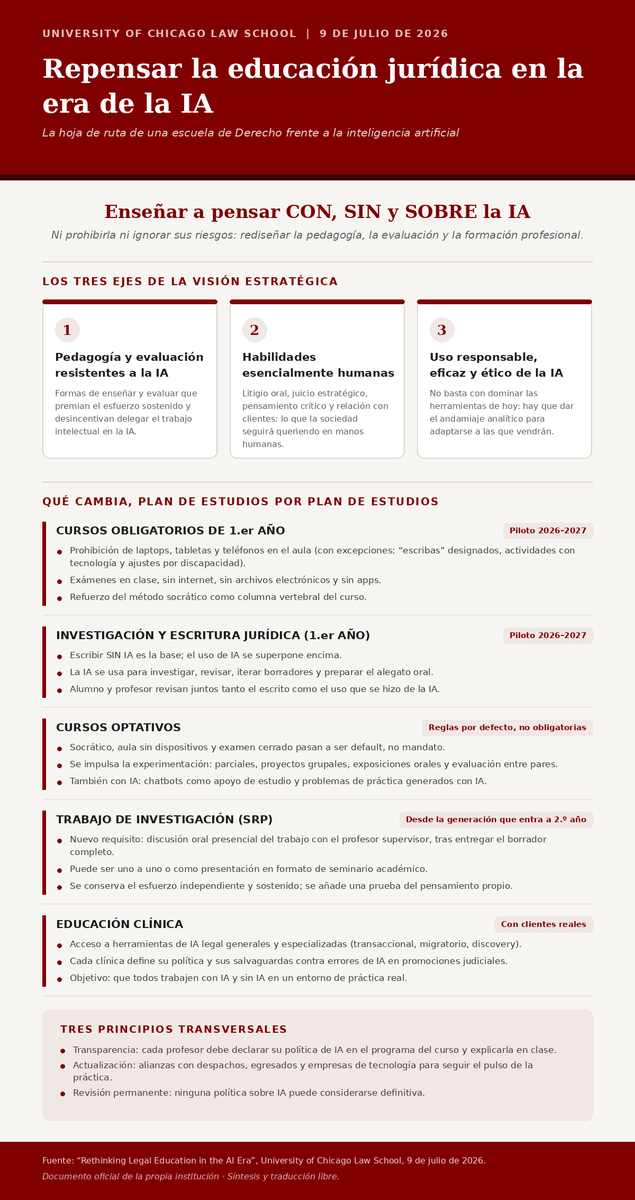
⚖️ 🤖 La Universidad de Chicago acaba de decidir cómo va a enseñar Derecho en la era de la #IA. Y la respuesta no es prohibirla.
▶️ El 9 de julio la Law School publicó su memorándum Rethinking Legal Education in the AI Era. Vale la pena leerlo completo, pero su tesis cabe en una línea: hay que enseñar a pensar con, sin y sobre la inteligencia artificial.
⚠️ Lo que más llama la atención es que no hay una política única, sino una gradación según el momento formativo:
➤ En el primer año —cuando el estudiante todavía no sabe juzgar la calidad de un output— vuelven al aula sin laptops ni celulares, a los exámenes cerrados y al método socrático. El "esfuerzo difícil" se protege deliberadamente.
➤ En investigación y escritura jurídica, en cambio, escribir sin IA es la base y el uso de IA se superpone encima: se supervisa tanto el escrito como el uso que se hizo de la herramienta.
➤ En el trabajo de investigación de titulación se añade un requisito que parece brillante por lo simple: una discusión oral presencial con el profesor sobre el propio texto. No hay tecnología en la que apoyarse cuando alguien te pregunta por qué escribiste lo que escribiste.
➤ En las clínicas, con clientes reales, el objetivo es trabajar con IA y sin IA, con salvaguardas contra errores de IA en promociones judiciales.
⚠️ Hay una lección que trasciende a las facultades de Derecho y llega directo a los despachos: la IA no sustituye el juicio profesional, pero sí puede impedir que se forme. La diferencia entre un abogado que usa IA y uno que depende de ella se decide en los años en que aprende a pensar.
⚠️ ¿Estamos formando —en la academia y en el ejercicio— a quienes puedan supervisar críticamente a la máquina, o solo a quienes sepan operarla?
🔗 Fuente: University of Chicago Law School, Rethinking Legal Education in the AI Era (9 de julio de 2026).
#EducaciónJurídica #InteligenciaArtificial #IAyDerecho #LegalTech #FuturoDeLaAbogacía #UChicagoLaw #EnseñanzaDelDerecho #JuicioProfesional #ÉticaProfesional #TransformaciónDigital #Abogados #FirmasLegales #AccesoALaJusticia #Innovación #LinkedInLegal
UNA INGENIERA DE ANTHROPIC LO DIJO CLARO: NO TIENES QUE PROMPTEAR A CLAUDE, TIENES QUE CONSTRUIR UN SISTEMA QUE SE PROMPTEA SOLO
en 45 minutos te muestra como armar un agente que se mejora a si mismo.
guardalo y miralo
Prompt, context, harness & loop engineering, clearly explained!
An agent is a while loop with four layers of engineering wrapped around it:
- Prompt engineering
- Context engineering
- Harness engineering
- Loop engineering
Each one wraps the last, and the model sits in the middle, so none of them compete with the others. Instead, they just zoom one level further out.
> Prompt engineering:
This defines the input the model sees on one call, often composed of a role, instructions, examples, and an output format.
The techniques here alter the internal computation and reasoning the model goes through due to the wording it sees:
- Chain-of-thought makes it work in steps before answering
- Few-shot examples define the format and the edge cases
- A JSON schema or XML tags make the output parseable by code
- Self-consistency samples a few chains and takes the majority
> Context engineering:
It's everything the model sees on a turn, not just the prompt. That includes the query, retrieved docs, memory, prior turns, and tool outputs from earlier steps.
The window is finite and fills up fast, so the engineering work is to rank inputs and cut everything that isn't pulling weight.
You do this by:
- Retrieving only the chunks relevant to the query, then reranking them
- Keeping key facts out of the middle, where accuracy drops
- Summarizing old turns, evict stale outputs, push big blobs to files
> Harness engineering:
It's the code around the model that defines the tools, parses the calls, retries on failure, and can route work to sub-agents so one handles retrieval and another handles code.
A verifier then grades the result by running tests, validating a schema, etc.
Prompt and context involve getting one call right. The harness involves everything that has to happen around that call for it to run in a real system.
> Loop engineering:
In the usual setup, you manage the outer loop, i.e, you write a prompt, read the turns the agent runs, write the next prompt, and repeat, while catching failures.
This layer hands that job to the agent itself. It kicks off on a schedule or an event, and runs many turns with no prompt in between.
A loop inherently doesn't know when it's finished. An agent can report that it's done and halt while the tests still fail. So the stop can't be the agent's word, but rather it has to be a real signal, like:
- A turn and token cap to stop stuck runs
- A no-progress detector to catch repeated calls
- A completion check to verify the goal with a separate model or a deterministic test
By this layer, you're operating on the whole run, so the engineering moves from writing each prompt to setting the goal and the stop conditions up front and letting it run.
If you want to dive deeper into loop engineering, my co-founder wrote a full breakdown of that outer loop.
It goes from the basic while loop to a run that finishes on its own, with the code behind each part, and the parts that are hard to get right, like knowing when to stop, context rot over a long run, and keeping the checker separate from the maker.
Read it below.
La CEO de AMD, Lisa Su, acaba de acabar con la caja de IA de $4,000 de Nvidia con una lonchera de $1,499.
Subió al escenario, la sostuvo en una mano y ejecutó en vivo un modelo de 235 mil millones de parámetros. Sin centro de datos. Sin nube. Sin GPU alquilada.
El chip en su interior es algo que nadie vio venir. El Ryzen AI Max+ 395 de AMD es el primer silicio x86 donde la CPU y la GPU comparten los mismos 128 GB de memoria. Ese solo truco permite que un escritorio ejecute modelos que antes necesitaban un rack de servidores.
De esos 128 GB, Linux le da al GPU 110 GB para jugar. Para contextualizar, una RTX 5090 te da 32 GB. Una 4090 te da 24. Esta caja te da más del triple que cualquiera de ellas, en un chasis del tamaño de un libro de bolsillo grueso.
El benchmark que rompió la sala: este chip superó a una Nvidia RTX 5080 por más de 3x en inferencia de DeepSeek R1. Una lonchera de $1,499 superando a una tarjeta gráfica discreta de $1,000 en una carga de trabajo real de IA. Nvidia pasó una década convenciendo al mundo de que necesitabas su hardware para IA seria. AMD acaba de poner eso en un escritorio por la mitad del precio.
Aquí está lo que nadie te está diciendo. Un usuario intensivo de IA ahora paga $200 por Claude Code Max, $200 por ChatGPT Pro, $20 por Cursor, $20 por Gemini. Eso son $5,280 al año saliendo de tu cuenta. La caja se paga sola en 9 meses y luego corre gratis por el resto de su vida.
Instala Ollama. Descarga Qwen3 235B. Apunta Claude Code a localhost. La misma interfaz que ya usas, excepto que ahora nada sale de tu máquina, nada cuesta por solicitud y ninguna empresa limita tu uso a las 3 de la mañana cuando por fin tienes tiempo para construir.
Este es el momento en que todas las suscripciones de IA se vuelven opcionales. Los abogados dejan de temer fugas de OpenAI. Los desarrolladores dejan de mirar el medidor de tokens. Los fundadores dejan de alquilar H100s para prototipos que nunca se envían porque la factura los asustó.
Las primeras mil personas en descifrar esto poseerán los próximos dos años de consultoría de IA privada.
Solo un filósofo como Slavoj Žižek sabría conectar la Inteligencia Artificial, el sexo y el descenso de coeficiente intelectual que está dándose en todo el mundo desde 2010.
🚨 El ingeniero de chips de Google DeepMind, Reiner Pope, acaba de explicar en pizarra lo que nadie te había explicado nunca: cómo funciona realmente un chip, desde la puerta lógica hasta el cerebro humano.
En 1h15 cubre todo lo que las escuelas de ingeniería tardan años en enseñar.
→ Cómo construir una multiplicación desde cero.
→ Por qué mover datos cuesta más que calcular.
→ Cómo funcionan los arrays sistólicos que hacen correr los LLMs.
→ Por qué un núcleo de CPU es 10 veces más grande que uno de GPU.
→ Por qué una GPU no es más que un montón de pequeños TPUs.
→ Y por qué el cerebro humano sigue siendo un enigma para los arquitectos de hardware.
Es gratis. Está en YouTube. Y es la mejor hora que vas a pasar esta semana si quieres entender por qué el hardware es el verdadero campo de batalla de la IA.
SOFTWARE ENGINEERS,
This 24 minutes video will teach you how to actually prompt Claude.
Not only Claude, basically any LLM.
Anthropic's own team leading this workshop.
Worth more than thousand bucks, Available FREE.
Watch NOW.
Bookmark for LATER.
Para Stiglitz, el sentido de la responsabilidad social que se aprecia en muchos de los magnates de la Gilded Age (fines del siglo XIX), que contribuían al bien público apoyando la creación de bibliotecas, universidades y centros de investigación, también representa un contraste radical con la ideología libertaria que exhiben hoy tantas personas de Silicon Valley, “una versión radical del ‘esto lo hice yo solo, déjame en paz’, una ideología con un grado de egoísmo alucinante porque lo cierto es que no han hecho nada por su cuenta, ha sido la investigación del Gobierno la que trajo internet y gran parte de las innovaciones con las que ellos ahora ganan dinero”.
Moreno para justificar el abandono en que habían dejado a los centros de alto rendimiento construidos durante el correismo, decía que la RC había construido muchos y que nuestros atletas nunca traían ni una medalla. Me cuesta creer que hay idiotas que le agradecen a este infeliz.
June 1983. A 28-year-old Steve Jobs walks into a design conference in Aspen, Colorado. He asks the room who owns a personal computer. Nobody raises their hand. He says “Uh-oh.”
Then he spends the next 55 minutes describing the next four decades of technology.
Jobs told the audience Apple’s strategy was to “put an incredibly great computer in a book that you can carry around with you, that you can learn how to use in 20 minutes… with a radio link in it so you don’t have to hook up to anything.” That’s an iPhone. In 1983. The Mac hadn’t even shipped yet.
He described an MIT project that sent a camera truck down every street in Aspen, photographed every intersection, and built a virtual walkthrough on a computer screen. Google Street View launched 24 years later. He said office networking was about 5 years away and home networking 10 to 15 years out. The web went mainstream in the mid-90s, about 12 years later. Dead on.
He described software being sent electronically over phone lines, with free previews and credit card payment. That’s the App Store, 25 years before it launched. He even compared it to the music industry and said software needed “the equivalent of a radio station” for free sampling. Apple built the iTunes Music Store 20 years later.
The AI prediction is the one that hits different now. Near the end, Jobs talked about machines that could capture a person’s “underlying spirit” or “way of looking at the world,” so that after they died, you could ask the machine questions and maybe get answers. He said 50 to 100 years. ChatGPT arrived in about 40.
The weird part is this speech was lost for nearly 30 years. The full hour-long recording only surfaced in 2012 when a blogger got a cassette tape from someone who attended the original conference. The Steve Jobs Archive didn’t release actual video footage until July 2024.
His timelines were consistently too fast. He wanted the “computer in a book” within the 1980s. Apple’s first attempt was the Macintosh Portable in 1989, which weighed 16 pounds and cost $6,500. The iPad arrived in 2010, 27 years late. He guessed voice recognition was about a decade away. Siri launched in 2011, nearly 30 years later. The vision was right every time. The clock was wrong every time.
Apple was doing about $1 billion a year in revenue when Jobs gave this talk, with under 5,000 employees. Today it’s worth $3.7 trillion.