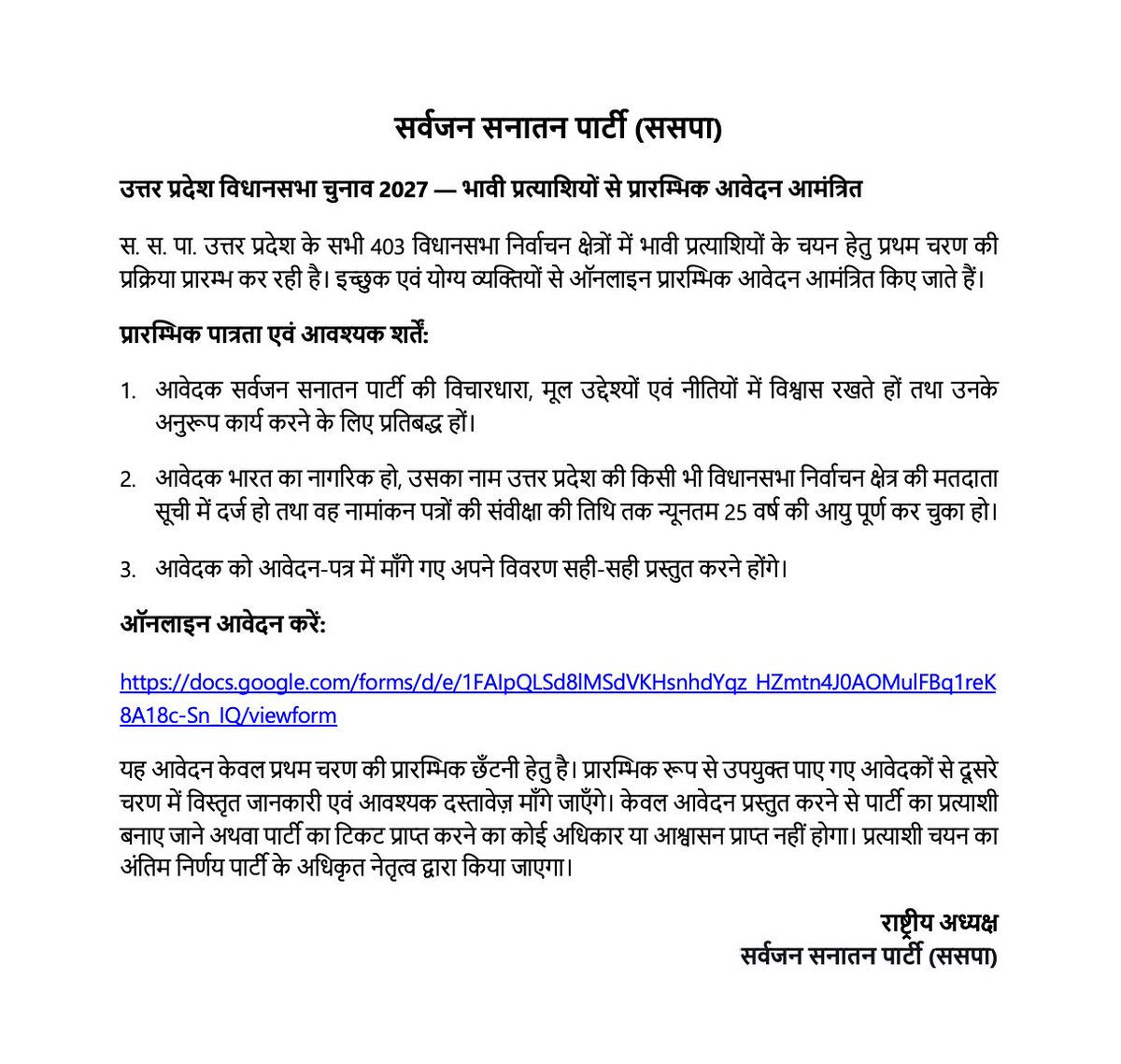
उत्तर प्रदेश विधानसभा चुनाव 2027 — भावी प्रत्याशियों से प्रारम्भिक आवेदन आमंत्रित
सर्वजन सनातन पार्टी (ससपा) उत्तर प्रदेश के सभी 403 विधानसभा निर्वाचन क्षेत्रों में भावी प्रत्याशियों के चयन हेतु प्रथम चरण की प्रक्रिया प्रारम्भ कर रही है। इच्छुक एवं योग्य व्यक्तियों से ऑनलाइन प्रारम्भिक आवेदन आमंत्रित किए जाते हैं।
प्रारम्भिक पात्रता एवं आवश्यक शर्तें:
1. आवेदक सर्वजन सनातन पार्टी की विचारधारा, मूल उद्देश्यों एवं नीतियों में विश्वास रखते हों तथा उनके अनुरूप कार्य करने के लिए प्रतिबद्ध हों।
2. आवेदक भारत का नागरिक हो, उसका नाम उत्तर प्रदेश की किसी भी विधानसभा निर्वाचन क्षेत्र की मतदाता सूची में दर्ज हो तथा वह नामांकन पत्रों की संवीक्षा की तिथि तक न्यूनतम 25 वर्ष की आयु पूर्ण कर चुका हो।
3. आवेदक को आवेदन-पत्र में माँगे गए अपने विवरण सही-सही प्रस्तुत करने होंगे।
ऑनलाइन आवेदन करें:
https://t.co/72J3DCUMfh
यह आवेदन केवल प्रथम चरण की प्रारम्भिक छँटनी हेतु है। प्रारम्भिक रूप से उपयुक्त पाए गए आवेदकों से दूसरे चरण में विस्तृत जानकारी एवं आवश्यक दस्तावेज़ माँगे जाएँगे। केवल आवेदन प्रस्तुत करने से पार्टी का प्रत्याशी बनाए जाने अथवा पार्टी का टिकट प्राप्त करने का कोई अधिकार या आश्वासन प्राप्त नहीं होगा। प्रत्याशी चयन का अंतिम निर्णय पार्टी के अधिकृत नेतृत्व द्वारा किया जाएगा।
#SarvjanSanatanParty
#SSP
#UPElections2027
#भावीप्रत्याशी
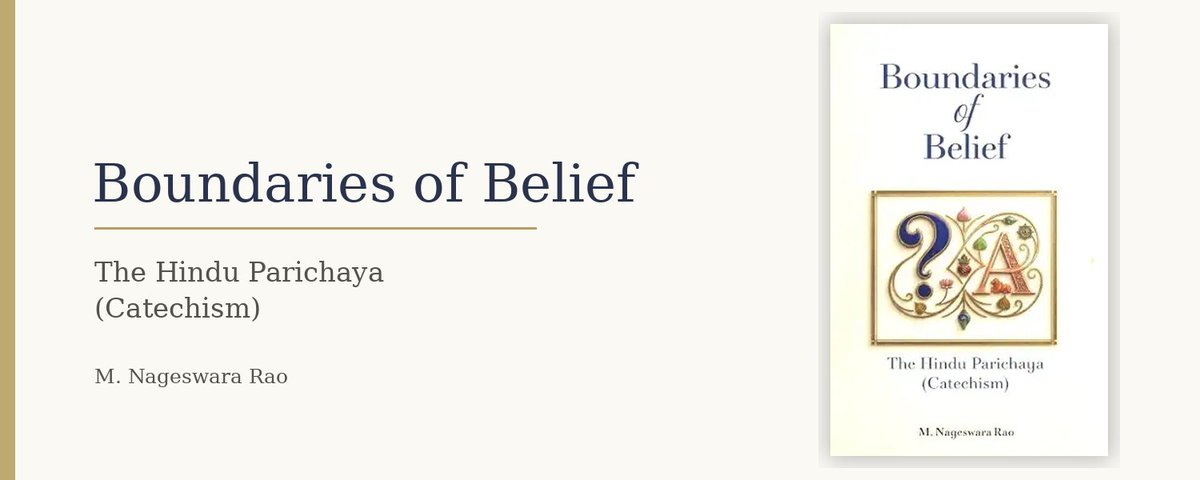
3/3 Built in a rigorous question-and-answer format, Boundaries of Belief cuts through ambiguity to deliver direct, unshakeable clarity. Read it as a cohesive architecture to understand the metaphysical framework of Hindutva, and let it shape our individual and collective religious life.
Order your copy here: https://t.co/3NqePF5OND
2/3 Boundaries of Belief is not merely an academic exercise; it is an attempt to map the foundational tenets, ontological commitments, and civilisational boundaries that have kept this eternal stream flowing through millennia of turbulence.
1/3 For too long, the discourse surrounding Sanatana Dharma (aka Hindutva) has been marked by either vague generalisations or apologetic obfuscation. We have allowed others to frame our identity on their terms. It is time for Hindus to reclaim epistemic sovereignty.
उत्तर प्रदेश विधानसभा चुनाव 2027 — भावी प्रत्याशियों से प्रारम्भिक आवेदन आमंत्रित
सर्वजन सनातन पार्टी (ससपा) उत्तर प्रदेश के सभी 403 विधानसभा निर्वाचन क्षेत्रों में भावी प्रत्याशियों के चयन हेतु प्रथम चरण की प्रक्रिया प्रारम्भ कर रही है। इच्छुक एवं योग्य व्यक्तियों से ऑनलाइन प्रारम्भिक आवेदन आमंत्रित किए जाते हैं।
प्रारम्भिक पात्रता एवं आवश्यक शर्तें:
1. आवेदक सर्वजन सनातन पार्टी की विचारधारा, मूल उद्देश्यों एवं नीतियों में विश्वास रखते हों तथा उनके अनुरूप कार्य करने के लिए प्रतिबद्ध हों।
2. आवेदक भारत का नागरिक हो, उसका नाम उत्तर प्रदेश की किसी भी विधानसभा निर्वाचन क्षेत्र की मतदाता सूची में दर्ज हो तथा वह नामांकन पत्रों की संवीक्षा की तिथि तक न्यूनतम 25 वर्ष की आयु पूर्ण कर चुका हो।
3. आवेदक को आवेदन-पत्र में माँगे गए अपने विवरण सही-सही प्रस्तुत करने होंगे।
ऑनलाइन आवेदन करें:
https://t.co/72J3DCUMfh
यह आवेदन केवल प्रथम चरण की प्रारम्भिक छँटनी हेतु है। प्रारम्भिक रूप से उपयुक्त पाए गए आवेदकों से दूसरे चरण में विस्तृत जानकारी एवं आवश्यक दस्तावेज़ माँगे जाएँगे। केवल आवेदन प्रस्तुत करने से पार्टी का प्रत्याशी बनाए जाने अथवा पार्टी का टिकट प्राप्त करने का कोई अधिकार या आश्वासन प्राप्त नहीं होगा। प्रत्याशी चयन का अंतिम निर्णय पार्टी के अधिकृत नेतृत्व द्वारा किया जाएगा।
#SarvjanSanatanParty
#SSP
#UPElections2027
#भावीप्रत्याशी
3/3 Built in a rigorous question-and-answer format, Boundaries of Belief cuts through ambiguity to deliver direct, unshakeable clarity. Read it as a cohesive architecture to understand the metaphysical framework of Hindutva, and let it shape our individual and collective religious life.
Order your copy here: https://t.co/3NqePF5OND
What makes a Hindu a Hindu?
Where does pluralism end and civilisational self-erasure begin?
If we don't articulate our own foundations and boundaries, others will define, and dismantle, them for us.
Delighted to share that my book, Boundaries of Belief: The Hindu Parichaya (Catechism), is now out. Read it, debate it, and pass it on to the next generation.
Grab your copy here: https://t.co/lObV1mFo4p.
2/3 Boundaries of Belief is not merely an academic exercise; it is an attempt to map the foundational tenets, ontological commitments, and civilisational boundaries that have kept this eternal stream flowing through millennia of turbulence.
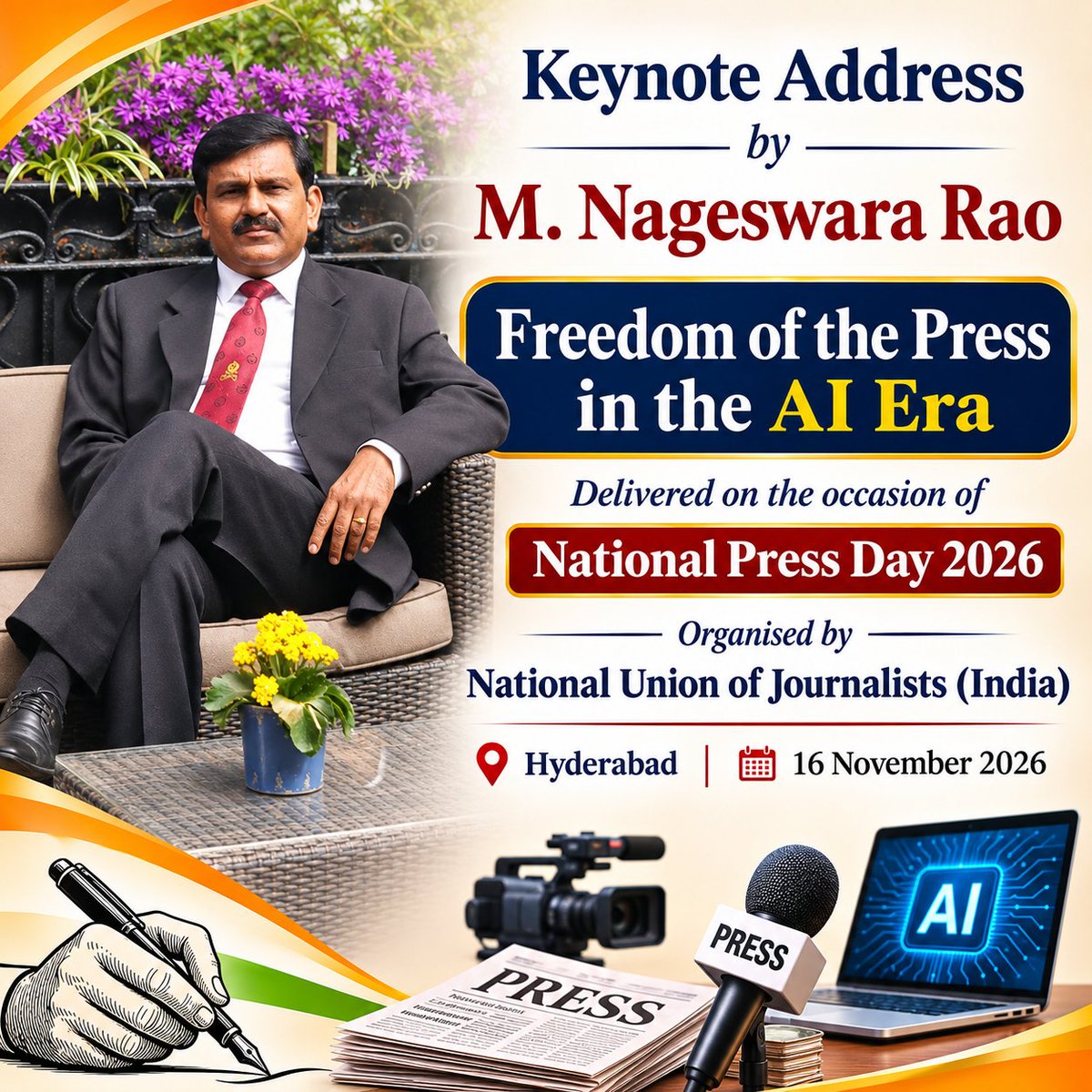
Text of My Keynote Address
Delivered at the National Press Day, 2026 celebrations organised by the National Union of Journalists (India), Hyderabad, on 16 November 2026.
*****
Distinguished office-bearers of the National Union of Journalists (India), members of the journalist fraternity, distinguished guests, ladies and gentlemen.
My greetings to all of you on #NationalPressDay2026.
I am delighted to address an issue that goes beyond the interests of journalists and media organisations. It concerns the survival of truth, the accountability of power and the foundations of democracy.
Artificial Intelligence is transforming how information is created and disseminated—and how people perceive reality. It offers extraordinary possibilities but also unprecedented dangers. In an age when reality itself can be manufactured, who will defend the truth?
For journalism, this is not merely a technological challenge. It is a test of credibility, independence and courage.
I would like to examine this challenge from a democratic and constitutional perspective.
1. AI AND THE MANUFACTURE OF REALITY
Every major technological revolution has transformed communication. The printing press expanded the dissemination of knowledge; radio and television transformed mass communication; the internet removed geographical barriers. Artificial Intelligence takes this transformation to an entirely different level.
Today, videos, voices, photographs, documents and entire narratives can be fabricated and presented as authentic. The consequences can be devastating: elections manipulated, reputations destroyed, social unrest provoked, national security threatened and the administration of justice compromised.
Yet AI can also assist journalism by analysing vast volumes of information, identifying patterns, translating Indian languages and helping uncover facts.
But one distinction is fundamental: the ability to manufacture information is not the ability to establish truth.
A convincing video is not necessarily genuine evidence. An algorithmically identified pattern is not proof of wrongdoing. A machine can generate a narrative, but it cannot assume responsibility for its veracity.
Verification, corroboration and independent human judgment remain indispensable.
AI may transform the tools of journalism. It must never be allowed to manufacture the truth that journalism is duty-bound to discover.
2. THE PRESS AND DEMOCRACY
A functioning democracy rests on four great institutions: the Legislature, the Executive, the Judiciary and the Free Press. The first three are constitutional organs of the State. The Press has evolved as the Fourth Estate, performing an equally indispensable democratic function.
Our National Emblem offers an interesting metaphor. The Lion Capital of Ashoka depicts four lions standing back to back. Three are visible; the fourth remains invisible. One could metaphorically associate that invisible fourth lion with the Press—not as a constitutional interpretation, but as a reminder of its indispensable democratic role.
The Legislature makes laws, the Executive implements them and the Judiciary interprets them and safeguards the rule of law. The Press informs citizens, scrutinises power, exposes wrongdoing and gives voice to public concerns.
It is the bridge between governance and the people, telling citizens what is done in their name, with their mandate and, most importantly, with their money.
Article 19(1)(a) of our Constitution guarantees freedom of speech and expression. The Supreme Court has recognised freedom of the Press as integral to this right, subject to the reasonable restrictions under Article 19(2).
Press freedom is not merely a professional privilege. It is also the citizen's right to receive information and form independent opinions.
The Press is not merely an observer of democracy. It enables citizens to question power and hold those who govern them accountable.
3. MEDIA INDEPENDENCE: FROM WHOM AND WHAT?
We frequently discuss press freedom in terms of censorship, governmental interference and intimidation. But the question of independence goes much deeper.
Independence from whom? Independence from what?
Is the Press independent of governments, political parties, corporate owners, commercial interests, ideological and religious influences? Is it independent of its own prejudices?
A Press free from governmental censorship but controlled by political patrons, corporate owners or ideological loyalties is not truly independent.
First: Independence from political ownership and control.
Political parties, politicians and their associates own, control or influence media organisations. At the same time, business interests increasingly enter politics, while politicians acquire commercial interests.
When business becomes politics and politics becomes business, the media becomes an instrument through which both protect their power and interests.
The expression Godi Media has become a widely used pejorative description of sections of the Indian mainstream media since 2014. It reflects the criticism that sections of the media have been manipulated, subdued or co-opted into functioning as publicity and propaganda instruments for the RSS-BJP political establishment and Prime Minister Narendra Modi.
The problem is not merely favourable coverage. It is the abandonment of scrutiny: governments are praised, opponents vilified and inconvenient questions suppressed.
As the saying goes, “A dog with a bone in its mouth cannot bark.”
Second: Independence from corporate and commercial interests.
Concentration of media ownership, dependence on advertising and commercial pressures can determine editorial priorities. The same business interests may have stakes in media, access to public finance and influence over political decisions.
Between FY2015 and FY2024, scheduled commercial banks wrote off approximately ₹16.35 lakh crore in bad loans, of which around ₹10 lakh crore was linked to big business houses.
Yet, where is the sustained media scrutiny? Where are the investigations into the beneficiaries and the accountability of those responsible?
When the powerful can influence both the flow of public money and the flow of public information, accountability itself is compromised.
Third: Independence of Journalists from Financial Vulnerability.
Journalists must receive fair and assured remuneration and reasonable employment security. Inadequate wages and precarious employment expose them to inducements and pressures that compromise their professional independence. Fair remuneration and employment security are therefore essential safeguards of independent journalism.
Fair remuneration is not merely an employment obligation; it is an essential safeguard of independent journalism.
Fourth: Independence from ideological and religious influence.
Journalists are entitled to personal political, ideological and religious convictions. But personal beliefs must never become professional prejudices. Ideology must not determine which facts are reported, which victims deserve sympathy or which perpetrators are spared scrutiny.
A journalist who applies different standards according to political allegiance or religious identity is practising partisanship, not independent journalism.
The most dangerous form of media control is not always censorship of what is published. It is control over what is never allowed to become a subject of public scrutiny.
Press independence must therefore be both institutional and intellectual: freedom from external control and freedom from prejudices that compromise professional judgment.
4. SELECTIVE JOURNALISM
Media capture by political, corporate and ideological interests has a direct consequence: selective journalism. Some events are amplified, others buried; some victims command national outrage, while others disappear from public consciousness.
Let me cite five examples.
First: Naxalism and Maoist insurgency.
For decades, sections of the intellectual and media establishment romanticised Naxalite and Maoist insurgents as revolutionaries and champions of the oppressed.
Marginalised populations have suffered genuine injustice, exploitation and deprivation. Their grievances deserve redressal. But reporting those grievances is fundamentally different from romanticising armed groups that exploit them to advance a violent, anti-democratic ideology.
Did the media adequately expose how deprivation and alienation were exploited to recruit cadres and perpetuate violence?
When journalism romanticises violent ideologies and neglects their victims, it risks becoming a propaganda instrument and force-multiplier for the very forces it ought to expose.
Second: The genocide and religious cleansing of Kashmiri Hindus.
The genocide and religious cleansing of Kashmiri Hindus from their ancestral homeland remain one of the darkest and most shameful chapters in democratic India's history. Hindus were subjected to targeted killings, terror, threats and religious persecution. An entire Hindu community was driven out of Kashmir, and the Indian State was complicit.
And what did the Indian media do? Where was its outrage? Where were its investigations and sustained campaigns for justice and the safe return of the displaced?
The media's failure was not simply inadequate coverage. It was a complicit silence in the face of the genocide and religious cleansing of an entire community.
By its silence, the media helped erase the suffering of Kashmiri Hindus from the national conscience. That is an indictment of the media as much as it is of the State.
Third: The religious persecution of Hindus in the Northeast.
In the Christian-majority states of Mizoram and Meghalaya, Hindus have been facing severe religious persecution and discrimination. In some instances, they have been denied even the basic right to perform the last rites of their dead, to cremate their own family members in accordance with their religious traditions.
What could be more fundamental than this right? And where is the national media? Where are the headlines, investigations and expressions of outrage?
When the media turns a blind eye to the persecution of a community, it abandons the victims and shields the perpetrators from scrutiny.
Fourth: Double standards in reporting religiously sensitive crimes.
There is a glaring asymmetry in crime reporting. When the victim is Christian or Muslim, or the accused is Hindu, religious identity is often prominently highlighted. But when Hindus are victims, or the accused is Christian or Muslim, that identity disappears into generic descriptions or silence.
Why should the same journalistic standards not apply to everyone?
I demand equal seriousness of investigation, prominence of coverage and accountability, irrespective of the community involved.
The test of secular journalism is not whether it ignores religion, but whether it applies the same standards of fairness and scrutiny to everyone.
Fifth: Neutrality Must Not Become Complicity.
The media cannot be neutral between the perpetrator and the victim. Silence in the face of oppression emboldens the perpetrator and abandons the victim. Neutrality that fails to distinguish between the two is not impartiality; it is complicity.
Journalistic independence demands an unwavering commitment to truth and equal scrutiny of every government, political party, ideology and institution, irrespective of whose interests are affected.
5. FREEDOM AFTER SPEECH
A remark attributed to Idi Amin, the former President of Uganda, captures a fundamental danger: “There is freedom of speech, but I cannot guarantee freedom after speech.”
It exposes the hollowness of a freedom that exists only so long as it does not inconvenience those in power.
This brings me to an important constitutional proposition.
Article 19(1)(a), while guaranteeing freedom of speech and expression, is not adequate by itself to provide the explicit institutional recognition and safeguards that an independent Press requires. The Constitution must recognise the Free Press as an independent Fourth Estate of our democracy.
As National President of the Sarvjan Sanatan Party @sarvjansp, I affirm our commitment to pursuing a constitutional amendment to provide explicit constitutional recognition and status to the Press, so that not only freedom of speech but, importantly, freedom after speech is constitutionally guaranteed and enforced.
If the Press is indispensable to democracy, why should its institutional independence and constitutional status remain without explicit constitutional recognition?
I leave this question before this distinguished gathering.
Thank you.
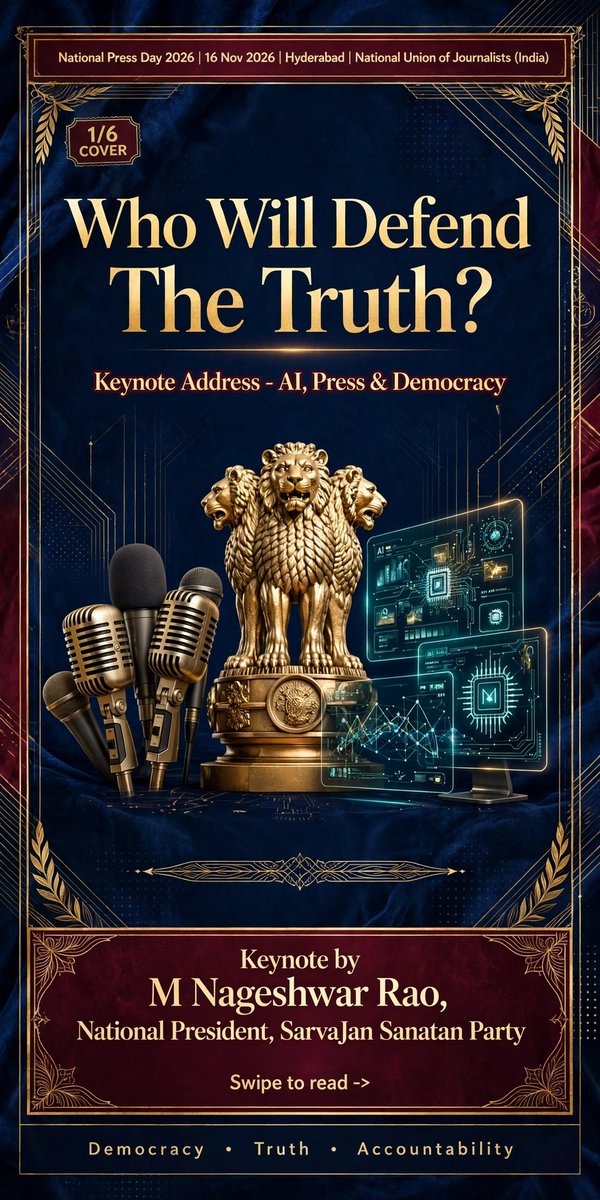
सत्य की रक्षा कौन करेगा?
@MNageswarRaoIPS गारू, राष्ट्रीय अध्यक्ष, @sarvjansp द्वारा मुख्य भाषण, भारतीय राष्ट्रीय प्रेस दिवस, 16 नवंबर को भाग्यनगर (हैदराबाद) में
"If the Press is indispensable to democracy, why should its institutional independence and constitutional status remain without explicit constitutional recognition?"
Extremely Pertinent Points for @PressCouncil_IN@PCITweets@IndEditorsGuild et al to empower #fourthestate
@MNageswarRaoIPS Who will Defend the Truth?
KeyNote Address by @MNageswarRaoIPS Garu, National President, @sarvjansp on Indian National Press Day, 16th November at BhagyaNagar (Hyderabad) #1
पूर्वोत्तर में हिंदुओं का धार्मिक उत्पीड़न 🚨
यह सच है कि पूर्वोत्तर में ईसाई नेतृत्व वाली सरकारों द्वारा हिंदुओं को “अंतिम संस्कार” करने की अनुमति तक नहीं दी जाती है।
और यह दुखद है कि हिंदुओं के इस उत्पीड़न पर मीडिया पूरी तरह से चुप है।
@MNageswarRaoIPS जी ने बहुत प्रभावी ढंग से बताया है कि कैसे 'चुनिंदा पत्रकारिता' (selective journalism) लोकतंत्र को कमजोर करती है।
जरूर पढ़ें ⬇️
@ipsjkishore08@RituRathaur
@MNageswarRaoIPS@counterdrakula@sarvjansp Sir ek chota suggestion hai:
Aap apni @sarvjansp party detailed manifesto, har social media platform pe share ko, aur agar influencer ki madad leni pade toh woh bhi karo, taki logo ko aapki party ke muddo par puri jankari ho.