Nvidia and AMD's venture arm just backed Genesis AI's $500M round, valuing the robot maker at $3.5B.
The bet is on hands. Genesis builds robots that handle objects the way people do, and their first jobs are in factories, warehouses and labs.
A new U.S. Commerce Department rule requires a license to rent overseas AI compute to Chinese firms or ship AI chips to Malaysia, Singapore, Indonesia, Thailand and Brazil.
Existing data centers get 90 days. U.S. buyers are exempt, so demand tied to China takes the hit.
Amicro designs the chips that tell a robot where it is and how to move through a room. It listed in Hong Kong on Thursday at HK$9.90 a share and closed day one up 38%.
Investors are paying for the parts every robot needs before any robot maker has shown it can sell at scale.
CoreWeave reported $3.7B of 3rd quarter revenue, up 168.2% from $1.4B a year earlier.
Sales grew more from the 2nd to the 3rd quarter than in the two quarters before it combined, so the AI cloud company's customers are still adding compute at a faster pace.
Biotech stocks have gained 72.2% in the 22 months since 2025 began. Semis were up 155.6% at the same point in their run, in Nov 2024.
AI chip demand that showed up in earnings carried semis for two more years. For biotech to follow, new drugs have to show up in sales.
Anthropic reported $17B of revenue in the 3rd quarter, up 1,127% from $1.4B a year earlier.
Its filing says customer demand still exceeds the compute it can get, so the $70.00 to $78.00 IPO range prices a business whose growth is capped by how much compute it can buy.
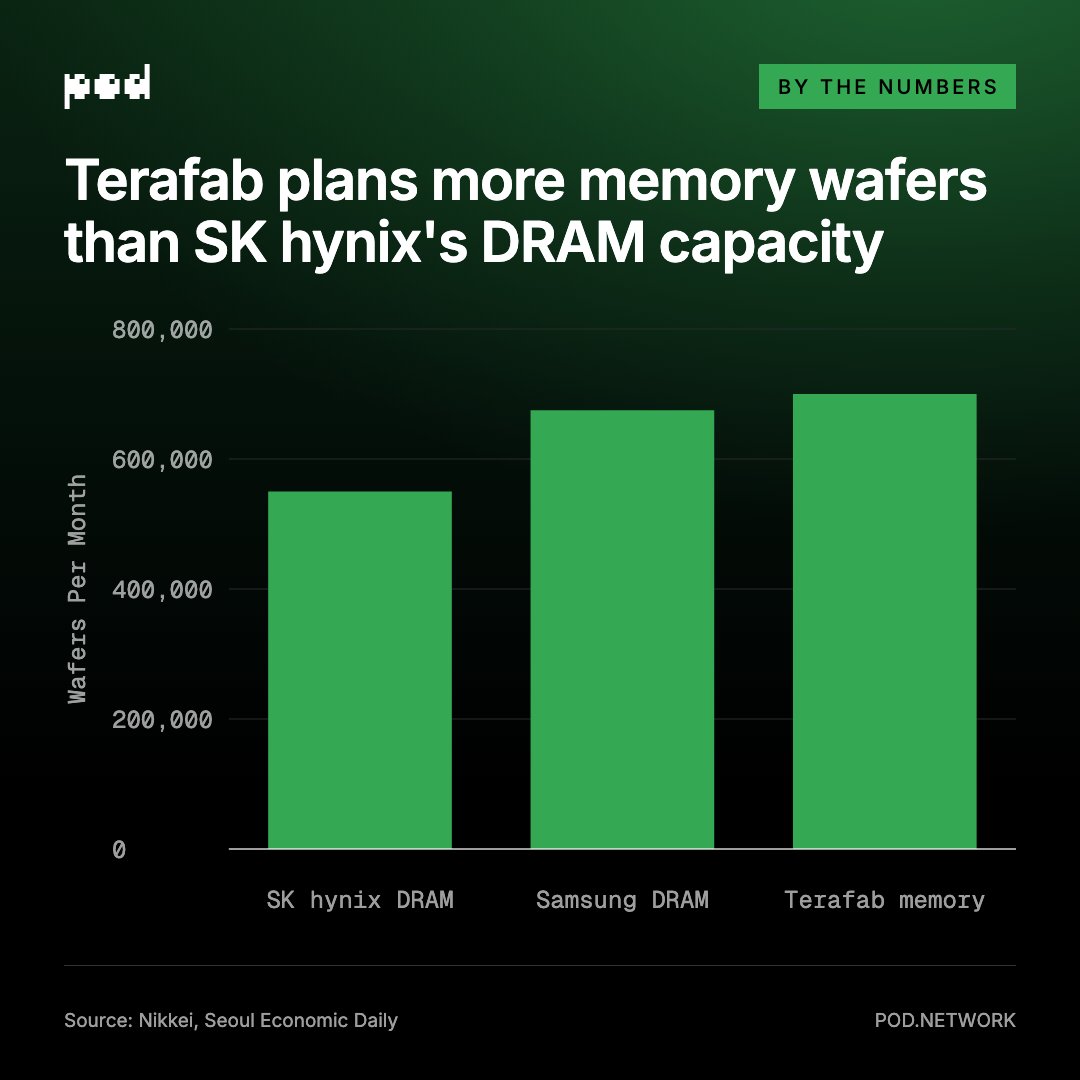
Terafab, the Tesla and SpaceX chip venture, has told equipment makers it wants 1 million wafers a month from 2032, with about 700,000 for memory. That's roughly Samsung's entire DRAM capacity today.
The split fits how AI is using up memory supply, though Terafab hasn't explained it. High bandwidth memory, the kind stacked beside AI chips, takes about three times the wafer area of standard DRAM for the same capacity, and server DRAM is expected to stay undersupplied this quarter.
Musk wants a terawatt of AI chips a year and thinks even Samsung and TSMC expanding won't meet the demand ahead. Nobody plans 700,000 memory wafers a month for after 2032 unless they expect memory to still be short.
Until that capacity exists, the shortage favors the companies with memory lines running today, led by Samsung, SK hynix and Micron.
Exotic.