I sometimes feel like my thoughts are objects floating through a vacuum, moving endlessly without ever reaching a destination. One thought leads to another, one question creates five more, and before I realise it, I’m no longer trying to understand what happened.
This is already a national disgrace and a slap in the face to every Nigerian who has lost a loved one to banditry, terrorism, and insurgency.
It is deeply troubling that, despite the serious allegations and concerns surrounding this individual, he is still being allowed to contest for the highest political office in the state.
what message does this send to the countless families who have suffered unimaginable losses as a result of insecurity?
If someone facing such weighty allegations can still aspire to become governor then there is no “Nigerian”
Imran is not a criminal. Supporting Malam El-Rufai and criticizing the government is a democratic right, not a crime.
We are tired of the intimidation, and our resolve ahead of 2027 remains unbroken.
#FreeImran#KadunaYouthStand
What we are witnessing with @IU_Wakilii
Is exactly how Dadiyata’s case started, the Government and security went mute before finally claiming not to have anything with his disappearance, Today right before our Eyes Imran is nowhere to be found and the police are mute about it.
KHALIFA IKON ALLAH
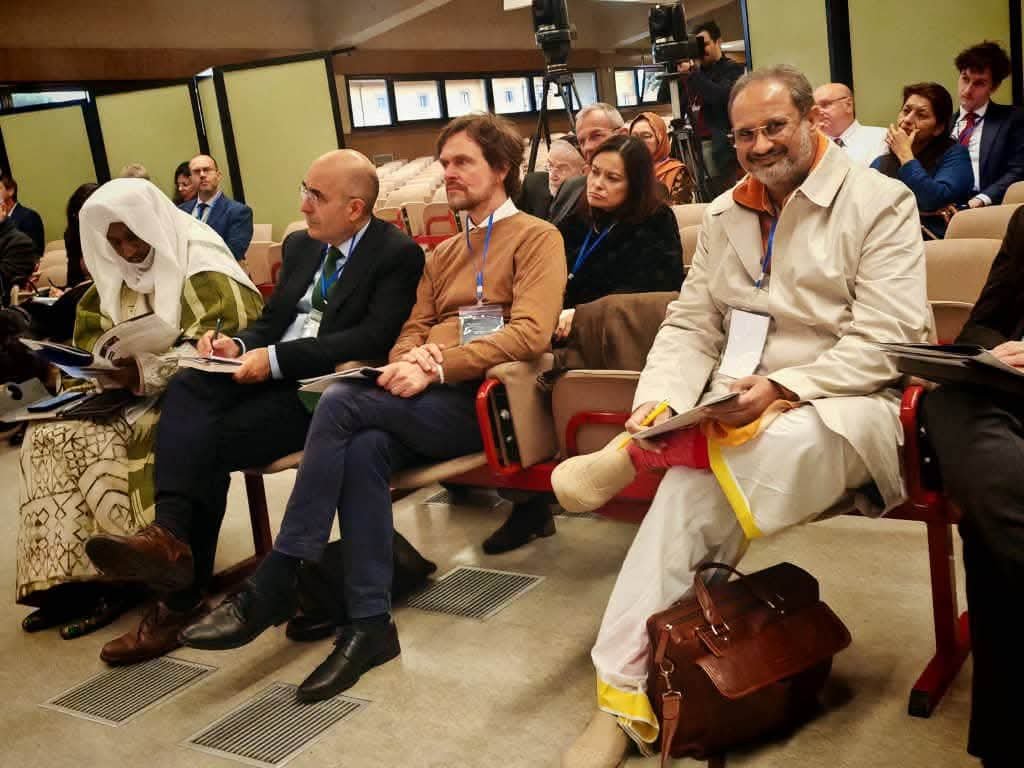
Yesterday, the Emir of kano His Highness, Khalifa Dr. Muhammadu Sanusi II, CON, graced the prestigious international conference on Religion and Global Development at the Papal summer residence in Castel Gandolfo, Italy.
A moment of pride for Kano & Nigeria!
@BlueChairman@Daniel_Nduka_ Not necessarily the Middle Belt. My point is that the overwhelming majority of Northern Nigeria’s population is concentrated in the North-West and North-East, hence why I referred to the populace.
Let me tell you something you probably already know: you’re wrong, and quite frankly, a good portion of the arguments you present across this account are intellectually dishonest.
And before you mistake this for an invitation to debate, understand that I’m not addressing you for your sake. I’m addressing the people reading who might genuinely mistake your confidence for competence.
I already know the routine. You’ll ask me to identify which claims are wrong, demand citations, and attempt to manufacture another engagement-driven exchange. But I’m not interested. I have absolutely no desire to participate in what is essentially intellectual theatre disguised as religious scholarship.
There’s a difference between genuinely questioning a religion and deliberately presenting complicated historical discussions as convenient gotcha questions for an audience that may not have the background to challenge you. If your objective were genuinely academic inquiry, intellectual honesty would be the bare minimum.
Instead, you’ve seemingly turned provoking impressionable Muslims into a business model. And honestly, I find it rather pathetic that something as serious as people’s faith has become an engagement strategy for you
Blogging the history of Islam, my foot
Dan kashin uba kawai
I think I should also acknowledge that reducing Kaduna’s voting patterns to religion alone would be doing the people of the state, and the administrations that have put in the work, a disservice. We do vote based on competence and performance too. Ever since Mallam, we have had a clearer sense of the minimum standard of performance and delivery expected of those seeking our votes. So, while I still believe religion has a significant influence on our politics, it is not the whole story. Voters also pay attention to what leaders have actually done and what they can offer.
It’s not bigotry; it’s recognising the political realities in Kaduna. Religion plays a huge role in shaping voting patterns. Much of Peter Obi’s support in Southern Kaduna is likely to come from Christian voters, just as Atiku enjoys considerable support among Muslim voters. There will always be exceptions, but they don’t erase the broader pattern.
Take Hon. Bello El-Rufai in Kaduna North. His father’s political legacy will count for something, and his Muslim identity may also influence how some voters relate to him. The same applies to the ADC gubernatorial candidate, who is also Muslim. These dynamics could shape voting decisions across Kaduna North and Southern Kaduna.
That said, Bello should be judged on his own record too. He has built his own reputation as a representative, and I believe he has done an exceptional job. Even the devil himself would have to acknowledge All of the good work he has done.
Ultimately, regional identity, political alliances, family legacy and candidate appeal all feed into Kaduna’s wider religious dynamics. Religion may not determine every vote, but it remains one of the biggest forces shaping the state’s politics. You cannot analyse Kaduna’s electoral landscape seriously while pretending otherwise.