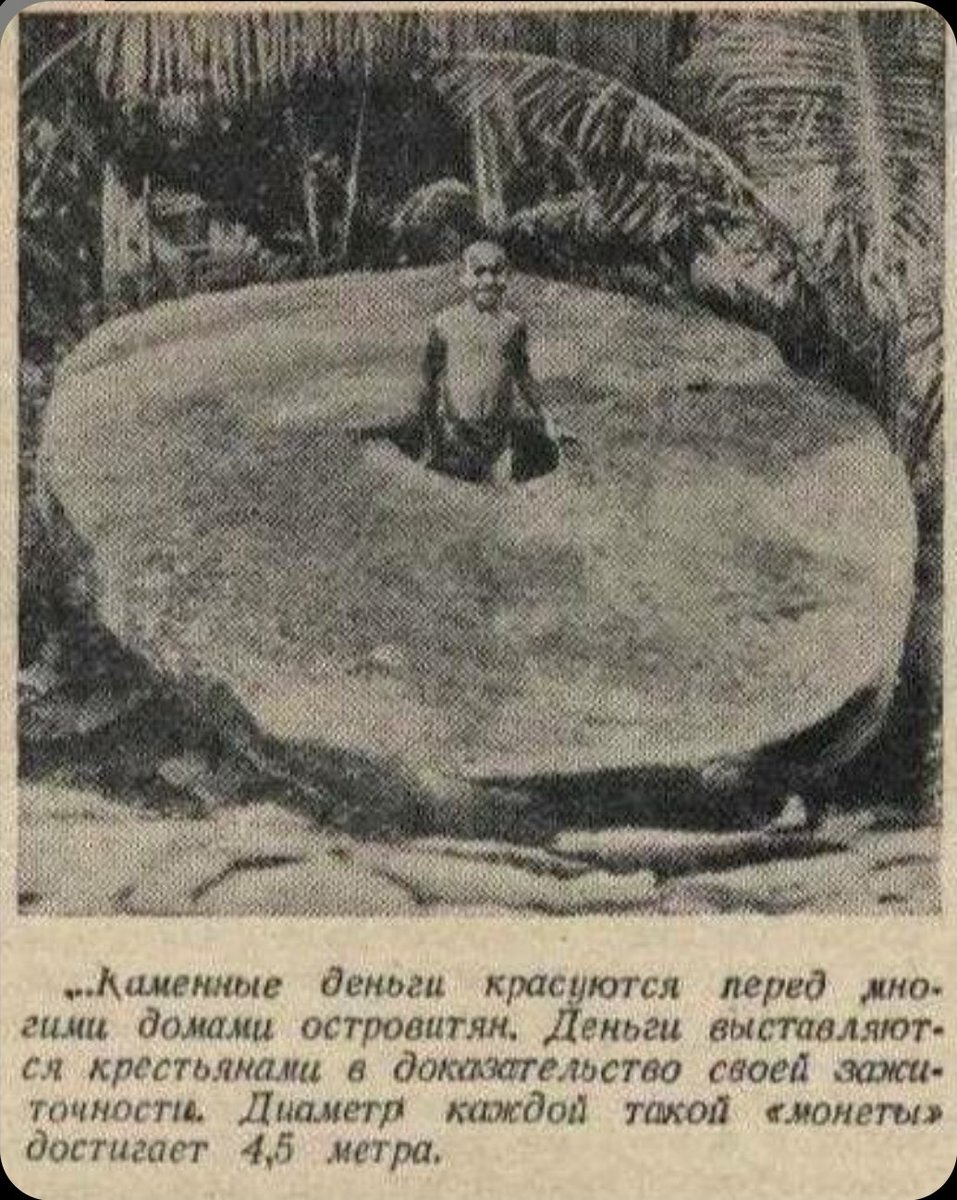
Rai stones.
This is the stone currency traditionally used on the island of Yap, in the Federated States of Micronesia. These giant limestone discs feature a hole in the center and serve as a unique form of conceptual and cultural currency. Rai stones vary in size and weight; because they are extremely heavy, they rarely change physical location once positioned. When a transaction takes place, the entire community simply acknowledges verbally that the stone's ownership has changed. They are often lined up outside homes, along traditional paths, or gathered in open-air "banks" within the villages. Although the US dollar is the currency used for daily life, Rai stones still hold immense cultural value and are used in significant traditional transactions, such as weddings, political agreements, or formal apologies between families.
The island of Yap is made of volcanic rock and lacks crystalline limestone (aragonite) the shiny mineral prized by the natives. Yapese navigators traveled to Palau in traditional canoes. With the permission of local chiefs, they quarried the stone from the Rock Islands. They carved these giant stones using primitive tools made of shell and hard stone, long before iron tools reached the region. Smaller stones were transported inside the canoes. The massive ones were lashed to bamboo rafts and towed by the canoes across the open sea, braving strong currents and storms.
Can you believe it?
What was the actual intended use of these stones?
To answer the question in my last post, I was showing the shaft that is connected to the mysterious staircase at the northern end of Abu Ruash, a few miles North of Giza. Here I descend to the point at which it is flooded, though it's hard to tell with all the trash on the water.
You basically have to know someone local to the neighborhood to get access to this area. Otherwise it's completely off limits, so very few have ever been there. There are many shafts all around the staircase, and two enormous manmade caves, hewn from bedrock. Soon I will have a full film about Abu Ruash and it's many hidden secrets!
@Weird_Old_World won the prize, first to call it, with bonus points, for actually having been there with me when it was filmed!
El primer videojuego de la historia no se jugó en una pantalla ni en una televisión, sino en un osciloscopio nuclear.
En 1958, el físico William Higinbotham creó Tennis for Two usando un medidor de señales eléctricas y dos perillas metálicas. La cuna del gaming empezó así.
Nobody else has ever pointed this out to me...
Geoffrey Drumm shows me that these Calcite crystal slabs at the Saqqara Pyramid Complex in Egypt, don't make sense AT ALL.
Unless... they serve a function beyond artistry...
The echoes of a lost technology?