🌌 EL CIELO SE VOLVIÓ ROJO… Y NADIE SABÍA POR QUÉ 😱
Luces rojas invadieron el cielo de Suecia y Noruega… 🇸🇪🇳🇴
De repente, todo cambió.
Un resplandor intenso, brillante… casi irreal. 🔴
Personas salieron a grabar, pensando en lo peor: explosiones, incendios… incluso algo fuera de este mundo 👽
Pero la verdad era aún más impactante.
Se trataba de una aurora boreal…
Un fenómeno natural provocado por partículas del Sol chocando con la atmósfera.
Lo inquietante no era su origen…
Sino su color.
Completamente roja…
"Bandito il tennis nel suo Paese, diventa una leggenda, partendo da zero. È la storia incredibile di Mansour Bahrami, che dopo la rivoluzione iraniana del 1979 si vede vietare lo sport che ama, perché considerato troppo “occidentale”.
ESTO ES UN PALANTIR GRATIS Y SE INSTALA EN UN SOLO COMANDO
se llama OSIRIS.
abres un globo 3D en tu navegador y ves, en tiempo real:
→ +10.000 aviones en el aire
→ +2.000 satélites
→ cámaras CCTV de todo el mundo
→ incendios, terremotos, tráfico marítimo
→ 13 zonas de conflicto activas
todo en una sola pantalla.
y no se queda ahí.
trae un toolkit OSINT dentro:
port scanner, DNS, WHOIS, análisis de dominios.
Palantir cuesta millones.
esto es:
→ open source
→ MIT
→ docker compose up
→ listo
la mayoría de fuentes funcionan sin meter ni una API key.
por qué te importa:
el tipo de inteligencia que antes solo tenían gobiernos…
ahora la levantas tú en tu portátil en 5 minutos.
ideal para periodismo, seguridad o verificación.
repo ⬇️
I organized an intervention to stop Elon from starting SpaceX. Here is the story...
Twenty five years ago, Elon and I sat in a car on a dark stretch of Long Island highway, two neurodiverse geeks staring at the night sky and wondering what came next. We had both experienced substantial exits and felt the weight of possibility ahead of us.
When I joked about 'space' while gazing upward, neither of us imagined we were planting the seed for what would become the largest IPO in history. We spent the next two hours debating why space was so hard. In the end, rockets are fuel and metal. We also debated where to go, and it was crystal clear that Mars was the only real destination.
Upon returning to NYC, we embarked on a global tour of space, meeting space agencies and luminaries worldwide. This opened our eyes to an industry stuck in bureaucratic thinking. If things continued at that pace, it was clear that we would never explore space in our lifetime.
So, we launched Life to Mars to show the world that two ambitious young men (29 and 30 years old), could send life to Mars without any government backing or support. We planned to send and grow plants on Mars, though some were pushing us to send mice.
We had a $50 MM budget that rested on our purchase of two Russian ICBMs for $7 MM each. We assumed one ICBM would fail, and we would learn and fix everything before launching again. When Elon went back to actually buy the ICBMs, the Russians tripled the price, bringing out launch costs from a total of $14 MM to $42 MM.
Our ambitious Life to Mars plan was no longer viable.
As you might imagine, Elon was not pleased. So, he decided to start SpaceX and create his own Mars rockets. Now, this is a crazy idea, both now and at the time, so I organized a large panel of top space experts, and we ambushed him at the Georgian Hotel one morning. It was set up like an intervention for an alcoholic, but for space.
Elon looked me in the eye when leaving the room and said, "I am going to do this." The intervention failed. Elon was committed. The rest is history.
I am excited to see this IPO after 25 years of hard work. What SpaceX has done is a testament to human will and overcoming insurmountable obstacles. It's nothing short of amazing.
Congratulations, E. Amazing.
Carolyn Davidson was a graphic design student at Portland State University when Phil Knight, who was then teaching accounting part-time, asked her to create a logo for his fledgling shoe company.
She billed the project at $2 per hour and received a total of $35 for her work. The design she produced would eventually become the iconic Nike swoosh.
Twelve years later, in 1983, Knight invited Davidson to a company event and surprised her with a special gift: a gold ring featuring the swoosh logo set with a diamond, along with an envelope containing 500 shares of Nike stock.
Over time, those shares grew in value and are now worth millions of dollars.
AI can now make you a great parent.
Introducing Ollie: the world’s first AI family assistant that manages your family life better than any human.
Here’s how it works:
"È che a volte noi tennisti non ci rendiamo conto di quanto siamo fortunati, qua ci sono ragazzini che hanno dei problemi che però sono così felici con dei piccoli gesti" ❤️🩹
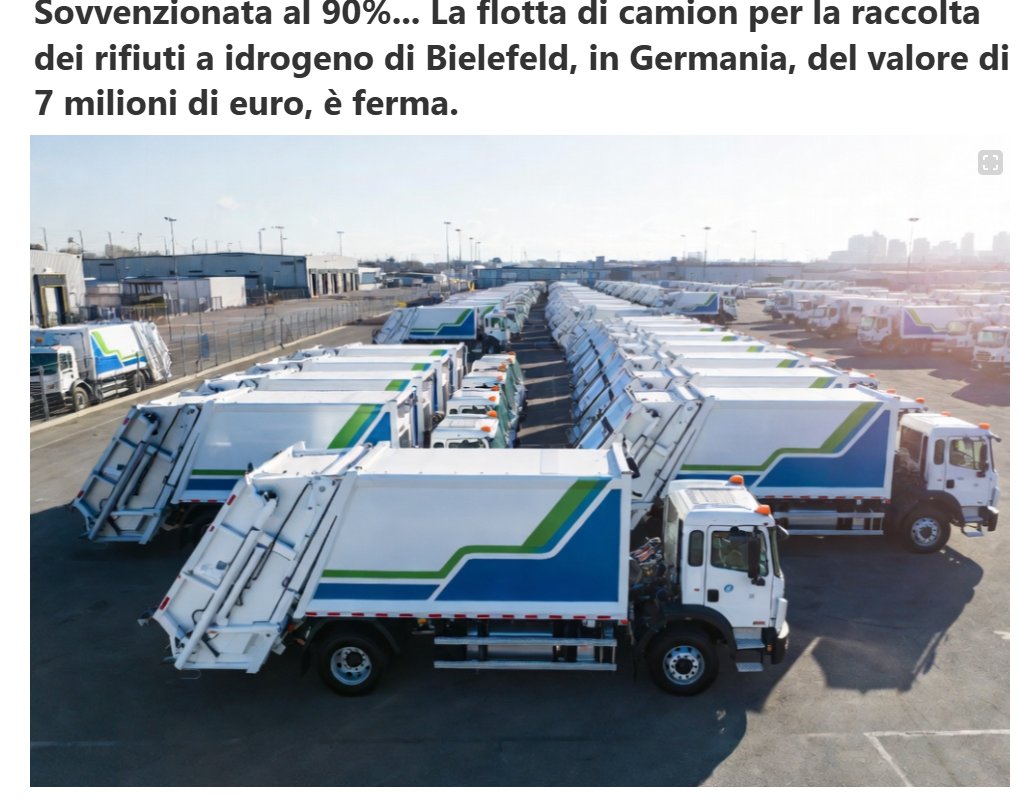
La città di Bielefeld in Germania ha acquistato sette camion per la raccolta dei rifiuti a idrogeno per sostituire quelli diesel in omaggio al trasporto "verde"
Il conto è stato di 7 milioni di euro (4 volte più costoso di una flotta diesel normale) con i contribuenti che coprono le spese.
Poi, l'unica stazione di rifornimento della città ha chiuso. Per camion con un'autonomia giornaliera di appena 300 km, questo si è rivelato un problema. La stazione successiva è a 180 km di distanza, il che significa che il rifornimento consumerebbe la maggior parte del percorso.
Quindi, la flotta ora è ferma. 7 milioni di euro in sussidi per camion della spazzatura che non possono raccogliere la spazzatura.
Adesso spiegatemi chi ci ha guadagnato!
Okay folks, this qualifies as BREAKING NEWS!
Harold “Sonny” White, the warp drive pioneer behind NASA’s EagleWorks Lab, just stepped out of stealth with Casimir Inc. to unveil MicroSPARC: the first battery free chip to harvest continuous electrical power straight from the quantum vacuum via the Casimir force.
The 5 mm × 5 mm device uses millions of custom microscale Casimir cavities fabricated on a substrate. Inside each cavity, two fixed conductive walls create a region of negative vacuum pressure (the well known Casimir effect). Stationary micropillars anchored in the middle act as antennas. Electrons from the cavity walls then quantum tunnel to the pillars because the interior is a lower energy “quieter” zone — and the probability of tunneling back is orders of magnitude lower. This one way “quantum ratchet” flow generates a measurable DC current with no external power source or moving parts.
Prototypes already fabricated at university nanofab facilities (Texas A&M AggieFab, MIT.nano) have been tested in RF-shielded, low noise chambers for weeks. The team reports outputs ranging from millivolts to volts at picoamp to microamp levels using precision electrometers and Kelvin Probe Force Microscopy. Target performance for the first commercial chip: ~1.5 V at 25 µA (≈40 µW continuous). Stacking and scaling could reach milliwatts or even watts per device.
Initial applications are ultra low power: always on IoT sensors, wearables, and medical implants. Longer term roadmap includes trickle charging phones, powering small electronics, and eventually grid independent homes or EVs. Commercialization is targeted for 2028, starting at ~$100/W before dropping toward $10/W.
White ties the work directly to his earlier theoretical paper on emergent quantization from a dynamic vacuum and sees it as a practical power source for the deep-space missions he’s long championed.
Extraordinary claims require extraordinary evidence, and independent scientists have so far declined public comment. But if the engineering scales as hoped, MicroSPARC would represent a genuine paradigm shift: continuous, maintenance free power drawn from the fabric of spacetime itself.
A bold leap from warp-drive theory into real hardware. Progress (and vacuum-powered chips) marches on.
Photo: MicroSPARC | Casimir Inc.
Source: https://t.co/11tlwNSf71
Elon Musk just revealed what’s actually holding AI back.
It’s not chips. Not models. Not data.
It’s concrete.
Someone asked him the obvious question. Why not just build private power plants next to data centers? Bypass the grid entirely.
His answer was four words.
Musk: “The power plant makers.”
There aren’t enough of them.
You can design the best chip on earth. Train a frontier model. Raise $10 billion for a hyperscale data center.
None of it matters if you can’t power it.
Musk: “You can drill down a level further.”
GPUs need power. Power needs turbines. Turbines need factories. Factories need permits. Permits need a government that hasn’t paralyzed itself.
Every link in the chain is physical. And every one of them is breaking.
We can train a frontier model in weeks. We can’t permit a power plant in under five years.
The country that invented the assembly line now needs 40 agencies to approve a gas turbine.
China doesn’t have this problem. They don’t run 7-year environmental reviews on infrastructure they need tomorrow. They break ground while America requests approval to break ground.
The AI race won’t be decided by whoever writes the best algorithm.
It’ll be decided by whoever can still build in the physical world.
We spent 30 years getting faster in software and slower in steel. Outsourcing manufacturing. Hollowing out supply chains. Treating builders like liabilities instead of assets.
Now the bill is due.
Every breakthrough in AI is gated by atoms. Steel. Concrete. Turbines that take years to manufacture and decades to approve.
The smartest code on earth is worthless without electricity.
Musk didn’t give a speech about this. He didn’t need to. He answered one question and the whole infrastructure myth collapsed.
“Where do you get the power plants from?”
Follow that thread far enough and you stop finding a technology problem.
You find a civilization that mastered thinking and forgot how to build.