Intégration économique régionale et souveraineté monétaire : Pourquoi la Guinée peut réussir sans monnaie unique (Par Mohamed Camara) https://t.co/PCrQoe5QPG
🇨🇳 Imagine drawing a math equation on a blackboard... and watching it instantly come to life.
At the 2026 World AI Conference in Shanghai, a company unveiled an AI-powered blackboard that transforms handwritten equations into live graphs and simple sketches into interactive 3D models in real time.
If this technology reaches classrooms, math lessons could look very different in the future.
Writer: Monica
« Aller vite impressionne. Durer transforme. Les économies qui changent durablement d’échelle sont celles qui construisent des institutions solides. »
Les barrières de notre développement ne se surmonteront pas avec des théories, mais avec une exécution rigoureuse ancrée dans les réalités du terrain. À travers cet entretien dans le podcast « Africa Legacy », nous dressons un état des lieux sans concession mais résolument optimiste des dynamiques macro-économiques africaines.
De la création du @GROUPECOFINA pour répondre aux besoins de financement des PME, au déploiement de solutions industrielles avec Neemba Group, notre ambition reste la même : produire davantage localement et créer plus de valeur sur le continent.
Au cœur de nos échanges : la structuration de l’économie informelle, la complémentarité entre finance et industrie, ainsi que le défi de la transmission des compétences pour accompagner la transformation de nos économies.
Un grand merci cher Mossadeck Bally, à toi et à tes équipes, pour l’invitation, la qualité de cet échange et la pertinence des sujets abordés.
L’intégralité de l’émission est maintenant disponible sur YouTube : https://t.co/ndscvPnEaS
Today, we released Gemini 3.5 Live Translate, our latest audio model for live speech-to-speech translation.
It supports over 70 languages and starts translating as soon as you start talking, streaming translations while listening to what you say next. No awkward pauses or choppy audio, just real connection without language barriers.
So, how does it work? 🤔
The model is able to make split-second decisions to juggle speed and translation quality so conversations actually feel fluid, human, and natural. In order to do this, the model must receive and contextualize the input while simultaneously outputting the translated speech.
Through this process, Gemini 3.5 Live Translate manages to stay mere seconds behind each speaker and can even maintain pacing, pitch, and intonation across extended sessions.
See it in action below, or try it yourself in the Google Translate app on iOS & Android.
😱 CETTE TURBINE À TOURBILLON POURRAIT CHANGER LA DONNE ÉNERGÉTIQUE.
🚨Une entreprise belge (Turbulent) a créé une turbine hydraulique qui utilise le vortex naturel de l’eau pour produire de l’électricité 24h/24.
💥Elle s’installe dans les rivières, les canaux ou les cours d’eau existants.
Avantages :
• Très faible impact environnemental
• Une seule pièce mobile → presque pas d’entretien
• Installation en environ une semaine
• Fonctionne tant qu’il y a de l’eau qui coule
• Peut alimenter des maisons ou de petites communautés
C’est simple, propre, et ça fonctionne vraiment.
Alors pourquoi ce genre de solution n’est-elle pas déployée massivement partout où il y a de l’eau qui coule ?
#Energie #Hydro #Turbine #QuestionTout
El futuro de la humanidad se está escribiendo sobre asfalto y hormigón...
Y su epicentro no está en Occidente ni en Asia, si no en África.
África vive la mayor revolución demográfica y urbana de la historia humana, un fenómeno que transformará por completo la geopolítica, la economía y la vida social del planeta antes de que termine el siglo XXI.
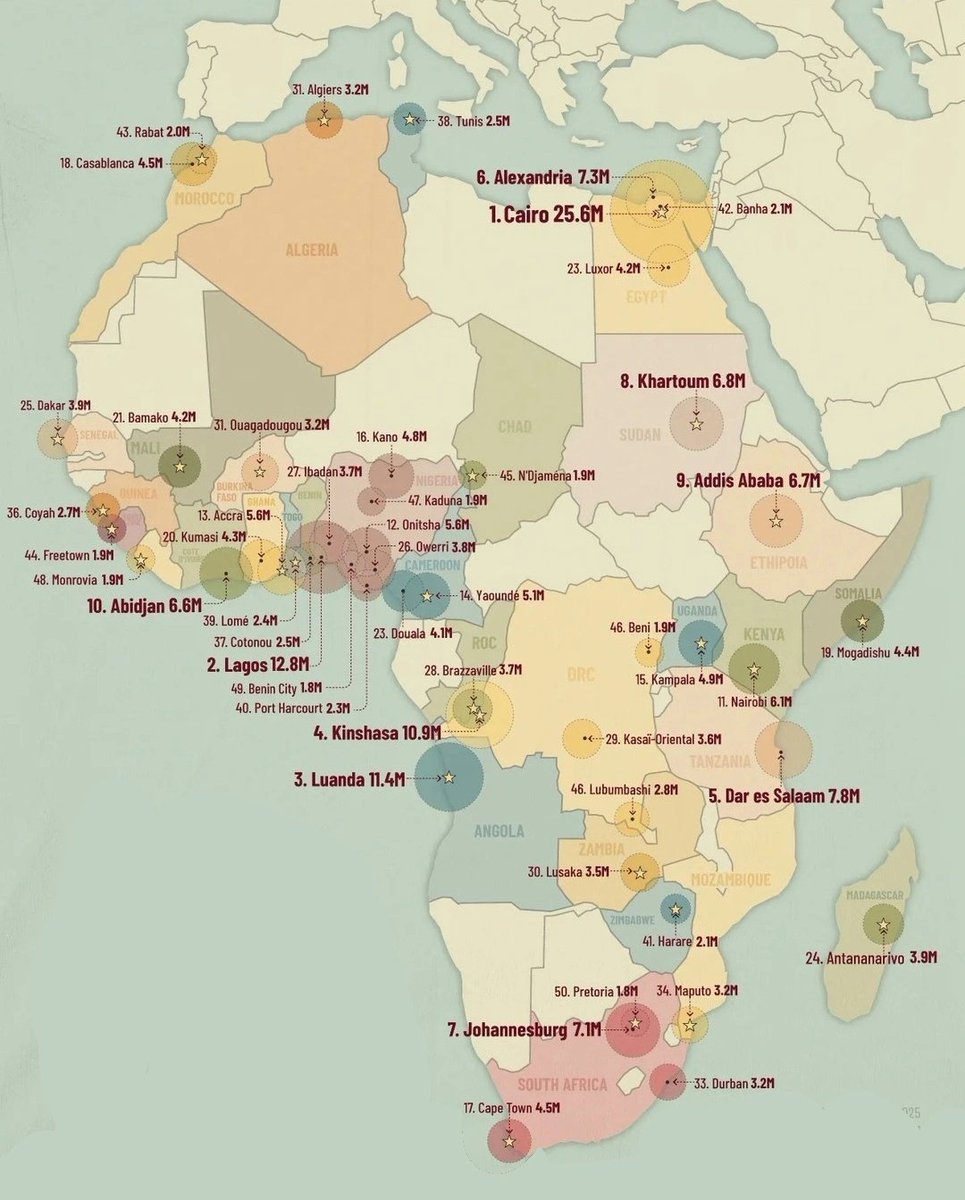
El horizonte de 2070 es una locura... Lagos y Kinshasa desafiarán el mapa urbano global.
Para el año 2070, urbes como Lagos (Nigeria), Kinshasa (República Democrática del Congo) y Dar es Salaam (Tanzania) proyectan poblaciones gigantescas que superarán los 50 y 70 millones de habitantes, desplazando a Tokio o Nueva York como los titanes metropolitanos del mundo.
Y atención. Es un crecimiento sin precedentes en la historia.
El ritmo al que se expanden las ciudades africanas desafía cualquier paralelismo histórico.
Mientras que las grandes capitales europeas tardaron siglos en absorber a sus poblaciones durante la Revolución Industrial, los centros urbanos africanos están duplicando o triplicando su tamaño en periodos de apenas quince a veinte años.
De acuerdo con estimaciones de las Naciones Unidas, la población total de África se duplicará para el año 2070, alcanzando aproximadamente los 3.200 millones de personas.
El motor de este colosal incremento se concentra en las ciudades: la OCDE estima que para 2050 el 65% de los africanos vivirá en zonas urbanas.
Esto se traduce en inyectar casi 1.000 millones de nuevos residentes a las redes urbanas en tiempo récord.
Los dos motores de la explosión urbana: el baby boom africano y el éxodo rural masivo.
El baby boom africano es increíble.
A diferencia del resto de continentes, donde las tasas de fertilidad se han desplomado, África mantiene una población extremadamente joven.
Con una media global superior a los 4 hijos por mujer en muchas regiones subsaharianas, el propio crecimiento interno de las familias que ya residen en la periferia urbana es el principal catalizador del avance demográfico.
El éxodo rural masivo también es clave.
El campo ya no puede sostener las ambiciones ni las necesidades de las nuevas generaciones. Millones de jóvenes emigran diariamente hacia las metrópolis persiguiendo conectividad, empleo, educación y servicios de salud que los entornos agrarios debilitados por el cambio climático no pueden ofrecer.
Pero esto conlleva desafíos críticos, como vivir al límite de la infraestructura.
Semejante explosión demográfica plantea retos de magnitudes colosales y el principal problema radica en el desfase temporal.
La población viaja en un tren de alta velocidad, mientras que la planificación urbana y las infraestructuras avanzan a pie.
La incapacidad de los gobiernos locales para construir viviendas formales ha disparado la proliferación de asentamientos informales o "slums".
Zonas donde el acceso al agua potable, el alcantarillado y la recolección de residuos se convierten en lujos diarios.
Hospitales, escuelas y redes de transporte público se encuentran crónicamente desbordados. Los sistemas eléctricos sufren apagones constantes ante una demanda que se multiplica exponencialmente mes a mes.
El mercado de trabajo formal es incapaz de absorber la gigantesca masa juvenil que llega al mercado cada año, empujando a un porcentaje abrumador de la población a la economía informal y al comercio ambulante como único medio de subsistencia.
Pero el lado positivo es el dividendo demográfico y los polos de innovación.
No todo el panorama es sombrío; el crecimiento de las super-ciudades africanas encierra también la mayor ventana de oportunidad económica del siglo.
La metamorfosis urbana de África no es un evento del futuro; es una realidad aplastante del presente.
El éxito o fracaso en la gestión de estas mega-ciudades determinará la estabilidad socioeconómica global de las próximas décadas.
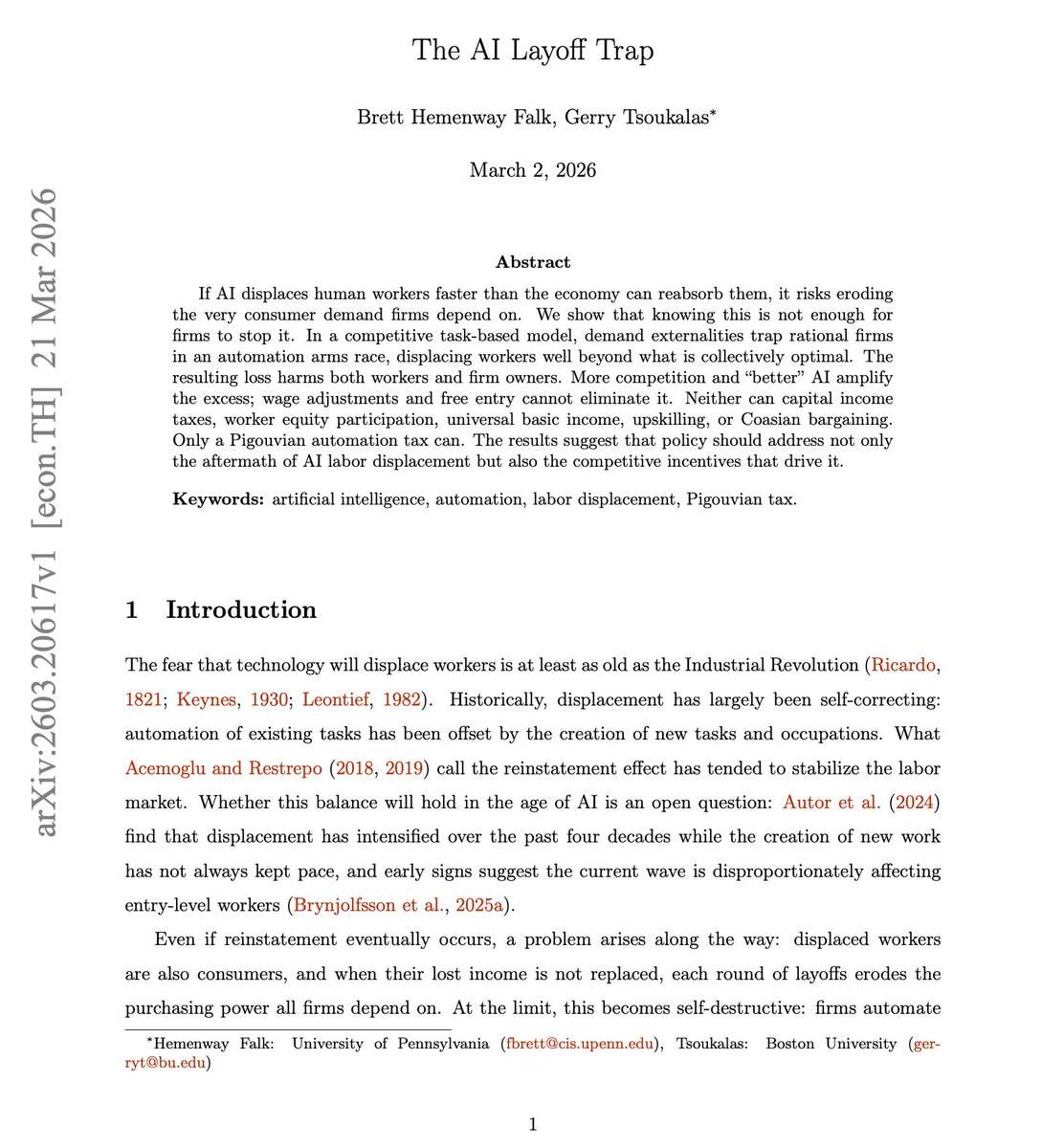
Two economists just published a mathematical proof that AI will destroy the economy.
Not might. Not could. Will — if nothing changes.
The paper is called "The AI Layoff Trap." Published March 2, 2026. Wharton School, University of Pennsylvania. Boston University. Peer reviewed. Mathematically modeled.
The conclusion is one sentence.
"At the limit, firms automate their way to boundless productivity and zero demand."
An economy that produces everything. And sells it to nobody.
Here is how you get there.
A company fires 500 workers and replaces them with AI. A competitor fires 700 to keep up. Another fires 1,000. Every company is behaving rationally. Every company is following the incentives correctly. And every company is building a trap for itself.
Because the workers who were fired were also customers.
When they lose their jobs faster than the economy can absorb them, they stop spending. Consumer demand falls. Companies respond by cutting costs — which means automating more workers — which means less spending — which means more falling demand — which means more automation.
The loop has no natural exit.
The researchers tested every proposed solution. Universal basic income. Capital income taxes. Worker equity participation. Upskilling programs. Corporate coordination agreements.
Every single one failed in the model.
The only intervention that worked: a Pigouvian automation tax — a per-task levy charged every time a company replaces a human with AI, forcing them to price in the demand they are destroying before they pull the trigger.
No government has implemented this. No major economy is seriously discussing it.
Meanwhile the numbers are already tracking the curve. 100,000 tech workers laid off in 2025. 92,000 more in the first months of 2026. Jack Dorsey fired half of Block's workforce and said publicly: "Within the next year, the majority of companies will reach the same conclusion."
Nobody is doing anything wrong. Companies are following their incentives perfectly. That is exactly the problem.
Rational behavior. At scale. Simultaneously. With no mechanism to stop it.
Two economists built the math. The math leads to one place.
Source: Falk & Tsoukalas · Wharton School + Boston University ·
A man spends 50 years teaching at MIT.
He knows his time is running out.
So he records one last lecture — everything he knows, distilled into a single hour.
He died 5 months later.
This is that lecture.
The most important hour you'll watch this week. 👇Bookmark it for later
Instead of watching Netflix, watch this 1-hour Yale lecture by Professor Ben Polak.
It will change how you think about decisions in negotiations, business, and everyday life.
Accord US/Iran 👇
Trump s’est rendu compte que la poursuite du blocus naval ne forcerait pas l'Iran à se rendre. Le retour à la guerre aurait causé d'énormes dommages économiques sur l’Iran mais aussi sur le pays du Golfe avec destruction des complexes pétri-gaziers, et ce sans aucune garantie de capitulation iranienne.
En fin de compte, Trump a été contraint d'accepter les conditions de l'Iran parce que les alternatives étaient encore pires.
Growth is not all, and GDP limitations are well known. However, despite ODA decline, highest cost of capital, imported inflation and volatile commodity prices, it is a remarkable proof of resilience that Africa is forecasted to attain the best continental world performance in GDP growth.
🚨 LIBERTÉ D'EXPRESSION EN DANGER : L'AFFAIRE ABERKANE RÉVÈLE TOUT
La justice suisse vient de condamner Idriss Aberkane à 24 mois de prison avec sursis, un durcissement spectaculaire face à la peine initiale. Ce verdict soulève des doutes légitimes sur l'impartialité d'un système qui semble vouloir neutraliser par la force judiciaire ceux qui osent éveiller les consciences et sortir du cadre imposé.
🔬 Face à cet acharnement, Aberkane riposte en déposant plainte à Paris pour escroquerie au jugement contre le Procureur Général du Canton. Cette traque institutionnelle montre la volonté de la caste de broyer toute alternative au récit officiel. La liberté de penser est attaquée : il est impératif de comprendre les dessous de cette manœuvre politique brutale visant à faire taire une figure influente de la dissidence.
@BOROWSKIMIKE analyse cette situation, en direct sur Géopolitique Profonde.
🔥 Rejoignez-nous et partagez autour de vous : https://t.co/rG56XJrTEB
‘I’VE ALWAYS LIKED TRUMP AND STILL FEEL SORRY FOR HIM, AS I DO FOR ALL SLAVES’ — Tucker Carlson to Newsmax
‘He’s hemmed in by other forces. He can’t make his own decisions. It’s awful to watch’
Gold has overtaken US Treasuries as the largest component of global central bank reserves for the first time since the mid-1990s.
Gold is rapidly replacing the US dollar as the global reserve currency.
The US dollar remains dominant in trade and finance. However, gold has become the preferred central bank reserve asset.
Saudi Arabia just published what it almost never publishes. A line-by-line accounting of what Iran destroyed.
700,000 bpd gone from the East-West Pipeline. 300,000 from Manifa. 300,000 from Khurais. 4 refineries hit. LPG terminals on fire. Global strategic reserves, by Riyadh's own admission, substantially depleted.
This is not a damage report. It is a structural confession of war losses.
The ceasefire was announced on 8 April. The drone hit the East-West Pipeline pumping station at 1pm the same day.
That was not a coincidence but the message.
Iran had already catalogued the bypass route. The pipeline had just hit a record 7 million bpd on 28 March, after Aramco converted NGL lines to crude service in under 3 weeks. Iran watched. Then struck it on ceasefire day.
The 2019 Abqaiq and Khurais strikes were the proof of concept. What happened between March and April 2026 is the operational maturation.
Every layer of the Saudi export architecture has now been touched. Hormuz. The pipeline bypass. Upstream fields. Refinery capacity. NGL terminals. The list is complete.
Saudi Arabia's entire geopolitical value proposition is being tested in real time.
It entered the war with roughly 1.8 to 2 million bpd of spare capacity. Khurais and Manifa alone have eaten 600,000 bpd of that. Add refinery damage and you have upstream production that can technically be restored but has nowhere to go.
The losses are bigger than what markets priced in.
Thw Saudi statement says explicitly that a significant portion of global operational and strategic emergency reserves has already been released. The IEA coordinated drawdowns in March. Six weeks of simultaneous Hormuz closure, upstream loss, refinery damage, and LNG disruption have worn the buffer down.
Saudi Arabia is telling the world the cushion is thinner than it looks. This is a statement to stop war continuation because it will result in a definitive global energy crisis. Saudi is using its soft power to send a message.
The 14-day ceasefire window does not fix this. Ras Tanura cannot be inspected and reintegrated in 2 weeks. The pipeline repair requires security assurance a fragile truce does not provide. Yanbu's actual export loading capacity is capped around 3 to 4 million bpd. The pipeline was theoretically carrying 5 million for export. That gap does not close during a ceasefire.
Vision 2030 is now running into a fiscal wall it was not modelled for. Aramco net income was already down from $117 billion in 2024 to $104.7 billion in 2025. NEOM contract cancellations started appearing months ago as early cash flow signals. The war has turned early signals into structural deficits.
The state that premised its transformation on oil revenue stability is managing an oil system under sustained attack.
Iran has proved something that will outlast any ceasefire.
The Gulf energy architecture was built on assumptions about Saudi resilience, backstop capacity, and infrastructure depth that six weeks of systematic targeting have invalidated.
Saudi will now have to borrow more to fund deficits.
When Bombs Meet Resilience: Iran’s Strategic Triumph Over the US-Israel
When the United States and Israel launched their attack on Iran on February 28, they did not expect a war that would last 40 days.
In fact, their predictions did not even include a strong Iranian reaction against the Gulf countries, let alone the closure of the Strait of Hormuz.
Everyone was stunned by the scale of the Iranian response, even after losing its top leaders.
The Israeli plan, which relied on decapitation strikes, a few days of bombing, and an internal uprising, turned out to be a complete fiasco.
It proved that Israeli intelligence has perfected the art of assassinations but knows very little about Iran and is incapable of accurately predicting scenarios.
They assassinated the entire Iranian command structure, yet 4 to 7 pre-selected successors for each position were already in place and immediately took over. The decapitation operations had zero effect on Iran’s operational capacity. The absurdity of these actions reached new heights when they even tried to assassinate leaders of the Iranian opposition.
Iran opened a new front by attacking 17 targets across 8 countries, launching dozens of missiles several times a day. The Iranian reaction was so intimidating that no Gulf country dared to even consider retaliating, especially since they knew they had chosen a side by allowing Israel and the US to use their soil and airspace to attack Iran.
American military personnel were ordered to hide in luxury hotels, which also became Iranian targets. For every American strike launched from Gulf bases, Iran responded forcefully, causing an economic damage that, after 40 days, could reach $150 billion in those countries.
Iran absorbed the attacks with remarkable resilience and maintained daily launches of 30–50 missiles and 60–100 drones until the truce, keeping its navy and air force active even after 40 days of war, with very little military equipment lost for a conflict of this scale.
The iranians showed that any base built in its vicinity can be rendered inoperable whenever it decides to do so. More than that, it demonstrated that America is incapable of protecting its allies in a direct conflict with Iran, and for those who understand the message, this clearly applies to Asia as well.
The closure of the Strait and the political-economic pressure on Trump forced him to desperately seek an agreement with Iran. Trump and Netanyahu failed to achieve a single one of their objectives in this war. Iran now comes to the negotiating table in a much stronger position than its pre-war negotiators.
The United States has already mobilized an enormous military force, yet Iran continues to hold the cards.
It is Iran that decides which targets to strike in order to move the markets. It is Iran that decides whether and when to reopen the Strait, and whether it will close the other strait through the Houthis.
It was not the Chinese or the Russians, but the Iranians who were effectively sanctioning the United States.
Read the full article:
https://t.co/5QqSI8hG62