I strive excellence, not perfection. Triathlon & Macroeconomic enthusiast. Tweets are my thoughts, not necessarily an advice or recommendation. Please DYOR.
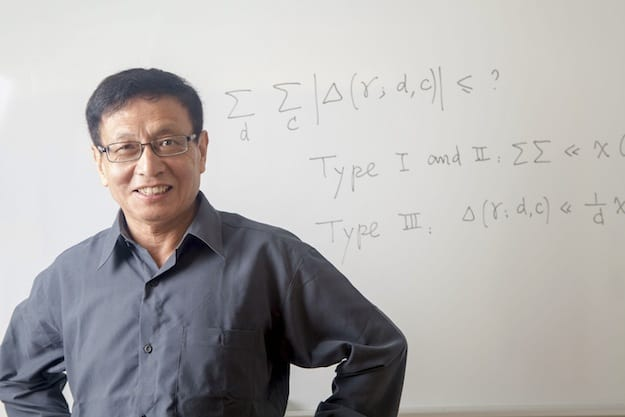
A Chinese mathematician spent 7 years making sandwiches at Subway after his PhD, and at 58 solved a 150-year-old math problem nobody thought was solvable.
His name is Yitang Zhang. The problem is called the Twin Prime Conjecture.
He was born in Shanghai in 1955 and knew he wanted to spend his life on mathematics by the time he was nine years old. That year he found his own proof of the Pythagorean theorem. Nobody taught it to him. He just worked it out.
Then the Cultural Revolution arrived and took everything.
The Chinese government closed the schools. Zhang's father had political troubles with the Communist Party, so Zhang was sent to the countryside with his mother to work in the fields. He spent 10 years as a farm laborer. No high school. No classroom. No teacher.
He read math books in the fields when he could find them.
When the revolution ended, Zhang was 23. He sat the university entrance exam and got into Peking University, one of the most competitive mathematics programs in China. He finished his bachelor's degree, then a master's. The president of Peking University personally recommended him for a full scholarship at Purdue University in the United States.
He arrived at Purdue in 1985. He earned his PhD in 1991.
Then the second wall hit.
His relationship with his doctoral advisor collapsed. The advisor did not write him letters of recommendation. Without those letters, the academic job market was closed. Zhang applied. Nothing came back. He spent the years after his PhD working as an accountant, doing delivery work, sleeping in his car during the stretches when nothing else was available.
A friend eventually opened a Subway sandwich restaurant in Kentucky and offered him a job. Zhang took it. He kept the books and made sandwiches. A man with a PhD in mathematics from Purdue, working a Subway counter because the academic world had no place for him.
He did this for seven years.
He was finally hired as a lecturer at the University of New Hampshire in 1999. Not a professor. A lecturer. The lowest rung of the academic ladder, with no research funding, no graduate students, and no institutional support. He taught calculus to undergraduates and worked on mathematics alone in whatever time was left.
Most people would have stopped believing by then.
Zhang did not stop.
The Twin Prime Conjecture is one of the oldest unsolved problems in number theory. Twin primes are pairs of prime numbers separated by exactly two: 5 and 7, 17 and 19, 41 and 43. The conjecture predicts that these pairs never stop appearing no matter how far you go along the number line. Mathematicians had believed this for over 150 years. Nobody had been able to prove it.
The deeper version of the problem asks something slightly different. Not whether twin primes are infinite, but whether there is any finite gap between prime numbers that appears infinitely often. This is called the bounded gap problem. The best mathematicians in analytic number theory had been attacking it for decades. A landmark 2005 paper by three researchers came agonizingly close and still could not close it.
Zhang worked on it alone. No collaborators. No funding. No department seminars where he could road-test his ideas. He once said he would go to a friend's house and think in the garden for hours.
In 2012, during a visit to a friend's home in Colorado, something unlocked.
He submitted his paper to the Annals of Mathematics in April 2013. The Annals is the most prestigious mathematics journal in the world. Papers sit in review for months, sometimes years. The editors read Zhang's submission and immediately knew something was different. They sent it to the leading experts in analytic number theory for review.
It was accepted in three weeks.
The paper proved that there are infinitely many pairs of prime numbers separated by a gap of less than 70 million. Not two. Not the twin prime gap specifically. But a finite gap. For the first time in history, someone had proved that prime numbers keep coming back together, that the universe of numbers never lets them drift apart forever.
Peter Sarnak, one of the most respected mathematicians at the Institute for Advanced Study, said: "He is not a fellow who had done much before. Nobody knew him. His result was spectacular."
Zhang was 58 years old.
Within a year he had the MacArthur Fellowship, the Cole Prize, the Rolf Schock Prize, and a full professorship at UC Santa Barbara. The man who spent seven years at Subway was now one of the most celebrated mathematicians alive.
He said in an interview: "I was not lucky. Maybe it is more important for a person to make himself known to the public. But that was not so easy for me."
He was not complaining. He was just being precise.
The mathematics establishment has a quiet belief that great work happens young. The Fields Medal cuts off at 40. Most mathematicians who change the field do it in their thirties. Zhang proved his most important theorem at 58, after a decade of farm labor, seven years of sandwiches, and a decade of teaching calculus to freshmen with no one watching.
He did not beat the deadline.
He proved there was no deadline to beat.
Typical coding day with Claude (Opus 4.8)
- explain to Claude the task (5 minutes)
- Claude implements task (10 minutes)
me: "Why is this necessary?"
Claude: "You're right to push back! I over-engineered this!"
- Repeat x87 times (13 hours)
patut diakui, editor Bloomberg KEREN banget ngett ngett !!!!!
visualisasi perbandingan GDP beberapa negara di S.E.A tahun 2025 pake motif kain batik gini
ada juga visualisasi Pelemahan Nilai Rupiah juga pake pewayangan gini; ini kreatif banget.
Bloomberg tahu bagaimana bercerita tapi pendengar/audiensnya adalah masyarakat Global dengan identitas Universal.
Bahkan ketika berbicara tentang PILIHAN TAK SEHAT, dia menganalogikan ini semua dengan GORENGAN yang terlihat nikmat namun sesungguhnya unhealthy.
🙂
“These forecasts have been abysmal. My dots wouldn’t be perfect either, so I wouldn’t give them.”
Fed Chairman Kevin Warsh has spent 15 years arguing the central bank says too much. Wednesday is his first meeting. My story on the quiet revolution he wants:
Can Indonesia and the Philippines avoid this week’s expected rate hikes if the U.S.-Iran deal holds? Local rates and currencies are rallying hard today – with a tailwind from stretched short positioning and off-cycle rate hikes, amplified by macro-prudential measures in Indonesia
Machines aren’t failing because they lack intelligence.
They fail because they lack the ability to effectively reduce information entropy, meaning they need contexts preprocessed for them.
🇺🇸 The most impressive thing about Elon Musk today is no longer just the number of companies he controls but the way these companies are starting to become increasingly connected.
➡️ Tesla, SpaceX, xAI, X, Neuralink and The Boring Company remain separate legal entities but their boundaries are becoming more and more porous. SpaceX can use xAI’s models. xAI can rely on data from X. Tesla can integrate Grok into its vehicles. xAI can buy Tesla batteries. SpaceX can buy Cybertrucks. Tesla can buy advertising on X. Each company is gradually becoming a customer, supplier, laboratory or distribution channel for the others.
🤔 Musk is assembling an ecosystem around some of the key building blocks of tomorrow’s economy. The potential is huge because very few players can move talent, data, products and industrial capabilities so quickly between several companies that are all strategically important. This is a new-generation form of vertical integration, far more fluid than a traditional conglomerate, but it also raises a legitimate question: does each transaction primarily serve the economic interest of the company involved or the broader interest of the Musk ecosystem?
This interconnection could become a massive competitive advantage but the more integrated the ecosystem becomes, the greater the governance risk.
*Bloomberg link: https://t.co/8s0gd85Y55
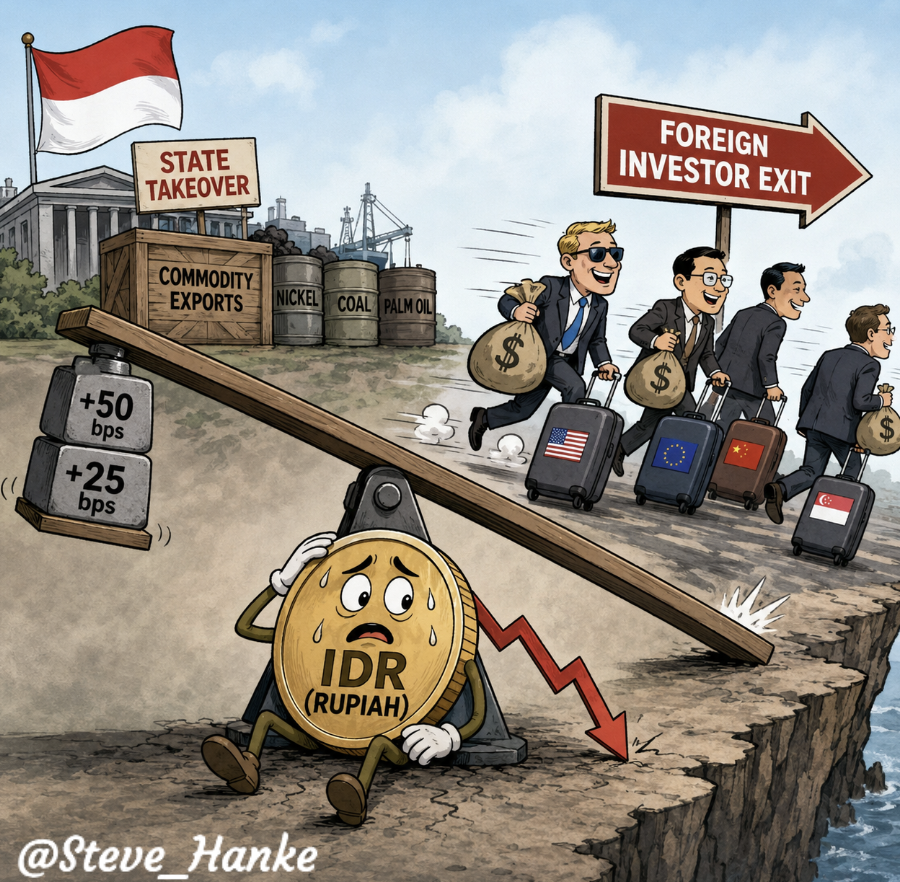
In a futile attempt to strengthen the TANKING Rupiah, Bank Indonesia just raised interest rates another 25 bps.
Sentiment has turned negative on Pres. Prabowo's interventionist policies and the Rupiah.
Stay tuned.
Here’s the email to employees:
Team,
Hope everyone’s doing well and enjoying the productivity enhancements from our AI tooling initiative.
Unfortunately, Finance has asked me to clarify a small issue.
It appears someone, and by “someone” I mean apparently all of you simultaneously, managed to spend $500,000,000 on @claudeai usage in a single month.
For context:
•NASA landed on the moon for less.
•We are now the proud owner of approximately 14% of Anthropic.
•Claude personally sent us a thank-you fruit basket.
•Our CFO has entered a fugue state and only communicates through Slack emojis.
•The electricity usage from your prompts briefly dimmed parts of Northern Virginia.
While we appreciate innovation, there are concerns that:
•“Can you make this email sound slightly warmer?” did not require 11,400 generations.
•Asking Claude to “rewrite this in the style of Succession, Hemingway, and Tony Soprano combined” may have been excessive.
•One employee appears to have used Claude to generate “a quick list of lunch options” that somehow consumed the GDP of a small island nation.
Going forward, please observe the following guidelines:
1Do not upload the entire internet into Claude “for context.”
2If your prompt begins with “simulate every possible outcome,” reconsider.
3Claude should not be used to:
◦settle fantasy football disputes,
◦write your wedding vows 97 times,
◦generate revenge edits of your ex’s LinkedIn bio,
◦or ask “what if Rome had WiFi?”
Most importantly:
If you see the message:
“This request may require additional datacenter construction”
…please stop immediately and contact IT.
Thank you all for your cooperation during this challenging yet technologically groundbreaking time.
Warm regards, Management
P.S. Whoever prompted:
“Generate every possible PR angle for every company founded since 1983”
…we just want to talk.