Sometimes the closest ones to you are the least happiest for you but when you have discernment you will feel it Don’t ignore the signs 🙌🏾 You just continue to love them at a distance so you don’t Block your BLESSINGS! When you are FAVORED every1 won’t be pleased with you💯
@BeeAsMarine@raye8405 This is horrible! When these beautiful creatures are gone these bastards will be no where to be found to help and claim they didn’t have any thing to do with their demise 😳🥺🤬
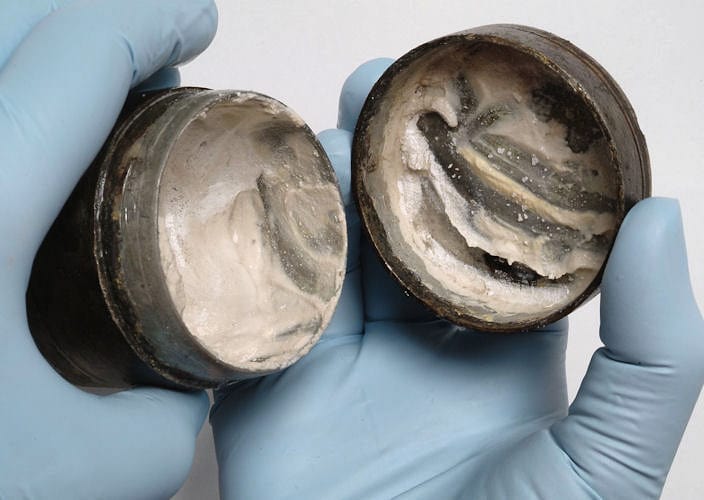
2,000-year-old face cream inside a metal container from Roman times with visible ancient finger marks.
"The cream was found to be composed of refined animal fat, starch and tin. The researchers then created their own version, made to the same recipe. When they rubbed the whitish cream into their skin, it produced a white layer with a smooth powdery texture. The latter quality was created by the starch—still used for this purpose in modern cosmetics."
According to Professor Richard Evershed from Bristol University, "White face paint was fashionable in Roman times and normally derived its colour from a lead compound. A tin compound would have been an acceptable substitute and in good supply from Cornwall."
In ancient Rome, lead was by far the most popular metal and was commonly used in cups, plates, coins, pipes, cosmetics, face powder, paints, food seasoning, and even birth control.
Scientists have even discovered that tap water from ancient Rome contained up to 100 times more lead than that of local spring water.
As a result, some historians have speculated that lead poisoning may have played a part in bringing down the Roman Empire.
In 1986, 22-year-old flight attendant Neerja Bhanot was on duty during Pan Am Flight 73 when terrorists hijacked it.
One Indian-American passenger was swiftly killed by the hijackers, who then asked Bhanot to gather all passengers' passports to identify the Americans. Defying their orders, Bhanot hid 43 American passengers' passports, some under seats and others in the trash.
After 17 grueling hours, the terrorists started setting off explosives and shooting. Bhanot, instead of escaping, opened the airplane doors and guided passengers to safety. In the process, she lost her life while protecting three American children from gunfire.
One of the children she shielded, only seven at the time, later became an airline captain. He credited Bhanot as his inspiration.
This is the final photograph taken of Hachiko, a Japanese Akita dog renowned for his unwavering loyalty to his owner. Hachiko belonged to Professor Eizaburo Ueno, who resided in Shibuya and taught at Tokyo Imperial University in the early 1920s. Each day, Ueno would walk to Shibuya station accompanied by Hachiko, and they would commute together to his workplace by train. At precisely 3 pm, Ueno would return to the station to head back home, and Hachiko would always be there, patiently waiting to join the professor on their journey.
However, one day, tragedy struck when Ueno suffered a stroke and never made it to the station. Undeterred by his master's absence, Hachiko faithfully went to the station every day for nine years until his passing in 1935. To honor his remarkable loyalty, a statue of Hachiko was erected outside Shibuya station in Tokyo. In 2015, on the faithful dog's 80th death anniversary, another statue of Hachiko was unveiled at Tokyo University, symbolically reuniting him with his beloved master, Professor Ueno.
This is the Baltic Way. On 23 August 1989, two million people joined their hands to form a human chain spanning 675.5 km across the three Baltic States of Lithuania, Estonia and Latvia. The protest was against Soviet oppression, and to support the independence movements of the three States and their desire to escape communism.