Most AI demos die in production.
Here is what it looks like when they don’t. Everything in this video is something I built and run.
Less prompting. More engineering.
Most AI demos die in production.
Here is what it looks like when they don’t. Everything in this video is something I built and run.
Less prompting. More engineering.
Vibe coding gets you a demo by lunch. It won't keep a system alive on Monday. The six layers that separate a vibe coder from an agentic engineer, and how to cross the gap.
Vibe coding gets you a demo by lunch. It won't keep a system alive on Monday. The six layers that separate a vibe coder from an agentic engineer, and how to cross the gap.. https://t.co/sI6NSxZCD0
Vibe coding gets you a demo by lunch. It won't keep a system alive on Monday. The six layers that separate a vibe coder from an agentic engineer, and how to cross the gap.. https://t.co/sI6NSxZCD0
Vibe coding gets you a demo by lunch. It won’t keep a system alive on Monday.
Same agents, same models, different job. The six layers that separate a vibe coder from an agentic engineer: spec, harness, evals, guardrails, review, and owning production.
5 minutes ↓
YouTube: https://t.co/9tBIDgGXpe
Stop telling your LLM what to do. Show it.
Our voice agent talked too much. Median reply: 25 words. Real sales reps, across 16,349 recorded turns: 13.
So I wrote rules. "Keep it short." "One question at a time." "No speeches."
Nothing moved. Not one word.
What actually worked:
→ On every turn, pull the 6 most similar real exchanges from a bank of 4,122 caller/rep pairs and put them in front of the model.
→ Cut the instructions in half, from 9,900 words to 4,855.
→ Enforce hard limits in code after the model, not in the prompt.
Median reply went from 25 words to 16. Short replies went from 5% to 24%. Invented facts went to zero.
Models copy examples far better than they follow instructions. Every page of rules you add is a page the model has to ignore.
What's the longest system prompt you've seen in production?
Phonic-1.1 takes #4 of 19 on our Speech Performance benchmark: 1114 ELO and #1 on Turn Bench. The team is moving fast and improved 2 spots in just 3 weeks.
• Up from Phonic-1 (1089)
• 1.68s median latency down from 1.99s, 3rd fastest of 19
• #1 at our turn bench : it talks through backchannels 86% of the time, where the median model manages 6%!
Congrats @phonic_co on the launch.
https://t.co/AheDpLMzPi
I don’t write better prompts anymore. I maintain a harness.
220 memories, 10 specialist agents, 15 hooks. Here’s the whole setup in 5 minutes, the incidents behind each rule, and how to build your own in a week.
Less prompting. More engineering.
YouTube: https://t.co/7WH1qcBmlp
Your AI voice agent is losing the call in the first 2 seconds.
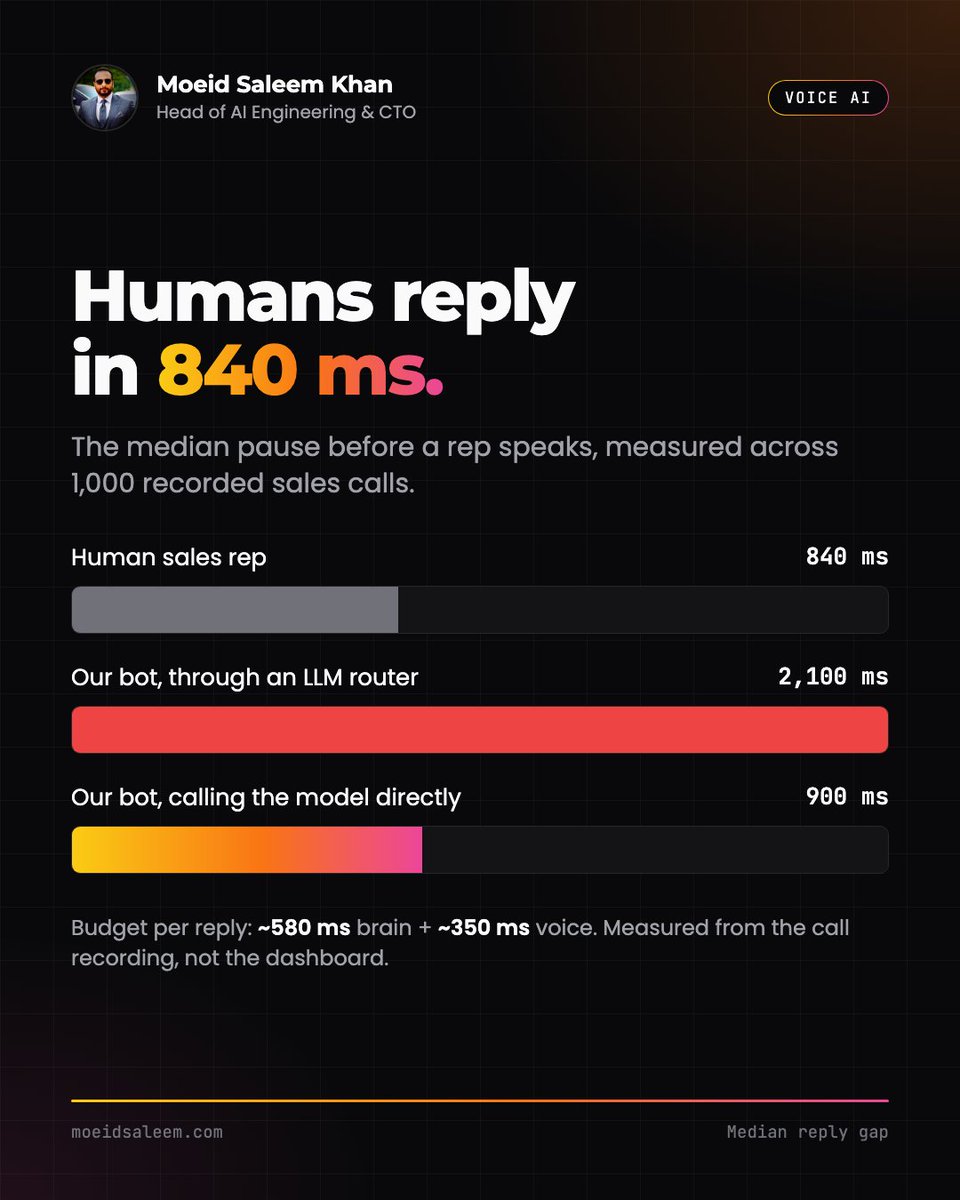
I measured 1,000 recorded calls from a human sales floor. The median gap between a caller finishing a sentence and the rep starting to speak: 840 milliseconds.
Our first bot took 2.1 seconds. On a phone line, that pause feels like a dropped call.
Here's what got us inside the human range:
→ Dropped the LLM router and called the model provider directly. 2.1 s became 900 ms median, 1.6 s at p90.
→ Split the budget: about 580 ms for the brain, 350 ms for the voice. Then optimised each one separately.
→ Stopped trusting our own dashboard. It said "reply p50: 40 ms". It was timing the wrong thing. The stereo recording told the truth.
Set your latency target from real humans, not from a vendor benchmark. And measure it from the recording, not from your logs.
What reply time are you seeing on your voice stack?
Tech in 60 seconds · 01 · RAG
Your LLM doesn't know your company. RAG is how you fix that without retraining anything.
Retrieval-Augmented Generation, in three steps:
1. Retrieve: search your own documents for the passages most relevant to the question.
2. Augment: paste those passages into the prompt, next to the question.
3. Generate: the model answers from what you gave it, and can cite where it came from.
Why it works:
→ Your data stays fresh. Update a document and the next answer uses it.
→ Answers can point to a source, so people can check them.
→ No training run, no GPU bill.
Where it fails: bad retrieval. If the right passage never reaches the prompt, the model can't use it. When a RAG system gives a wrong answer, check what it retrieved before you blame the model.
Save this for the next time someone says "let's fine-tune it".
@0xaditin The tell for me is usually the empty states and error screens, the hero screen is easy to get right. Curious what research the MCP pulled in before it drew the layout.
@shubhranshu2009 Mostly AI infrastructure lately: Atrix, an AI workspace with a remote MCP server, and Vodial, an AI outbound voice dialer. Always happy to compare notes on agent tooling. What's yours?
@Miracle_NNnn Congrats on 10k. The number I'd watch next is how many come back in week four. Acquiring users through a directory is the easy part. Retention tells you whether the listings are useful.
@ActuallyIsaak Curious how the 42K SFT set was filtered and whether the RL gains hold on held-out tasks, not only the eval used during training. A breakdown across the 0.8B and 9B sizes would be useful.
@murad_ux The motion helps: watching a trace unfold step by step makes an agent's order of operations legible. Curious how it holds up with hundreds of concurrent traces, since layouts usually break there first.
@mutediamond8385@Kimi_Moonshot@cerebras Five puzzles is a small sample and dropouts make timing noisy. Fifty puzzles with the same retry policy for both would tell you more. Still a fair signal that the gap is worth testing properly.
@tyd3n_ Stopping features to focus on distribution at this stage is the right call. Pick the one channel where your next 20 users already gather, go deep there, then add a second. Good luck with the €1k.