Libya’s NOC has signed a final settlement with Trasta, ending the foreign partner’s stake in LERCO and restoring full Libyan ownership of the Ras Lanuf Refinery & Petrochemical Complex.
Ras Lanuf is Libya’s largest refinery, with a reported capacity of around 220,000 bpd, and forms part of a major industrial hub on the Gulf of Sirte that includes refining, petrochemical, storage, export, and port infrastructure.
The agreement closes more than a decade of legal and arbitration disputes following the post-2011 crisis, and could pave the way for the rehabilitation and restructuring of one of Libya’s most strategic downstream energy assets.
NOC Chairman Masoud Suleman described the agreement as a key step toward fully Libyan-led management and redevelopment of the complex.
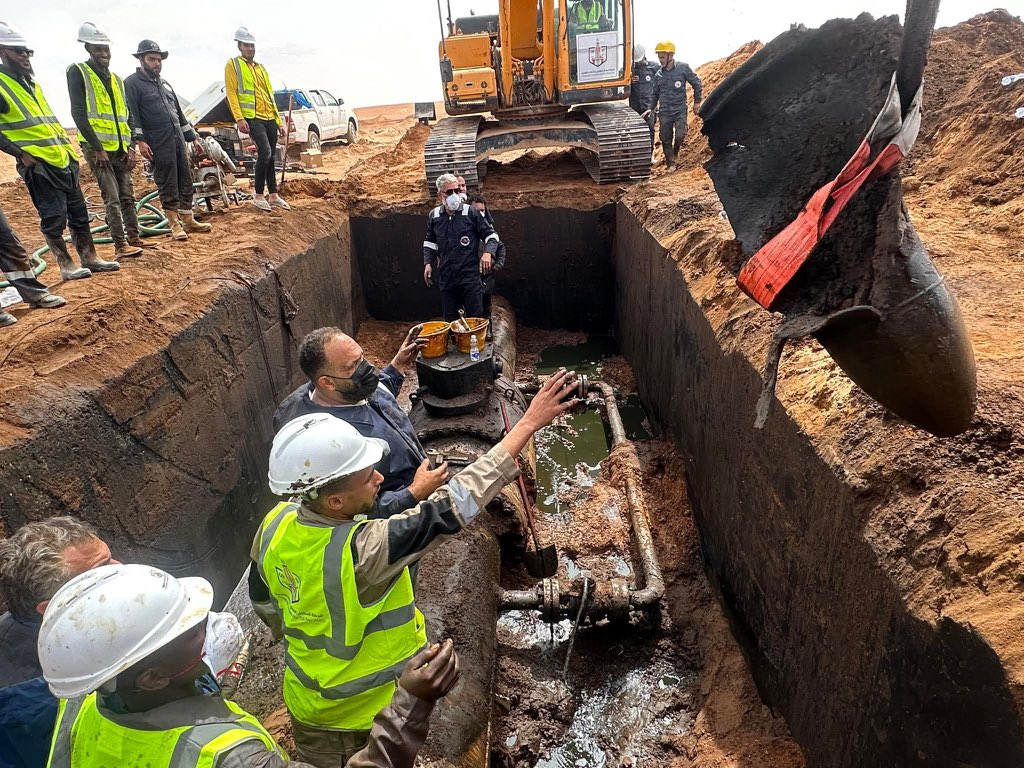
Multiple field sources reported two separate leaks on the 18-inch crude oil pipeline linking the H & B fields to Station 186 in Libya’s Murzuq Basin, operated by Akakus Oil Operations.
According to preliminary information from the field, the two leak points are located approximately one kilometer apart. The first leak was identified on Friday evening, while the second was discovered on Saturday morning.
The incident has reportedly resulted in an estimated production loss of around 43,000 barrels per day, according to the field manager’s initial assessment.
Excavation and technical inspection work is currently ongoing to expose the affected sections of the pipeline, assess the extent of the damage, and determine the appropriate repair methodology.
The affected infrastructure is part of the broader NC-186 concession area in southwest Libya, one of the country’s key oil-producing zones connected to the Sharara Oil Field production network. Station 186 has previously been exposed to security and operational incidents due to the strategic importance of the corridor.
Multiple sources indicate an ongoing issue involving the Sharara oil field and Akakus Oil Operations, within a complex context that includes actions by the Public Prosecutor and active investigations.
According to the same sources, there are growing signals of a potential oil shutdown, driven by financial disputes with local contractors working with Akakus, who are facing increasing pressure to recover their outstanding payments.
It is worth noting that the Akakus pipeline was targeted by two sabotage attacks within approximately ten months between 2025 and 2026. The most recent incident resulted in a fire that lasted around 40 hours, marking one of the largest oil-related incidents in the region.
Estimated losses reached approximately 2.58 million barrels of oil, equivalent to around $269 million in direct losses, due to production stoppages and reductions during the fire and until maintenance operations were completed.
Exclusive | Mohammed Algrj
Libya has reached a deal on a unified development budget, following rare consensus between the East, West, and South — the first of its kind in over a decade.
Implementation will be shared across institutions:
• Western authorities (GNU) through their executive agencies
• Eastern authorities (House of Representatives) via reconstruction and development funds
• The South through dedicated, targeted projects
The development allocation is estimated at ~LYD 40 billion, based on a $70 oil price.
The agreement has already been signed. A formal announcement is expected shortly, with representatives from all sides.
UN security advisory indicates unconfirmed but credible information regarding potential IED threats in #Tripoli. No specific targets identified, but the overall risk level is elevated.
This is not a warning of an imminent attack, but a precautionary alert based on incomplete intelligence.
Bottom line: city-wide vigilance, not a targeted threat.
Egypt is set to purchase two crude cargoes from Libya, each ~600,000 barrels (total ~1.2 million bbl), priced in line with Brent Crude Oil benchmarks and standard market practices.
This is not a structural shift—just routine supply diversification. Egypt has traditionally relied on Gulf sources, hence the current media noise.
On the other side, Libya had accumulated electricity import debts to Egypt exceeding $400M. About $350M was repaid in early March, reducing the outstanding balance to roughly $140M.
At current government contract pricing (~$85–95/bbl), this remaining balance is broadly equivalent to the value of ~1.2 million barrels—the same volume now being traded.
From an accounting perspective, a partial offset—settling part of the debt against the value of these oil cargoes—is a plausible and standard mechanism in state-to-state energy arrangements.
As previously indicated, Prime Minister Abdul Hamid Dbeibeh has formally instructed the National Oil Corporation to terminate the controversial development agreement between Arabian Gulf Oil Company and Arkenu.
The decision cites public rejection, lack of institutional clarity, and the need to safeguard state interests—while the file has been referred to the Attorney General for a full review of all similar arrangements.
According to information from the Council of Ministers, Prime Minister Abdul Hamid Dbeibeh is expected to announce a decisive measure regarding the agreement between Arabian Gulf Oil Company and Arkenu within the coming hours, possibly tonight.
This anticipated move could mark a turning point, with reactions likely to clearly expose where key actors stand.
Reports indicate that Prime Minister Abdul Hamid Dbeibeh is moving to terminate the controversial development agreement between Arabian Gulf Oil Company and Arkenu, following sustained public backlash.
The decision is expected to be executed within legal frameworks to safeguard state rights, while the entire file has reportedly been referred to the Attorney General for a comprehensive review of similar development arrangements.
If confirmed, this move will serve as a critical stress test: networks benefiting from the deal—political, financial, and media—are likely to react aggressively. Any coordinated pushback will expose aligned interests.
This is no longer just a contract dispute—it is a transparency moment for Libya’s oil sector.
Libya has issued an urgent maritime warning after the LNG tanker ARCTIC METAGAZ went adrift offshore following a failed towing operation. Severe weather (40–50 knot winds, 5m waves) caused loss of control at 04:00 on April 2.
The vessel is now drifting near 33°50’N, 16°43’E. All ships are instructed to stay at least 10 nautical miles away.
Authorities warn of potential risks including leakage or explosion, urging immediate reporting to Libya’s Maritime Rescue Coordination Center (RCC).
This incident highlights elevated operational and environmental risks in the central Mediterranean under extreme weather conditions.
Update on the Sharara–Al Rayayina corridor:
As maintenance teams began clearing the lines and draining residual oil, evidence confirmed a deliberate sabotage attempt. A 250 kg explosive device was recovered yesterday.
Today, further indicators suggest additional devices may still be buried beneath the valve area. Operations have been immediately suspended.
The Petroleum Facilities Guard has secured the site, with EOD units, counter-terror teams, and the Attorney General’s office expected to intervene.
NOC, Akakus, and all operators will not proceed under conditions where undetected explosives may remain in place.
This development reinforces earlier warnings: Libya’s energy infrastructure is facing sustained, multi-layered pressure — not isolated incidents.
Caution. What we are seeing is not random.
Attempts to disable Libya’s energy system are escalating in sequence:
– The Russian tanker incident near offshore assets triggered emergency alerts but didn’t fully succeed.
– Attacks on valves in El Feel, Akakus, and Hamada disrupted output but were contained.
– Tensions around valve zones peaked without full shutdown.
– Now, pressure is shifting directly toward gas infrastructure.
If contained, the next front could be the Oil Crescent.
There is a clear pattern: systematic pressure to deny Libya a historic window to recover its losses, exploiting local fears across the western region and oil zones to trigger internal disruption.
Every day of reduced or halted production benefits actors who profit from instability—financially and geopolitically.
Libya is no longer on the sidelines. It sits at the intersection of the Russia–Ukraine war and the wider Middle East conflict.
Without strategic awareness and competent political-economic management, the risk is not just economic loss—but becoming a conflict arena.
Breaking
Unconfirmed reports indicate that gas flows at the Mellitah complex may have been halted after protesters allegedly shut down the pipeline, citing the Government of National Unity’s failure to address the drifting Russian tanker.
According to these reports, protesters are warning that the vessel is approaching the coast near Zuwara, raising concerns over a potential environmental risk, amid what they describe as a lack of effective response so far.
Russian tanker update:
The drifting tanker is moving at ~1.1 knots toward Zuwara, having passed the Sabratha offshore platform and currently sailing near the Valy rig. If weather conditions persist, it is expected to reach the Zuwara coast.
The attached map shows its current position.
Libyan authorities confirm communication with the tanker owner and the Russian ambassador to coordinate next steps.
At present, there is no immediate risk to oil infrastructure.
I stand in solidarity with Libyan civil and political activist Mahdi Abdulati from Misrata, known for his outspoken criticism of government policies, his live broadcasts exposing issues around Arkno Oil, and alleged corruption within the banking sector.
Mahdi has been missing since yesterday under unclear circumstances after leaving a café in Misrata.
His safety must be urgently clarified. Silence is not an option.
Oil on fire — but the real issue runs deeper: failing infrastructure, weak security, and delayed maintenance now surfacing all at once.
Firefighters are containing the flames. The system itself remains at risk.
Developments at Libya’s Sharara oil field point to a recurring pattern: disruptions tend to coincide with rising oil prices—often around March.
This is not incidental. It reflects structural vulnerability. Vast pipeline networks with weak surveillance, deteriorating infrastructure, and reduced field security create conditions where both technical failures and sabotage become more likely.
The decline in the Petroleum Facilities Guard has significantly lowered on-ground protection and monitoring capacity. Fewer patrols, limited response capability, and aging assets are now converging into systemic risk.
These risks were formally flagged months ago. Incidents previously reported near Al Rayayina, and now along the same corridor, confirm a broader issue: under-maintained pipelines with minimal oversight.
Whether this latest event is a leak or deliberate damage, it is unlikely to be the last without immediate intervention.
Libya’s oil infrastructure is not just an energy asset—it is the backbone of national stability. Strengthening field security, deploying smart monitoring systems, and restoring maintenance cycles are no longer optional.
Libya’s dinar isn’t weakening because of speculation — it’s being shaped by fiscal arithmetic.
In my latest piece for Libya Economic Review, I break down how a $9bn FX gap and rising liquidity are driving exchange rate pressure.
Read here:
Fiscal pressure, not just speculation, is at the heart of Libya’s dinar story.
In this new piece for Libya Economic Review, @moelgrj examine how government spending, liquidity growth, and Libya’s structural dollar gap continue to shape exchange rate pressure.
https://t.co/f8c4BEyu1e
Major offshore gas discovery in Libya.
@eni confirms two new gas finds — BESS-2 and BESS-3 — holding over 1 Tcf of gas, located near the Bahr Essalam field offshore Libya.
The proximity to existing infrastructure means fast-track development is possible, strengthening Libya’s gas supply to the domestic market and Europe via the Mediterranean corridor.
A significant milestone for Libya’s energy sector in cooperation with @NOC_Libya.