INSTEAD OF WATCHING NETFLIX TONIGHT. Spend 2 hour with this. Claude AI FULL COURSE that teaches you how to BUILD and AUTOMATE anything. The people who watch this tonight will wake up tomorrow with a new skill. Watch it and bookmark it now.
A lot of people think Data Science and AI is a career only for computer science graduates. I disagree.
An economist, a business graduate or someone from social sciences can become an excellent data scientist. They already understand problems that data can help solve.
What they need is the right technical foundation and practice.
This is the thinking behind atomcamp's 3-month Data Analytics Bootcamp. Our next cohort starts November 17. This bootcamp will prepare you for a data career and will build your foundation for AI.
Link in the first reply.
What happens when the State Bank becomes the dominant buyer of dollars in the market? Great piece by Farooq Arby. Has clear ramifications for exchange rate management.
https://t.co/1aWB5pbcJm
We need to rethink the way how we serve the people, or we don't - extended deliberations on a pro-1% policy takes away time from policies that may actually uplift everyone else. We need more people to move around, and not just more car owners to move around.
https://t.co/jkbTxl3cv4
Current account deposits across 15 banks increased by PKR 2685bn during 9M2026.
UBL added PKR 1167bn to its current account deposits in just 9M2026. Thats almost equal to the entire deposit base of HMB (a 34 year old bank) which stood at PKR 1243bn as of Sep-26.
So esentially UBL added the equivalent of a 34 year old bank to its balance sheet in just nine months.
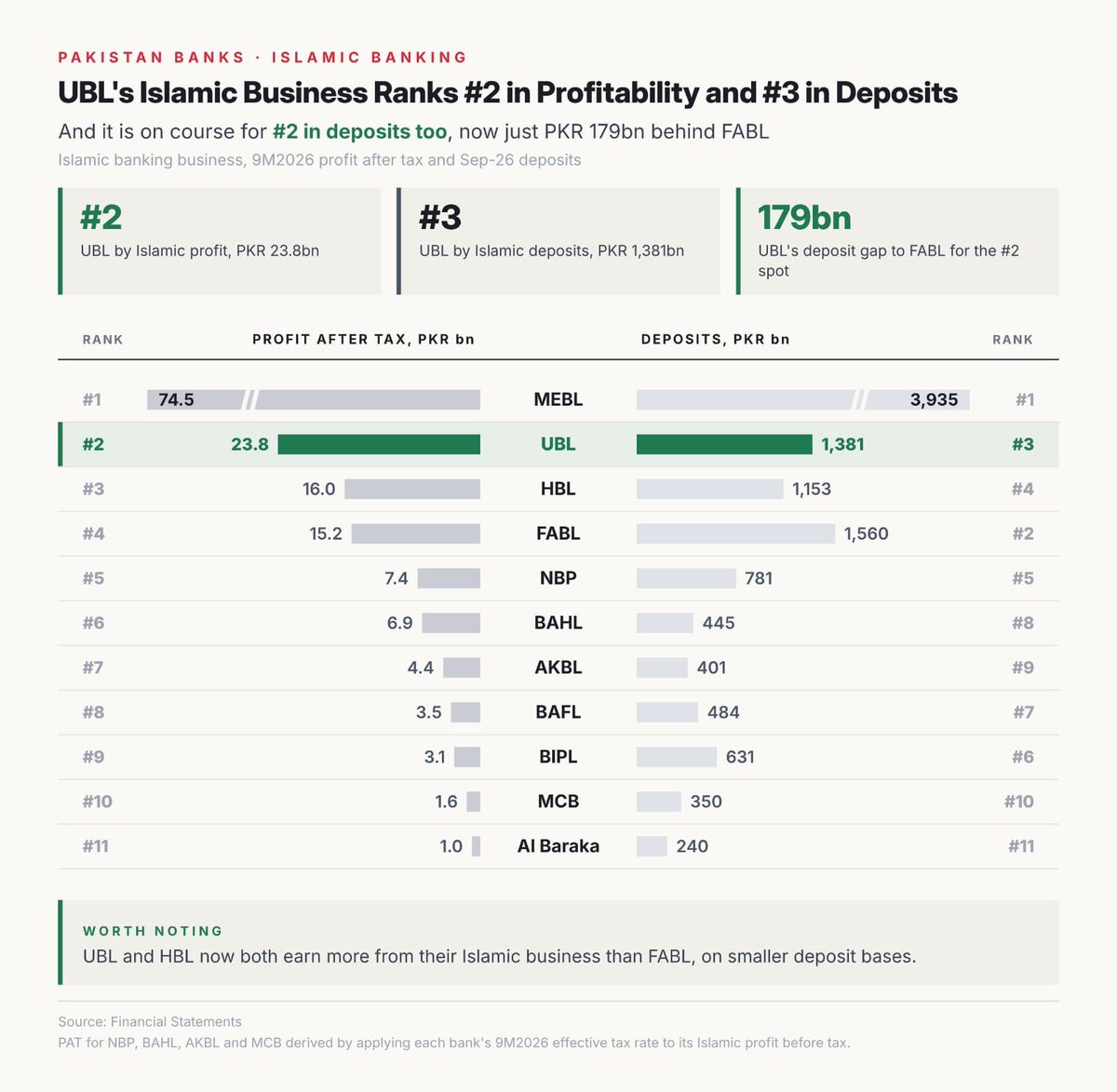
UBL's Islamic Business Ranks #2 in profits and #3 in deposits, now just PKR 179bn behind FABL to become #2 in terms of deposits.
Interestingly, both UBL and HBL are making more profits from their Islamic businesses than FABL, despite having smaller deposit bases.
Few years back, @gonwei along with his colleagues at the World Bank highlighted an important point on Pakistan’s exports:
A 1% REER depreciation increases exports by ~0.5% in the long run, but the adjustment is asymmetric. Exports fall much faster after rupee appreciation than they recover after depreciation.
The reason is structural. Losing export clients is easy; rebuilding buyer relationships, pricing strategies, and customized production takes time and cost, especially in textiles and surgical goods. Commodity exports like rice and wheat adjust relatively faster due to organized markets and benchmark pricing.
Another key takeaway from the same report: Pakistan’s export challenge is not just the exchange rate. High import tariffs, low productivity, limited long-term financing, and weak market intelligence also constrain export growth.
Pakistan's 🇵🇰 export problem runs deeper than you think.
The import tariffs meant to protect local industry are quietly strangling exports. And most people have no idea.
A brilliant piece by Gonzalo @gonwei explains how (published in 2022). Sharing key insights
Conclusion: import protection doesn't just shelter domestic firms, it quietly kills their incentive to compete globally.
Here is how 👇
We think import duties are taxes on imports. They are. But they're also, implicitly, taxes on exports.
When the govt imposes an import duty on a sector, it makes selling domestically more profitable than exporting. Firms that sell abroad get no such protection.
Result: an anti-export bias. Tariffs meant to substitute imports end up substituting exports instead.
This effect is amplified by cascading duties, where tariffs on final goods are higher than on raw materials and intermediates. Pakistan has the 2nd highest import duty cascading in the world 🌍
A simple example makes this vivid:
Imagine Pakistani bike makers. A bike sells internationally at $100. Input costs = $67, value added = $33, of which $25 is profit.
Now the govt imposes a 10% import duty on bikes (but not on inputs, classic cascading).
Domestic selling price rises to $110 → profits jump from $25 to $35 (+40%)
Export price stays at $100 → profits stay at $25
A mere 10% tariff has made exporting 40% less attractive relative to selling locally.
A brand new Alto on a bank loan needs a salary of about Rs 3 lakh a month. Here is the full ladder from Alto to Fortuner, with today's prices, down payment and monthly installment. 30% down, 5 years, Meezan Car Ijarah at 14.36%. (THREAD)
Investing in a Pension Fund is one of the most underrated tax moves available to salaried Pakistanis.
Section 63 of the Income Tax Ordinance 2001 gives you a direct tax credit — not a deduction, a credit — meaning rupee-for-rupee reduction in your tax bill. Here's everything you need to know.
THE 3 PILLARS THAT CONTROL YOUR CREDIT
① Taxable Income — salary PLUS every taxable perk, allowance or benefit your employer gives you (cash or non-cash)
② Tax Payable — your actual tax liability on that income
③ Average Tax Rate — Tax Payable ÷ Taxable Income
This average rate is applied to your pension fund investment to calculate your credit. Change any one of these three and your credit changes too.
THE FORMULA
Step 1 → Average Tax Rate = Tax Payable ÷ Taxable Income
Step 2 → Eligible Investment = lower of 20% of Taxable Income OR Actual Investment
Step 3 → Tax Credit = Eligible Investment × Average Tax Rate
EXAMPLE — Monthly Salary Rs. 400,000
Annual Taxable Income → Rs. 4,800,000
Tax Payable → Rs. 861,000
Average Tax Rate → 17.94%
Max Eligible Investment → Rs. 960,000
Tax Credit = Rs. 172,200
Add a conservative 9% fund return on your investment= Rs. 86,400
Total Year 1 gain = Rs. 258,600 on Rs. 960,000 invested — an effective 26.94% return.
GOT A BONUS? YOUR CREDIT GOES UP
Add a Rs. 500,000 December bonus:
Revised Taxable Income → Rs. 5,300,000
Revised Tax Payable → Rs. 1,036,000
Revised Average Tax Rate → 19.55%
Revised Eligible Investment → Rs. 1,060,000
Revised Tax Credit → Rs. 207,200
Every taxable benefit your employer gives you — cash bonus, car allowance, housing perk — increases your eligible ceiling and your credit. Your taxable income is not a fixed number. Track it throughout the year.
BUSTING THE BIGGEST MYTH
"Your money gets locked in the pension fund."
Wrong. What is restricted is tax-free withdrawal — not access to your money itself.
You can withdraw any time. Tax is deducted at your average rate from your last 3 filed returns — tax you would have paid on your salary had you never invested.
So where is the loss? There is none.
THE TIMING TRAP NOBODY TALKS ABOUT
Your employer gives you the credit by reducing monthly tax deductions. But if he has already deposited most of your annual tax to FBR, he may not have enough left to give you the full credit.
Annual tax payable → Rs. 861,000
Deposited in 10 months → Rs. 717,500
Remaining with employer → Rs. 143,500
Your entitled credit → Rs. 172,200
Shortfall → Rs. 28,700
That Rs. 28,700 becomes a refund claim with FBR. Anyone who has dealt with FBR refunds knows what that means — years, notices, follow-ups, maybe never.
Invest early. July to December is the sweet spot. Do not wait until March-June.
HOW MUCH TO INVEST?
The eligible amount is a ceiling, not a floor. You do not have to invest Rs. 960,000 in one shot(in above example).
→ Rs. 50,000/month via standing instruction or whatever amount as per your convenience
→ Lump sum whenever you have liquidity
→ Transfer your company provident fund if it earns zero return — same money, tax credit + investment returns both
Invest slightly above your base calculation to absorb any bonus or perk that arrives mid-year without missing the additional credit.
YOUR CHECKLIST
① Calculate annual taxable income — salary + all perks
② Compute tax payable and your average tax rate
③ Eligible investment = lower of 20% of taxable income or actual amount
④ Invest early — July/August ideally
⑤ Submit proof to your employer immediately
⑥ Track every bonus and top up accordingly
- Open a VPS account. Keep allocation at 100% equity, and grow wealth tax free. Get tax credit on salary. Contribute every month
- Avoid direct investment in PSX, unless ETFs. You will not be able to handle volatility, and information asymmetry
- Keep a Savings Account -- if a bank says it cannot be done, push harder
- Keep surplus cash in a Money market fund
- Do not buy a plot. High chance you will lose it all
- Do not invest in apartment project. High chance it will be stranded, and you will lose it all
- Target buying an average of 1 gram of physical gold every month (you can buy every quarter or whatever) -- regardless of price. Do not buy silver, or copper, etc. - unless you manufacture fans for a living
- Max out any available government housing scheme loans; this is the only property you should buy
- Keep renting; this is the most economically efficient decision
- Do not buy anything offered by bancassurance or that says life insurance savings plan. Run for the exit. Block their numbers.
- Do not invest with family.
SBP just launched InvestPak so ordinary citizens can invest directly in government securities. Very on brand for a country where the government has spent decades quietly borrowing from us, except now it's official and comes with an app. Jokes aside, here's the breakdown
(1/n)
One last point on how Reval Surplus/Deficit impacts banks.
Reval surplus/deficit is not just an accounting line, it directly affects equity & therefore capital adequacy.
So while it may look “unrealized”,
it directly impacts CAPITAL, GROWTH, & DIVIDEND PAYOUTS.
1/3
Bank like UBL has a big pile of money invested in govt bonds or fixed rate securities. These are like loans the bank gave where the interest rate is locked (fixed) for many years.What happens when interest rates rise? 🤔
1% move in interest rates isn’t just macro noise — it has real balance sheet consequences for banks🏦 👇
1% increase in interest rates can lead to Rs100bn hit to OCI for UBL .
Yes — PKR 100bn.
To put that into perspective:
➡️ This is ~20% of UBL’s equity
1/2
Pakistan has never been relevant as much as it spur recently. Our generation has witnessed thz pivot point where critical decisions of world being taken place in Pakistan. Excellent & Balanced diplomacy by Govt. and our very own CDF FM Syed Asim Munir and Team👏
@OfficialDGISPR
تین دوست ممالک کے وزرائے خارجہ کیساتھ آج تفصیلی اور جامع گفتگو ہوئی، خطے میں جاری جنگ کے فوری خاتمے کیلئے مختلف آپشنز پر تبادلہ خیال ہوا۔ امریکہ اور ایران کے بیچ بات چیت کیلئے اسلام آباد میں متوقع مذاکرات بارے دوست ممالک کو آگاہ کیا۔کوشش ھے کہ جلد از جلد جنگ بندی ہو۔
وزیر خارجہ اسحٰق ڈار