Our stories on the #UberFiles
in today's @IndianExpress
How Uber used stealth technology to bypass regulators; tapped into a sprawling lobbying network; aggressively cut corners as it drove through loopholes in law and regulation.
https://t.co/C36CFusjb0
"Now I am like a parent to my parents." That was one of the last things Delhi University professor Debosmita Paul told a colleague. A week later, she was dead.
@AlokReporter & I profile the woman behind the headlines and what she dreamt to do and become
https://t.co/pCGffQIqFR
Exclusive: I look into the Telangana case that got Meenakshi Natarajan’s Rajya Sabha nomination cancelled. What I found instead of a bitter political rivalry in Telangana which exploded in Madhya Pradesh.
https://t.co/2shSjEHJLF
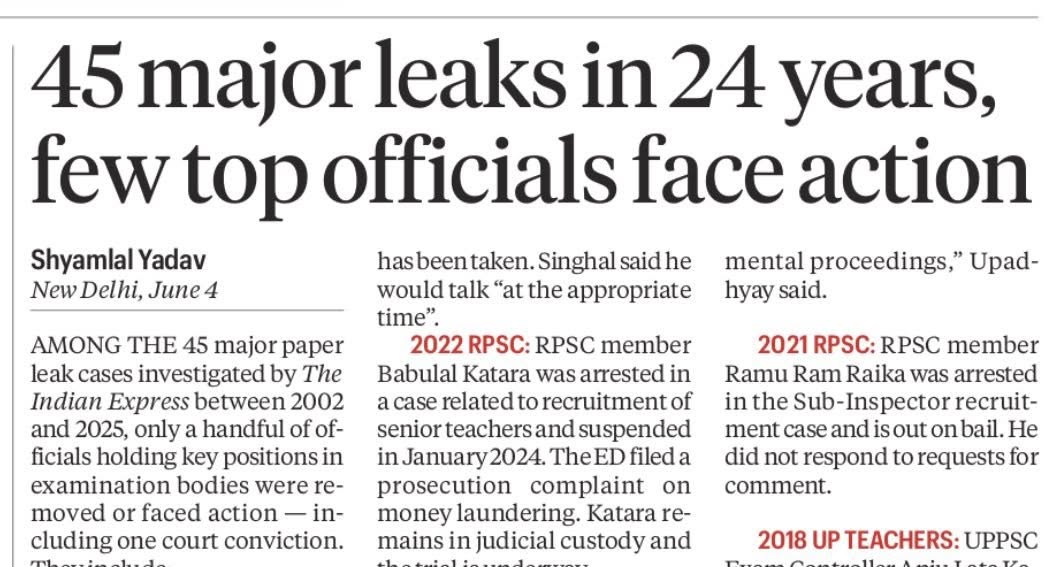
Amid frequent paper-leaks, read our investigation and watch video that what happened to big cases of last 24 years, how many arrested, how many charge-sheeted, how many convicted, who are in jail who are acquitted. Links of video and stories in comment box:
@mazoomdaar@saurabhtop
We @IndianExpress have been closely tracking the developments of the CBSE OSM chaos since May 8, when the first signs of the glitches surfaced. Read our full coverage in the thread here:
Class 12 results delayed due to OSM glitches: https://t.co/VxrPnjnXWK
Excl: After trial in Delhi in Jan, two reports sent to Board, highlighted major problems, tech glitches, random increase, decrease in marks. They mention that glitches noticed on the first day run until the end and suggest to delay the rollout by a year.
https://t.co/WDTUIAhl7e
HARDLOOK: ‘This could alter my chances to even qualify JEE’: How CBSE OSM chaos disrupted college plans for thousands. The new digital evaluation system, implemented for the first time this year for Class 12 board exams, has been under fire
https://t.co/FFi5wLfSpM
मध्यप्रदेश की स्वास्थ्य व्यवस्था की भयावह तस्वीर फिर सामने आई है।
The Indian Express की रिपोर्ट के अनुसार, सिर्फ सीधी जिले में अप्रैल 2025 से मार्च 2026 के बीच प्रसव से पहले, दौरान या बाद में 53 दलित-आदिवासी महिलाओं की मौत हो गई। इनमें सबसे कम उम्र की महिला सिर्फ 19 वर्ष की थी और मृतकों की औसत उम्र मात्र 26 वर्ष थी।
और सबसे चिंताजनक बात यह है कि स्वास्थ्य विभाग को लगातार पत्रों, समीक्षा बैठकों और चेतावनियों के माध्यम से इस स्थिति की जानकारी दी जाती रही, लेकिन सुधार के लिए प्रभावी कदम नहीं उठाए गए।
राष्ट्रीय स्तर पर मातृ मृत्यु दर (MMR) 87 है, जबकि मध्यप्रदेश का MMR 159 है। वहीं सीधी जिले में यह आंकड़ा 211 तक पहुंच गया है, जो पूरे तंत्र की विफलता को उजागर करता है।
यह सिर्फ आंकड़े नहीं हैं।
ये 53 परिवार हैं जो उजड़ गए।
53 बच्चे हैं जिन्होंने अपनी मां खो दी।
53 ऐसी मौतें हैं जो बेहतर स्वास्थ्य व्यवस्था, समय पर इलाज और प्रशासनिक संवेदनशीलता से रोकी जा सकती थीं।
एक तरफ सरकार विज्ञापनों में विकास के दावे करती है, दूसरी तरफ गर्भवती महिलाओं को सुरक्षित प्रसव तक की गारंटी नहीं दे पा रही।
मुख्यमंत्री जी और स्वास्थ्य मंत्री को बताना चाहिए कि आखिर माताओं की जान से बड़ा कौन-सा काम है?
मध्यप्रदेश की माताएं आंकड़ा नहीं हैं। उनकी सुरक्षा और जीवन सरकार की सर्वोच्च प्राथमिकता होना चाहिए।
@INCIndia@INCMP@DrMohanYadav51@rshuklabjp@NirmalaBhuria
#US11872
#IndianExpress की न्यूज़-
मध्य प्रदेश के सीधी ज़िले की एक चिंताजनक रिपोर्ट सामने आई है।
-अप्रैल 2025 से मार्च 2026 के बीच गर्भावस्था, प्रसव या प्रसव के तुरंत बाद 53 महिलाओं की मौत हो गई।
कारण -अस्पतालों में स्टाफ की कमी,
- विशेषज्ञ डॉक्टरों जैसे स्त्री रोग विशेषज्ञ और एनेस्थेटिस्ट का न होना
- खून, दवाइयों और जरूरी चिकित्सा संसाधनों का अभाव।
Overwhelmed delivery wards. Severe staff shortages. Women being referred from one facility to another. Families travelling long distances during medical emergencies. And in just one district of Madhya Pradesh, 53 maternal deaths reported in a year.
This is not merely a health story. It is a governance story. A democracy story. A priorities story.
A functional democracy is not judged by the volume of slogans, television debates, religious spectacles, or election marketing. It is judged by whether a pregnant woman can safely give birth, whether a public hospital has doctors and nurses on duty, whether ambulances arrive on time, and whether citizens receive dignity through public services.
For years, Indians have been told about development models, double-engine governments, civilizational pride, and endless political branding. Yet when basic state capacity is tested in delivery rooms, emergency wards, rural health centres, schools, and nutrition programmes, many regions continue to show deep structural failures.
Maternal mortality is among the clearest indicators of how seriously a society values human life. Most maternal deaths are preventable when healthcare systems function properly through timely antenatal care, adequate staffing, emergency obstetric services, blood availability, transport networks, and accountability. When women die because wards are overcrowded or healthcare systems are understaffed, these are not unavoidable tragedies. They are policy failures.
The contradiction is stark. Enormous political energy is spent on identity mobilisation, religious polarisation, and symbolic cultural battles, while many citizens still struggle for fundamental healthcare protections. A democracy cannot sustainably thrive when spectacle receives greater investment than public welfare.
Nationally, India has made significant progress in reducing maternal mortality over the years, proving that improvement is possible. Yet states like Madhya Pradesh continue to record some of the country's highest maternal mortality figures, exposing the uneven reality behind headline claims of development.
The real test of governance is not how loudly power speaks. It is whether ordinary people survive childbirth, access healthcare, receive education, find employment, and live with dignity.
A nation becomes stronger when hospitals work better than propaganda, when accountability matters more than image management, and when every mother's life is treated as a national priority rather than an unfortunate statistic.Source: (https://t.co/IghHxPHMyD)
Background data on maternal mortality trends and Madhya Pradesh's maternal health indicators:
Dispatches from the Double Engine. Very disturbing report about alarmingly high maternal mortality in a Madhya Pradesh district, the state which is the second worst state for deaths of women in pregnancy or childbirth.
मध्य प्रदेश के सीधी ज़िले में प्रसूति वार्डों की बदहाली और स्टाफ की भारी कमी को लेकर एक चिंताजनक रिपोर्ट सामने आई है।
रिपोर्ट के अनुसार, अप्रैल 2025 से मार्च 2026 के बीच गर्भावस्था, प्रसव या प्रसव के तुरंत बाद 53 महिलाओं की मौत हो गई। कारण -
-अस्पतालों में स्टाफ की कमी,
- विशेषज्ञ डॉक्टरों जैसे स्त्री रोग विशेषज्ञ और एनेस्थेटिस्ट की भारी कमी,
- खून, दवाइयों और जरूरी चिकित्सा संसाधनों का अभाव।
इंडियन एक्सप्रेस में रिपोर्ट छपी है।