Because #India needs a reel to understand the real pain!
My most painful experience from #Jharkhand
She is just 17 and her words would haunt you. Yesterday she was there when the lathi charge happened
“Yes I am a #cockroach, you have seen cockroaches of Delhi, now see us”
In a civilization like India which invented cold pressed seed oils and ghee thousands of years ago, and ate them for thousands of years without issues, a foreign company called Dada marketed hydrogenated vegetable fat as a "healthy alternative" to Ghee as early as 1930s and won people's minds with "Dalda."
The power of mental programming by clever marketing is real and dangerous. Indians are going through it right now at an unprecedented rate via social media. Indians are made to hate their own country and look up to superficial others.
Just like hydrogenated vegetable fat with transfats was proven to be dangerous to health decades later, and Indians are turning back to cold pressed oils and ghee, one day everyone will realize they made a mistake hating their own country for some others shown as great now.
But that day may be too late.
LONG Thread: #SIPs – Right Strategy – Wrong Direction: An explainer in 10 charts:
Why the SIPs will fail Indian investors. A perfectly right strategy but applied in wrong direction. A potential solution to follow.
SIPs karo - Aur option hi kya hai ? Almost any critique to the expensive valuations in India is met by the response – “Aur option kya hai”.
Well, looks like everyone is making the same assumption. The assumption is - Markets will always deliver above all other asset classes & definitely above fixed deposits. If this is your assumption, then yes , there is no alternative to SIPs in equities. However, let me phrase the question little differently.
What is the option to losing money? The clear answer is - Not losing money.
How can anyone lose money in SIPs ? You’re fed plenty of market history to justify systematic investments. But you’re reading history with tinted glasses. Let’s clear the lenses a bit. Same data but a different perspective. This time, from someone who isn’t selling you anything. Let’s go for a ride.
A drone farewell was done for Cristiano Ronaldo in his hometown in Madeira after he played his last game for Portugal 🇵🇹 against Spain in the World cup …… He really put them on the map❤️
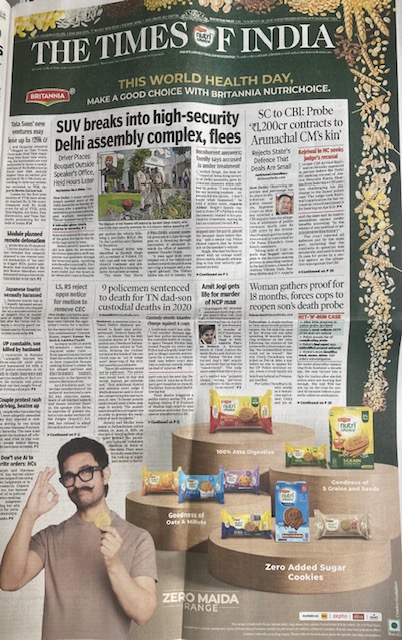
Look at the advertisement of Nutri Choice Biscuits: Junk Food Product
The Britannia Nutrichoice Digestive High Fibre Biscuit is High in added sugars(12.1g), total fats (20.8g) and sodium (362 mg )per 100g as per NIN Guidelines for Indians. As per NOVA classification it is Ultra-Processed Food product containing emulsifier, invert sugar syrup, raising agents, malt extract, artificial flavouring substances and dough conditioner.
These biscuits cannot be considered healthy.
Yet advertised as a ‘healthy’ and ‘good choice’ on World Health Day and endorsed by none other than Amir Khan.
Question : Shouldn’t Junk Food Ads Go Off Print & Air?
Appreciate your response !!
Why do this at all? Investors can themselves blend two funds into a custom one and create their own “index fund” called “Parikh-Nippon Flexi-Small Cap Index” – which has fallen less in crashes, and has recovered faster. There is no need to look for proxies here.
Investing in the Current Stock Market: Strategies from S. Naren (Head of ICICI Prudential Mutual Fund)
Honesty is rare in Indian finance. S. Naren, who manages Rs. 6.5 lakh crore in equity, is an extraordinary mutual fund manager who is warning small investors to get cautious.
S. Naren is a self-confessed fan of Charlie Munger. So, before we begin, here’s a short story Charlie Munger used to tell about fund managers:
"There was this guy who sold fishing rod sets. I asked him: ‘My God, they’re purple and green. Do fish really get attracted by these colors?’ And he said: ‘Mister, I don’t sell to fish.’ Fund managers remind me of that fishing rod salesman."
Priceless Guidance for Retail Investors from S. Naren’s Recent Interview on CNBC
1. Indian Stock Market Investors are the Sole Risk-Takers Financing the Entire Economy: Stock market investors today do not realize that instead of the banks, it is their hard-earned money which is now financing the companies.
This “investor financing” is happening through over-valued IPOs, QIPs, MNCs Selling, and Promoter Exits.
2. Stocks are Trading at Insane Valuations: The problem with equity investing at present is that stocks are trading at 50 PE, 60 PE etc. in the hope that earnings growth will follow. But what happens if the earnings don’t come?
During the “Lost Decade” from 1994 to 2004, many small and mid-cap companies disappeared. Growth and earnings did not come. Only large caps survived. Same risk applies to today’s over-valued market.
3. Judgment Day May Be Yet to Come: Private equity players who sell over-valued IPOs after cashing multi-bagger returns say “why worry – everyone is making money in India.” But the final time to judge the returns may not be today.
4. “Hold for the Long-Term” Mantra Only Works for Quality Stocks: With good stocks, time is your friend. With bad stocks, time is your enemy. At today’s valuations, even if you buy and hold for the long-term, capital destruction can happen – unless you buy high quality stocks.
5. Three Mistakes Investors Made in the 1990s Bull Market: As the bull market expanded: (a) They reduced the quality of their portfolios (by buying low quality stocks); (b) They reduced the liquidity of their portfolios (by buying illiquid stocks); and (c) They reduced the capitalization of their portfolios (by buying stocks with smaller market caps).
Avoid these 3 mistakes – these are the lessons we learnt from the nineties.
6. India is the Only Market Where IPOs are Still Selling: Private equity investors say India is the only market where they can still sell their IPOs and get profitable exits. They have not made that kind of multi-bagger returns in any other market.
7. A Stock at 25 PE is Over-valued if There is No Earnings Growth: Most investors don’t understand what it means to buy a stock at 25 P/E with no earnings growth. It means you are paying the price for 25 years’ earnings.
EXPLANATION: If a company has an EPS of Rs. 1 and its stock price is Rs. 25 (P/E = 25). So, you are paying Rs. 25 upfront for that stock. If the company continues to earn Rs. 1 per share every year (no growth in earnings), it will take 25 years (Rs. 1 x 25 years) to recover the initial stock investment of Rs. 25.
Today there are so many companies whose quarterly results come and there is no earnings growth. So, even 20 or 25 P/E for such stocks is an over-valuation.
8. Will Indian Stock Valuations Always Remain High Because Only 6% Households Have Equity Participation and SIP Money Has a Long Runway? Naren: Flows alone cannot determine the valuations of an asset class in the long run. All the market gurus in history have said this.
With the SIP inflows you might extend the over-valued market for another 2 or 3 years. But in the long run, only corporate earnings will determine valuations. Earnings growth is not happening right now in India.
9. Indian Stock Market in Next 2-3 Quarters: If consumption picks up in the festive season, and if credit growth improves (if people start taking fresh loans), then corporate earnings will come. But as of now, credit growth is low, and in this situation, earnings cannot come.
10. Strategy: Invest in Other Global Markets: Most global stock markets are cheaply valued and doing much better than India right now. Investors in India should consider investing in other global stock markets, which will likely deliver multi-year returns because of the low base.
11. Strategy: Diversify to Gold: Gold is no longer cheap, but for the sake of risk diversification, investors should consider investing partially in gold. No asset class is cheap in India right now (except perhaps office properties).
12: Strategy: No Interest in Crypto – Naren: “I’ve seen that whatever Charlie Munger said comes true with a time lag. He was against crypto investing. So, I’ve never considered it as an asset class for my investing.”
13. Strategy: Short-term Investing – Naren: "In today’s market, even if we find we have a 10% or 20% potential upside in a stock, we buy. And then take a gain, and exit.
If my target upside in a stock is 20%, and the stock price goes down by 5%, then my potential upside becomes 25%. So, we invest in those kinds of short-term opportunities. In that sense, volatility is my friend right now."
14. Strategy: Oil & Gas Stocks like ONGC/BPCL etc. – Naren: “This is the only pocket where I feel the stock valuations in India may still be reasonable. The goal with low valuations is to limit your downside risk.”
15. Strategy: Pharma Stocks: Tariffs have created uncertainty, but pharma stocks are a multi-decadal story. The world population as well as India’s population is aging. With age, you need more medicines and more healthcare. Demand in this sector will only increase.
16. Strategy: Banking Stocks: Right now, banking growth is restricted because companies don’t need bank credit (as stock investors are financing them.) But whenever stock market correction happens, the banking sector will outperform because then good companies will have to take loans from the banks.
17. Strategy: Personal Investing: Naren is partially invested in his own mutual funds and partially invested in global stocks outside India. Percentage of India vs. Global allocation: Did not reveal.
Endpiece:
Charlie Munger said: “Fish where the fish are.” Right now extremely cheap valuations are available outside India. Look at global stocks with an open mind. If the mind is closed, it is dangerous to play the stock markets.
Key takeaways from conference:
PSU banks are largely targeting for loan growth in the range of 11%-13% YOY in FY26
NIM decline, QOQ, in Q2FY26 will be higher than NIM decline in Q1FY26, QOQ
Small ticket MSME is horrible in pain
Although, risk peaked in Nov'24; stress remains elevated
Micro-LAP book below Rs5 lakh is in huge distress
Auto financing business is seeing stress uptick - not seen in last 3 years (highest stress in 3 years)
Majority of the lenders are trying to grow their fee income to combat (certain extent) decline in NIMs
Lenders are now focusing on cross-selling loans to existing customers only
Elevated stress in microfinance business till H1FY26; then, things should improve
GDP growth rate expected at 7% in FY27
Corporates aren't taking loans due to deleveraging & alternate source of funds
Delinquencies are higher in urban market than rural market
Avoiding states with govt related business in construction equipment