Every growth journey is unique. By reflecting on those stories, we can create a map. The problem with a map is not simply that it is an abstraction; we need abstraction. Maps also need interpretation.
The legend who taught us inversion principle will be missed.
“I always say I want to know where I would die so I can never go there.”
- Charlie Munger
Than you for enlightening us.
The solution will be a mix of contract management, project management, and expense management. We do not want to build a core value that tries to be everything at once, so we have started with the promise of getting crafters paid on time with https://t.co/FM37gjZDC9
Your work is your craft,
Creating something that propels you forward,
Not running on a hamster wheel,
Full-time work feels limiting,
Not for making more, but for doing better,
While some places have it all figured out,
Finding them is hit or miss,
Contracting can be a way forward,
But it has this perception of commitment phobic,
If one is committed to their craft, why worry,
We spend so much time getting started,
Defining too many conditions sucks creativity out it, Leaving it open-ended leads to misunderstanding,
It comes down to,
Let me send you an email,
With a rough estimate of duration, cost, and milestones,
As time passes,
Email! When?
New unknowns arise,
making the old irrelevant,
Now, it's time to play the blame game,
Without a clear project boundary,
Both view the project from different perspectives, Leading to misunderstandings and a lack of collaboration.
In this democratized world, there exists a gap, where crafters can work with builders in a way that provides builders with access to the best talent and allows crafters to earn with their minds, not their time.
Your work is your craft.
You want to create work that takes you forward.
Not something that feels you are running on the hamster wheel.
Working full-time feels limiting,
not to make more, but to do it better.
Yet there are places that have everything going, but finding them is a hit or a miss.
Contracting can be a way forward,
but it has this image that one is not committed.
If I am committed to my craft, why does one worry.
We spend so much time to get started,
Defining too many conditions takes away the craft from work,
leaving it open ended also leads to misunderstanding.
Okay, let me send you an email,
with rough estimate of duration, cost, and a few milestones.
Email! When?
As time goes on, new unknowns arise, and the old email becomes irrelevant.
Now it time to play the blame game
Without a clear project boundary, both view the project from two different sides of the coin,
leading to misunderstandings and a lack of collaboration.
In this democratized world, there is a gap where crafters can work with builders in a way that provides builders with access to the best talent and allows crafters to earn with their minds, not their time. This will promote excellence in one's craft while experiencing the financial freedom to do so. A world where two people can collaborate on a problem that excites them, instead of competing, would be a better place.
The solution will be a mix of contract management, project management, and expense management. We do not want to build a core value that tries to be everything at once, so we have started with the promise of getting crafters paid on time with https://t.co/IIJ2Qrjn4H.
@jasonfried Thanks for sharing @jasonfried. Watched till the end. Have been a user of Hey since the launch. I would love to see some improvements with search. I feel it has scope for 37signal magic.
🛑 Charging by seat: A Hindrance to Product Growth
Charging by seat is harmful for your product growth than you think.
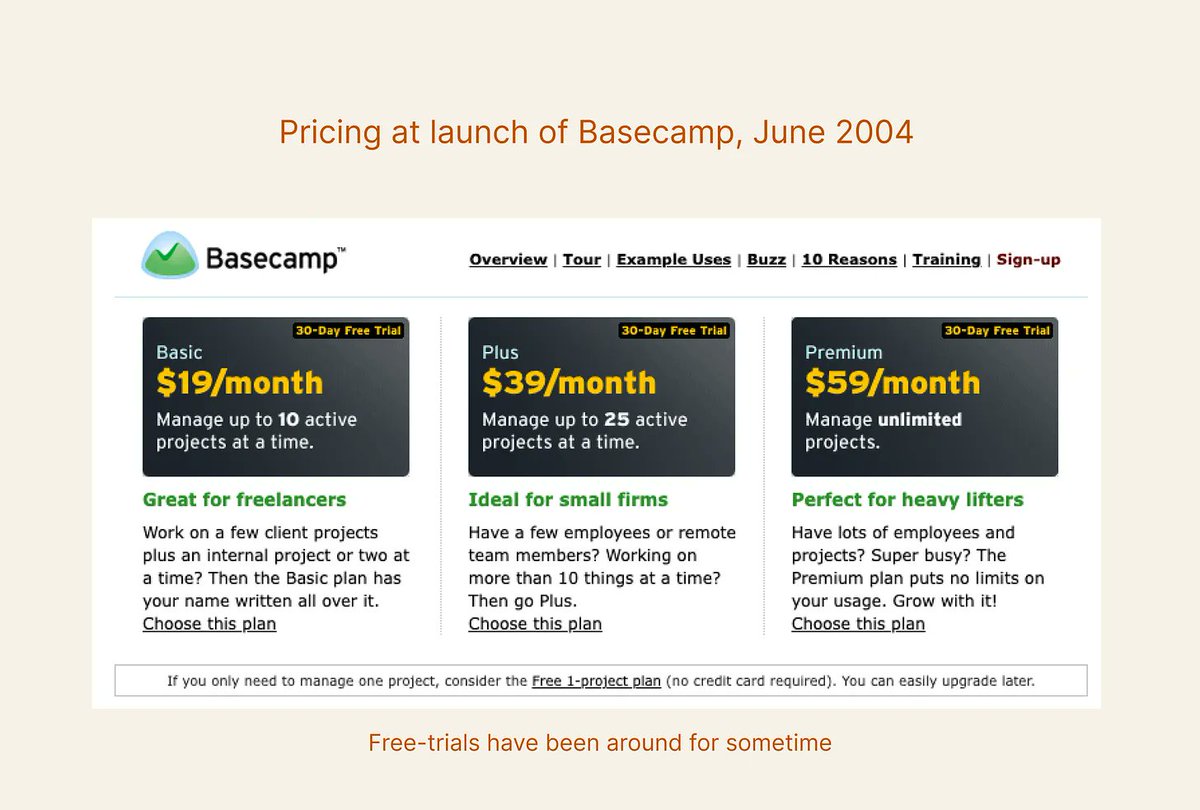
⛺ Take Basecamp, for example. From the early days (June 2004), they decided to charge flat rates instead of charging per seat. As Jason Fried said, this approach allowed them to prioritize delivering the best possible product to all of their customers, rather than chasing large contracts.
Basecamp's easy-to-use product and simple pricing quickly spread like wildfire. Back in the day, In just six weeks after release, they hit their 1-year goal of $5k MRR. The rest is history.
🏦 If you choose per seat pricing, you are allowing the enterprise motion agents to take over. The contract value gives them the right to dominate the product roadmap rather than the product value that the team set out to build.
🍯 Basecamp did go with variable pricing, but it was not a function of the number of seats. Instead, it was based on the number of projects, which is connected to the value that their users derive from it - “Managing projects”.
🎯 Your pricing is not only a way to capture the value on the table, but it is also a way to keep your teams focused on what drives value for users and what should be optimized at an organizational level.
🤔 What is your pricing lever ? (especially in a growing phase)
I could spent more than 40 hours of research to interpret truths and signals by studying the growth journey maps of Figma, Notion, Basecamp, and Arc. Here is the link to the part one of the series - https://t.co/2XKVKTT2ZV
Every growth journey is unique. By reflecting on those stories, we can create a map. The problem with a map is not simply that it is an abstraction; we need abstraction. Maps also need interpretation.
But interpretation creates another map. Using someone else’s map for your journey may not work. Only when interpretation takes the form of signals that can guide us on a similar journey does it works like a compass.
As Oprah Winfrey puts it, “you can’t have an Aha! moment unless you already knew it. The Aha is a remembering of what you already knew, articulated in a way to resonate with your own truth”.
“That makes sense”
We say this when we encounter something that is both novel and familiar.
The complete picture may seem new and provide a fresh perspective, but its building blocks are recognizable.