🇮🇳 The Road to Aichi–Nagoya 2026 begins! 🏅
The Asian Games squad announcements are underway, and we’ll be tracking every Indian team selected for the continent’s biggest multi-sport event.
From established stars to exciting new faces, this thread will bring you the complete list of athletes representing 🇮🇳 across disciplines.
📌 Bookmark this thread and stay tuned as more squads are announced!
#AsianGames2026 #TeamIndia #AichiNagoya2026 #RoadToAsianGames #IndiaSportsHub
We really do not talk enough about Tejaswin Shankar.
An athlete who is rewriting Indian decathlon history while holding NR in high jump should be one of the biggest names in Indian sport.
Instead, his achievements often pass with far less attention than they deserve.
Just look at what happened in Ranchi yesterday.
10.77s in the 100m. PB.
7.67m in Long Jump. PB.
2.25m in High Jump.
48.29s in the 400m. PB.
4511 points after Day 1.
Do you understand how good that is?
Only 45 decathletes in the history of the sport had ever crossed 4500+ on Day 1 before this. Tejaswin Shankar just became the 46th human being to do it.
And while doing a decathlon, he cleared 2.25m in high jump something only SIX decathletes in history have managed. Only the second in this century.
This is not normal. This is not “good for India.” This is elite by global standards.
Every single competition, he finds a way to improve.
Every single time, he pushes his body across ten brutal events and somehow comes back stronger. There are athletes who specialise in one discipline their whole lives and never touch numbers like these.
Yet Tejaswin is doing it across TEN events.
National Record in sight. Maybe even 8100+.
One day, people will look back and realize they missed witnessing one of the greatest all-round athletes India has ever produced.
The least we can do right now is talk about him while he is still building this legacy in real time.
And if you are in Ranchi GO CHEER FOR HIM.
Lets Go @TejaswinShankar
Inputs inspired by @Eighty7_Fifty8
🚨 BIG BREAKING NEWS IN MMA 🔥
India's Sonam Zomba defended her MFN Strawweight World Title at Matrix Fight Night 18.
The girl from Arunachal Pradesh defeated Brazil’s Alves and made the whole India proud in MMA!
🇮🇳❤️
Extremely disappointed with the Badminton World Federation (BWF) decision to alter the scoring system—and even more concerning is the overwhelming support it has received from Council members.
The existing format ensured a true level playing field across playing styles, especially in the premier events—Men’s and Women’s Singles—which have always embodied the very essence of our sport: skill, resilience, fitness, and mental strength.
By effectively reducing the duration (and in essence removing one game’s worth of play—18 points), BWF risks diluting what made these events so compelling. The explanation that this will “create early excitement” feels short-sighted. Badminton has never lacked excitement—what it has offered is sustained intensity, something very few sports can match.
If change was necessary, why not apply it selectively to doubles formats, while preserving the integrity of Singles? That would have been a more balanced approach.
Equally concerning is the continued neglect of player welfare and voice:
* No prize money for the World Championships
* No meaningful increase in rewards for Singles, the flagship category
* No implementation of a review/referral system for critical umpiring decisions
These are areas that truly needed attention.
Badminton is widely regarded among the toughest sports in the world. A 90-minute Singles match can have nearly an hour of shuttle in play—far exceeding many longer-duration sports. Yet, instead of strengthening these unique aspects, decisions like this risk undermining them.
Players are expected to adapt—but are rarely heard.
While other global sports continue to evolve by empowering athletes, improving officiating, and enhancing viewer engagement, badminton seems to be moving in the opposite direction.
It’s disheartening to see a sport followed so passionately—especially across Asia—being reshaped for reasons that do not address its real challenges.
This is not evolution. This is dilution.
Did you know ??
Out of 14 compulsory holidays:
4 are Muslim festivals
2 are Christian festivals
2 are national holidays
1 each is for Buddhism, Jainism and Sikhism
1 even for Mohandas Gandhi buddy
Just 4 for Hindu festivals
Hindu-majority country?
And no one dares change it??
Let’s expose the double standards of @BBCWorld
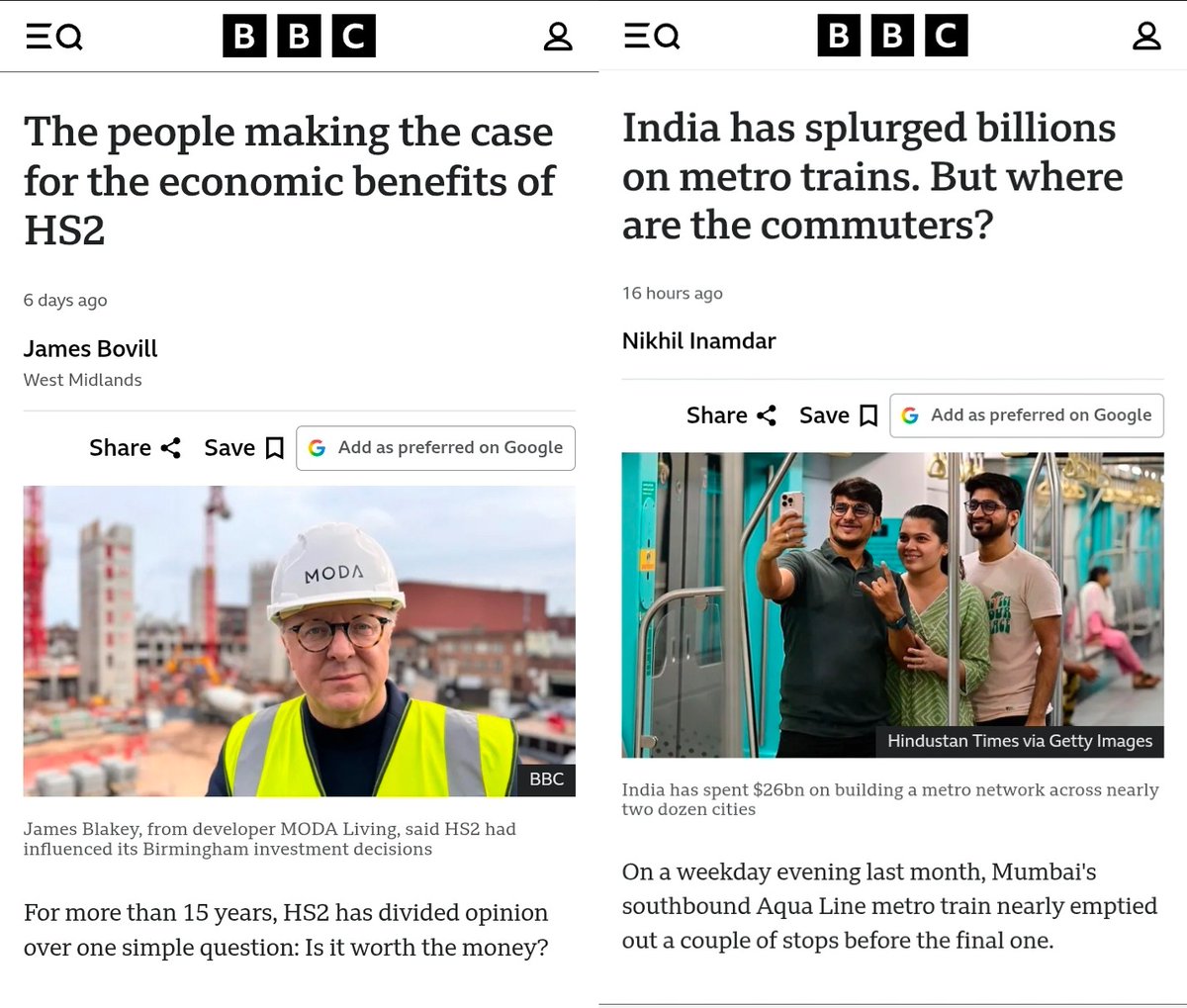
The UK is building HS2 a ~225 km high-speed rail line that is already delayed by nearly 15 years. The cost? Around ₹8 lakh crore so far, with projections going as high as ₹10–12 lakh crore, and yet, even before a single kilometre is fully operational, BBC is busy discussing its economic benefits.
Now compare that with India: India has already built 1000+ km of metro networks across multiple cities, many of them among the largest and busiest systems in the world, and that too within a similar or even lower cost range. On top of that, rapid expansion is actively underway in several cities.
But instead of acknowledging this scale and impact, BBC has gone ahead and labeled Indian metro systems as a failure.
What makes it worse?
The article criticizing Indian metros is written by someone of Indian origin, yet the same publication wouldn’t dare apply this level of scrutiny or tone when covering HS2.
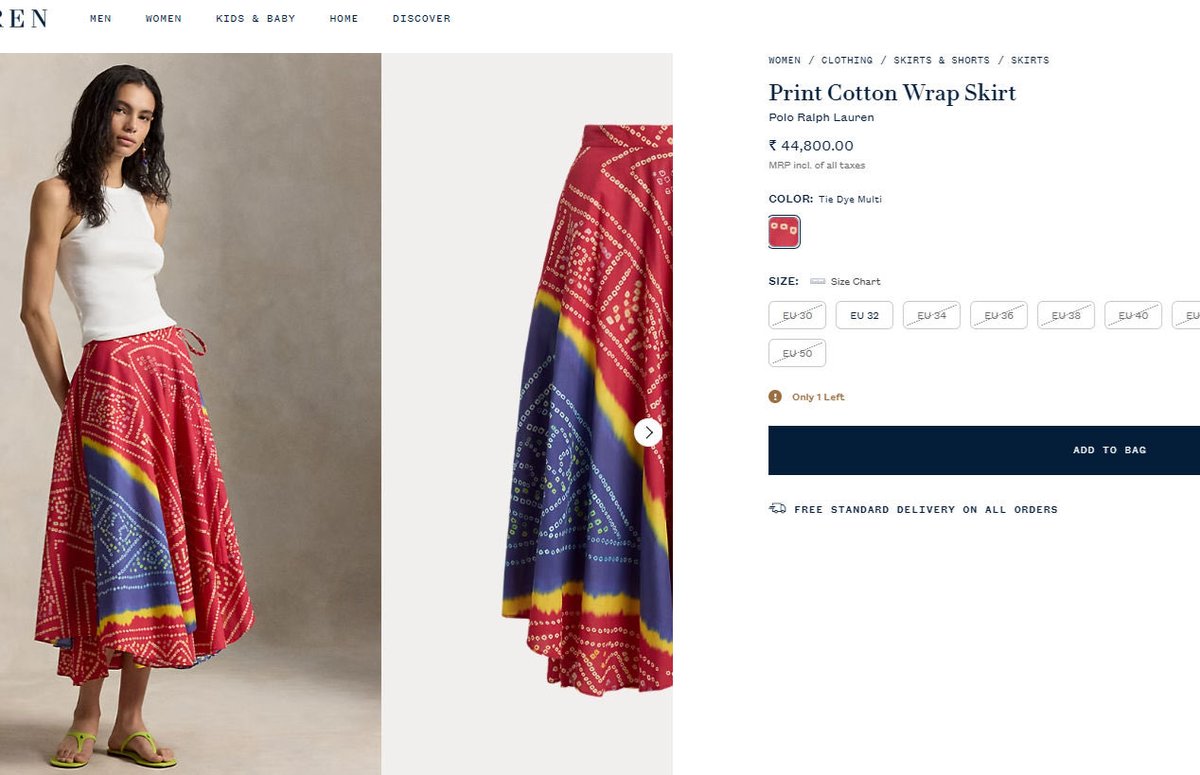
This is how international fashion brands kiII Indian crafts. This is East India Company redux. @RalphLauren is selling this PRINTED bandhani skirt for a whopping 44,000 INR, without mentioning that it is Bandhani.
First of all, Bandhani or bandhej is a millennia old Indian tie and dye craft technique that has been seen even in the Ajanta paintings. Bandhani is created knot by painstaking knot by artisans whose skill is passed down not in design schools but across generations. Every dot in a bandhani saree is a decision made by human fingers, a tiny act of devotion to craft. Every bandhani textile is unique. Even the word Bandana in English has come from Bandhani.
But Ralph Lauren bastardizes Bandhani with a cheap printed cotton wrap skirt, a machine approximation of centuries of handwork, listed blandly and prices it at ₹44,800, with not a word about India, not a word about the artisans whose ancestors built this language of cloth. Real hand done bandhani skirts in Bharat cost less than 5000 Rs!
Ralph Lauren stole the aesthetic and erased the ancestry, just like the British East India Company did! Absolutely shameful!
As a Muslim, I find it strange how ‘annihilate Hinduism’ is packaged as academic discussion. Try flipping the religion and see how fast the global response comes.
If annihilation of a religion becomes acceptable language, we’ve already failed the idea of coexistence.
The semifinal between Ayush Shetty and Kunlavut Vitidsarn (World No. 1) at the Asian Badminton Championships was a powerful reminder of what our sport truly stands for.
It was intense, demanding, and deeply tactical—everything that makes badminton special. Ayush’s win underlined one critical truth: there are no shortcuts in our sport. Physical endurance, resilience, and mental strength are non-negotiable.
Which is why I must say this clearly to the Badminton World Federation:
Do not dilute badminton by altering the scoring system to shorten matches.
This move risks reducing a sport built on endurance and skill into one designed merely to fit television windows. The idea of compressing five events into a three-hour broadcast slot cannot come at the cost of the sport’s essence.
Badminton is not just about speed—it is about attrition, strategy, adaptability, and sustained excellence. The current scoring system allows contrasting styles—attacking and defensive—to compete on equal terms. That balance is the soul of the game.
Compromising this for convenience would be a serious mistake.
If you shorten the game, you don’t modernize badminton—you diminish it.