🧡 gRialo
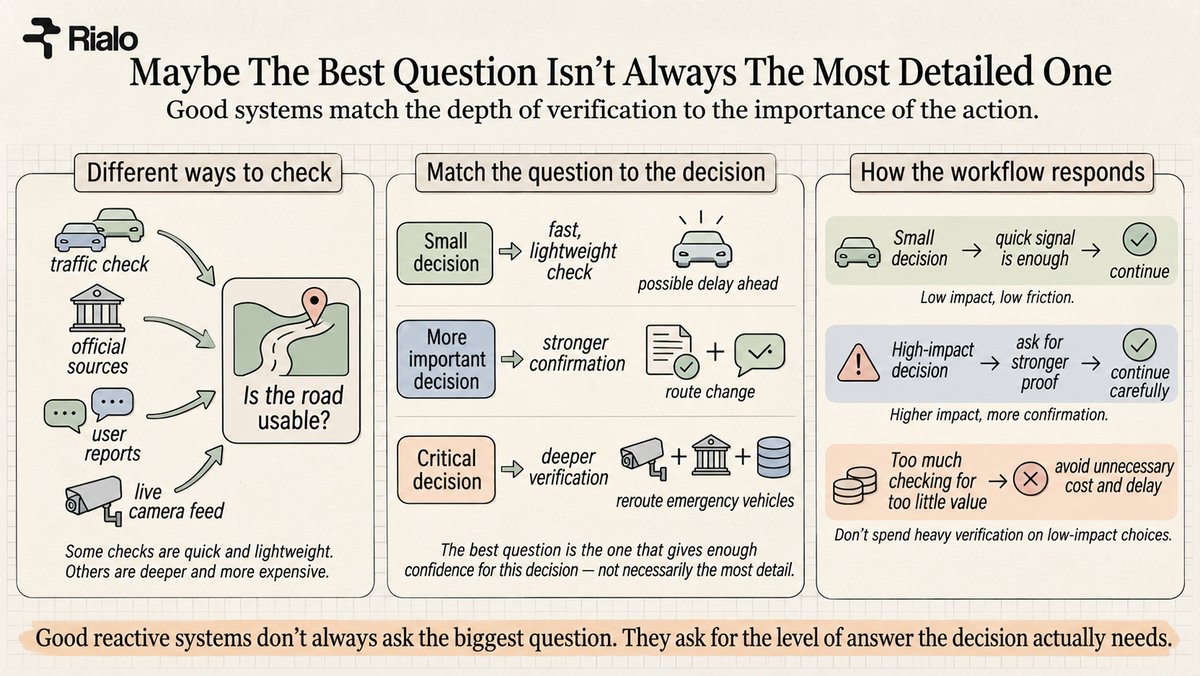
[ Maybe The Best Question Isn’t Always The Most Detailed One ]
There’s another thing I keep thinking about when a system has several ways to check something.
The “best” question might not always be the most detailed one.
Imagine an app wants to know whether a road is still usable.
It could request a live camera feed.
Check multiple official sources.
Pull traffic data.
Compare recent user reports.
That would probably give a very complete picture.
But it could also be slow.
Expensive.
And unnecessary.
Maybe a quick traffic check is enough for a small decision.
But if the app is about to reroute emergency vehicles,
then a deeper verification makes a lot more sense.
That changes the question from:
“What gives us the most information?”
to:
“What level of information does this decision actually need?”
So maybe the workflow looks like:
Small decision → fast, lightweight check
More important decision → stronger confirmation
Critical decision → deeper verification
I like that because it makes reactive systems feel more practical.
They don’t have to use the most expensive form of verification every time.
They can match the effort to the importance of the action.
And this is where Rialo’s external connectivity and Determination feel useful together.
The application can reach different external sources,
but the workflow can decide how much checking is actually worth doing before it continues.
That matters for AI agents too.
Sometimes an agent just needs a quick signal.
Sometimes it needs strong proof.
The useful part is knowing the difference.
Maybe good reactive systems aren’t the ones that always ask the biggest question.
Maybe they’re the ones that know how much of an answer they really need.
@RialoHQ
🧡 gRialo
[ Maybe Good Verification Shouldn’t Have To Start From Zero Every Time ]
Imagine three different applications need to know whether a package has been delivered.
A shopping app.
An insurance service.
An AI assistant managing customer support.
Each application might contact the same delivery provider,
check the same tracking information,
and verify the same event independently.
That feels a little repetitive to me.
What if one of them has already verified the information?
Could the others make use of that result instead of starting from zero?
Of course, simply sharing an answer probably isn’t enough.
The other applications would still need to know:
• where the information came from • when it was verified • how it was checked • whether it’s still relevant
But if those details can be verified too, things get more interesting.
The workflow might look like:
External event → verify information → preserve the result and its context → reuse it where appropriate
That could reduce unnecessary API calls,
repeated verification,
and the cost of checking the same thing over and over.
This is where I find the relationship between Rialo’s Determination and Verification interesting.
Determining something about the outside world is useful for one application.
But having a verifiable result could potentially make that information useful to other applications too.
Not every application needs to trust the original decision blindly.
It can still apply its own rules and request additional checks if needed.
I like the possibility of applications building on information that has already been verified,
rather than each one investigating the same reality from scratch.
Maybe the value of verification isn't limited to the moment it happens.
Maybe part of its value is what other applications can safely do with it afterward.
@RialoHQ
🧡 gRialo
[ Rialo Builder’s Hub Recap ]
Another interesting Builder’s Hub this week!
We had three teams presenting today: Probly, Agora, and Payroll Master.
Payroll Master encountered some technical issues during the demo and will be given priority to present again next time, so I'll leave it out of today's recap.
Let's take a look at the other two projects.
1️⃣ Probly
Direction: Prediction Markets × NFT Speculation → expanding what people can make predictions about
Probly combines traditional prediction markets with NFT speculation.
Beyond predicting real-world events, users can predict whether an NFT collection's price will rise or fall, or whether an upcoming mint will sell out.
During the demo, the team showed:
• Yes/No prediction markets • NFT price and mint predictions • User-created markets with predefined resolution criteria • Weekly challenges, badges, and leaderboards
The team described using Rialo to determine market outcomes based on external information and settle payouts onchain.
💬 Interesting Q&A
One question focused on how market outcomes can be fair and accurate.
The team explained that each market has a predefined resolution source.
However, how conflicting information or disputed outcomes would be handled wasn't clearly explained.
Another question focused on differentiation from existing platforms like Polymarket.
The team emphasized gamification through weekly challenges and rewards.
2️⃣ Agora
Direction: AI Agent Debate × Latch × Gamification → turning AI agents into competitive participants
Agora takes a pretty interesting approach to AI.
Instead of chatting with an AI, users bring their own agents to compete against others in a debate arena.
Each agent has its own private strategy and model.
The debate is evaluated through reasoning, evidence, rebuttal, and relevance.
The winner is determined by:
• 70% audience voting • 30% AI judging
When audience participation is insufficient, AI judging determines the result.
What caught my attention was the use of Latch to manage scoped permissions for AI model access.
💬 Interesting Q&A
One question asked how Agora prevents multiple agents from collectively exceeding a user's authorization or spending limits.
The team explained that these policies are managed through Latch rather than Agora itself.
However, the enforcement of combined limits across concurrent agents wasn't demonstrated.
The team also shared plans for future tournaments, rewards, and winner predictions.
My Take
What stood out to me this week was how both projects approached competition.
Probly lets people compete through predictions.
Agora lets AI agents compete through arguments.
Different experiences, but both raise an interesting question.
Who decides the outcome, and why should we trust that decision?
For Probly, it's about reliable information and fair settlement.
For Agora, it's about fair judging and controlled agent permissions.
I think this is an interesting area for builders exploring Rialo.
Creating a competitive system is one thing.
Making its outcomes trustworthy is another.
@RialoHQ
🧡 gRialo
[ Maybe Reactive Systems Should Know What To Ask Next ]
Sometimes uncertainty doesn’t disappear on its own.
And that made me wonder:
What if the system could actively look for the missing piece?
Imagine an app trying to confirm whether a road is closed.
One source says yes.
Another says no.
Waiting might help.
But maybe the real problem is that the application is missing one specific kind of evidence.
So instead of just sitting there, it could ask:
Is there an official update?
Can another independent source confirm it?
Did a camera feed change?
Has traffic actually stopped moving?
That changes the workflow a little.
Unclear situation → identify what’s missing → request another signal → compare again → continue, wait, or fall back
I like that because it makes uncertainty feel less passive.
The system isn’t only saying:
“I don’t know.”
It’s also asking:
“What would help me know more?”
And this is where Rialo’s external connectivity becomes really interesting to me.
If an application can interact with outside services as part of a long-running workflow, then it doesn’t have to depend only on whatever information happened to arrive first.
It can go look for the next piece of evidence it needs.
Then Determination becomes more than judging the signals already on the table.
It can also shape what the application checks next.
That feels useful for a lot of things.
AI agents.
Travel apps.
Logistics.
Games.
Any system where the outside world doesn’t give one perfect answer immediately.
Maybe good reactive applications don’t just wait for certainty.
Maybe they know how to search for it.
@RialoHQ
🧡 gRialo
[ Maybe Reactive Systems Should Know Which Question Is Worth Asking ]
Being able to ask for more information sounds useful.
But then another question comes up.
Should the system ask for everything it possibly can?
Probably not.
Imagine an app still isn’t sure whether a road is closed.
It could check:
traffic data,
weather,
camera feeds,
social posts,
local authorities,
navigation services,
and probably a lot more.
But most of that might not actually help.
Maybe one official update would settle the question immediately.
That makes me think the harder part isn’t only:
“What information are we missing?”
It’s also:
“Which missing piece would change the decision the most?”
So the workflow could look more like:
Uncertainty remains → identify possible checks → choose the most useful one → request it → evaluate again
I like that because it keeps the system from turning uncertainty into endless data collection.
More information isn’t always better.
Sometimes one well-chosen signal is more useful than ten extra ones.
And this is where Rialo’s combination of external connectivity and Determination feels especially interesting to me.
If an application can reach outside services during a long-running workflow, then it doesn’t just need the ability to fetch more data.
It also needs some logic for deciding which external check is worth making next.
That could matter for AI agents,
logistics,
travel,
games,
or any application operating around changing real-world conditions.
Maybe good reactive systems don’t just know how to ask for more information.
Maybe they know which question is actually worth asking.
@RialoHQ