1/2
”𝗨𝗨𝗦𝗜 𝗡𝗢𝗞𝗜𝗔” 𝗜𝗦𝗞𝗜 𝗝𝗔̈𝗟𝗟𝗘𝗘𝗡: 𝗚𝗢𝗢𝗚𝗟𝗘𝗡 𝗝𝗔̈𝗧𝗧𝗜𝗞𝗢𝗡𝗘𝗦𝗔𝗟𝗜 𝗠𝗔𝗞𝗦𝗢𝗜 𝗛𝗔𝗠𝗜𝗡𝗔𝗟𝗟𝗘 𝗣𝗬𝗢̈𝗥𝗘𝗔̈𝗧 𝗡𝗢𝗟𝗟𝗔 𝗘𝗨𝗥𝗢𝗔 𝗬𝗛𝗧𝗘𝗜𝗦𝗢̈𝗩𝗘𝗥𝗢𝗔
Pitäkää kiinni hatuistanne ja varatkaa kottikärryt valmiiksi, sillä datakeskuslobbareiden lupaama kultasade on vihdoin saapunut suomalaisiin kuntiin! Kymen Sanomat täräytti juuri tiskiin uutisen, joka pitäisi kehystää jokaisen suomalaisen kunnanvaltuuston seinälle ja lähettää pikapostina sekä Forssan kaupungintalolle että Mikael Jungnerille: ”Etelä-Kymenlaakson saamien yhteisöverojen potti pieneni – Googlen tytäryhtiö Tuike Finland ei maksanut Haminalle veroja lainkaan.”
Siis luitte aivan oikein. Ei euroakaan, ei senttiäkään, pyöreä nolla! Kyseessä ei ole mikään eilen pystytetty harjoituskoppi, vaan Suomen vanhin, suurin ja juhlituin lippulaivadatakeskus, jota on käytetty viisitoista vuotta malliesimerkkinä siitä, miten konesalit pelastavat kuihtuvat tehdaspaikkakunnat ja muuttavat sähkön silkoiksi veromiljardeiksi. Kun Haminan kaupunginjohtaja ja kamreeri ovat menneet avaamaan kaupungin verotiliä nähdäkseen, kuinka monta uutta koulua ja terveyskeskusta maailman rikkaimpiin kuuluvan biljoonajätin yhteisöveroilla tänä vuonna rakennetaan, tilinauhassa on komeillut yhtä tyhjä rivi kuin forssalaisessa riisipellossa marraskuussa.
Tämä Haminan upea nollatulos laittaa viime päivien konesaliuhon aivan uuteen, suorastaan hulvattomaan valoon:
Vastahan lobbari Jungner laski meille X:ssä, kuinka Suomen sähkönkulutuksen tuplaaminen datakeskuksilla ja sähkön hinnan nostaminen 15 senttiin kilowattitunnilta tuo Suomelle ”verotulojen kasvua 6 miljardia euroa vuodessa”. Haminan mallilla laskettuna tuo kuuden miljardin veropotti vaatii enää sen, että kerromme nollan äärettömällä!
Syyskuussa pääministeri Petteri Orpo istui eturivissä haltioituneena, kun Google julkisti uuden jättimäisen datakeskusinvestointinsa Suomeen. Samaan aikaan valtioneuvoston kanslian pöytälaatikkoon piilotettiin Orpon tilaama asiantuntijaraportti – jota oli laatimassa myös Googlen oma Suomen-maajohtaja Antti Järvinen – ja jossa todettiin harvinaisen rehellisesti, että datakeskukset sijoittuvat tekoälytalouden arvoketjun alimpaan pohjasakkaan ja ”merkittävä osa laitehankinnoista ja toiminnan tuotoista valuu ulkomaille”. Nyt ymmärrämme, miksi raporttia ei ”ehditty lukea”: olisihan se ollut kiusallista kertoa juhlayleisölle, että arvoketjun alapäässä suomalaiselle kunnalle jää käteen pelkkä lämmin kädenpuristus ja nollan euron verokuitti!
Kun oikea Nokia maksoi huippuvuosinaan Suomeen jopa pari miljardia euroa yhteisöveroa vuodessa ja työllisti täällä suoraan 25 000 ihmistä, uusi konesali-Nokia työllistää koko maassa suoraan 300 henkeä (siis koko datakeskuskenttä) ja maksaa Haminassa yhteisöveroa
0 euroa. Tällä tahdilla meidän ei tarvitse enää huolehtia valtionvelasta,sillä pelkkä konesalien tuijottaminen tekee meistä kaikista henkisesti miljonäärejä!
Miten on mahdollista, että satoja megawatteja suomalaista sähköä nielevä globaalin teknojätin konesali ei maksa sijaintikuntaansa lainkaan yhteisöveroa? Koska kansainväliset jätit osaavat konsernin sisäisen siirtohinnoittelun, korkovähennykset ja laitepoistot unissaankin. Suomen tytäryhtiö on pelkkä kulupaikka, joka tuottaa konsernin sisällä ”alijäämää” tai nollatulosta uusimalla kalliita palvelimiaan, kun taas varsinainen miljardiliikevaihto ja verotettava voitto kirjataan sinne, missä tekoälymallit ja mainosmyynti sijaitsevat eli Yhdysvaltoihin ja Irlantiin.
Mutta älkää suinkaan kertoko tätä Forssan kaupunginjohtaja Jari Kesäniemelle tai tekniselle johtajalle Antti Heinilälle, ettei hyvä tunnelma mene pilalle! Forssassahan myytiin juuri 150 hehtaaria maata Wall Streetin sijoitusjätille 2,67 euron neliöhinnalla,koska kaupunginjohtajan sanoin investointi on Forssalle ”taloudellisesti erittäin merkittävä” ja sen ”odotetaan tuovan kauaskantoisia hyötyjä alueellisesti”. Jos edes omaa huipputuottoisaa pilviliiketoimintaansa pyörittävä
The most important part of what he says in this interview? Did you catch it? The advice didn’t come from inside El Salvador it came from USAIDish multi lateral organizations. Economists.
Why do you think the Fabians set up the London School of Economics with Milner? The economic hitmen of the globalists are used to control countries. To convince them that allowing crime is a good thing. Look at every country that the CIA overthrew…you will find a team of economists deployed in the aftermath to set up the military dictatorships controlled by the globalists.
The reason they attacked @nayibbukele was bc he broke out of their control and proved to the world it can be done. He’s a huge threat to their model of crime, chaos and control. That same network is trying to destroy Trump for the exact same reason. He is proving that you can get rid of the crime, chaos and control mechanisms. Trump isn’t just doing that in America is and his team is doing it globally. Anyone attacking Trump is either ignorant or complicit. You decide.
Comme une impression de déjà-vu.
Le manuel existe. Il a été écrit en 2016. Il suffit de le rouvrir à la page 1.
Étape 1 : créer un mouvement. Surtout pas un parti, un parti c'est sale. Un mouvement. Avec un nom qui ne veut rien dire, donc qui peut tout dire. Trois cents personnes dans une salle, un clip, un site web, et la presse titre "phénomène".
Étape 2 : être ni de droite ni de gauche. Traduction : être les deux, selon l'heure et la salle. Libéral au petit-déjeuner avec les patrons. Social à midi avec les syndicats. Souverainiste au goûter. Européen au dîner. Le programme n'est pas flou, il est quantique : il prend la forme de celui qui l'observe.
Étape 3 : le pèlerinage. Un été, tu descends au Puy du Fou. Tu admires les Vikings, tu prends Philippe de Villiers par l'épaule, tu le regardes droit dans les yeux et tu lui dis : "on va sauver la France, Philippe". Devant les caméras, tu glisses que tu n'es pas socialiste. La droite fond. Le lundi, tu expliques à la gauche que c'était du tourisme.
Étape 4 : regarder les Français les yeux dans les yeux. Très important, les yeux. Tant qu'ils regardent tes yeux, ils ne regardent pas ton programme.
Étape 5 : annoncer qu'on va relever la France. Contre qui, on verra. Avec quoi, on verra. L'essentiel, c'est de faire front. Tous ensemble. Derrière toi.
Étape 6 : le soir du premier tour, fêter ça à la Rotonde. Le peuple a parlé, il mérite bien que tu trinques à sa santé dans une brasserie de Montparnasse, entre amis, loin de lui.
Étape 7 : quelques années plus tard, expliquer que si ça n'a pas marché, c'est la faute des Gaulois réfractaires.
Et puis, une fois élu, le masque tombe.
Parce que le ni droite ni gauche n'a jamais été une absence de ligne. C'était l'emballage. Dedans, il y a toujours la même politique : celle de Bruxelles. Qui est celle de Davos. Une vision où la nation est un obstacle, la frontière une anomalie, le citoyen un consommateur interchangeable, et où tout se décide loin de ceux qui subissent. Un communisme en costume trois pièces : tu ne possèdes plus rien, tu ne décides plus rien, mais tu es prié d'être heureux.
Avec une première étape, toujours la même : défaire la civilisation européenne occidentale. Ses nations, ses frontières, sa mémoire.
En 2016 on nous a vendu le Mozart de la finance. En 2026, le Mozart du tatami. Le visage change. Le masque, lui, est le même.
On a déjà vu le film. Le premier a duré dix ans.
Recently I told you there are two kinds of people in this system: cynics and believers.
Ursula von der Leyen, I put her with the believers. And that's exactly why you need to understand how the machine works.
Because cynics are very rare. Soros, I put him in that category: he knows exactly what he's doing, and he has never hidden it.
He read Popper, he has a theory of change, and he understood early on something the right still hasn't figured out: you don't change a society by winning an election. You change it by funding, for thirty years, the people who will write the reports, train the lawyers, and advise whoever wins the elections.
$24 billion spent by Open Society since its creation. More than 50,000 grants. In 2015, he wrote in plain text that the EU must accept at least a million asylum seekers a year, and mobilize NGOs, churches and businesses to take them in.
All of it is public. That's the most impressive part.
Here's how the system got hacked, in three steps.
Step one: selection.
Nobody recruits idiots. No need. The money does the selecting on its own.
A grant never goes to the person who doubts. It goes to the person who already believes. Repeat that over thirty years and tens of thousands of grants, and you get an entire ecosystem where the free thinker was filtered out at the door. He wasn't fired. He just never got funded.
What's left: people who are sincere, credentialed, conformist, and whose paycheck depends on the cause.
Step two: funding manufactures conviction.
Try explaining something to someone whose paycheck depends on not getting it.
The NGO produces a report. The report gets cited by an expert. The expert testifies before the Commission. The Commission turns it into a directive. And the NGO guy ends up in a cabinet, then goes back to a foundation.
Everyone knows each other, cites each other, funds each other. It's an echo chamber with a budget.
Step three: emotion.
You never debate results. You debate intentions.
One photo beats a thousand statistics. Every objection backed by numbers becomes a moral failing. And when reality contradicts the narrative, the dissonance always gets resolved the same way:
"It's a necessary evil."
"It's collateral damage."
"The real problem is elsewhere."
Immigration is never a problem. The problem is your perception.
The result: the system doesn't produce corrupt people. It produces NPCs. People reciting a script while convinced they wrote it themselves.
Ursula doesn't need to be bought. She has spent her entire career in an environment where every expert, every report, every "civil society" group tells her the same thing. She is convinced she's on the side of good. And that's what makes her immune to facts.
And the best part of the story: Soros isn't even the system's biggest funder anymore.
You are.
Between 2021 and 2023, €7.4 billion in EU funds went to more than 12,000 NGOs. The European Court of Auditors itself says it can't get a reliable picture of who gets what.
The hack worked so well that the machine now runs on your taxes.
This is not a conspiracy. A conspiracy hides. Here, the amounts are public, the op-eds are public, the recipients are public.
It's an incentive system. And you don't fight an incentive system by insulting the believers. You fight it by cutting off the tap and demanding total transparency: who funds whom, to say what.
As long as it stays opaque, they'll keep shipping believers at scale.
Morderca z Krakowa, Michał Oksiński, był radykalnym lewicowym aktywistą, antyfaszystą i anarkokomunistą, który naigrywał się z chrześcijaństwa. Rząd Tuska i media chciały go powiązać z grupami prawicowymi, ale dziś wiadomo, że tak nie jest.
Wszystko wyciekło z kont Oksińskiego, które teraz zostały usunięte, pytanie brzmi: kto usunął dwa konta napastnika na Facebooku, skoro jego oboje rodziców i siostrę znaleziono martwych w ich mieszkaniu ⁉️
Publikował na ukraińskich forach i nosił ukraińską flagę na niektórych ze swoich mundurów...
« Je soutiens la guerre en Ukraine parce que c'est Poutine qui a attaqué en premier. »
Cette phrase n'est plus acceptable.
Regardez ce qui se passe à l'intérieur du pays que vous prétendez défendre. Ce n'est pas la propagande russe qui le dit, c'est le médiateur des droits de l'homme ukrainien lui-même. Plus de 6 000 plaintes contre les centres de recrutement en moins de dix mois cette année. Des détentions illégales. Des hommes raflés dans la rue et jetés dans des fourgons. Un père de famille nombreuse mort le lendemain de sa mobilisation. Un vétéran démobilisé de Bakhmut retenu de force, les côtes cassées. Des pots-de-vin pour sortir du fourgon. Le médiateur parle de « crise systémique » et admet qu'il ne rend pas public 1 % des cas. La commission d'enquête de l'ONU documente les mêmes violations. Et hier, une foule a encerclé une maison de la Garde nationale près de Kyiv parce que des familles pensaient que leurs fils y étaient retenus.
Pendant ce temps, l'entourage du président est éclaboussé par un scandale de 100 millions de dollars de pots-de-vin dans le nucléaire. L'associé de Zelensky en fuite à l'étranger. L'ancien ministre de l'Énergie arrêté à la frontière. Le chef de l'administration présidentielle poussé à la démission.
Alors aujourd'hui, la seule ligne acceptable, c'est celle-ci : l'OTAN a sa part de responsabilité. On a passé vingt ans à tirer la queue de l'ours. Oui, c'est l'ours qui a attaqué, personne de sérieux ne le nie. Mais un adulte se demande comment on en est arrivé là, établit les responsabilités des deux côtés, et cherche un deal juste. C'est comme ça que finissent les guerres. Pas avec des slogans.
Et ceux qui répètent que sans chèque en blanc, Poutine sera à Paris dans six mois ? Ils servent de caution à un système où la corruption prospère à l'abri de l'urgence permanente. Ce système va bientôt s'arrêter.
Elon Musk l'a dit sans détour : ceux qui veulent prolonger cette guerre sont des « va-t-en-guerre assoiffés de sang », prêts à continuer jusqu'à ce que le dernier homme d'Ukraine meure dans un fossé. Il a raison. Ceux qui envoient les autres au front depuis leur bureau ne verront jamais une tranchée. Ni eux, ni leurs enfants. C'est à vomir.
We thought Europe had been cured of totalitarianism. The European Union is proving us wrong.
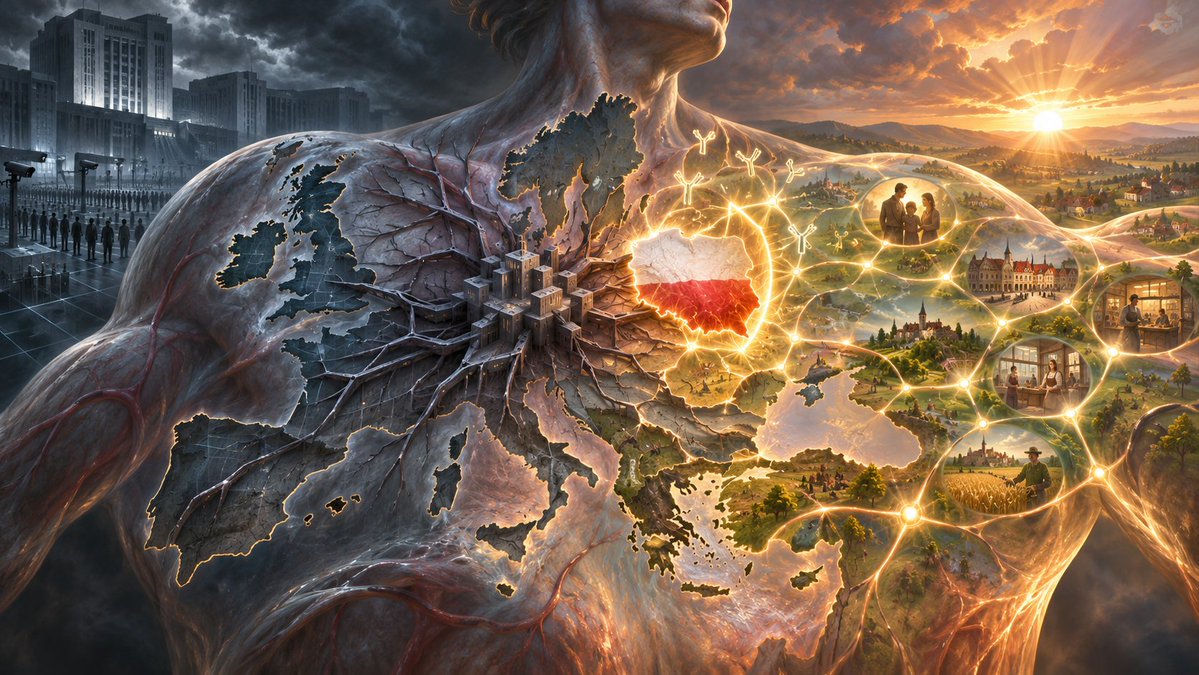
In the 20th century, Europe had cancer: totalitarianism. Nazism, Stalinism, tens of millions dead. In 1945, then again in 1989, we thought we had beaten it. People talked about the end of history.
But in Western Europe, we never truly eradicated it. We removed the visible tumor: the uniforms, the camps, the dictators. But we left the diseased cells behind. What remains is the belief that a center should decide everything, that the state should manage everything, that peoples must be guided against their will.
And those cells found a new body to grow in: the European Union. A machine that centralizes, standardizes, decides on behalf of the people, and treats every nation that resists as an anomaly to be corrected.
The disease is coming back. It's a relapse, quieter, slower, more polite. But it's the same disease.
People really need to understand this. The only question that matters now is this one: will it kill the organism this time?
To answer that, you have to see the world the way I see it: as an organism.
A cell is an organism. An organ is an organism. A human is an organism. A family, a company, a nation are organisms. And humanity as a whole is an organism.
This isn't just a metaphor. It's a lens that explains a lot.
A healthy organism isn't run by a center that controls everything. Your brain doesn't tell each of your cells how to divide, how to breathe, how to repair itself. Every cell knows how to do its job. Every organ has its own autonomy. The liver doesn't ask the heart for permission. The system works because it's distributed, and because each level does what it does best.
That's exactly how a healthy society works. The individual runs their own life. The family raises its children. The company creates value. The town handles what's local. The nation protects and settles what no one else can settle. Every level has its role, and none devours the others.
And then there's disease.
In biology, there's a name for a cell that forgets it serves an organism, that starts growing without limit, hoards every resource, and colonizes the organs around it. It's called cancer.
Totalitarianism is the cancer of human societies. A center that keeps growing, that absorbs the economy, culture, education, private life, and ends up killing the very organism that feeds it.
But an organism learns. It's its most extraordinary property. Your immune system remembers every infection it has ever defeated. It recognizes the enemy the second time, and it reacts faster.
Humanity works the same way. It learns through trial, through error, and above all through pain.
The 20th century was our great illness.
We tested several forms of totalitarian collectivism at full scale: Stalinism, Hitlerism, Maoism. The flags were different, the theories were different, but the pattern was the same. The promise of a new man. A new order. A central machine that knows better than you what's good for you. Individuals reduced to cogs, nations dissolved into a project bigger than themselves.
And every single time, the result was the same: camps, famines, persecution, tens of millions dead.
Those dead are our immune memory. They're the price the organism paid to learn to recognize the disease.
The problem is that old demons never really die. They come back as zombies, and not with uniforms and parades. They come back in a cleaner suit, with a softer vocabulary. Nobody talks about class struggle or living space anymore. Now it's governance, regulation, harmonization, shared values, the fight against disinformation.
But the underlying logic is the same: centralize, standardize, decide on behalf of the people, and treat any resistance as a malfunction to be fixed.
Today, this temptation has two names, and we already know them: the globalist project and the European Union.
And there's something deeply symbolic about this playing out in Poland.
Poland is the country where World War II began in 1939. The country carved up by Hitler and Stalin at the same time, which lived through Nazism and then communism. The country of Solidarność, the one that started cracking the Soviet bloc from the inside. If any people in Europe has antibodies against totalitarianism, it's the Poles.
Over the past few days, the government of Donald Tusk, Brussels' golden boy, had police surround the Constitutional Tribunal. A judge whom the Polish president had refused to swear in announced she was suspending the Tribunal's president, who was then blocked from entering his own institution. President Nawrocki turned his plane around mid-flight to rush back to Warsaw. He denounced a violation of the constitutional order and the forcible takeover of a state body. Even liberal legal scholars who oppose the Tribunal's president say the legal basis for this suspension is nonexistent.
Let's call it what it is: an attempted coup. And to me, this is the European project showing its true face. When the ballot box and the institutions don't go the right way, you go around the ballot box and you seize the institutions.
If this power grab succeeds, you can picture a world that slowly slides toward a third world war. A Europe fracturing between peoples who resist and powers who impose. And at the end of it, everything that always follows: camps, famines, persecution. History doesn't repeat itself, but it rhymes.
And yet, I'm optimistic. Deeply.
Because the organism has learned. The immune memory is there. Millions of people see the pattern. They feel something is wrong, even if they can't quite put it into words yet. Information now flows outside the controlled channels. The antibodies are waking up, in Poland, in Hungary, in the United States, and in France too.
I believe we're capable of not repeating the same mistakes. But for that, we'll have to choose. And we'll have to choose with clear eyes.
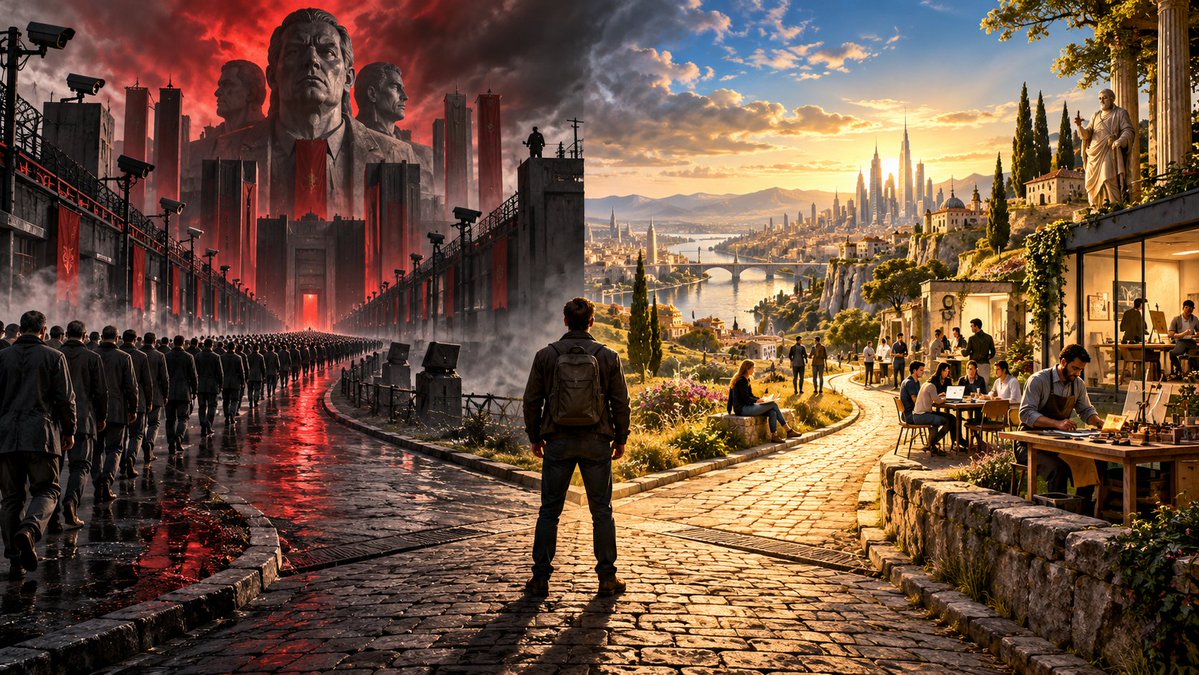
The first path is totalitarianism. The path of Macron, Philippe, Attal, and everyone who embodies the globalist project.
The most unsettling part is that even they don't realize it. They're not movie villains. They sincerely believe they're doing good. They're cogs in a machine bigger than they are, a machine that is gently taking us back to where we've already been. That's always how it starts. Totalitarianism never needed monsters. It needs people convinced they're right, and a system with no checks and balances left.
The second path is a return to sovereign nations.
A state that massively pulls back from what it doesn't know how to do, starting with the economy. That stops planning, subsidizing, and regulating every move of every entrepreneur. That gives individuals, families, and companies their autonomy back, like the organs of a healthy body.
And a state that refocuses radically on its core sovereign functions, on what only it can do: security, justice, borders, defense. A smaller but stronger state. Less present in your life, but truly there when it matters.
It's a return to the logic of living things. A distributed organism, where every level does its job, and the center protects without devouring.
There's no real third way anymore. The status quo isn't an option: it's just the first path taken slowly.
The organism has already seen where the first road leads. It still carries the scars.
So, will the cancer kill the organism? I don't think so. But only if we choose the second road. And only if we choose it now.
Ko smo se odločali za vstop v EU, si ni nihče predstavljal, da bo v kaki njeni članici in uniji nasploh mogoče brez posledic:
1. Razveljaviti predsedniške volitve (Romunija);
2. Ukiniti informativni program na nacionalni RTV (Madžarska);
3. Poslati policijo na Ustavno sodišče (Poljska);
4. Tri tedne pred volitvami poslati v zapor predsednika stranke, ki vodi v anketah (Slovenija);
5. Zasesti nacionalno RTV s policijo in zamenjati vodstvo (Poljska);
6. Prekiniti mandate vodstvu nacionalne RTV in izvesti čistko zaposlenih (Slovenija);
7. Poslati v zapor člane prejšnje vlade brez možnosti obrambe (Madžarska);
8. Podeliti skoraj milijon državljanstev ilegalnim migrantom po hitrem postopku (Španija);
9. Zapreti novo Nuklearno elektrarno in zgraditi plinovod do Rusije (Nemčija);
10. Obdavčiti ogljične energetske vire ob hkratnem zapiranju NE ter preseliti industrijo v države z nizkimi ekološkimi standardi pod pretvezo, da tako rešujemo planet.
Nastala je EU, ki se mora reševati sama pred sabo.
“L’UE n’a RIEN à voir”, Jean ? Vraiment ?
Tu couvres Bruxelles depuis trente ans, alors je vais t’ouvrir les yeux sur ce que tu ne vois plus.
Commençons par la Pologne. Le cœur de la crise, c’est le Tribunal constitutionnel. Qui a déclaré que ce tribunal n’était pas un tribunal indépendant ? La Cour de justice de l’Union européenne, le 18 décembre 2025, saisie par la Commission européenne. Pourquoi la Commission l’avait-elle attaqué ? Parce qu’en 2021, ce tribunal avait osé dire que la Constitution polonaise primait sur le droit européen. Le ministre de la Justice de Tusk l’a dit lui-même : cet arrêt “oblige” l’État polonais à agir. Bruxelles n’a pas envoyé la police devant le Tribunal. Bruxelles a signé le permis.
Maintenant, la vraie question. Pas “le PiS avait-il raison ?”, pas “Orbán était-il corrompu ?”. La seule question qui compte : quand un peuple dit non, quand un peuple vote mal, quand un gouvernement déplaît, que se passe-t-il ? Regarde les faits. Ils pointent tous dans la même direction.
Quand un peuple dit non, on le fait revoter ou on le contourne. Le Danemark rejette Maastricht en 1992 : on le fait revoter en 1993. L’Irlande rejette le traité de Nice en 2001 : on la fait revoter en 2002. La France et les Pays-Bas rejettent la Constitution européenne en 2005 : elle revient en 2007 sous le nom de traité de Lisbonne, sans référendum. L’Irlande rejette Lisbonne en 2008 : on la fait revoter en 2009. Les Pays-Bas rejettent l’accord d’association avec l’Ukraine en 2016 : il est ratifié quand même. La Grèce vote non à 61 % au plan de la troïka en juillet 2015 : huit jours plus tard, elle signe un plan encore plus dur. Six peuples, six non, aucun n’a tenu. En trente ans, un non n’a jamais été une réponse. Seulement un brouillon.
Quand un gouvernement déplaît, on coupe l’argent. Les fonds européens de la Pologne sont gelés sous le PiS. Tusk arrive : débloqués en deux mois. Les fonds de la Hongrie sont gelés sous Orbán, 17 milliards d’euros. Orbán perd le 12 avril 2026 : accord pour débloquer plus de 16 milliards fin mai, sept semaines plus tard. Mêmes traités, même pays, même argent. Seul le gouvernement a changé.
Et ce n’est même pas caché. En septembre 2022, à trois jours des élections italiennes, Ursula von der Leyen est interrogée sur une possible victoire de la droite. Sa réponse : “Si les choses vont dans une direction difficile, j’ai parlé de la Hongrie et de la Pologne, nous avons des outils.” La présidente de la Commission prévient un peuple de ce qui l’attend s’il vote mal.
Quand une élection gêne, on la neutralise. En 2011, la BCE envoie à Rome une lettre qui dicte la politique économique de l’Italie. Quelques mois plus tard, Berlusconi tombe et Mario Monti, ancien commissaire européen que personne n’a élu, prend sa place. La même année, Papandréou annonce un référendum en Grèce. Il l’abandonne sous la pression de Paris et Berlin, et il est remplacé par Loukas Papadímos, ancien vice-président de la BCE, lui non plus élu. Fin 2024, l’élection présidentielle roumaine est annulée. Thierry Breton, ancien commissaire européen, commente sur RMC : “On l’a fait en Roumanie”, en ajoutant qu’il faudrait le faire en Allemagne si nécessaire.
Quand une décision engage des peuples, on ne leur demande rien. Pour le Mercosur, la France vote contre et se fait mettre en minorité. L’accord est découpé pour contourner les parlements nationaux, puis appliqué provisoirement sans attendre l’avis de la Cour. Pour l’immigration, le Pacte impose une “solidarité obligatoire” : tu accueilles ou tu paies. Pas un seul peuple consulté.
Quand on veut savoir, on te ferme la porte. La présidente de la Commission négocie par SMS avec le patron de Pfizer le plus gros contrat de l’histoire de l’UE. Elle refuse de les communiquer. En mai 2025, le Tribunal de l’Union européenne juge ce refus illégal.
Prends n’importe lequel de ces faits isolément, et tu trouveras toujours une excuse : la crise, l’état de droit, l’urgence, la technique. Mets-les bout à bout. Trente ans, des dizaines de cas, et pas une seule fois l’arbitrage n’a penché du côté du vote populaire contre Bruxelles. Une erreur, c’est un accident. Dix erreurs dans le même sens, c’est un système.
Et un système a toujours une idéologie. Celle de l’UE n’est même pas cachée : il suffit de lire ses propres textes.
Le 22 novembre 2023, le Parlement européen adopte une résolution pour réviser les traités. Le but : supprimer le droit de veto des États dans de nombreux domaines et transférer de nouvelles compétences à Bruxelles. Dans ses références officielles, il cite le Manifeste de Ventotene. Ce texte de 1941, coécrit par Altiero Spinelli, un ancien communiste, annonce que la révolution européenne devra être socialiste. Il écrit aussi que la propriété privée devra être “abolie, limitée, corrigée, étendue au cas par cas”. Quand Giorgia Meloni a lu ces passages devant le Parlement italien en mars 2025, la gauche a crié au scandale. Les fact-checkeurs ont pourtant dû l’admettre : chaque phrase est bien dans le texte. C’est cette référence-là que le Parlement européen a choisi d’inscrire dans sa résolution de 2023.
Regarde ensuite la méthode. Bruxelles avait décrété qu’à partir de 2035, plus aucune voiture thermique neuve ne pourrait être vendue à 450 millions d’Européens. Il a fallu la fronde de sept États et de toute l’industrie automobile pour qu’elle recule en décembre 2025. En 2020, l’UE a émis pour la première fois une dette commune massive, 750 milliards d’euros, que nos enfants rembourseront. Aucun référendum. Chaque crise sert le même objectif : la dette Covid, l’énergie, la santé, la défense. La direction ne change jamais : vers le centre.
Et où se fabrique cette vision ? Pas dans un complot. Dans un annuaire public. Ursula von der Leyen siégeait au conseil d’administration du Forum de Davos, et elle y figurait encore au moment d’être désignée présidente de la Commission. Christine Lagarde, présidente de la BCE, y siège toujours, et Davos veut en faire sa présidente. C’est là que Klaus Schwab a lancé en 2020 son “Great Reset” : profiter de la crise du Covid pour réinitialiser l’économie mondiale. Mêmes salles, mêmes gens, même idée : gérer le monde d’en haut.
Voilà pourquoi je dis que ce projet est communiste dans son ADN. Pas le communisme des chars et des goulags. Le communisme de méthode : une avant-garde éclairée qui sait mieux que toi ce qui est bon pour toi. Elle planifie ta voiture, ton énergie, ta monnaie, tes frontières, et elle traite chaque vote contraire comme une erreur à corriger. Le Manifeste de Ventotene appelait ça la dictature du parti révolutionnaire. Aujourd’hui, ça s’appelle la Commission.
Et je ne suis pas seul à le voir. Elon Musk demande l’abolition de l’UE et le retour de la souveraineté aux nations. La stratégie de sécurité nationale des États-Unis écrit noir sur blanc que l’Union européenne sape la liberté politique et la souveraineté des peuples. Alex Karp répète que l’Europe a abandonné la course à l’IA et que son modèle de régulation est exactement ce qu’il ne faut pas faire. Si tu penses être plus lucide que ces gens-là sur un sujet aussi profond, tu es juste un peu naïf.
Donc à partir de maintenant, trois possibilités : tu es corrompu, tu es stupide, ou tu es enfin éclairé.
Ne me remercie pas.
1/2
Suomalainen on totisesti maailman onnellisin ihminen – ainakin jos onnellisuutta mitataan sillä, kuinka leveästi kansalainen jaksaa hymyillä samalla, kun oma valtio tyhjentää hänen taskunsa, vie tuhkatkin pesästä ja myy vielä kansallisomaisuudetkin ulkomaille. Meille on vuosikausia hoettu vakavalla naamalla, kuinka tähtitieteelliset polttoaineiden ja lämmitysöljyn hinnat johtuvat vain ”maailmanmarkkinoiden häiriöistä”, ”sodasta” ja ”vihreästä siirtymästä”, joille me pienet raukkuuden esikuvat emme muka mahda yhtään mitään.
Nyt tämä satu on riisuttu alastomaksi, ja alta paljastuu laillistettu puhallus, jolle kalpenevat jo keskiaikaiset vouditkin. Valtion enemmistöomistama öljy-yhtiö Neste löi pöytään heinä–syyskuun osavuosikatsauksensa: yhtiön liikevaihto paisui 6 551 miljoonaan euroon ja vertailukelpoinen käyttökate lähes kolminkertaistui käsittämättömään 1 555 miljoonaan euroon vuodentakaisesta 531 miljoonasta. Yli puolitoista miljardia euroa katetta pelkästään kolmessa kuukaudessa maassa, jonka talous on virallisen totuuden mukaan niin kuralla, ettei meillä ole enää varaa edes neuvoloihin tai kyläkouluissa opettamiseen.
Mistä tämä rahasade sitten oikein taikoontui? Ei mistään suomalaisen insinöörityön mystisestä taikatempuista, vaan siitä, että Neste kiskoo tällä hetkellä jokaisesta jalostamastaan öljytynnyristä kovempaa jalostusmarginaalia kuin yksikään länsimainen öljyjätti maapallolla. Jopa pörssianalyytikot haukkovat henkeään ja kutsuvat tasoa ”aivan käsittämättömän korkeaksi”. Katsokaa ja verratkaa, kuinka paljon raakaöljyn ostohinnan ja valmiin polttoaineen myyntihinnan välistä katetta eri jätit ottivat jokaiselta tynnyriltä kolmannella vuosineljänneksellä:
• Neste: 48,2 dollaria barrelilta – kirkkaasti koko läntisen maailman kovin välistäveto, yli kolminkertainen vuodentakaiseen 15,5 dollariin verrattuna.
• Shell: 42,0 dollaria barrelilta – yhtiön oma historiallinen ennätys, mutta silti yli 6 dollaria tynnyriltä vähemmän kuin Nesteellä.
• Yhdysvaltain jalostamot keskimäärin: noin 42,0 dollaria barrelilta – maassa, jossa halpa kotimainen raaka-aine ja energia tekevät jalostamisesta kultakaivoksen.
• Valero (USA): 39,24 dollaria barrelilta – täydet 9 dollaria tynnyriltä vähemmän kuin meidän kotimaisella kruununjalokivellämme.
• Phillips 66 (USA): 38,0 dollaria barrelilta – yli 10 dollaria tynnyriltä vähemmän kuin Nesteellä.
• TotalEnergies: 33,2 dollaria barrelilta – peräti 15 dollaria tynnyriltä vähemmän kuin Porvoon jalostamon portilta ulos ajettavassa tavarassa.
Lähi-idässä Aramco, ADNOC ym. eivät julkaise samanlaista läpinäkyvää barrelikohtaista refining-marginaalia kuin US-yhtiöt. Heidän etunsa on pääosin halvassa raaka-aineessa ja energiassa sekä alhaisissa tuotantokustannuksissa mutta moni laitos on ollut vaurioituneena tai rajoitettuna.
Luitte aivan oikein. Maailman suurimmat monikansalliset öljyjätit kalpenevat kateudesta, kun Suomen valtion oma yhtiö näyttää, miten omaa kansaa lypsetään kuiviin suljetulla markkinalla. Yhdysvalloissa jalostamot joutuvat sentään kilpailemaan keskenään, mutta Suomessa autoilija, rekkakuski, traktorin tankkaaja ja öljylämmittäjä ovat maantieteellisessä vankilassa. Kun kilpailua ei ole, jokainen noista ylimääräisistä marginaalidollareista nyhdetään suoraan sinun lompakostasi, kun seisot marraskuun räntäsateessa tankkaamassa autoa päästäksesi töihin.
Mutta eihän suomalainen kurittaminen olisi täydellistä ilman ideologista kirsikkaa kakun päällä. Kun fossiilisen öljyn 48,2 dollarin tynnyrimarginaali muunnetaan tonneiksi, se on noin 355 dollaria tonnilta. Vaan paljonko Neste otti myyntimarginaalia uusiutuvista polttoaineistaan? Käsittämättömät 1 068 dollaria tonnilta – yli tuplat vuodentakaiseen 480 dollariin verrattuna, ja kesällä käytiin jo 1 223 dollarissa! Ja aivan sattumalta juuri samalla viikolla valtion rahoittama 15 professorin Ilmastopaneeli marssii julkisuuteen vaatimaan, että polttoaineiden jakeluvelvoite on nostet
https://t.co/oNuSaLJJJC?
With everything happening right now, one thing is almost certain: globalism and the European Union are going to collapse, and sooner than anyone in Brussels is willing to admit.
So let's stop mourning the old world and start designing the next one.
Here are my proposals.
The Ten Commandments of the Western Renaissance
I. Every people is sovereign in its own home. It alone decides its immigration policy, holds its borders, and sets the rules of assimilation. No supranational body will ever decide in its place who becomes one of its own.
II. Merit becomes the law again. Hierarchy is built on competence, work, and results. Not quotas, not networks, not administrative castes.
III. Every nation's culture is a sacred treasure. Multiculturalism doesn't make cultures coexist. It dissolves them all. The only way to protect the world's diversity is to protect the uniqueness of each people.
IV. Optimism is a duty. No more prophets of degrowth who for fifty years have told us to be ashamed of existing, producing, and dreaming. The future is not a threat. It is a conquest.
V. Speech is free. A First Amendment for the entire West. No state, no platform, no committee has the right to decide what a citizen may think or say.
VI. A free people is a people that can defend itself. A Second Amendment for the West: the right to own a firearm and learn to use it. A freedom you cannot defend is just a permission.
VII. Abundant energy is the foundation of power. Massive nuclear, cheap energy, produced on our own soil. A civilization that rations its energy has already begun to die.
VIII. Family is the first pillar of the nation. A civilization that no longer has children has no future left to defend. Birth rates become a national priority.
IX. No transfer of sovereignty without the people. Never again a treaty imposed after a No vote. Every surrender of power goes through a referendum, and the people can always take back what they gave.
X. We build. Factories, power plants, rockets, AI, semiconductors. The West becomes once again the civilization that builds, invents, and sets out to conquer the stars.
A Letter to America, From a Frenchman Who Loves You
Yesterday, the Prime Minister of Poland posted this: "Restoring the rule of law is our duty. After years of PiS-led lawlessness, this is a difficult process, sometimes painful, and it requires decisive action. There is no other way."
Read it slowly. "There is no other way." In today's Europe, that is the sentence a government says right before doing something it could not do through the normal rules.
I'm French. I'm the grandson of a farmer from Brittany. I taught myself to code at twelve, spent a year in Silicon Valley when I was young, and today I build a tech company between Paris and San Francisco. I'm writing to you because I watch what is happening to my continent, and I'm afraid you are about to take the same road.
Let me tell you what "rule of law" means in Europe now.
When Donald Tusk came to power in December 2023, one of his first moves was to take over Poland's public broadcaster. Rather than pass a media law the president would veto, his government used corporate law to replace its leadership, and the state news channel briefly went dark. When that was blocked, it put public TV into liquidation. When the Constitutional Tribunal ruled against the government, the government stopped recognizing its rulings. Tusk himself said openly that restoring the rule of law would sometimes require decisions that would not fully meet the criteria of legality.
And Brussels? For years, the European Commission froze billions in EU funds to Poland over "rule of law" concerns under the previous conservative government. Once Tusk was in, it unfroze the money and closed its proceedings.
That's the lesson. In Europe, the rule of law is no longer a principle. It is a label. When a conservative government reshapes the courts, it's an assault on democracy. When a pro-Brussels government ignores a court, it's "restoring the rule of law."
It isn't only Poland. In Romania in December 2024, the Constitutional Court annulled the first round of a presidential election after the wrong candidate came first. In France, a TV channel, C8, lost its broadcasting license in 2025, and this week a member of parliament declared that shutting down CNEWS, the most-watched news channel in the country, is "a priority." In Germany, domestic intelligence labeled the main opposition party extremist. In Brussels, the Digital Services Act gives unelected commissioners the power to fine platforms up to 6% of global revenue, and its first fine ever went to X, with more investigations into "disinformation" still open.
There are no gulags here. Let me be precise about that. But there is a reflex: an elite that knows better than the people, that decides what the people are allowed to read, and that corrects their vote when it comes out wrong.
Now let me tell you why you are the first power on earth.
It's not oil. It's not size. It's not luck. Europe has had all of those. You are number one because you built your entire system on a radical idea: the individual comes before the state. Your First Amendment doesn't say "speech shall be protected unless it's disinformation." It says Congress shall make no law. Your Constitution protects private property against the government that wrote it. And your culture lets people fail and try again.
In France, a founder who fails carries it for life. In America, a founder who fails is called experienced. In Europe, we passed a law to regulate artificial intelligence before we had an AI industry. You built the industry. That's not an accident. That's what happens when a society trusts its citizens more than its bureaucrats.
Your system is not perfect. Your politics are loud, ugly and polarized, and I see it. But it is fairer than ours, because it was designed by people who distrusted power, including the power of good intentions. That distrust is the most valuable thing you own.
So here is what worries me as I watch you vote on Tuesday.
From Paris, when I look at the Democratic side, I recognize the European reflex. I saw an administration lean on social media platforms to take down posts; Mark Zuckerberg later wrote to Congress that the government had repeatedly pressured Meta to censor content and that he regretted not pushing back. I saw a proposal to tax unrealized gains, meaning taxing wealth you haven't even sold. I hear calls to end the filibuster, add seats to the Supreme Court, and add new states to the Senate. Each one can be defended on its own. Together, they look like what Europe did: when you can't win under the rules, you change the referee. And a majority that rewrites the rules in its favor doesn't plan on being a minority again.
The twentieth century already ran the collectivist experiment, and it ran it to the end. Every time a state decided that individuals were a means to a collective goal, and that some category of people stood in the way of justice, it ended in camps and mass graves. Tens of millions dead. But it never started with camps. It started with good intentions, a moral elite, and a list of things that were too dangerous to say, too much to own, too misinformed to count.
I'm not telling you Democratic voters are Bolsheviks. Most of them are your neighbors and they want good things. I'm telling you the reflex is real, that I live under it every day, and that you are the last big country on earth built to resist it.
When Europeans want to build something, we look at you. When we leave, we go to you. If you become us, there is nowhere left to go.
Keep your First Amendment. Keep your property. Keep your right to fail. Vote on Tuesday.
From Paris, with love, and with fear.
What just happened in Poland is something every Western citizen should look at squarely. Because it's the trailer for what's coming to the rest of us.
Friday night in Warsaw, the president of the Constitutional Tribunal and his vice-president were "suspended" for a month. The announcement appeared on the Tribunal's own website, which the Tribunal's leadership says was unlawfully taken over. Right after, riot police deployed around the country's highest court and entered the building. The President of the Republic, Karol Nawrocki, was mid-flight to Senegal. He turned the plane around.
Read that again, slowly. In a European Union member state, in 2026, police walk into the constitutional court and the head of state has to rush home.
This is not an accident. It's the endpoint of a method. December 2023: barely in office, the Tusk government cuts the signal of the public news channel and puts public television into liquidation. Then it stops publishing the Constitutional Tribunal's rulings in the official gazette. When the Tribunal suspends one of its reforms, a ministry calmly replies that the court has "no legal basis" to operate. The justice minister moves to strip the court president's immunity. And when none of that is enough, they send in the uniforms.
The official story is "we are restoring the rule of law." It's always the official story. Nobody has ever dismantled a democracy while announcing they were dismantling a democracy.
Now zoom out. Why now?
Because the globalist project is losing its grip. They lost the media war: people get their information elsewhere, compare, verify, and no longer trust the official line. They lost the trust of the people. And the countries that are bouncing back, the ones finding their energy, their birth rates, their pride again, are precisely the ones that understood that the Brussels machine, as it runs today, is not the cure but the disease. Poles elected Nawrocki against the system's candidate. The message was clear.
When a system loses trust, it has two options: reform or harden. They chose. All-in.
Think of an organ transplant. The body rejects the organ. The surgeon doesn't conclude the organ is incompatible. He raises the immunosuppressants. Then raises them again. Until the body can no longer defend itself at all. That's the mechanism now in motion: platform regulation in the name of fighting "disinformation," Chat Control that keeps coming back to the table, the digital euro, a presidential election annulled in Romania in 2024, and now police inside a constitutional court.
And this is where history should chill us. No totalitarian regime of the 20th century began with people who thought they were evil. They all began with elites convinced they were right against their own people, and ready to suspend the rules "temporarily" to save the people from themselves. We know how that ended. Millions dead. I'm not saying it's tomorrow. I'm saying it's the slope, and you don't climb back up a slope once you've started sliding.
And don't think this stops at the Vistula. The tools are European, which means they're already in France, in Germany, everywhere. What's being tested in Warsaw is the answer to one simple question: how far can you go against an institution that gets in your way before anyone pushes back? If the answer is "very far," France in 2027 has been warned. And every Western democracy should be taking notes.
So they have to be stopped now. Not with violence. With what still works as long as we use it: the vote, free speech, refusing to self-censor, and demanding that our judges, our media, and our elections stay independent from ALL powers, including the ones claiming to protect us. This is the moment it's decided. Once the hard phase begins, it's already too late.
Watch Poland. And open your eyes.