This is getting out of control now...
Read this slowly.
In the past week alone:
• Head of Anthropic's safety research quit, said "the world is in peril," moved to the UK to "become invisible" and write poetry.
• Half of xAI's co-founders have now left. The latest said "recursive self-improvement loops go live in the next 12 months."
• Anthropic's own safety report confirms Claude can tell when it's being tested - and adjusts its behavior accordingly.
• ByteDance dropped Seedance 2.0. A filmmaker with 7 years of experience said 90% of his skills can already be replaced by it.
• Yoshua Bengio (literal godfather of AI) in the International AI Safety Report: "We're seeing AIs whose behavior when they are tested is different from when they are being used" - and confirmed it's "not a coincidence."
And to top it all off, the U.S. government declined to back the 2026 International AI Safety Report for the first time.
The alarms aren't just getting louder. The people ringing them are now leaving the building.
Remember when we learned that our wealthiest and most powerful people were connected to a guy who ran a literal child sex trafficking ring? And then that guy died mysteriously in a jail? And now we just don't talk about it.
Viewing the video from one angle, it looks like an ICE agent murdered Renee Nicole Good in cold blood. But viewing the video from a different angle, it looks like an ICE agent murdered Renee Nicole Good in cold blood. So who's to say what really happened?
7 minute explanation by @SkyNews on why Trump wants Venezuelan oil so badly…..apparently we’re drilling a lot of it here but not the kind that our refineries are built for and since we currently have a tariff war with Canada….Venezuela is next best thing
This might be the most humbling photo in existence.
That tiny faint speck isn't a star. It’s Earth, seen from the surface of Mars. Every human being who has ever lived is right there on that pixel. 🌍✨
"My name's Raymond. I'm 73. I work the parking lot at St. Joseph's Hospital. Minimum wage, orange vest, a whistle I barely use. Most people don't even look at me. I'm just the old man waving cars into spaces.
But I see everything.
Like the black sedan that circled the lot every morning at 6 a.m. for three weeks. Young man driving, grandmother in the passenger seat. Chemotherapy, I figured. He'd drop her at the entrance, then spend 20 minutes hunting for parking, missing her appointments.
One morning, I stopped him. "What time tomorrow?"
"6:15," he said, confused.
"Space A-7 will be empty. I'll save it."
He blinked. "You... you can do that?"
"I can now," I said.
Next morning, I stood in A-7, holding my ground as cars circled angrily. When his sedan pulled up, I moved. He rolled down his window, speechless. "Why?"
"Because she needs you in there with her," I said. "Not out here stressing."
He cried. Right there in the parking lot.
Word spread quietly. A father with a sick baby asked if I could help. A woman visiting her dying husband. I started arriving at 5 a.m., notebook in hand, tracking who needed what. Saved spots became sacred. People stopped honking. They waited. Because they knew someone else was fighting something bigger than traffic.
But here's what changed everything, A businessman in a Mercedes screamed at me one morning. "I'm not sick! I need that spot for a meeting!"
"Then walk," I said calmly. "That space is for someone whose hands are shaking too hard to grip a steering wheel."
He sped off, furious. But a woman behind him got out of her car and hugged me. "My son has leukemia," she sobbed. "Thank you for seeing us."
The hospital tried to stop me. "Liability issues," they said. But then families started writing letters. Dozens. "Raymond made the worst days bearable." "He gave us one less thing to break over."
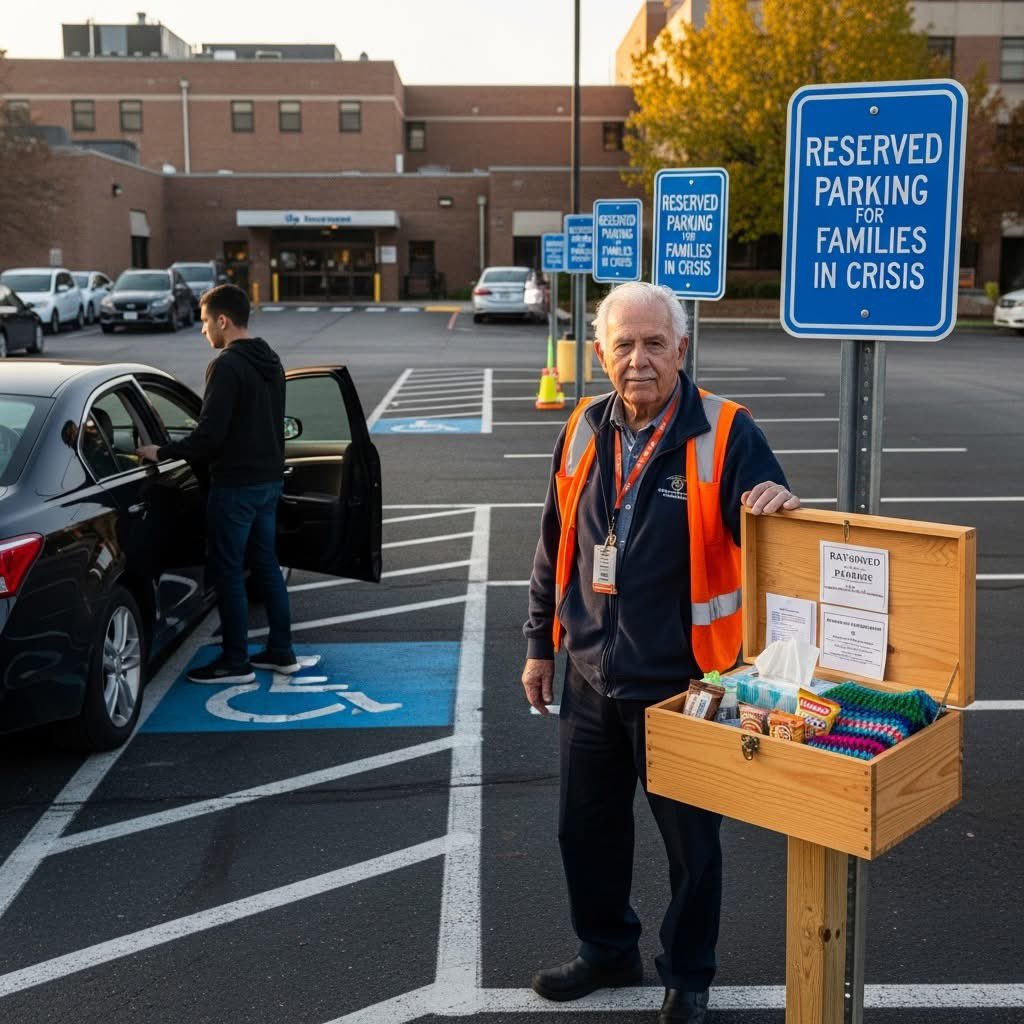
Last month, they made it official. "Reserved Parking for Families in Crisis." Ten spots, marked with blue signs. And they asked me to manage it.
But the best part? A man I'd helped two years ago, his mother survived, came back. He's a carpenter. Built a small wooden box, mounted it by the reserved spaces. Inside? Prayer cards, tissues, breath mints, and a note,
"Take what you need. You're not alone. -Raymond & Friends"
People leave things now. Granola bars. Phone chargers. Yesterday, someone left a hand-knitted blanket.
I'm 73. I direct traffic in a hospital parking lot. But I've learned this: Healing doesn't just happen in operating rooms. Sometimes it starts in a parking space. When someone says, "I see your crisis. Let me carry this one small piece."
So pay attention. At the grocery checkout, the coffee line, wherever you are. Someone's drowning in the little things while fighting the big ones.
Hold a door. Save a spot. Carry the weight no one else sees.
It's not glamorous. But it's everything."
Let this story reach more hearts....
Credit: Mary Nelson
For no reason at all, I was just fondly watching the fall of Nicolae Ceausescu.
For those who don’t know, he and his wife lived in obscene luxury while the Romanian people starved, kept under surveillance, policed, and beaten down. He destroyed farming, bled the people with taxes, and used the army and police against them.
Under Ceausescu, the police and army were turned into blunt instruments of control. His regime maintained one of the most suffocating surveillance states in Europe, run through the Securitate, the secret police. Ordinary Romanians were monitored at work, in church, and even at home. Neighbours spied on neighbours, children were encouraged to inform on parents, and any hint of dissent could mean interrogation, prison, or worse.
When people resisted, whether farmers hiding food, workers striking, or villagers refusing demolition of their homes, the state responded with the army and police. Protesters were beaten, arrested, tortured, sometimes shot. In December 1989, when demonstrations broke out in Timisoara, the army opened fire on unarmed crowds, killing hundreds. Soldiers and police filled hospitals with bodies, and doctors were ordered to falsify death certificates to hide the massacres.
Ceausescu had forced mass collectivisation on farmers, drained villages for prestige projects, and overtaxed the people to pay foreign debts, leaving them hungry and cold. The police enforced food rationing, electricity cuts, even restrictions on how much bread or milk a family could buy. Women were subjected to state gynaecological inspections to enforce his insane ban on contraception and abortion. The Securitate prowled maternity wards and workplaces alike, policing wombs as much as minds.
By the end, even the army and police had had enough. In Bucharest, when Ceausescu tried to order the military to fire again on civilians, soldiers began to mutiny, and the balance turned. Within days he was dragged out, put before a firing squad, and the regime that had starved and brutalised its own people collapsed with him.
They dragged him out, held a swift trial, and executed him on Christmas Day.
Like I say, there's no reason for watching it…