The Death Scramble for Capital A.I. Has Begun. 👇
At 7:45 a.m. this morning, Intel Corp. (Nasdaq: INTC) announced a $15 billion common stock offering.
This afternoon, the Financial Times is reporting that Nvidia will raise an incredible $500 billion in debt with funding from Apollo Global, Blackstone, BlackRock, Brookfield Asset Management, Goldman Sachs and KKR.
There will be more deals announced as the entire A.I. capex boom finally runs out of money.
And there��s never been a more dangerous time to invest. Just look at Intel’s other recent capital raises:
· August 18, 2025: $2 billion from SoftBank Group Corp.
· August 22, 2025: $8.9 billion from the U.S. Treasury
· September 2025: $5 billion private placement to Nvidia Corp.
Intel has also received $5.7 billion from CHIPS Act disbursements. And it sold 51% of Altera for $4.3 billion and all its Mobileye shares for $0.9 billion.
Total capital raised in twelve months: ~$45 billion.
But Intel's capital raising is not a growth signal. It is a solvency warning. Intel's cumulative FCF burn over the last five years was: -$48.7 billion.
The bulls will point to revenue growth: Q2 2026 revenue was $16.13 billion, up 25.4% — Intel's fastest quarterly growth since 2011. But, even so, Intel is still not even close to generating cash earnings. Revenue growth without earnings is the signal hallmark of a capex bubble. WorldCom had it in 2001. Jay Cooke's Northern Pacific had it in 1872.
This essay explains why that will happen within the next year.
In November 2007, Citigroup Inc. (NYSE: C) sold $7.5 billion of preferred stock to the Abu Dhabi Investment Authority.
A month later, Morgan Stanley (NYSE: MS) sold $5 billion to China Investment Corp.
Then, in January 2008, Merrill Lynch took $6.6 billion from Kuwait, Korea, and Temasek and UBS AG (NYSE: UBS) sold $9.75 billion to the Government of Singapore Investment Corp.
Two things struck me at the time:
#1. Sovereign wealth funds are the biggest piles of “dumb” money ever created and they’re proving it;
#2. If they’re the only buyers, the banks are completely fucked.
On May 31, 2008, in my newsletter, Stansberry’s Investment Advisory, I wrote:
Firm after firm has been trying to raise capital before the money runs out, just like the railroads did in 1907. And like they did then, financial institutions are using innovative ways, like convertible preferred shares, to entice investors to buy into their stock at a sharp discount from its market price. Even so, firms are beginning to discover no more money is available. That’s what happened to Bear Stearns. As its mortgages lost value, it couldn’t raise enough capital to pay for the losses, thanks to extreme leverage, about 30-to-1.
Within months, Fannie Mae, Freddie Mac, Bear Stearns, Lehman Brothers, Merrill, Citi, Wachovia, and Washington Mutual were all destroyed.
It’s all happening again.
No, not in mortgage banking this time. Today the capital tide is going out in tech. The death scramble for capital is starting.
On June 15, 2026, Nvidia – the A.I. market’s clear technical leader – priced $25 billion (!) of senior unsecured notes across seven tranches. Coupons ran from 4.25% on the 2028s to 5.625% on the 2056s – incredibly cheap capital, relative to U.S. Treasury bonds. But, Nvidia’s stated use of proceeds was merely “general corporate purposes, including the repayment and refinancing of outstanding notes.”
On the surface, that doesn’t make any sense. Nvidia only had $8.5 billion of senior notes outstanding. And… then there’s this: Nvidia generated roughly $50 billion of free cash in the second quarter. Companies with $50 billion of quarterly free cash do not raise $25 billion in debt for general corporate purposes.
And… before I could even publish this today… Nvidia just announced it’s going to raise another $500 billion (!) in debt. Why does it need so much money?
So… what’s the money really for…? Vendor financing.
Vendor financing is also known as ‘lending for revenue’ or more darkly, ‘how to turn a credit rating into earnings.’ Ask Enron or GE to explain how it works out.
Nvidia, seeing these cautionary tales, has… doubled down. Instead of merely providing credit for the purchase of its products, Nvidia is providing equity for its clients. Nvidia’s private-company investments grew from $3.24 billion to $42.34 billion in the twelve months ending April 26, 2026. That’s a 13-fold increase in a year. Is Nvidia a hedge fund? Is it a venture capital fund? Nvidia is supposed to be the world’s leading provider of compute. But it’s beginning to look, more and more, like a very sophisticated Ponzi scheme.
Nvidia’s latest quarterly filing notes, with unintentional irony: “some of these investments include AI model makers that may indirectly purchase or use our products in the cloud.”
The same filing also discloses agreements to guarantee partners’ facility lease obligations. And what’s the collateral? Warrants on their stock. Or, in other words: Nvidia is now selling default protection on its customers’ real-estate obligations. These are the same customers it is simultaneously financing to buy its own chips. Do Nvidia’s customers actually pay for anything…?
We have seen this before. That is the exact financial structure that destroyed the telecom equipment companies during the Internet bubble.
Lucent booked revenue selling switches to Winstar Communications on vendor financing. Winstar filed Chapter 11 in April 2001. Lucent took $2.2 billion of bad-debt provisions in fiscal 2001 and $1.3 billion more in 2002.
To survive, the telecom equipment makers began a “death scramble” for capital. Lucent Technologies raised $1.75 billion, upsized to $2.0 billion, of convertible preferred stock in August 2001 with an 8% coupon. The investors that bought these securities lost everything.
Lucent lost $16.1 billion in fiscal 2001 and $7 billion in fiscal 2002. And then it disappeared.
Remember that in the coming months as every kind of A.I. business is trying desperately to raise capital. Don’t buy it. No matter how good the terms seem.
And be especially careful of the concentration that occurs when an entire industry is being funded by only a handful of equipment vendors.
In the telecom bubble, McKinsey put the combined telecom-equipment vendor financing at year-end 2000 at $25.6 billion across only nine suppliers.
A.I. is even more concentrated.
Nvidia’s 10-Q discloses three direct customers at 21%, 17%, and 16% of revenue. And three customers at 30%, 18%, and 16% of receivables. The filing adds that “one AI research and deployment company contributed to a meaningful amount of our revenue by purchasing cloud services from our customers.”
You’ve got two guesses, lol. There are only two private companies that now anchor most of the AI-capex demand.
On September 10, 2025, OpenAI signed a five-year, $300 billion compute contract with Oracle Corp. (NYSE: ORCL) OpenAI’s 2025 revenue was approximately $10 billion. The contract requires OpenAI to pay Oracle an average of $60 billion a year.
On April 20, 2026, Anthropic committed more than $100 billion over ten years to https://t.co/gqUIUAzUOn Inc. (Nasdaq: AMZN) to buy Trainium chips. Where’s the money coming from? Amazon invested $5 billion in additional equity on top of the $8 billion previously invested, with up to $20 billion more tied to milestones.
Two private companies. Combined revenue perhaps $50 billion this year. Combined committed compute purchases over $500 billion! The question for investors isn’t whether or not these firms will see revenue growth. The question is: at what margin? And, if the answer to that question is less than zero, there’s going to be an epic financial crisis.
How’s it going so far? They’re expected to lose $20 billion this year alone.
What caused the telecom bust of 2001? As one recent analysis of the vendor-financing loop put it, “it was a synchronized unwind, with roughly four dozen competitive local exchange carriers entering bankruptcy across 2000 to 2003 as the same funding source dried up for all of them at once.”
When funding tightens on OpenAI or Anthropic, every hyperscaler and every neocloud holding compute orders in “committed backlog” will discover what those receivables are worth: nothing.
Who’s most at risk from extreme vendor financing deals…?
Meta Platforms Inc. (Nasdaq: META) discloses in its 2025 10-K a 20% interest in a Louisiana data-center venture formed in October 2025 that Meta does not consolidate. Meta’s maximum loss exposure: $45.95 billion.
So… who really owns this data center?
Meta’s auditor, Ernst & Young, designated “accounting for a variable interest entity” a critical audit matter in the 2025 annual report. It said its determination of which entity was the primary beneficiary was “especially challenging due to the significant judgment required.”
Moody’s, in a February 23, 2026 opinion, wrote that Meta’s accounting “is not in line with the expected economics of this transaction,” called its disclosure “opaque,” and warned it stood ready to make a “quantitative debt adjustment.”
You can’t say that investors haven’t been warned. But it is extraordinary that they haven’t yet begun to punish the guilty.
And remember when the financial plumbing goes zero-sum, the pain will not be meted out equally. It’s the weakest who will suffer the most. As Jesus says in Matthew 25: From him that hath not, even that which he hath is taken away.
Here’s one “hath not” that I’m certain will soon go to zero: CoreWeave Inc. (Nasdaq: CRWV).
CoreWeave is a “neocloud.”
When a business model is described by a made-up word that has no actual meaning in the English language… buyer beware.
Neoclouds are companies that buy huge quantities of Nvidia GPUs, house them in data centers, and rent them out by the hour or the month, primarily to AI companies. CoreWeave's biggest customer (both directly and indirectly) is Anthropic.
CoreWeave has a business model only a sadistic mother would love. It is enormously capital-intensive because it must buy the Nvidia GPUs upfront — billions of dollars at a time. But the customer revenue comes in slowly over the following years.
And here’s the bigger problem: its collateral is also Nvidia GPUs. GPUs are physical hardware that Nvidia itself has said will obsolete on a roughly two-year cycle. A GPU-backed loan is a claim on hardware that is losing value from the moment the loan is signed. And the price of these rapidly depreciating assets is correlated to demand for CoreWeave’s services. Remember how the car rental companies all go broke? When there’s a recession and no one is renting cars, the price of used cars likewise collapses. It will be the same for CoreWeave’s datacenters.
On July 29, 2026, CoreWeave came to the leveraged loan market to raise $2.6 billion of new debt secured by its GPUs. But the death scramble for capital had already begun. The primary dealers running the loan book found that their own repo funding cost had risen (more about this below). And the private credit funds that would normally buy the loan had less cheap repo funding available themselves. Worse still, CoreWeave's collateral looked shakier than it had ten weeks earlier, because the market had started digesting the possibility that AI-application revenue wasn't scaling as fast as the capex commitments.
The loan came to market with initial price talk of SOFR+425 to +450 at 99 OID. Translation: the interest rate would be the standard short-term rate (SOFR, currently around 4.3%) plus roughly 4.4% on top — so about 8.7% all in — and the buyer would pay 99 cents on the dollar and get repaid at 100, giving them a small extra return over the life of the loan. That's "price talk" — where the underwriters expected the deal to clear based on pre-marketing to buyers.
The deal actually cleared at SOFR+550 at 97 OID. Translation: the interest rate rose to about 9.8%, and the buyer only paid 97 cents on the dollar and would get repaid at 100 — another chunk of return.
That's a "125-basis-point flex" — the interest rate had to be widened by 1.25 percentage points from the initial guidance to get buyers to take the paper. The total yield to maturity ended up at 10.44%. And to get even that, CoreWeave had to accept a covenant requiring a 1.35x debt service coverage ratio, meaning if its EBITDA falls below 1.35 times its debt payments, the lenders can take action, aka, force the company into liquidation.
Only ten weeks earlier, CoreWeave had raised $3.1 billion at SOFR+450 and the deal had actually tightened by 50 basis points during marketing — meaning demand was so strong the underwriters could offer worse terms to buyers. By late July, the same borrower had to offer 125 basis points more, plus a discount on the paper, plus a tighter covenant, just to get the deal done.
The borrower didn't change materially in ten weeks. But the credit environment did.
What kills capex booms isn’t poor earnings. Investors, seeing revenues soaring, will always put up more capital.
What kills capex booms is the money running out.
And the money is running out.
Hyperscaler free cash flow is on track to fall roughly 50% from its late-2024 peak through early 2026, and to turn negative for the first time in 2027.
That means the entire bubble will depend, more and more, on credit.
Microsoft Corp. (Nasdaq: MSFT), Alphabet Inc. (Nasdaq: GOOG), Amazon, Meta, and Oracle have added roughly $350 billion of on-balance-sheet debt in five years, plus $1.1 trillion of off-balance-sheet data-center lease commitments and GPU supply deals — $1.65 trillion of hidden obligations across five names.
Morgan Stanley estimates the sector faces a $1.5 trillion external financing gap against $2.9 trillion of capex through 2028.
Where will the money come from…?
Banks, ever ready to package dodgy debt for other people to hold, have begun operation “A.I. bag holder.”
Outstanding data-center debt securitization issuance grew from $4 billion in 2020 to $61 billion year-to-date 2026. Today Barclays projects $180 billion in securitizations by year-end 2028 (!) How will so much A.I. data center debt possibly be sold to investors? By regulatory arbitrage of course! How do you make dodgy debt attractive to the financial system? By “proving” to the regulators it’s risk-free.
On February 11, 2026, $500 million of Compass Datacenters’ $830 million ABS became the first data-center securitization rated AAA by Moody’s, S&P, or Fitch. Pricing: +120 basis points over Treasuries.
Keep in mind, Moody’s only began rating the sector in September 2025.
On a credit channel that’s scaled 15x in six years, using a rating methodology that’s about six months old, Moody’s delivered its first AAA-rating just as the bubble reaches its zenith.
Where have we seen this before? The AAA-rated CDO of the AI era is here!
History rhymes because leverage rhymes.
Jay Cooke & Company financed the Northern Pacific Railway on the theory it could always sell more bonds to European investors. A Vienna real-estate bust froze European demand in mid-1873. Cooke was left holding 75% of the bonds himself. He declared bankruptcy on September 18, 1873. The New York Stock Exchange closed for ten days. Eighty-nine of the country’s 364 railroads failed. Eighteen thousand businesses went under. Unemployment reached 14% nationally and 25% in New York City. Rail construction fell from 7,500 miles laid in 1872 to 1,600 miles in 1875.
The A.I. collapse will be similar. What’s the first domino? Oracle.
Its credit spreads will blow out when its $300 billion of committed revenue disappears and its equity will collapse.
Data-center ABS spreads will widen from +400 to +800 basis points within six months of the first hyperscaler cancellation.
Digital Realty Trust Inc. (NYSE: DLR) and Equinix Inc. (Nasdaq: EQIX) marks drop 50%.
Regional banks with datacenter and office exposure will fail: Zions Bancorporation NA (Nasdaq: ZION), Regions Financial Corp. (NYSE: RF), KeyCorp (NYSE: KEY), Truist Financial Corp. (NYSE: TFC), and Fifth Third Bancorp (Nasdaq: FITB).
Index fund concentration is worse today than it was in March 2000. The top seven S&P 500 stocks are 35% of the index today, versus 18% for Cisco Systems Inc. (Nasdaq: CSCO), Microsoft, Intel, and General Electric Co. (NYSE: GE) at the 2000 top. A 50% to 60% Mag 7 drawdown takes the S&P 500 down 35% to 45%.
Treasuries rally… at first. Flight to quality will push the 10-year yield down 75 to 100 basis points. But then the fiscal deficit will soar as capital-gains tax receipts collapse and unprecedented government borrowing demand will push yields to levels we haven’t seen in decades. Over 10% on the 10-year U.S. Treasury bond.
Unemployment will soar. Direct tech and hyperscaler layoffs of 300,000 to 500,000. Data-center construction workers, utility contractors, and second-order services take another million+. Prime-age labor-force participation will fall another 100 basis points.
Then the 2028 election will become a critical referendum on how we’re going to run our country. The Democrats will win. And they will choose socialism.
Expect CHIPS Act 2.0, with grants converted to equity. Expect direct Fed liquidity facilities to backstop the data-center ABS and GPU-collateralized-loan markets, resembling the 2008 CPFF and TALF. Total emergency fiscal envelope, 2026 through 2028: $500 billion to $800 billion, on top of existing deficits.
How to protect yourself? Gold, in the long run. Cash in the short run. Regulated utilities that captured the AI power-purchase agreements before the mania. Tobacco and energy majors with capital discipline. Biotechnology, because compute cannot destroy a twenty-year patent.
What to short: Oracle. CoreWeave. Nebius Group N.V. (Nasdaq: NBIS). IREN Ltd. (Nasdaq: IREN). Vertiv Holdings Co. (NYSE: VRT). Digital Realty. Equinix.
How do I know the funding and the buildout won’t continue? Because this entire bubble was never about technology. The A.I. bubble was caused, like all financial bubbles, by a corruption of the money supply.
The railroad boom of 1865-1873 was fueled by the paper money of the Civil War. The telecom bubble of 2000 was fueled by the Fed’s response to the Russian default and fears about Y2K. And, of course, the mortgage bubble of 2008 was fueled by the Fed’s aggressive response to 9/11 and the “War on Terror.”
The A.I. bubble is a direct result of the Federal Reserve’s response to COVID. Our central bank created an unimaginable amount of new money – roughly $7 trillion.
By late 2021, the money market funds where most of this cash landed couldn't find enough safe short-term places to put it. So the Federal Reserve opened up what amounts to a giant parking lot for cash. It's called the “reverse repo facility,” or RRP for short.
Don’t let the jargon fool you. This is simply the government printing money and handing it out to favored financial institutions.
Technically it works by a money market fund depositing its cash to the Fed overnight. (Note: there’s no reason the Fed, which can create as much cash as it wants, would ever need to borrow money from a money market fund.) The Fed then gives the fund a Treasury security as collateral for the night. The next morning the Fed gives the cash back plus a tiny amount of interest. It's called "reverse repo" because from the Fed's point of view it's the reverse of a normal repo — the Fed is borrowing the cash rather than lending it. (Once again, when something is called a made-up word that has no actual meaning in the English language, beware.)
With the Fed handing out money for nothing, it was no surprise that the RRP “parking lot” filled up fast. At its peak in December 2022, the RRP was holding about $2.5 trillion of money market fund cash.
And that money is what has been powering the entire A.I. bubble.
Let me show you what happened.
Early in 2023, the interest rate on T-bills got higher than the interest rate the Fed was paying on RRP cash. That happened because the Fed was responding, finally, to the massive inflation their policies and the government’s massive deficits had caused.
Money market funds are legally required to try to get the best safe yield they can, so as interest rates rose, they started pulling cash out of the RRP and buying T-bills instead. This happened continuously from mid-2023 through October 2025. Roughly $3 trillion of cash came out of the RRP over that period — from $2.5 trillion at peak down to essentially zero by October 2025.
As you’ll see below, what happened to this capital as it entered the private financial system is complicated. But all you have to know is that from mid-2023 until last October trillions in capital flooded into our financial system. And that’s what’s driven equity valuations higher and higher and that’s what’s funded the entire A.I. buildout.
The key thing to know is, that money is now all spent.
Our private financial system works primarily on two tiers. Money market funds (when they can’t get a completely free ride from the Fed) lend cash to primary dealers (the biggest banks). The primary dealers relend cash to everybody else: hedge funds, private credit funds, real estate financing vehicles, and increasingly, the AI-capex financing engine.
When the RRP started draining in 2023, the money that came out went into T-bills at first. But it didn’t stay there. Through private repo lending, it funded the primary dealers (the big banks). And because the big banks now had an enormous amount of cheap short-term cash coming in, they lent out increasingly to non-bank borrowers. Why? Because trillions in capital had to land somewhere in only about two years.
"Non-bank" is finance jargon for any lender or credit institution that isn't a chartered bank. It includes hedge funds, private credit funds, private equity firms, mortgage lenders that aren't banks, insurance companies, pension funds, real estate investment trusts, business development companies, structured product vehicles, and so on.
Collectively they are called the "shadow banking system" because they perform banking functions — they extend credit — but they don't take insured deposits and don't have direct access to the Federal Reserve's liquidity facilities.
The shadow banking system has grown enormously over the last 15 years. It's where most private credit lending lives — Blue Owl Capital Inc. (NYSE: OWL), Apollo Global Management Inc. (NYSE: APO), Ares Management Corp. (NYSE: ARES), Blackstone Inc. (NYSE: BX), KKR & Co. Inc. (NYSE: KKR). It's also where most of the AI-capex financing sits. Not the equity — that's on the hyperscalers' balance sheets — but the debt behind the data centers, GPU purchases, and neocloud operators. That financing gets warehoused in the shadow banking system and eventually distributed as securitized paper, which, hey, why not, Moody’s says it’s AAA!
The shadow banking system funds itself largely through repo. It borrows short-term cash from the primary dealers, secured by whatever collateral it holds — Treasuries for the most part, but also mortgage bonds, corporate loans, structured products rated AAA. That’s what’s so valuable about that Moody’s rating.
As a result, from mid-2023 through October 2025, both sides of the plumbing grew simultaneously. The primary dealers' repo funding grew because money market funds were pushing more and more cash into it as they pulled out of the RRP.
Non-bank lending grew because the primary dealers, flush with all that new cheap cash, extended it out to the shadow banking system, which used it to fund private credit, hedge fund leverage, and — most importantly for our purposes — the entire ecosystem of data center loans, GPU-backed term loans, and neocloud financings.
Both grew because the same exogenous force — the RRP draining — was pushing money into both simultaneously. It looked like the private credit system was generating its own growth out of business demand. It wasn't. It was being lifted from underneath by the parking lot emptying.
By October 2025, the RRP was effectively empty. The parking lot was drained. The COVID “credit card” was tapped out.
From that point on, the financial system became zero-sum. Any new dollar of primary-dealer repo funding has to come from somewhere else in the system. It can't come from the RRP anymore because the RRP is empty.
Money market funds have a finite amount of cash to lend. If they lend more of it to primary dealers in repo, they have less to lend elsewhere. And the primary dealers, if they want to keep their own repo books growing, have to pay higher interest rates to attract that cash. Higher repo rates mean the shadow banking system's funding cost rises. Higher funding costs mean the shadow banking system can either extend less credit or charge borrowers more for it.
Over the past week I showed you three numbers your doctor has probably never calculated.
HOMA-IR: 0.80. Optimal. Predicts heart disease better than glucose or insulin alone. 65 studies. 516,325 people.
Trig/HDL ratio: 0.83. Ideal. Gaziano showed a 16 fold increase in heart attacks at the other end of the scale. The strongest lipid predictor ever measured.
hs-CRP: 1.2. Moderate. The one I am still fighting. Outperformed LDL for 30 years in 27,939 women. The strongest inflammatory predictor in cardiology.
Every person who saw those posts asked the same question. “How did you get there?”
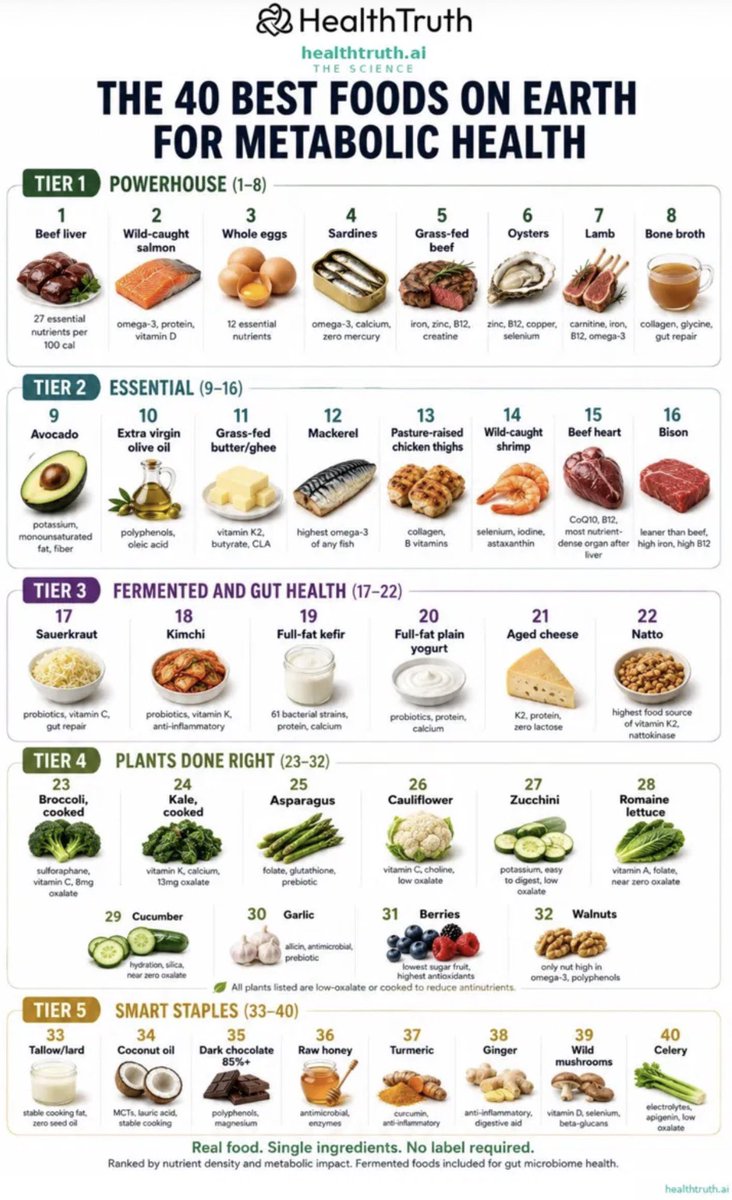
This is the answer. 40 foods. Ranked by nutrient density and metabolic impact. No prescription. No protocol. No diet with a name.
Tier 1 is what moved my HOMA-IR. Beef liver. Wild caught salmon. Whole eggs. Sardines. Grass fed beef. Protein and nutrient density that stabilizes insulin without spiking it. Dragon head number one goes quiet when you eat from the bottom of this list.
Tier 2 is what moved my trig/HDL ratio. Avocado. Extra virgin olive oil. Grass fed butter. Mackerel. These are the fats that raise HDL and keep triglycerides low. No drug has ever done what these foods do. Four pharmaceutical programs tried. Every one failed.
Tier 3 is what I am using to fight my hs-CRP. Sauerkraut. Kimchi. Full fat kefir. Natto. Fermented foods rebuild the gut. The gut controls inflammation. Inflammation is the marker I am still working on. 1.2 is not where I want to be. This tier is how I get there.
Tier 4 is plants done right. Broccoli. Kale. Asparagus. Garlic. Berries. Walnuts. Anti-inflammatory. Low oxalate. Cooked to reduce antinutrients.
Tier 5 is smart staples. Tallow instead of seed oils. Coconut oil. Dark chocolate 85 percent or higher. Turmeric. Ginger. Every one of these replaces something that feeds the dragon with something that fights it.
No seed oils on this list. No refined sugar. No ultra processed food. No artificial anything.
Three numbers. 40 foods. Zero drugs. Six years.
Your doctor checks your LDL and writes a prescription. I checked two hundred markers and changed what I ate.
The truth heals
I am going to tell you about the single strongest predictor of heart attack that your doctor has probably never mentioned.
It is not LDL. It is not ApoB. It is not total cholesterol.
It is the ratio of your triglycerides to your HDL.
In 1997, Gaziano published in Circulation that this one ratio predicted a 16 fold increase in myocardial infarction in patients with no prior history of heart disease. Sixteen fold. No other lipid marker comes close (Gaziano, Circulation 1997).
So why has your doctor never brought it up? Because there is no drug to sell you.
Is sauna worth the time and money?
Researchers tracked 2,315 men for 20 years and found a 40% lower death risk for frequent users.
Plus toxin removal 122x faster than kidneys.
Here's the real science behind sauna (and how to use it): 🧵
The AI crash is over. What comes may be even more important.
In this week's video I explain why:
• The July AI speed crash was a positioning event. I go through what comes next.
• Factor volatility fell sharply since Situational Awareness Day while global equity markets are making new highs.
• Gavin Baker's latest SV trip with AI data strengthens the compute scarcity thesis.
• The U.S.-Japan yen intervention may be one of the biggest macro signals of the year. Debasement is back
• Gold, Bitcoin, and AI infrastructure are all telling the same story.
• Lessons learned from July and how to hedge AI going forward before the next speed crash
AI isn't just changing companies.
It's changing market structure itself as it compresses time.
Watch: https://t.co/lQ5RLi56Ly
A fund can return +50%, -50%, +50% and advertise a 16.7% average. Your dollars go from $100 to $150 to $75 to $112.50. Actual return: 4%. The gap has a name.
Variance drag.
A smooth 8% return builds real wealth. A wild 8% return builds a story. Same average. Different math. Different life.
Robert Shiller teaches the reason for free. Yale. Financial Markets 252. Lecture 4 is called Portfolio Diversification. Seventy-eight minutes. Two years after recording it he won the Nobel Prize in Economics.
He does not raise his voice. He does not sell anything. He stands at a whiteboard in front of freshmen and derives one equation.
The geometric mean.
Then he does something better. Combine two assets that are not perfectly correlated. Arithmetic mean does not move. Variance falls. Geometric mean rises. You finish richer for no reason other than the math bending in your favour.
This is why mutual funds exist. Why index funds beat stock pickers. Why no serious institution has ever put its capital in one company on purpose.
Every pension, every endowment, every sovereign wealth fund on Earth is quietly harvesting the same asymmetry Shiller draws on the board in minute forty-two.
Five equations sit underneath all of it. Compound growth. Present value. The geometric mean. The Rule of 72. Real return. Older than any bank on Earth. All fit on a napkin. None behind a paywall.
The lecture has been on YouTube fourteen years. Free. Seventy-eight minutes. 311,000 views.
Almost none were the ones who needed to watch it.
Cortisol = thinning hair.
If cortisol stays high, shedding won't stop, no matter what you put on your scalp.
Here are the best ways to bring it down:
1. No food 3 hours before bed.
Preparations continue for “changes not seen in 100 years” - a.k.a. for gold to resume its role as the world’s primary/sole reserve asset, as it was pre-1922 Genoa Conference
Gold likely needs to be way higher than $5,000/oz. to resume that role
This is massively bullish for USA
If you get value from my posts, you'll love my 10 Day Stock & Options Transformation Training.
No day trading.
No swing trading.
No BS.
Just Stocks & Options the right way + access to my mastermind Discord community
Get set up here:
https://t.co/zZXTE0xMPY
The founder of Citadel went to China after DeepSeek dropped. What he saw should worry America
- "Not one author on DeepSeek was educated in America. It was a point of national pride."
Ken Griffin on losing the talent war, China quietly wiring Africa's power, airports and networks, and why US tariffs only speed the retreat
bookmark & watch - the clearest warning that America is losing ground to China