Hilo de un poco de lo que cocino (en mayoría asiática) junto con los videos de cocina histórica y de anime.
Link a redes y mi libreto de recetas en la bio (tmb a mi lista personal de libros y papers).
Por dios qué insoportable es cursar con gente que parece que se quedó en el secundario y se ríen por cada cosa que les parece CRINGE y no dejan que el docente de la clase. 20 añubis ademas
A new working paper of mine, forthcoming in JPE: Macroeconomics, makes a simple point with data. The point is old and well understood, but easy to forget.
When output is supply-constrained, or close to it, with a steep aggregate supply curve, a central bank can engineer rapid disinflation at little cost to output. Raising rates aggressively does nothing more than withdraw the excess aggregate demand.
Many missed this during COVID and the recent energy shocks. A central bank that accommodates when output is supply-constrained is pushing on a string.
The same withdrawal of excess demand can come through fiscal policy, and in some circumstances, that is the better tool. This was Keynes’ central insight in his 1940 essay, “How to Pay for the War.”
My read is that many central banks drew the wrong lesson from the late 2000s and early 2010s. Expansionary monetary and fiscal policy did not raise inflation then, but only because output was demand-constrained. Accommodation buys output cheaply when demand is the constraint. It buys inflation when supply is.
There is an equivalent reading through the FTPL. For space, we set it aside in the paper, but we are really making a statement about the real value of government debt. When output is supply-constrained, an excess of nominal claims chasing a fixed bundle of goods shows up as inflation: the price level rises until the real value of outstanding nominal liabilities equals the present value of the primary surpluses that back them. Disinflation then requires raising that present value, either through higher future surpluses or by retiring claims today, which is exactly what an absorption of excess demand does. Keynes’ compulsory saving scheme and the central bank’s rate hike become two routes to the same revaluation.
An ungated copied can be found here:
https://t.co/wy4J6g4sLV
For those interested, here are my slides from yesterday's Cowles Lecture at the Econometric Society Meetings @YaleCowles@econometricsoc
https://t.co/HilQnlxMEG
Thanks so much for listening and for the great discussion and comments!
@RBCtabris@mean_field_zane >leaves college to "escape the matrix"
>educates himself through tiktok
>"sun your balls, raw milk, etc"
>gets testicular cancer and organ failure
Goth Girl Spit is now a real energy drink that you can actually buy thanks to Echelon
Real spit was only used for "testing purposes only" and the citrus-flavoured drink has already sold out
Major international soccer tournaments like the World Cup have a significant negative effect on student exam performance.
The odds of reaching the achievement benchmark fall by 12% on average and considerably more for students likely to be interested in soccer.
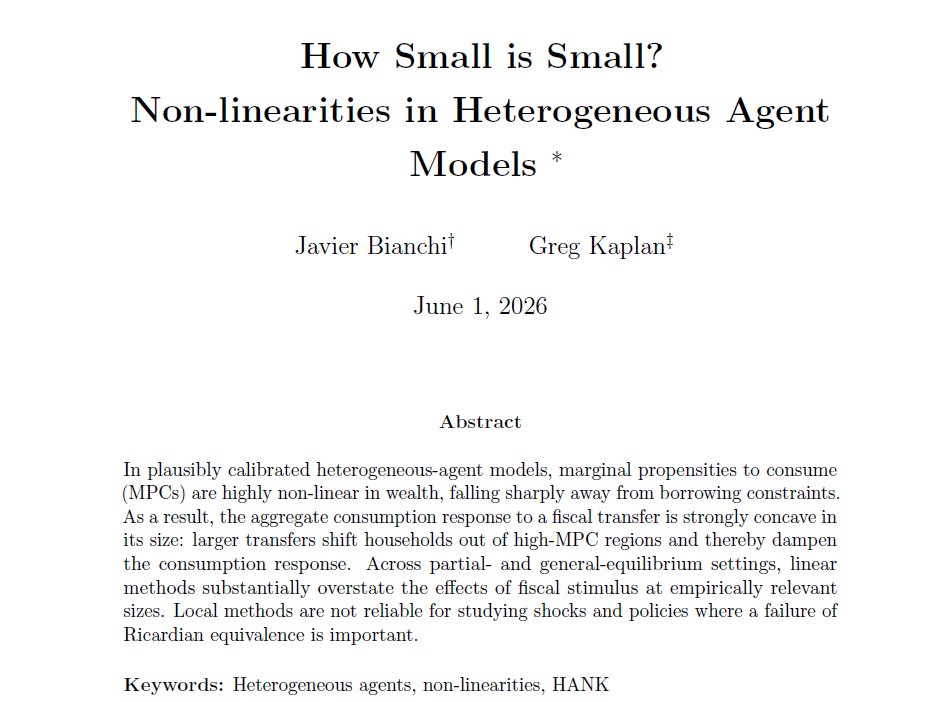
📢 New paper w/ @GregWKaplan 🧵1/10
How small is “small” for local-linear methods to deliver reliable answers in heterogeneous-agent models of fiscal stimulus?
Our answer: very small.
Introduce yourself with 10 bands you’ve seen live:
1. Radiohead
2. My Bloody Valentine
3. Dinosaur Jr
4. The Cure
5. Sonic Youth
6. Public Image Ltd
7. Sigur Rós
8. Explosions in the Sky
9. Slowdive
10. Low
You’re right.
On China, the Guanzi essays on “light and heavy” (qingzhong) are probably the closest thing to an early geoeconomic literature. They are explicitly concerned with how a state can enrich itself while weakening its rivals. The essays discuss the use of price manipulation, state monopolies on salt and iron, grain stockpiling, and other economic instruments as tools of power. Some of the stratagem stories are amusing. One famous example involves inducing the state of Lu to specialize in silk production and then abruptly cutting off purchases, thereby undermining its economy. Another strategy is buying up Chu’s deer to distort its incentives and redirect its resources.
The Salt and Iron Debate of 81 BCE is perhaps the classic Chinese discussion of state control over the economy and the extent to which economic organization should serve broader political and strategic objectives. More generally, the Legalist doctrine of “agriculture and war” ties economic capacity directly to military strength in a way that feels surprisingly modern.
The Arab tradition is somewhat different. It tends to focus less on economic conflict between states and more on the economic foundations of political authority itself. The obvious figure here is Ibn Khaldun. There is a lively debate over how to interpret him. Some scholars see in his work remarkably modern insights about taxation, production, incentives, and the cyclical rise and decline of dynasties, even including something akin to a Laffer-curve argument about tax rates. Others are more skeptical and argue that we are reading contemporary economics back into a very different intellectual framework. Even earlier, Abu Yusuf’s Kitab al-Kharaj treated taxation as an instrument of statecraft and governance.
I focused on the German and Anglo-American traditions simply because that is where the term “geoeconomics” itself originates. But I agree that any serious history of the subject should devote much more attention to these non-European traditions.
las críticas de no-economistas a los historiadores económicos dan ganas de hacer sudoku
Hemos encontrado ciudades perdidas con modelos comerciales y estimaciones de pib pero nah no pueden estar bien pq is very difficult todo esto