@MikeASperrazza Let me ask you a question Mike- if I’m telling you I smoked crack, why in the world would I lie about snorting it? There’s plenty of pictures of me smoking crack doing all sorts of stupid things, with all sorts of people and rarely with clothes on. But not snorting cocaine.
All I ask is a little recognition.
There's not a single person on this platform like me.
In return, you get my real-time narration on the thiiiiickest market on the planet.
The elites have made this a game folks .
If you don’t trade and don’t invest because you’re afraid, you will remain poor .
Elites don’t work, they simply trade . Buy and sell and get rich.
That’s their game .
Learn it, trade orderflow, unpoor your self.
#inspire
What's going on? Are neocons having a come-to-Jesus moment?
After Bob Kagan writing an article on how the U.S. is facing "total defeat" in Iran (see https://t.co/Io9xy1M8ks), you now have Max Boot - the very author of “The Case for American Empire” and one of the most vocal advocates for the Iraq war - publishing a Washington Post interview explaining that China has surpassed the U.S. in most military domains.
If anything, Boot’s interview is even more devastating than Kagan's piece, because it's not editorial opinion - he’s interviewing John Culver, a former top CIA analyst (he was national intelligence officer for East Asia) and one of the world’s foremost authorities on the Chinese military which he’s been studying since 1985.
This isn't a pundit opining - this is someone who spent decades inside the intelligence community staring at the actual data.
So what is Culver saying?
1) In case of war with Taiwan, the U.S. will flee the theater
This is undoubtedly the single most stunning revelation in the entire piece. Culver says that - as far as he is aware - the Pentagon’s plan in case of war with Taiwan is… flee!
This is the exact quote: "I think some of the thinking in the Pentagon, and it may have evolved since I retired, is that when we think there’s going to be a war, we need to get our high-value naval assets out of the theater, and then we would have to fight our way back in. From where, it’s not clear. Guam is no bastion either."
Why? Because, as he explains, any high-value U.S. assets would be sitting ducks in the entire area. China can strike U.S. forces deployed to Japan, Australia, or South Korea “in a way that Iran really can't” and, given that Iran has hit at least 228 targets across U.S. bases in the Middle East - forcing the U.S. to evacuate most of them - that's saying something. Also, U.S. aircraft carriers would need to operate within 1,000 miles of the fight to matter, which - given it’s well within range of Chinese missiles - they won’t.
As Culver bluntly puts it: “There's really no safe spaces.”
2) China leads in most military domains - and it's not even close
Culver says that “it’s hard to not be hyperbolic” about China’s military capabilities and that, at this stage, “it’s hard to point to an area other than submarines and undersea warfare and say the United States still has an advantage.”
In some critical areas, such as advanced munitions - which, when it comes to war, is pretty damn relevant - his assessment is that China leads by “magnitudes.” As a reminder, an order of magnitude means 10x so, by assuming he knows that and meant what he said, “magnitudes” means at least a hundred times more, meaning U.S. capabilities would be less than 1% those of China.
At the same time, Culver also says that “whichever side runs out of bullets first is going to lose.” So if China produces “magnitudes greater than our industrial base could produce” - as he puts it - then you don't need a PhD in military strategy to put two and two together…
The picture, if anything, is even more damning in shipbuilding capabilities. He reminds that a single shipyard in China - Jiangnan Shipyard, on Changxing Island near Shanghai - “has more capacity than all U.S. shipyards combined.”
Put all Chinese shipyards together and China’s broader naval shipbuilding capacity is 232 times larger than that of the United States (and this is from a leaked U.S. Navy briefing slide).
Culver helpfully adds that China “deploys enough ships every year to replicate the entire French navy” - which, as a Frenchman, hurts a little, but at least we'll always have the cheese (I hope).
3) Despite this, a war in Taiwan is highly unlikely
If your only window into China is Western media coverage, you'd naturally assume all of the above means war over Taiwan is about to break out. After all, if China is so powerful and the U.S. so outmatched, why wouldn't it just take Taiwan and be done with it?
Culver’s assessment - and mine, incidentally - is the exact opposite: China’s increasing relative strength vis-a-vis the U.S. makes war less likely, not more.
How so? As Culver explains Taiwan is “a crisis Xi Jinping wants to avoid, not an opportunity he wants to seize.” The stronger China gets, the less it needs to fight: why launch a war when you can simply wait for the military balance to become so lopsided that the U.S. quietly drops its security guarantee on its own? Culver himself foresees a future “when Americans might start to say, maybe Taiwan is a war we don’t want to get involved in.” That would almost automatically mean peaceful reunification, which has always been China’s primary objective.
This doesn't mean China views the U.S. as harmless. Quite the contrary - Culver says Beijing sees America “as a very militarily aggressive country” that is “declining in power and becoming more violent” as a result. Which he says is one further reason why “war over Taiwan is not something that Xi Jinping is looking for.”
China doesn't want to hand a pretext to a dangerously trigger-happy power - all the more when patience alone delivers what it wants.
4) The game is up
Last but not least, perhaps the most revealing aspect of the interview is that Culver doesn’t seem to see a way out: this is structural and irreversible.
Asked by Boot whether “the Trump administration’s $1.5 trillion defense budget, assuming it’s approved, [would] change the trend lines” (which, as a reminder, would constitute a 50% increase in defense spending), his reply is that “it would probably help to some extent, but I worry that we could be throwing good money after bad.” Not exactly brimming with optimism…
Similarly, when asked why the U.S. keeps investing billions in aircraft carriers and even “Trump-class battleships,” his answer is that it's because “the military services have a nostalgia for the things that meet their expectations for how you get promoted.” In other words, wasted money.
Same thing for the Pentagon's much-hyped “Hellscape” drone strategy to defend Taiwan. Culver asks the obvious question: “What drones are you talking about launching from where?” He points out that they’d “have to pre-deploy them if not on Taiwan itself then on Luzon or the Japanese southwest islands, all of which can be struck by the Chinese.” He adds that this is “the tyranny of time and distance when you look at war in the Pacific.”
The picture that emerges, both from Boot’s Culver interview and Kagan’s article, is remarkably consistent: the U.S. is “checkmate” in the Middle East, would need to entirely flee the Pacific theater before a war even starts, cannot produce enough weapons, cannot keep its supposed “allies” safe, and has no strategy to reverse any of it - nor can one even be produced given the structural nature of the gap. Even a 50% increase in defense spending, Culver says, would be “throwing good money after bad.” That's not my assessment - that's theirs.
Two of America's most prominent hawks, in two of its most establishment outlets, in the space of 48 hours, have essentially published the obituary of American military primacy.
Yesterday I concluded my post by saying that even the arsonists now smell the smoke. Today I'll say: the arsonists are now writing the fire report.
My formula will make you millionaire—
1. Be frugal.
2. Save 50% of what you earn.
3. At end of every month, plough this 50% into orderflow names.
You will become millionaire in less than 10 years.
@TheLongInvest Your personal growth journey is an inspiration for everyone. I was blessed to have a decent capital in my family and I’m in your Patreon to consolidate wealth for my kids, but I believe that if somebody starts from nothing and follow your principles will become millionaire
"Our war aim is to return to the status quo ante we ourselves destroyed" is one of the clearest admissions of strategic failure you can get from a sitting Secretary of State.
Basically the equivalent of saying "yup, we fucked up."
⚠️ Prepare for #3️⃣
1/US Navy 🚢 escorts global commercial ships 🛳️ through Hormuz.
2/Iran 🇮🇷 fires 🔫💥 @ US 🇺🇸 ‘Humantarian Envoys” & US 🇺🇸 is forced to “respond defensively”
⏭️Iran now is seen 👀 as starting a NEW conflict.
So… 👇 👇 👇 👇 👇 👇 👇 👇 👇
👉US 🇺🇸 is subtly no longer “the aggressor”
👉 No new War Powers clock 🕰️ starts, because the US 🇺🇸 is acting ‘defensively’ & ‘did not initiate hostilities’.
👉 Trump 🃏has increased midterm political cover for the likely drawn out conflict that proceeds…
👉 Europe 🇪🇺 + other allies now have political cover to support the US 🇺🇸 conflict.
Reminds me of that joke, when you had a friend in a large family... and we'd say "what, don't you own a TV?"
In all seriousness, a penny for my thoughts:
We didn’t just drift into collapsing birth rates - we engineered it.
Over time, we replaced the family unit with an economic unit.
Two incomes became survival, not choice.
Parenting became outsourced.
Connection became scheduled.
And we called it progress.
Now we’re exhausted, financially stretched, time-poor… and wondering why fewer people are choosing to have children.
This isn’t about “going backwards.”
It’s about recognising what we broke.
The real issue isn’t feminism, capitalism, or technology in isolation (as the interviewed states) - it’s the system we built when all three collided.
A system that:
Prices homes for two full-time incomes
Rewards productivity over presence
Treats raising children as a lifestyle choice, not a societal priority
So what’s the fix?
👉 Make family formation economically viable again.
That means:
Housing policies that support single-income optionality
Tax structures that don’t punish one parent stepping back
Flexible work as a default, not a perk
Treating parenting as nation-building, not career interruption.
Because right now, we’ve created a world where having children feels like a financial and personal risk.
And no society can sustain that.
We don’t need to rewind history.
We need to redesign the system - so people can build families without breaking themselves in the process.
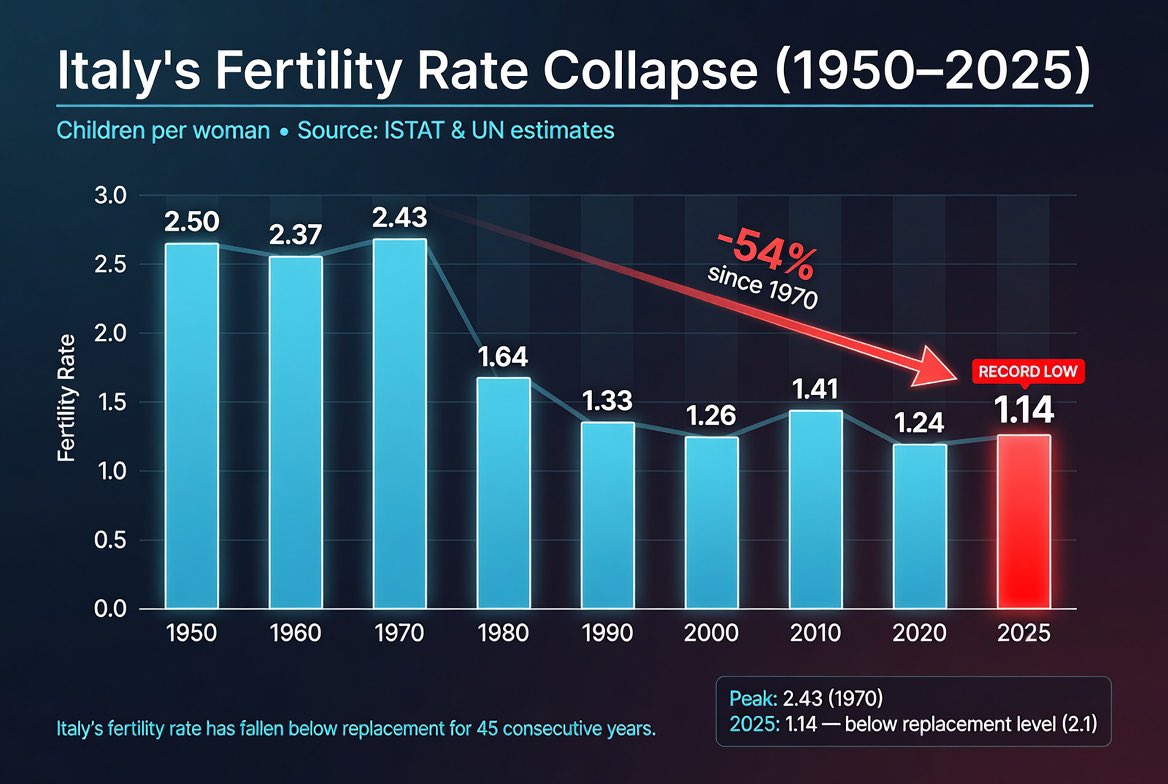
ITALY IS DYING — AND THE NUMBERS ARE BRUTAL
Italy just recorded its lowest number of births since 1861.
Only 355,000 babies were born in 2025, while deaths reached 652,000 — a net loss of nearly 300,000 people in a single year.
The total fertility rate has collapsed to 1.14 children per woman, far below the 2.1 needed to sustain a population.
This isn’t a temporary dip.
It’s a long-term demographic collapse that threatens Italy’s entire future: shrinking workforce, collapsing pensions, aging society, and disappearing regions.
Without massive immigration, Italy’s population would be shrinking even faster.
This is what happens when birth rates stay critically low for decades.
Italy is the clearest warning sign for many other developed nations heading in the same direction.
Boredom is the price you pay for greatness 💰
When you’re bored, that’s when the best ideas come.
Ideas breed desire.
Strong Desire channeled into hard action leads to greatness.
This is neuroscience 101.
Be bored. Become great.
“People want to have that special experience, and regardless of their income level, a $9 coffee doesn’t feel like they are wasting money. This is a really affordable premium experience when they drink that $9 coffee”.
— Starbucks CEO
LOL
$sbux



![RnaudBertrand's tweet photo. What's going on? Are neocons having a come-to-Jesus moment?
After Bob Kagan writing an article on how the U.S. is facing "total defeat" in Iran (see https://t.co/Io9xy1M8ks), you now have Max Boot - the very author of “The Case for American Empire” and one of the most vocal advocates for the Iraq war - publishing a Washington Post interview explaining that China has surpassed the U.S. in most military domains.
If anything, Boot’s interview is even more devastating than Kagan's piece, because it's not editorial opinion - he’s interviewing John Culver, a former top CIA analyst (he was national intelligence officer for East Asia) and one of the world’s foremost authorities on the Chinese military which he’s been studying since 1985.
This isn't a pundit opining - this is someone who spent decades inside the intelligence community staring at the actual data.
So what is Culver saying?
1) In case of war with Taiwan, the U.S. will flee the theater
This is undoubtedly the single most stunning revelation in the entire piece. Culver says that - as far as he is aware - the Pentagon’s plan in case of war with Taiwan is… flee!
This is the exact quote: "I think some of the thinking in the Pentagon, and it may have evolved since I retired, is that when we think there’s going to be a war, we need to get our high-value naval assets out of the theater, and then we would have to fight our way back in. From where, it’s not clear. Guam is no bastion either."
Why? Because, as he explains, any high-value U.S. assets would be sitting ducks in the entire area. China can strike U.S. forces deployed to Japan, Australia, or South Korea “in a way that Iran really can't” and, given that Iran has hit at least 228 targets across U.S. bases in the Middle East - forcing the U.S. to evacuate most of them - that's saying something. Also, U.S. aircraft carriers would need to operate within 1,000 miles of the fight to matter, which - given it’s well within range of Chinese missiles - they won’t.
As Culver bluntly puts it: “There's really no safe spaces.”
2) China leads in most military domains - and it's not even close
Culver says that “it’s hard to not be hyperbolic” about China’s military capabilities and that, at this stage, “it’s hard to point to an area other than submarines and undersea warfare and say the United States still has an advantage.”
In some critical areas, such as advanced munitions - which, when it comes to war, is pretty damn relevant - his assessment is that China leads by “magnitudes.” As a reminder, an order of magnitude means 10x so, by assuming he knows that and meant what he said, “magnitudes” means at least a hundred times more, meaning U.S. capabilities would be less than 1% those of China.
At the same time, Culver also says that “whichever side runs out of bullets first is going to lose.” So if China produces “magnitudes greater than our industrial base could produce” - as he puts it - then you don't need a PhD in military strategy to put two and two together…
The picture, if anything, is even more damning in shipbuilding capabilities. He reminds that a single shipyard in China - Jiangnan Shipyard, on Changxing Island near Shanghai - “has more capacity than all U.S. shipyards combined.”
Put all Chinese shipyards together and China’s broader naval shipbuilding capacity is 232 times larger than that of the United States (and this is from a leaked U.S. Navy briefing slide).
Culver helpfully adds that China “deploys enough ships every year to replicate the entire French navy” - which, as a Frenchman, hurts a little, but at least we'll always have the cheese (I hope).
3) Despite this, a war in Taiwan is highly unlikely
If your only window into China is Western media coverage, you'd naturally assume all of the above means war over Taiwan is about to break out. After all, if China is so powerful and the U.S. so outmatched, why wouldn't it just take Taiwan and be done with it?
Culver’s assessment - and mine, incidentally - is the exact opposite: China’s increasing relative strength vis-a-vis the U.S. makes war less likely, not more.
How so? As Culver explains Taiwan is “a crisis Xi Jinping wants to avoid, not an opportunity he wants to seize.” The stronger China gets, the less it needs to fight: why launch a war when you can simply wait for the military balance to become so lopsided that the U.S. quietly drops its security guarantee on its own? Culver himself foresees a future “when Americans might start to say, maybe Taiwan is a war we don’t want to get involved in.” That would almost automatically mean peaceful reunification, which has always been China’s primary objective.
This doesn't mean China views the U.S. as harmless. Quite the contrary - Culver says Beijing sees America “as a very militarily aggressive country” that is “declining in power and becoming more violent” as a result. Which he says is one further reason why “war over Taiwan is not something that Xi Jinping is looking for.”
China doesn't want to hand a pretext to a dangerously trigger-happy power - all the more when patience alone delivers what it wants.
4) The game is up
Last but not least, perhaps the most revealing aspect of the interview is that Culver doesn’t seem to see a way out: this is structural and irreversible.
Asked by Boot whether “the Trump administration’s $1.5 trillion defense budget, assuming it’s approved, [would] change the trend lines” (which, as a reminder, would constitute a 50% increase in defense spending), his reply is that “it would probably help to some extent, but I worry that we could be throwing good money after bad.” Not exactly brimming with optimism…
Similarly, when asked why the U.S. keeps investing billions in aircraft carriers and even “Trump-class battleships,” his answer is that it's because “the military services have a nostalgia for the things that meet their expectations for how you get promoted.” In other words, wasted money.
Same thing for the Pentagon's much-hyped “Hellscape” drone strategy to defend Taiwan. Culver asks the obvious question: “What drones are you talking about launching from where?” He points out that they’d “have to pre-deploy them if not on Taiwan itself then on Luzon or the Japanese southwest islands, all of which can be struck by the Chinese.” He adds that this is “the tyranny of time and distance when you look at war in the Pacific.”
The picture that emerges, both from Boot’s Culver interview and Kagan’s article, is remarkably consistent: the U.S. is “checkmate” in the Middle East, would need to entirely flee the Pacific theater before a war even starts, cannot produce enough weapons, cannot keep its supposed “allies” safe, and has no strategy to reverse any of it - nor can one even be produced given the structural nature of the gap. Even a 50% increase in defense spending, Culver says, would be “throwing good money after bad.” That's not my assessment - that's theirs.
Two of America's most prominent hawks, in two of its most establishment outlets, in the space of 48 hours, have essentially published the obituary of American military primacy.
Yesterday I concluded my post by saying that even the arsonists now smell the smoke. Today I'll say: the arsonists are now writing the fire report.](https://pbs.twimg.com/media/HIFMk0mbMAAA8DI.jpg)