@molfar_agency
Consults businesses & research for you.
Teaches OSINT gov & biz. Online/offline.
Contact us via [email protected]
Volunteers: 1400+ investigations of war crimes.
Published in @nytimes, @guardian, @TheEconomist, @FT, @PBS.
https://t.co/9u6lCNIUgG
We’ve entered a strategic data partnership with @getswarmer (Nasdaq: SWMR). Our verified intelligence data now feeds Swarmer’s autonomous systemsʼ AI models — trained on 100,000+ real combat missions.
https://t.co/52bZ6pO4Gd
3/3 Russia invests heavily in information and psychological operations. According to Defence Intelligence of Ukraine, the “Maidan-3” campaign alone — a large-scale operation consisting of multiple coordinated disinformation efforts targeting Ukraine — cost Russia approximately $1.5 billion.
More broadly, security expert Oleksandr Melnychenko estimates that Russia spends at least $4.6 billion annually on information and psychological operations worldwide.
These campaigns can have tangible consequences beyond the information space. In Ukraine, attacks targeting TDC staff, police officers, and military vehicles have increased significantly in recent years. While 118 attacks on recruitment center personnel were recorded in 2024, the number rose to 341 in 2025. By the end of April 2026, more than 117 such attacks had already been documented.
Full material: https://t.co/zUrZFhfS7I
1/3 How Russia creates information operations against Ukraine. Part 1 — who spreads them, what budget they use, and how to counter them.
For the past year, analysts at Molfar Intelligence Institute have been researching Russian information and psychological operations against Ukraine.
This is the first article in a series dedicated to uncovering how these operations work. In upcoming publications, we will examine specific Russian disinformation campaigns, including attempts to discredit the Azov Brigade and coordinated efforts to spread false narratives about TDC.
Full material: https://t.co/zUrZFhfS7I
This publication was produced by Molfar Intelligence Institute with the support of the Askold and Dyr Foundation, administered by ISAR Ednannia as part of the project “Strong Civil Society of Ukraine — A Driver of Reform and Democracy”, funded by Norway and Sweden. The content is the sole responsibility of Molfar Intelligence Institute and does not reflect the views of the governments of Norway or Sweden, or of ISAR Ednannia.
2/3 Russia has institutionalized information warfare as part of its military apparatus. The country trains information and psychological operations specialists through dedicated military programs and continues to expand related units within its armed forces.
Ukraine’s Defence Intelligence (HUR) reported that Russia increased the size of its IPSO units in the 3rd and 51st Combined Arms Armies in March 2025.
These efforts are supported not only by military structures but also by organizations such as the Social Design Agency (SDA). The agency manages bot networks across social media, spreading pro-Kremlin narratives and amplifying social tensions around mobilization, recruitment centers, and energy-related issues.
Between January and April 2024, SDA generated nearly 34 million negative comments online.
Full material: https://t.co/zUrZFhfS7I
Deportation of Ukrainian children to Russia: Molfar Intelligence Institute identifies individuals involved
Analysts at the Molfar Intelligence Institute have identified four people who may be involved in the transfer of Ukrainian children from occupied parts of the Luhansk region to Russia.
Those identified include school staff and guardianship officials, as well as guardians with notable profiles: an unemployed artist listed in phone directories as a “fortune-teller”, and a leader of a religious organisation described in media reports as a closed group with sect-like characteristics.
According to an investigation by the Molfar Intelligence Institute in cooperation with the Bring Kids Back, Ukrainian children were transferred to Russian families through such intermediaries. 16 of them ended up under guardianship in Russia’s Leningrad, Novosibirsk and Tyumen regions.
Full article: https://t.co/8onqV88q4x
Another person involved in the deportation is Roman Vinogradov
On social media, he describes himself as the father of ten children. Eight children are under his guardianship, including one child from the occupied Luhansk region.
Vinogradov is a senior church leader at the religious organisation “Church of Christians of Evangelical Faith (Pentecostals) ‘New Generation’” in Novosibirsk, Russia. Media reports describe the organisation as having cult-like characteristics and using psychological influence techniques. On social media, Roman posted photos of children attending events organised by this group.
In 2007, Roman was likely convicted of fraud.
According to the Yale Humanitarian Research Lab, children are sent to at least 210 facilities in Russia and occupied territories for “re-education” or militarization. These include summer camps, cadet schools, and even a military base. Some of these facilities are linked to Gazprom and Rosneft.
Full article: https://t.co/8onqV88q4x
One of those involved in the deportation of children is Tetiana Udovkina
Tetiana is originally from Lutuhyne in the Luhansk region, an area under Russian occupation since 2014.
In the summer of 2024 she accompanied students to a sports event (Spartakiad) held on the Klyazma River in Moscow. Later the same year, Udovkina and 41 children spent three weeks at the “Lesnaya Polyana” summer camp in Russia’s Oryol region.
Tetiana has a Russian passport and a bank account with Russia’s Promsvyazbank. There is information about her trips to Krasnodar Krai and Moscow in 2023 and 2025.
At least 20,570 children are known to have been deported to Russia or forcibly transferred from temporarily occupied territories.
So far, 2,145 children have been returned. Analysts from Molfar Intelligence Institute identified 192 children, and 11 of them are already back home.
Full article: https://t.co/8onqV88q4x
OSINT на війні: @molfar_agency x Характер
Як працює сучасна розвідка, коли у хід йдуть відкриті дані та уважність до деталей?
OSINT починається з дрібниць. Іноді достатньо пляшки мінералки, тіні на будівлі а��о навіть дитячого малюнка, щоб визначити локацію ворога чи його логістику. Про OSINT, HUMINT, GEOINT на війні — у подкасті медіа Характер.
Спікери:
• Вікторія Самойленко — OSINT-аналітикиня Molfar Intelligence Institute (MII);
• Гіл Варфоломєєв — співавтор книги “Розвідка: анонімності не існує” та аналітичного блогу MII;
• Олександр Попов — полковник, командир 15-ї окремої бригади артилерійської розвідки “Чорний ліс”.
https://t.co/I4BmvVRpun
1/3 Teodor Currentzis, a Russian conductor of Greek origin, continues to perform across Europe, with concerts in Rome, Paris, Berlin and other major cities.
Meanwhile, his projects, including the musicAeterna orchestra, are backed by sanctioned Russian banks and businessmen. Among the partners listed on the orchestra’s website are VTB Bank, Gazprom, Rosatom and Nornickel.
Analysts at @molfar_agency reviewed Currentzis’s business ties, public statements, sources of funding and international activities: https://t.co/6tAFJO93HQ
3/3 In 2006, Currentzis called Russia “the best country in the world” and claimed that in Russia “there are values that have long been destroyed in the Western world.”
In 2019, he told Greek journalists there is no censorship in Russia, noting that he receives grants for “very radical shows that criticise the government.”
He accused the West of spreading anti‑Russian propaganda and added: “Russia is not the kind of country where people are killed on the streets for being homosexual”
No public statements by Teodor Currentzis condemning Russia’s invasion of Ukraine have been found: https://t.co/6tAFJO9Bxo
How a blogger revealed the location of a Russian air defence unit in Crimea
If you have not yet seen @prestonstew_��s interview about this case in English, you can watch the Ukrainian version on @molfar_agency's YouTube channel: https://t.co/PI5M6rPTM2
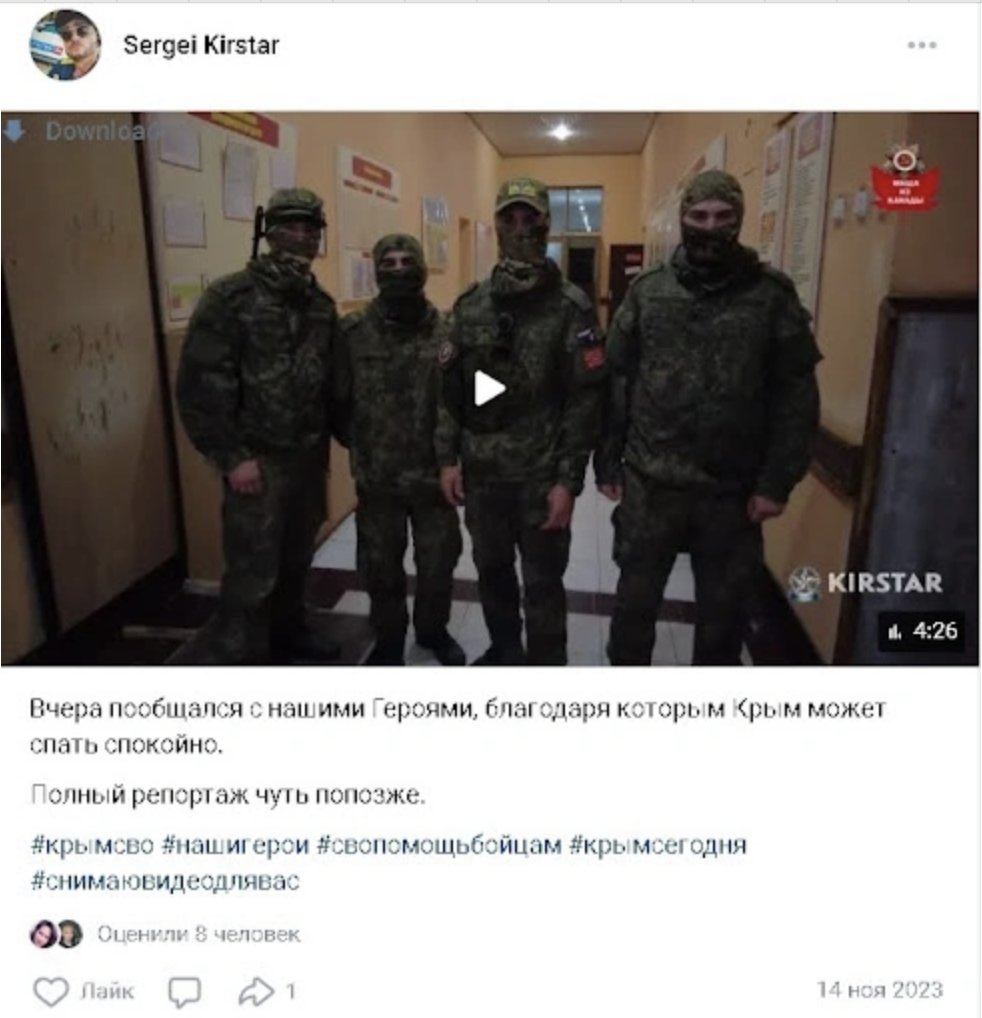
In this case, analysts at @molfar_agency used details from a video posted by Russian blogger Sergei Kirstar to identify the location of an air defence unit in Crimea.
Although the search area seemed large at first, it was narrowed down thanks to the lack of dense development, as the area includes only small villages and towns.
One of the key clues was the green roofs of the hangars, which helped quickly verify the location on satellite images.
A full breakdown in video format is available in @prestonstew_’s video with @molfar_agency's analyst Maksym Khorolskii: https://t.co/3khYowEqmZ
It is always a pleasure to join Preston for these conversations!
1/3 A Russian blogger accidentally gave away the location of an air-defence unit in Crimea.
In November 2023, Sergei Kirstar posted a VK clip of Russian soldiers with the caption: “thanks to them, Crimea can sleep peacefully.” It was an air defense unit.
On his profile, he lists himself as Deputy Director of regional broadcasting at Russia 1 (a state TV channel sanctioned by the EU, the U.S., Canada and Ukraine for spreading propaganda that supports violence and war).
Full breakdown of the case: https://t.co/7Njdg21P9y
3/3 Analysts at @molfar_agency were able to confirm this is where the Russian air-defense unit was based. They used simple, free tools: Google Maps and Google Earth Pro.
In the end, what gave it away was civilian infrastructure and a careless post by Sergei Kirstar, who says he’s a deputy director at Russia 1. The analysts just had to pay attention to the details.
Full breakdown of the case: https://t.co/7Njdg21P9y
The Kremlin is listening in from Vienna’s rooftops — Financial Times
Satellite dishes atop Russian diplomatic buildings are being used for intelligence gathering.
“We know they have been targeting NATO government and military communications with what they’ve got,” said a European diplomat in Vienna.
Ahead of the Munich Security Conference, one large dish was temporarily reoriented before being returned to its original position: https://t.co/n2YAow0LVg
Vienna’s largest Russian compound, known as Russencity, also has satellite dishes on its roof. The compound includes residential buildings and a school for diplomats’ children.
Austrian intelligence estimates there are around 500 Russian diplomats in the city, with up to a third suspected of being spies.
@molfar_agency previously conducted an investigation into Russian spies operating across Europe: https://t.co/68cFCk8HJE
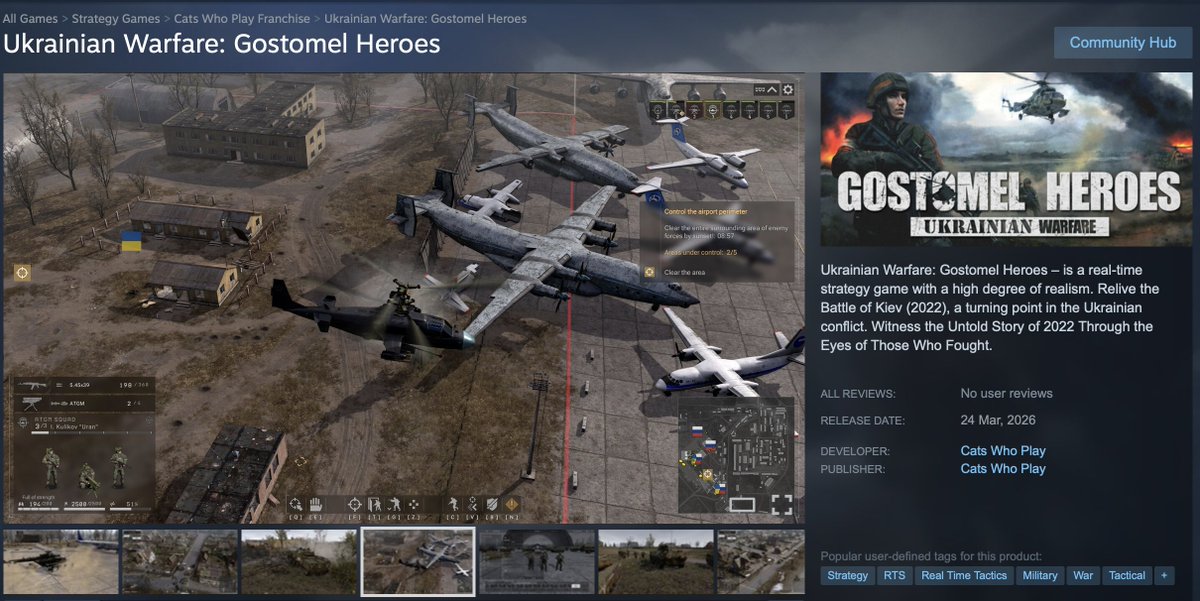
Is @Steam spreading Russian propaganda again?
Ukrainian Warfare: Gostomel Heroes is a video game set to release on March 24, created by a Russian studio.
It’s a real-time strategy game about the start of Russia's full-scale invasion of Ukraine.
The developers write: "Modern games are not just entertainment — they are another form of media, another way to convey information, often even more effectively than the most detailed analytical articles or news segments."
This isn’t the first time Russia has used video games as a tool for propaganda: https://t.co/GHLWPyZD27