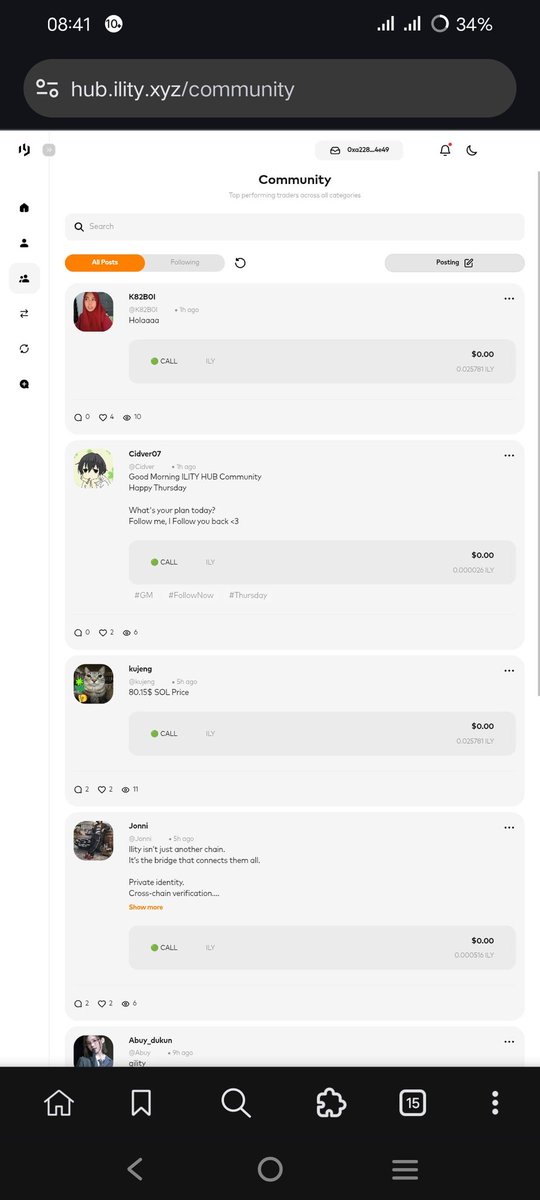
I’ve always dreamed of sharing my daily life and trading journey within a small, trusted circle, a place where connection feels real and meaningful. When I discovered Ility Hub, I was genuinely amazed. It’s incredible how we can interact with the Ility circle in a way that feels personal and engaging. Unlike endless chats on Discord, which can sometimes feel exhausting, @ILITY_xyz Hub lets me truly enjoy the moment with the community. It’s not just about sharing or trading, it’s about feeling part of something alive, close, and joyful.
#ILYDAILY
Snap snap 🦞 the gates are back open — but only for a few hours!
https://t.co/LEUS0ArXAw 🌎
3,000+ wallets got clipped for skipping steps or deleting actions.
No promises, no guarantees — only good vibes 🌊
Snap snap 🦞 the gates are back open — but only for a few hours!
https://t.co/LEUS0ArXAw 🌎
3,000+ wallets got clipped for skipping steps or deleting actions.
No promises, no guarantees — only good vibes 🌊
let’s ga 3x @FumoFamily before bed,
to enter:
simply like, repost and say gfomo in the cs.
winners will be selected through raffle in the morning,
btw, ts is just 1k.
fomoliquid!
Stop thinking of AI as just a chatbot
This is the 'Data Flywheel' in action.
@PrismaXAI is turning robot operation into a decentralized skill. If you can move a mouse, you can train a robot to change the world. This is what $11M in backing and a16z vision looks like. Join NOW!
Before talking about @BitRobotNetwork, it helps to understand how robots and AI evolved to this point and where the current limitations come from.
Robots didn’t start out as intelligent machines. In the beginning, they were simple tools that followed strict rules and repeated the same actions over and over, usually in factories or controlled environments.
As automation advanced, robots became faster and more precise, but they still lacked understanding. The real shift began when artificial intelligence entered the picture. With the rise of machine learning, robots started to perceive their surroundings, adapt their movements, and make decisions based on data rather than fixed rules. Yet most of this intelligence was developed in isolation inside labs, simulations, and closed datasets owned by a small number of companies.
Meanwhile, AI itself grew rapidly in the digital world, powering assistants, search engines, and language models, while physical robots struggled to keep up due to the complexity of real-world environments.
Teaching robots to function in messy, unpredictable spaces requires constant human input, guidance, and correction. Ironically, while humans play a critical role in shaping robotic intelligence, the ownership and long-term value of that intelligence remain centralized.
As this gap becomes more visible, a deeper question emerges: who should shape the future of robots, and who should benefit from their growth?
@BitRobotNetwork approaches this problem from a different angle. Instead of treating robots as isolated products controlled by single entities, BitRobot envisions robots as part of a decentralized network, connected through the internet, guided by AI, and coordinated using blockchain technology.
How BitRobot Works?
At its core, BitRobot treats robots not as standalone machines, but as participants in a shared learning network. Each robot is connected to the internet and powered by AI models that allow it to perceive, move, and respond to human input. Instead of learning in isolation, robots learn through interaction—by being guided, corrected, and taught by many humans over time.
More broadly, this approach challenges the assumption that advanced robotics must be controlled by a few large institutions. By aligning human incentives with machine learning, BitRobot suggests that the growth of physical AI can be both open and sustainable. Humans are no longer just operators or data sources—they become co-builders of intelligence, with a voice in how robots evolve and how value is distributed. If successful, this model could reshape how societies interact with intelligent machines, shifting the narrative from automation replacing humans to collaboration between humans and AI. In that sense, BitRobot is not just experimenting with robots, but with a new social and technical framework for how intelligence itself is created in the real world.
As the robotics and AI landscape continues to evolve, understanding these systems requires more than surface-level explanations. BitRobot offers a glimpse into how robots, humans, and decentralized coordination might grow together in the real world. While this article introduces the core ideas and structure behind the network, there is still much more to explore beneath the surface—from technical components to real-world applications and challenges. We will continue to learn about the key components of the BitRobot network more deeply in the next discussion. See you in the next topic. Let’s learn together, Gbot..
At first, I used to think robots were just machines that follow commands.
Move. Stop. Repeat. Nothing more.
But as I started learning about @BitRobotNetwork, that simple idea began to change.
What if robots could do real work, have that work verified, and be rewarded fairly?
Cheese 📸
A selfie, a smile, a shared belief 🧡
Congrats to all WL & Stone holders!
your patience and conviction made this moment real 👏🔥
I don’t own a lil Fogeess yet, but belief doesn’t start with ownership! it starts with community.
Public sale is ahead. I will wait you there babies. See you soon, @lilfogees 🧡
@fogo@im_jowee
Good night ☺️
Taking care of @lilfogees until they fall asleep. Before Fogees take them as their own, we stay a little longer🤣Watching over them, making sure they’re safe,
then gently letting them rest and dream on their own 🌙Gfogoo @fogo
Intelligence that is really OPEN.
Open means no KYC. No permissions.
Turn idle bandwidth into rewards, in minutes.
Start contributing to the next generation of open intelligent systems and get rewarded for sharing your internet.
Install Once. Contribute Compute. Earn Passively. Become the Network.
https://t.co/F8fIB5yUUJ
The new Perceptron interface is live. Cleaner layout. Sharper stats. Real uptime clarity. Same signals, but presented like an actual analytics tool instead of a relic.
If you run a node, open the dashboard. Your node activity is about to make a lot more sense.
Share your dashboard👇