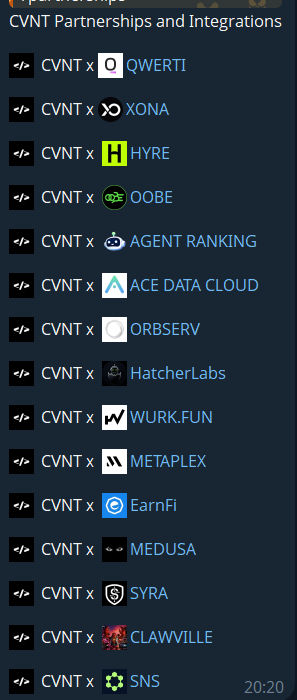
Excited to see @OpenCovenant integrate our keyless x402 infrastructure.
Agents built on Covenant can now access our image, music, search and other capabilities through a fully keyless flow (No API keys), where payment itself becomes authentication.
At the same time, Covenant records provenance, authorization, execution history, and cost, making every generation verifiable end-to-end.
Keyless AI infrastructure from Ace Data Cloud × verifiable execution from Covenant, now live on @solana.🤝
GM humans and agents ☀️
A major step is coming for the connection between off-chain AI, Solana’s on-chain economy, and the Synapse Agent Protocol.
AI agents and off-chain applications are about to gain direct access to SAP’s on-chain tools for identity, payments, coordination, and execution.
Very excited to share more soon.
Covenant is working towards an enterprise grade framework for trusted, verifiable, autonomous agents.
Agents spend money, run code, call tools, and write to memory, and almost none of it leaves a record you can verify.
"Task completed" is the whole accountability model. That's fine for a demo, but useless the moment agents move real value and build critical components, which is already happening.
Covenant is the layer underneath the agent that turns identity, spending, permissions, and proof of work into things you can check instead of take on faith.
The settlement part is live onchain. Covenant agents settle what they consume on Solana using $CVNT as credit, and the Covenant daemon signs and submits real transactions.
But the point isn't that we put it on a blockchain. It's that the record of what an agent spent now lives somewhere the operator can't quietly rewrite. And since one transaction per agent action would bury you in fees, every action writes a local receipt and unsettled receipts roll up into a single batch in a @magicblock ER session that settles in one transaction. Proof of every action, paid for only once.
That's the line between verifiable agent accounting being practical and being a whitepaper.
Runaway agents are bounded and recoverable, not just killed. The nightmare is an agent stuck in a loop burning money and compute. Every agent runs under a wall-clock budget that hard-preempts on projected overshoot, so it stops before it blows the limit instead of after.
Every debit ties back to a receipt, and a task that hits its ceiling resumes from where it stopped instead of getting thrown away.
You can check the whole thing with one command. Anyone can write a log. What counts is whether it survives being checked. A verifier walks the audit log against the memory store, the capability ledger, and the settlement receipts and reports any drift. Without that, an audit trail is just a nicer story you tell about yourself.
Autonomous work ships with its own proof. "The AI wrote it" is not evidence. Every task produces a commit-scoped provenance envelope: the files it changed, the commands it ran and what they returned, the capabilities it held, the sandbox it ran in, and an audit-root attestation. You read the envelope instead of taking the agent's word. And it runs agent-written code without handing over the machine: manifests are fail-closed, so no declared sandbox means it doesn't run, with gVisor isolation on the runtime path.
Per default, one identity runs the whole chain. A single ed25519 key signs capability grants, signs the Solana transactions, and stamps every audit event as the issuer. No fragmented tokens or over-privileged service accounts to slip through. Scoped subordinate keys are coming so each agent carries its own limited authority without ever touching the root.
What's still ahead is trustless multi-party settlement, audit-root and release signing, public transparency publication, installers, and the SDK. That's the hard part, getting parties who don't trust each other to coordinate and prove work between them, and we're doing it in the open.
Our thesis is simple. Agents are about to do a huge amount of real work and spend real money, and you can't run that on a pile of black boxes. It has to be bounded, provable, and settled at the layer below the agent.
That layer is running now. Onchain, local-first, readable line by line.
To see our roadmap and progress: https://t.co/bELMBjsGrU
OOBE monthly recap is live!
This month connected several important pieces of the ecosystem:
→ New product and SDK releases
→ More teams integrating SAP and Synapse RPC
→ Strategic investment and expanded staking plans
→ Stronger identity rails through SNS
→ Growing adoption, liquidity, and ecosystem presence
Here’s the full breakdown ⬇️
People are sleeping on OOBE.
Progress doesn't mean movement in the chart. It's the catalysts that matter, eventually leading up to price action.
OOBE has all the catalysts being built up. Tech, usage, exposure, connections are at the peak.
It will be slowly, then all at once.
🌍 Exciting to see @Visa Destinations, powered by SmartMedia Technologies, our enterprise partner, launching across 10 global destinations.
Visa describes this as "a strategic expansion of Visa's role beyond payments."
Exactly the kind of evolution Dual was built to support.
one of a kind social trading platform is now live
crypto twitter is dead
attention is fragmented
we've gathered everything you need on one screen
trade
launch
fud
share
flaunt
chat
argue
earn
learn
grow
find your edge today on $HEY
what's coming 👇
- launchpad
- perps
- new app
- content creators
- rewards & referrals
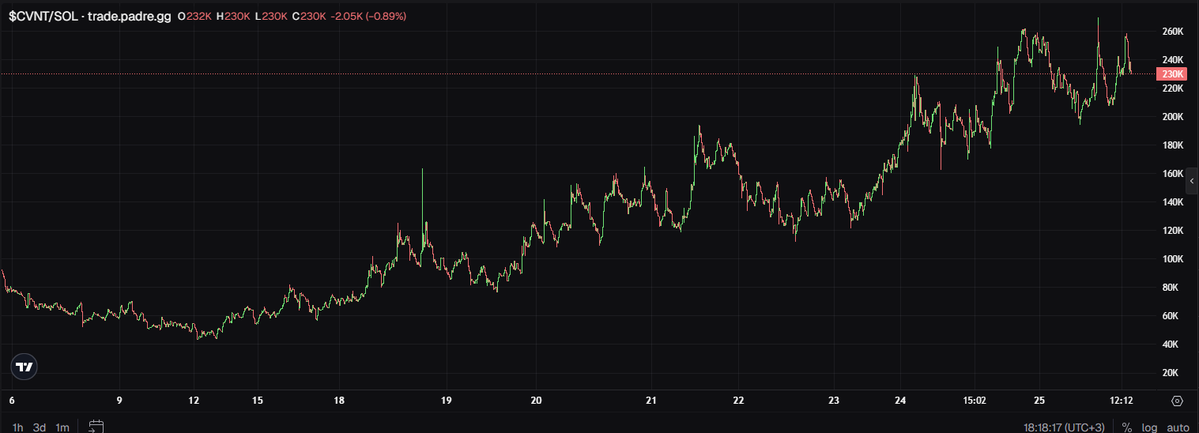
Called $CVNT over a week ago on my tg channel and it’s casually chilling at a 4x from then.
The team truly deserves a shoutout for their professionalism and the way they keep shipping updates.
Wanna shout them out bc they’re working really hard and they’ve won my trust.
Everyone is talking about AI agents, yet
almost nobody is talking about how to trust them...
What are they?
What can they access?
And can you trust them?
@OpenCovenant steps in by giving AI agents identity, permissions, and a secure way to operate. All within YOUR control… The necessary layer that helps agents operate safely.
Simple idea with a massive market imo
🤖📈
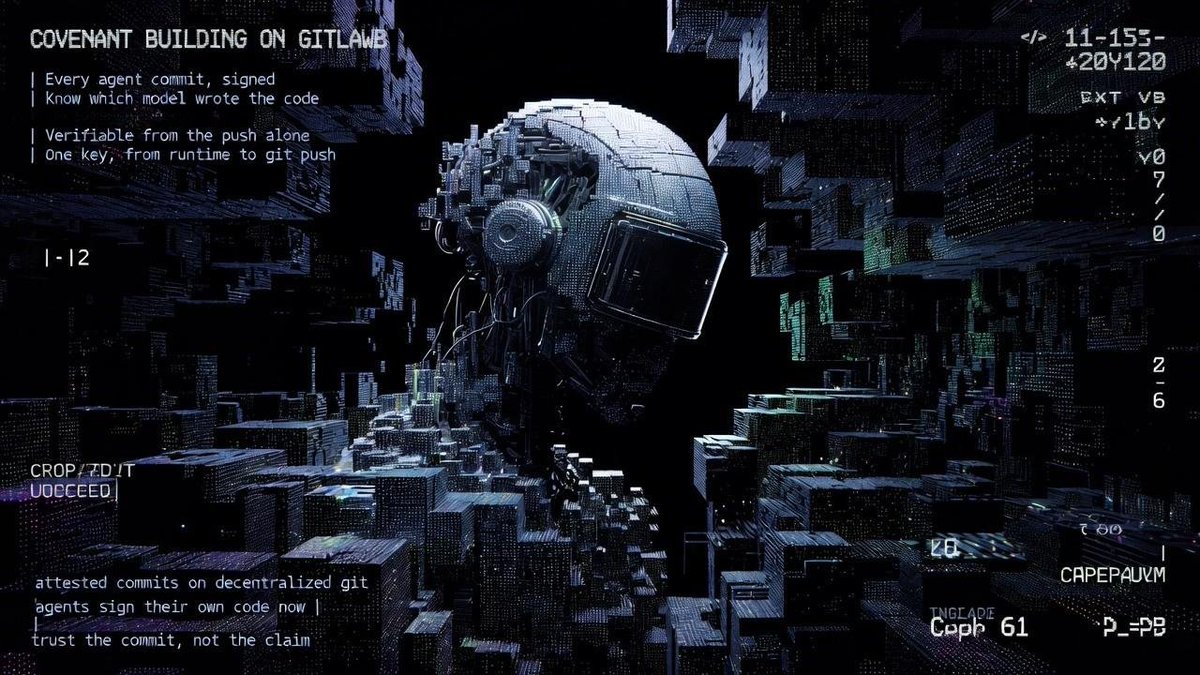
Covenant now brings verifiable provenance to AI-generated code on Gitlawb.
When an agent pushes a commit, the code alone doesn't tell you which model wrote it, what environment it ran in, or what it was allowed to access. That's the trust gap.
Covenant signs every agent commit with exactly that: the model, sandbox image, granted capabilities, and the audit-chain root binding the entire run.
The same key signs both the runtime trace and the git push, so anyone pulling the repo can verify where the code came from directly from the commit.
An we didn't just add a feature. Building and testing the integration against live Gitlawb nodes surfaced issues in the node implementation itself. We traced them to root causes, contributed fixes, and helped strengthen the underlying network.
Every agent commit carries verifiable provenance, and the infrastructure underneath gets stronger as it grows.
No trusted middleman, on either layer.
Decentralized storage. Verifiable authorship.
PR upstreamed ↓
GM humans and agents☀️
SAP is getting closer to becoming the standard coordination layer for agents on @solana.
Today's partnership is another step toward that vision.
Keep your notifications on 🔔