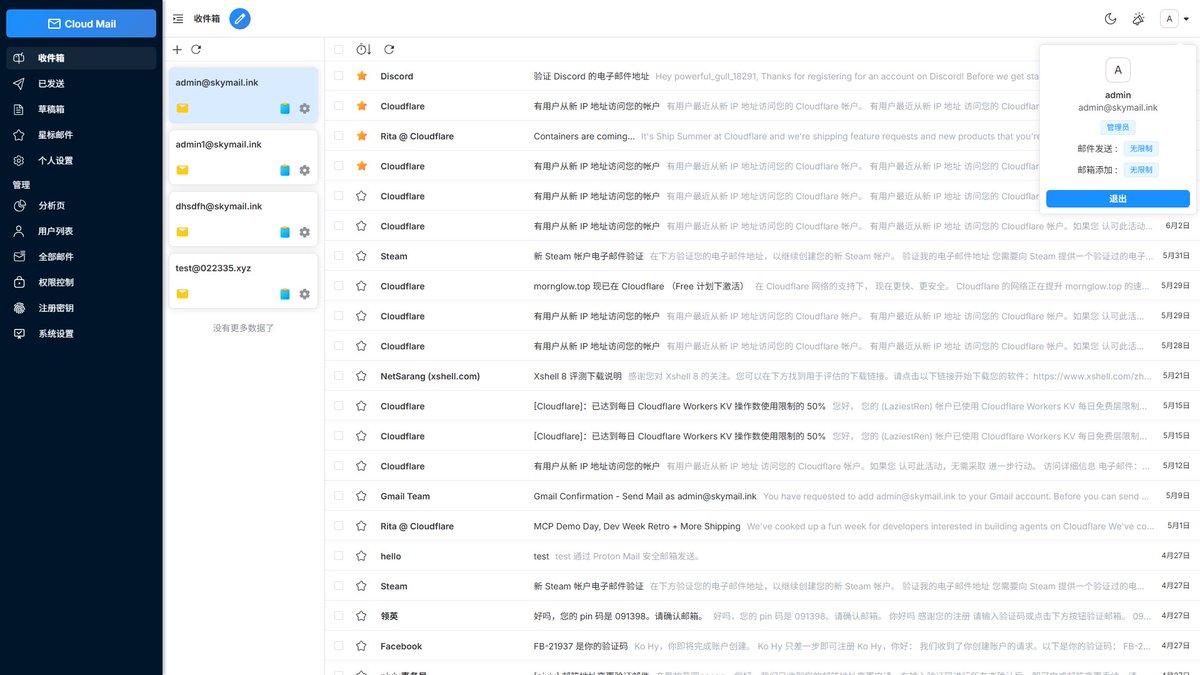
Cloud Mail : un service mail self-hosted sur Cloudflare Workers, sans serveur. Envoi via Resend, pièces jointes sur R2, notifications Telegram et détection automatique des codes de vérification par Workers AI. ⬇️
70% of AI research isn’t reproducible. With ICML 2026 happening last week, over 6000+ research papers have dropped, but how many are actually real and reproducible?
We’re excited to partner with @huggingface on a community challenge to find out.
All you have to do is pick a paper, select one of the claims, and start experimenting.
And now, you can use our autoresearch agent to do the hard work for you while contributing to a massive library of open research artifacts.
Prizes: $4500 in GPU credits 👀
Full details found below 👇
"Requential Coding: Pushing the Limits of Model Compression with Self-Generated Training Data"
This paper, Requential Coding, compresses models by coding what they learn, not their weights.
So a student trains on samples it generates itself. A teacher then only points out which samples are useful, which means the code only pays when teacher and student disagree.
This makes compression ignore model size and raw data noise.
And the results are surprising. They found that bigger models can need fewer bits at the same loss, and this gives stronger generalization bounds for scaled LLMs.
🚨 DeepSeek V4 is now running entirely on Huawei AI chips
China appears to be assembling a fully domestic frontier AI stack:
• DeepSeek V4 has been adapted to run entirely on Huawei Ascend clusters
• Huawei’s Atlas 950 SuperPoD debuts publicly tomorrow
• The system links thousands of Ascend processors into one computing cluster
• Designed for large scale AI training and inference
• Beijing will promote Chinese open-source AI as a low-cost alternative to Western closed models
This is one of China’s biggest steps yet towards removing Nvidia from its frontier AI ecosystem.
Will China finally compete with Nvidia?
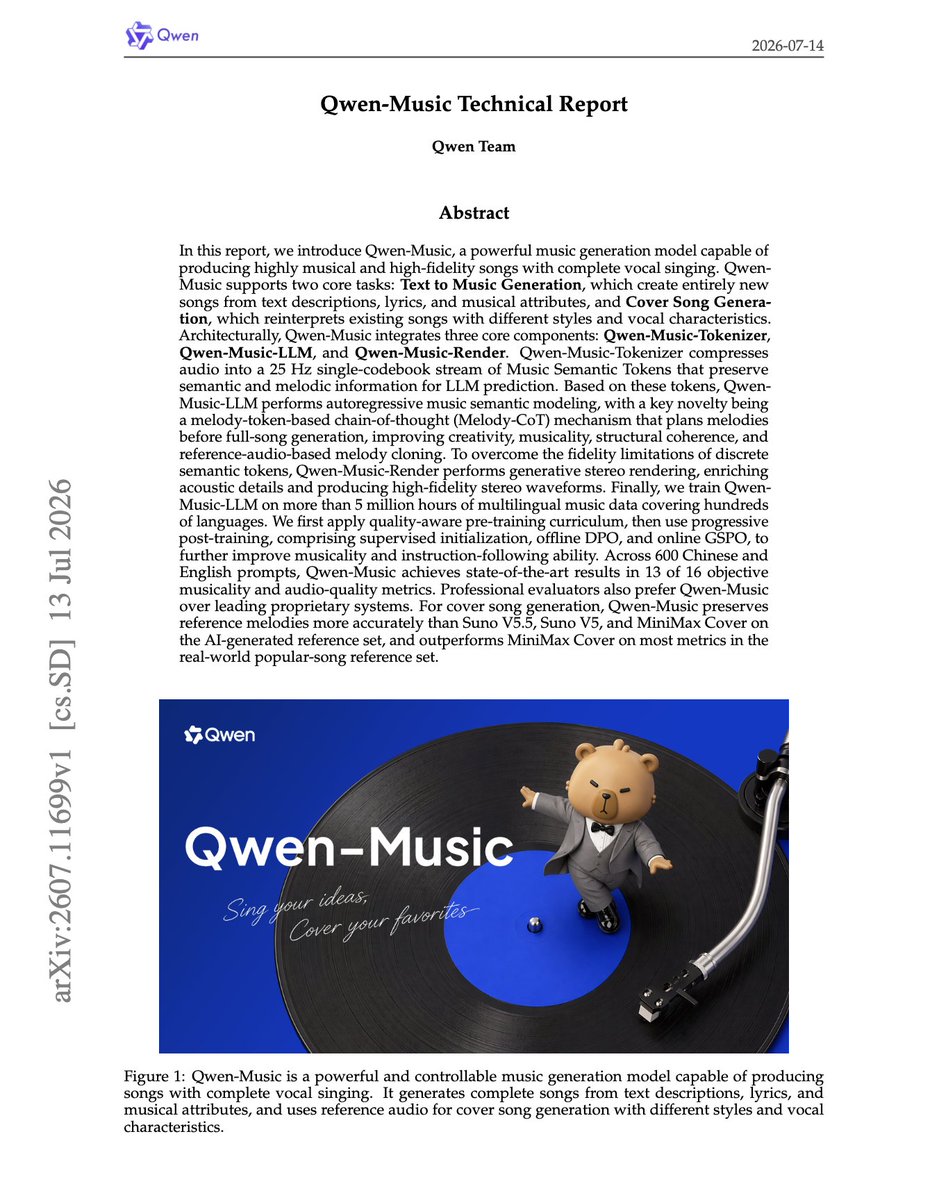
“Qwen-Music Technical Report”
AI music generation has to solve two problems at once, composing a coherent song and rendering it as high-fidelity audio.
This Qwen paper however splits them apart.
Qwen-Music first plans music in compact 25 Hz semantic tokens, uses Melody-CoT to reason over melody, then renders the result into 48 kHz stereo audio.
This creates a single model for prompt-to-song and cover generation that beats or matches top proprietary systems across most objective and human evals.
Un LLM n’est pas une BDD.
Tu lui balances 3000 pages sans RAG, sans chunking, sans pipeline de recherche, puis tu t’étonnes qu’il hallucine ?
Il croit faire une démonstration des limites de l’IA alors qu'il démontre juste ses limites le "journaliste tech" de BFMTV @GrablyR .
Bon, je veux connecter avec ceux qui build dans l'écosystème IA francophone. Si tu es dans :
- les agents IA (Hermes, OpenClaw, N8N)
- les SaaS et les outils builds en vibe-coding
- les modèles, les benchmarks, l'infra
Un commentaire avec ce que tu construis, qu'on continue de grandir ensemble 🌱
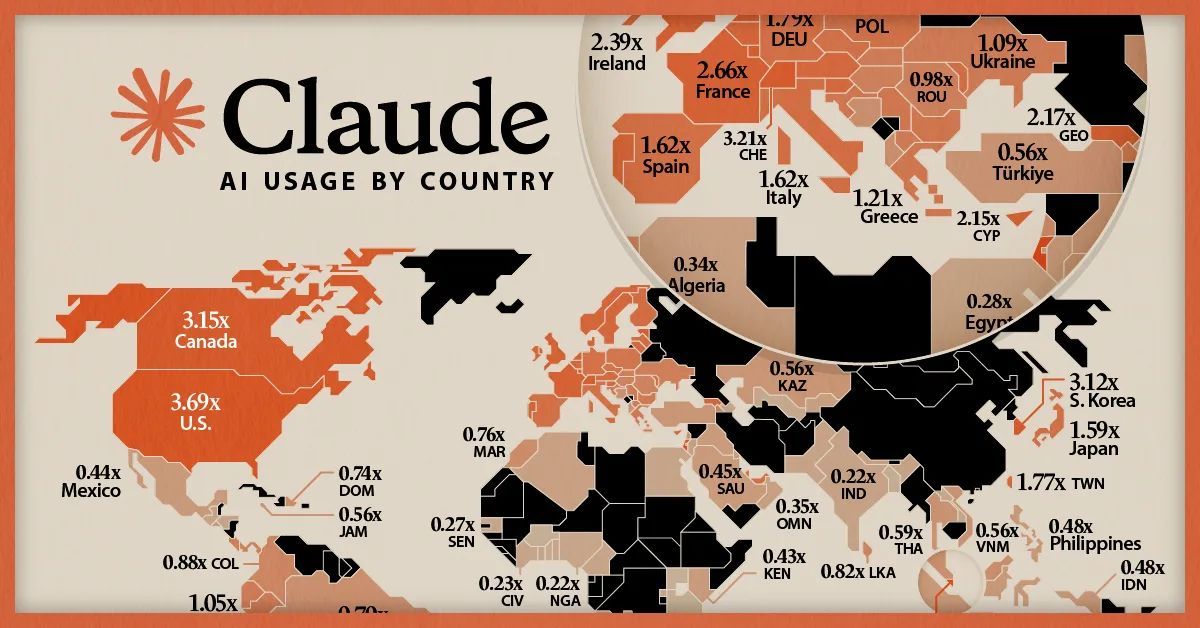
Rediff :🌎 Quels pays utilisent le plus Claude AI 🤖 ?
Israël, Singapour et les États-Unis dominent
Les plus petits pays se classent mieux en termes d'intensité d'adoption
https://t.co/DggF0nj4Td
We grew a very big model in a very tiny pot. 🌱
Meet Bonsai 27B; a 27B-class multimodal model that fits on a phone.
🪴 3.9 GB at 1-bit
💻 5.9 GB in ternary
🧠 Reasoning, vision, tool use
🔓 Apache 2.0
Small footprint. Full-grown intelligence.
https://t.co/3QFvwYdGcj
🚨 New Post: Self-Driving Agent Infrastructure
Software engineering is becoming autonomous, and it makes sense that AI engineering is the first to get self-driving capabilities.
Learn how I build my self-driving agent platform.
https://t.co/nPrXSxrXQZ
The phone threshold is even harder than the storage number suggests.
A phone exposes only part of its memory to an application, and the model must share that budget with its KV cache, activations, runtime, and the rest of the product.
At 3.9 GB, 1-bit Bonsai 27B clears that threshold with room to work, making 27B-class local AI possible on a phone for the first time.
(Demo Mode: cached & prefilled image context)
Great question! I’ll assume you’re referring to investing in publicly listed stocks in Cameroon.
Stock investments in Cameroon are handled through the Bourse des Valeurs Mobilières de l’Afrique Centrale (BVMAC), the regional stock exchange serving the CEMAC region. However, you can’t buy shares directly, you need to go through a licensed broker, commonly called a Société de Bourse (SDG). You can find the list of licensed brokers here: https://t.co/Sus42KYsp1
When I wanted to start investing, I emailed every SDG on that list to compare their responsiveness. That gave me a good idea of which ones offered the best customer service.
To invest, you’ll need to open a Securities Account. Most people are familiar with current and savings accounts, but a securities account is what allows you to buy and sell shares on the stock market.
One thing many people don’t know is that your shares remain protected even if your SDG goes bankrupt. Under the regulations of COSUMAF, the regional market regulator, your securities can be transferred to another licensed broker, so you don’t lose ownership.
Opening an account is fairly straightforward today. Some SDGs are building mobile apps to simplify the process, although the user experience still has room for improvement. In many cases, you’ll still need to visit their offices.
When you purchase shares, you’re issued a share certificate. Depending on the bank and its policies, these shares may also be used as collateral for a loan, which can be useful if you’re looking for leverage.
The main challenge with BVMAC today is liquidity. Since relatively few shares are traded, buy or sell orders can take time to execute.
For example, earlier this year I decided to buy SAFACAM shares. The quoted price when I was presented the opportunity was 28,000 XAF per share. By the time my order was executed, the price had risen to 30,000 XAF. Today, it’s around 33,000 XAF per share.
That illustrates both the market’s illiquidity and its potential for long-term appreciation. Personally, I see some of these shares appreciating much like land, you can benefit from capital gains over time while also earning dividends.
A few people also asked how often dividends are paid. The answer is simple: it depends. A company must first make a profit, and then its shareholders, through the board and annual general meeting, decide whether to distribute part of those profits as dividends or reinvest them into the business.
Some investors avoid companies like SOCAPALM, because they don’t usually pay dividends while others have different preferences. BGFI Bank, which listed only a few months ago, has already paid dividends. If the company continues to perform well, more investors may buy the stock, driving up its price. On the other hand, if it fails to execute its growth strategy, the share price could fall just as quickly. That’s the nature of equity investing.
DM me specifics (sector, ticket size, risk appetite), happy to share more tactical advice or intros where it makes sense. What’s your angle: public markets, private, or a mix?
𝐒𝐩𝐚𝐢𝐧'𝐬 𝐎𝐟𝐟-𝐁𝐚𝐥𝐥 𝐈𝐧𝐭𝐞𝐧𝐬𝐢𝐭𝐲 𝐂𝐫𝐮𝐬𝐡𝐞𝐬 𝐅𝐫𝐚𝐧𝐜𝐞 𝐇𝐲𝐩𝐞
Spain are used to beating teams through sheer possession dominance.
This one they won thanks to their off-ball intensity.
https://t.co/ifD3b7y1wg
Alibaba's Qwen-Audio-3.0-TTS-Plus is the new leading model on the Artificial Analysis Speech Arena Leaderboard for Provider Voices, narrowly surpassing Simba 3.2 and ahead of Gemini 3.1 Flash TTS, and Sonic 3.5
Qwen-Audio-3.0-TTS-Plus is Alibaba's latest Text to Speech model, released with increased naturalness and contextually appropriate intonation. The release continues Alibaba's strong momentum across AI model releases, following recent leading launches in language, image, and video generation.
Key takeaways:
➤ Quality: Qwen-Audio-3.0-TTS-Plus has an Elo score of 1,236 (+17/-17) based on 1,305 arena appearances, narrowly ahead of Simba 3.2 at 1,234 (+17/-17), with overlapping confidence intervals, and ahead of Gemini 3.1 Flash TTS at 1,214 and Sonic 3.5 at 1,207.
➤ Throughput speed: The model generates 16 characters per second, below other leading models Simba 3.2 (30.2), Gemini 3.1 Flash TTS (27), and Sonic 3.5 (120)
➤ Pricing: Qwen-Audio-3.0-TTS-Plus is priced at $27.59 per 1M characters via Alibaba Cloud Model Studio, below Sonic 3.5 ($39.00/1M), above Gemini 3.1 Flash TTS ($18.31/1M) and Simba 3.2 ($10.00/1M).
See more details and listen to samples below ⬇️
🚨 Kimi K3 set to launch within hours
Moonshot AI may have accidentally revealed the date through its own Kimi API platform:
• An official page appeared titled “Kimi K3 launch limited-time recharge campaign”
• The campaign begins on July 15 at 00:00 China time
• The original page now redirects instead of displaying the announcement
• K3 will use a completely new architecture focused on long-horizon agent tasks
• Separate rumours suggest 2.5T parameters and a 1M-token context window
• No official benchmarks or model card have appeared yet
Do you think this model could become the strongest model from a Chinese AI lab?
Kimi K3 Leaks: Coming Tomorrow
- Kimi K3 is to be launch tomorrow, according to leaked Kimi API platform page
- It will launch alongside a limited-time API top-up promotion, offering 10-30% bonus credits depending on the recharge amount.
- Kimi K3 is built on a new architectural innovation, rather than being just a larger version of previous Kimi models.