@Halia0__ Always notice, many of these try to have you divide a fraction to trip you up. In this case 18 div by 2, but it’s not. (It’s like double division.) You have to multiply by the denominator (same as div by the fraction).
The car industry had a century to build an electric car people actually wanted. It didn’t.
The aerospace industry had sixty years to make a rocket reusable. It didn’t.
The telecom industry had decades to connect the billions it couldn’t profit from. It didn’t.
One person looked at all three and started crossing them off.
Reusable rockets that land themselves. Electric cars that outsell their gas-powered rivals. A satellite network that beams internet from orbit to any point on the planet. A platform where speech is no longer filtered through a handful of editors. A chip inside a human brain that lets a paralyzed person control a computer with their thoughts.
And now a car that flies.
Six companies. Six industries. Each one operating at the frontier of its field while feeding engineering, data, and capability back into the others.
The rockets fund the satellites. The satellites fund the rockets. The cars train the robots. The AI runs them. The platform keeps the conversation free. The energy powers all of it.
People keep waiting for him to fail. They have been waiting for twenty years.
The rockets were supposed to explode. They land on boats. The cars were supposed to be toys. They outsell everyone. The satellites were supposed to be impossible. They connect six continents.
The brain chip was supposed to be science fiction. It is inside a human skull right now.
At some point the pattern stops being luck and starts being something the critics are not equipped to recognize.
Not because they lack intelligence. Because the framework they use to judge what is possible was built inside the institutions that couldn’t do what he does.
The conversation about Elon Musk has never been about Elon Musk.
It has been about how uncomfortable it makes people to watch one person accomplish what entire industries organized themselves to attempt and never finished.
History does not produce this combination often. The drive. The technical depth. The pain tolerance. The willingness to let the mission burn through everything else. And the insane ambition to attempt all of it at once.
Every one of these technologies would have arrived eventually. Reusable rockets. Electric vehicles. Global connectivity. Brain interfaces. None of them violated the laws of physics.
But eventually can mean fifty years. And fifty years is the difference between your grandchildren seeing it and you seeing it.
The most overlooked thing Musk has done is not any single invention.
It is how much of the future he pulled into the lifetimes of people who would have died before it arrived.
Earth does not get many of these.
And the people still betting against him are making the same mistake every industry made before he walked in and did the thing they said couldn’t be done.
In 1957, a Russian immigrant published a novel of more than a thousand pages built around one question: what happens if the people who make the world run simply stop?
Its title is Atlas Shrugged. In France it's called La Grève, The Strike. It wasn't even translated into French until 2011. That tells you something.
This morning, I think Elon Musk wrote the sequel.
A. Where the book comes from.
Ayn Rand was born Alisa Rosenbaum in Saint Petersburg in 1905. As a teenager, she watched Bolshevik soldiers walk into her father's pharmacy and seize it in the name of the people. Her family lost everything. Not to a competitor. To a committee.
She fled to America in 1926 and spent the rest of her life writing about one distinction: those who create, and those who seize.
B. The story.
In Atlas Shrugged, America is sliding into decline. Not because of war. Because of rules. Year after year, a growing class of bureaucrats, regulators and planners decides that production must be controlled, shared "fairly," frozen. They never build anything. They issue directives. The worst one freezes every worker in his job and forces every inventor to hand over his patents for the public good.
And one by one, the people who make the country run start disappearing. The best engineers. The industrialists. The inventors. An oil man sets his own wells on fire before vanishing. The whole country keeps repeating a question it doesn't understand: "Who is John Galt?"
John Galt is the man behind the disappearances. He has convinced the creators to go on strike. They withdraw to a hidden valley in the Colorado mountains, where everyone keeps what they make and trades freely. And they let the world find out what it looks like without them.
The lights go out in New York. The grey men are left alone with their directives, and discover that a directive has never produced a single kilowatt.
C. The core idea.
The strike isn't about money. It's about consent.
Rand's insight is that the system that captures the creators runs on their cooperation. It needs them to keep producing so it has something to redistribute. The bureaucrat is a parasite who needs a host. Remove the host, and he's exposed as what he always was: useless.
D. What Musk just did.
This morning, Musk announced that next year he will give one of his own SpaceX shares to every kid in America. "The first of many."
Here's what's fascinating. It's the strike, run in reverse.
Rand's creators withdrew. Musk stays. He keeps building rockets, satellites, AI. But instead of walking away from the system, he walks around it. The value goes straight from the builder to the citizen. No ministry, no agency, no committee in the middle.
Rand had to make the creators disappear to prove the bureaucrats were useless. Musk doesn't need to disappear. He just needs to stop routing value through them. Same result. The grey men are left standing in the middle of a pipe nobody uses anymore.
E. The difference that changes everything.
Rand's strike has a flaw her critics never stopped pointing out: ordinary people are left behind. The creators retreat to their valley. The rest of the country sits in the dark.
Musk's version fixes that. He isn't taking the creators out of the world. He's bringing the world into the valley. Every kid in America becomes a shareholder in the machine. Not a spectator of the strike. A participant.
That's the alliance being formed right now: builders and citizens, directly, with nothing in between. And the only people who lose that deal are the ones who never built anything.
F. Why now, and not in 1957.
In Rand's time, the strike was a fantasy. You couldn't produce at scale without the state's permission, and you couldn't reach every citizen without its pipes.
In 2026, one founder can build rockets, run a global network from orbit, and pledge equity to 73 million children in a single post. AI will soon do in seconds what a ministry does in years. The tools of the strike finally exist. And they don't require anyone to leave.
G. The ending.
For seventy years, "Who is John Galt?" was a shrug. A way of saying nothing can be done.
In the book, the strike ends when the creators decide the road is clear and walk back into the world to rebuild it.
That's the scene we're watching. Not a man leaving. A man coming back, with a gift for every child.
The grey men are about to discover what Rand promised them seventy years ago: a world that no longer needs them.
I’m French. I want to talk to Americans who are about to vote Democrat. Not to insult you. To warn you.
I come from your future.
In France we did everything your progressive politicians promise. Free healthcare, free college, generous welfare, strong unions, heavy regulation, high taxes on the rich, a state that takes care of everything. Public spending close to 57% of GDP, one of the highest on the planet. On paper, it’s the dream.
Here’s what it looks like from the inside. France hasn’t passed a balanced budget since 1974. Our debt is above 3,300 billion euros. Interest on that debt is becoming one of the biggest items in the national budget. Our hospitals are collapsing despite record funding. Our schools rank lower every year. Young people with degrees can’t afford an apartment in the city they were born in. Our best engineers leave for London, Zurich and San Francisco. And the rich you wanted to tax? They left too, and took the jobs with them.
The promise was protection. The result is stagnation.
The worst part is that nobody in France voted for decline. Every single step sounded generous, compassionate, reasonable. One more program. One more regulation. One more tax to fund it. Each step alone makes sense. Fifty years of them, and you wake up in a country that can no longer build a nuclear plant on time or keep its streets safe.
I love America because it’s the one place on earth where people still believe they can build something from nothing. I came to Silicon Valley as a self-taught kid and it changed my life. That spirit is the most precious thing your country has.
Before you vote, ask yourself one question: is the program you’re voting for making America more like America, or more like France?
Trust me. You don’t want to be France.
Hola, soy palestino. 🇵🇸
Y como la honestidad es poco común en mi política, permítanme confesar algunas cosas.
1947. La ONU me ofreció un estado. Junto a Israel. Fronteras, independencia, reconocimiento. Dije que no. Mis líderes prometieron que la guerra "arrojaría a los judíos al mar". En cambio, lo perdí todo y lo llamaron catástrofe. No porque no me ofrecieran un estado, sino porque lo rechacé.
1948–2025. Los estados árabes podrían haberme integrado, dado derechos, pasaportes, dignidad. En cambio, me encerraron en campos de refugiados durante generaciones, para que siguiera siendo un arma contra Israel. Construyeron palacios para ellos y cárceles para mí. Me usaron como propaganda, no como personas.
1967. Tras otra guerra perdida, podría haber construido un estado en Cisjordania y Gaza. En cambio, insistí en "ni paz, ni reconocimiento, ni negociaciones". Tres noes. Cincuenta años después, sigo sin Estado. Resulta que el rechazo no paga el alquiler.
Oslo, década de 1990. Israel dijo: «Intentémoslo». Me dio autonomía. Armas para la policía. Miles de millones en ayuda. ¿Qué hicieron mis líderes? Robaron el dinero, armaron milicias y lanzaron una intifada. Atentados suicidas en lugar de escuelas. Cohetes en lugar de fábricas.
Gaza, 2005. Israel se fue por completo. Sin colonos, sin soldados. Tuve la oportunidad de convertir Gaza en un Singapur mediterráneo. Voté por Hamás. La convirtieron en Mogadiscio junto al mar. ¿Miles de millones en ayuda? Túneles, cohetes y palacios para sus líderes, mientras mi gente come comida enlatada en la oscuridad.
¿Democracia? No he tenido elecciones en casi 20 años. Hamás mata a los disidentes en Gaza. Fatah los encarcela en Cisjordania. Mis líderes cancelan elecciones porque están demasiado ocupados luchando por el poder.
Religión. En lugar de construir un futuro, pongo a clérigos en televisión enseñando a los niños a odiar a los judíos. Glorifico a los "mártires" que hacen estallar autobuses. Crío a mis hijos con canciones de sangre y fuego en lugar de libros y ciencia. Cambio la esperanza por la guerra santa.
Mundo árabe. Los regímenes árabes me llaman "hermano". Pero pregúntenles cuántos palestinos pueden vivir libremente en Líbano, Siria, Egipto o Kuwait. Me excluyen, pero celebran mi muerte, porque mi muerte es su excusa.
Absurdo. Sigo diciendo que quiero "construir un estado". E irónicamente, justo al lado está Israel: el vecino que construyó una democracia próspera, una potencia tecnológica, granjas en el desierto, ciudades de polvo. Sin petróleo, sin riqueza infinita, solo coraje. Podría haber aprendido, copiado, colaborado. En cambio, elegí la envidia y la rabia.
Obsesión antijudía. Podría haber aceptado a los judíos como vecinos. Podría haber dicho: "Dos naciones, dos estados". En cambio, repito: "Del río al mar". En lugar de exhibir el honor, la hospitalidad y la rica cultura árabe, mostré solo la cultura de la espada: la ira, el extremismo y la sangre. En lugar de gritar salaam (paz) a los israelíes, grité muerte a los judíos. Y luego finjo sorprenderme cuando los israelíes no confían en mí, cuando están enojados, decepcionados y convencidos de que no quiero coexistencia en absoluto.
Responsabilidad. Culpo a Israel de todo. Siempre. ¿Mis líderes roban miles de millones? Culpa de Israel. ¿Hamás dispara cohetes desde hospitales? Culpa de Israel. ¿Glorifico la muerte más que la vida? Culpa de Israel. La responsabilidad no es mi fuerte.
Soy palestino.
Podría haber construido una nación, muchas veces. Elegí el rechazo, la corrupción y la guerra sin fin. Podría haber vivido en paz con Israel, pero elegí vivir a la sombra de su destrucción.
Así que sí, soy una víctima. Pero con demasiada frecuencia, soy víctima de mis propios líderes, de mis propias decisiones y de mi propia negativa a abandonar el odio.
Y esa, querido lector, es la tragedia que nadie quiere admitir.
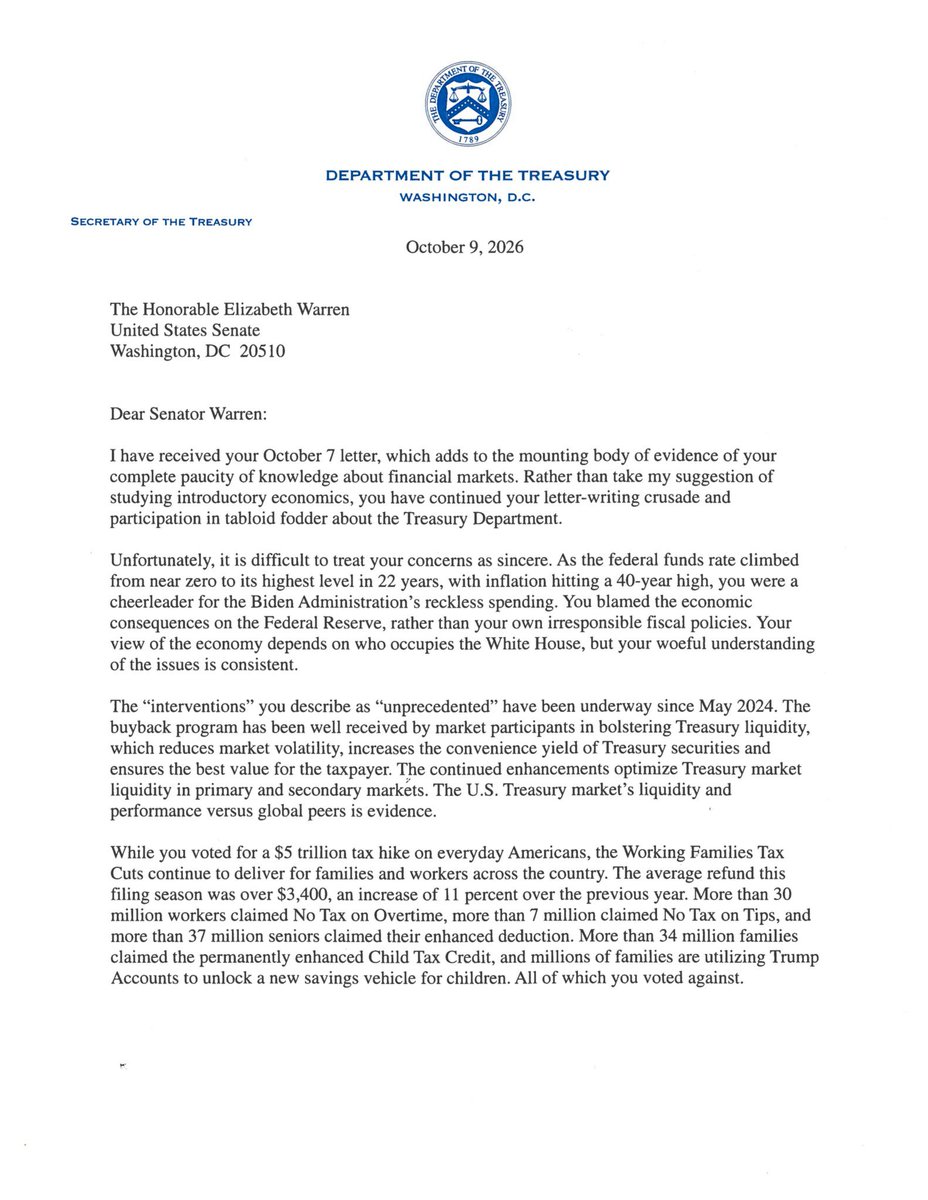
🇺🇸 SCOTT BESSENT JUST POSTED THIS:
Dear Senator Elizabeth Warren:
I have received your October 7 letter, which adds to the mounting body of evidence of your complete paucity of knowledge about financial markets. Rather than take my suggestion of studying introductory economics, you have continued your letter-writing crusade and participation in tabloid fodder about the Treasury Department.
Unfortunately, it is difficult to treat your concerns as sincere. As the federal funds rate climbed from near zero to its highest level in 22 years, with inflation hitting a 40-year high, you were a cheerleader for the Biden Administration’s reckless spending. You blamed the economic consequences on the Federal Reserve, rather than your own irresponsible fiscal policies. Your view of the economy depends on who occupies the White House, but your woeful understanding of the issues is consistent.
The “interventions” you describe as “unprecedented” have been underway since May 2024. The buyback program has been well received by market participants in bolstering Treasury liquidity, which reduces market volatility, increases the convenience yield of Treasury securities and ensures the best value for the taxpayer. The continued enhancements optimize Treasury market liquidity in primary and secondary markets. The U.S. Treasury market’s liquidity and performance versus global peers is evidence.
While you voted for a $5 trillion tax hike on everyday Americans, the Working Families Tax Cuts continue to deliver for families and workers across the country. The average refund this filing season was over $3,400, an increase of 11 percent over the previous year. More than 30 million workers claimed No Tax on Overtime, more than 7 million claimed No Tax on Tips, and more than 37 million seniors claimed their enhanced deduction. More than 34 million families claimed the permanently enhanced Child Tax Credit, and millions of families are utilizing Trump Accounts to unlock a new savings vehicle for children. All of which you voted against.
These results are made possible by the employees of the Department of the Treasury, who are working around the clock for the American people. Unsurprisingly, you have responded by criticizing their dedication and aptitude for the job in a recent interview.¹ Despite your malign characterization, the Domestic Finance team you alluded to in your interview is fully staffed relative to historical levels. It is ironic that you have voted against every presidential appointee for a position at Treasury, no matter how impressive the qualifications for the role. Given your newfound interest in Department personnel, I challenge you to reverse course and thoughtfully engage with future nominees and support their confirmation.
Finally, my offer of a Foreign Exchange for Dummies tutorial still stands and if you receive a passing grade on the Yale metric, not the Harvard curve, I would be happy to also include a Fixed Income for Dummies.
Sincerely,
Scott Bessent
Then he finished with a handwritten note ✍️
Happy Indigenous Peoples’ Day in advance to you and your family.
💀
American an European friends,
I’m so ashamed, but you need to see what France has become.
Don’t make the same mistakes we did.
The only peaceful solution is to send them back to their countries of origin they love so much.
We cannot coexist. It will be them, or us.
You have to count “I” as a brother, because each individual has the other three as brothers.
(There is no multiplication involved because the brother relationship works both ways. 2 brothers each have a brother, 3 brothers each have 2 brothers, 4 brothers each have 3 brothers, etc.)
In 1948, the Jews had nowhere to go, and the Europeans didn't want them back. The United Nations, at the prompting of the United States, said that the Jewish people could be established in their historic homeland. The original UN agreement made a place for a Jewish homeland and a homeland for the Palestinian people.
On the day the UN made that proclamation, all the surrounding nations—Lebanon, Syria, Jordan, Egypt—attacked Israel, a brand new country. Day one, no standing government, no standing military, no real international support. I have friends that lived there, and they heard people on the radio telling the people in the area, "Take a week's vacation. We're gonna drive the Jews into the sea." And somehow, inexplicably, the Jewish nation survived.
When we talk about the West Bank, we're talking about land on the west bank of the Jordan River. At the end of that war, the Jordanians controlled it. The people who lived there had Jordanian passports. Nobody called the people there Palestinians. There was never a Palestinian government there. Palestine referred to a region, like we refer to the southeastern United States. It was a name for a region in the Middle East because the Romans didn't want the Jews there anymore.
Then came the Six-Day War. Israel was attacked, and at the end of it, the Israelis had captured the West Bank. From 1967 until today, it's been a disputed territory. The Israelis, under a great deal of pressure from the Americans, put together a peace deal that would have given the Palestinian people the entire West Bank and half of Jerusalem. That was the deal on the table. And Yasser Arafat said, "No, we want it all." At multiple points in this story, the leadership of the people in this region have refused to make peace.
In the Six-Day War, the Jews took control of the Temple Mount, the holiest place in all of Judaism, for the first time since 70 AD. Then Moshe Dayan went to the Prime Minister and said, "If we give to the Muslim nations the Temple Mount, our holiest place on the planet, they will understand how much we want peace." So the Israelis gave the Temple Mount to the Muslim people—and it didn't bring any peace.
So, did Israel steal the Palestinians' land? The reality is that the Israelis didn't steal anyone's land. The Muslim world wasn't interested in the Palestinian people having a homeland. They're determined to drive the Jews into the sea.
This is why it is crucial for Christians to understand history and to pray for the Jewish people.