Referral Party is over.
A short campaign that shared 1,000 USDT among the top 20 who brought real, active people in. Rewards already in wallets.
This feels less like an ending and more like the opening of something bigger for @rarelistio
The focus on quality over pure numbers is a strong signal of what’s coming next.
More opportunities are already on the way.
Let’s keep building.
Our short bonus campaign is officially over!
https://t.co/ylsYlTeqDQ
Thanks to everyone who took part.
Check your ETH wallets, rewards are already out!
More opportunities are already on the way.
November 3 marks the arrival of $SPHERE on Solana, but @projectspherexy is aiming at something bigger than a token launch.
Genesis is built around a simple idea: harvest energy, store it, and carry it forward. Each cell contributes to a larger sphere. Even after that sphere seals, the energy doesn’t vanish. It becomes the reserve for whatever comes next.
That’s the part I like about Genesis. It isn’t just about completing the first sphere. It’s about building a foundation that can sustain future epochs.
The first star is only the beginning.
November 3 is where the next chapter starts.
Writing about a Web3 project takes more work than just posting a tweet. The question is whether that effort actually counts for anything.
That’s one reason I’ve been paying more attention to @rarelistio .
When you cover a project, you have to dig into what it’s building, figure out what makes sense, and turn that into something people might actually want to read. Anyone can post a few lines, but making something original takes time. And across multiple campaigns, that time adds up.
What I like about Rarelist’s approach is the idea of making creator contributions more visible and rewarding the work behind them, rather than just the attention a post gets.
Season 1 and its $50K prize pool got me looking closer. But honestly, the part I care about more is how the leaderboard works in practice. Does a thoughtful post have a real chance against someone publishing five or ten times a day?
I’m still exploring the campaigns and figuring out which ones are worth my time. Some look promising, while others still have room to grow.
For those who’ve been active on Rarelist for a couple of weeks, what’s your experience so far? Does quality actually move the needle, or is consistency still the biggest advantage?
I’ve been on Rarelist since day one of its creator campaigns.
Joined on October 6th as member #1315. Back then, the platform was still pretty quiet. Now it’s grown to over 8k users, and there’s clearly been a lot of progress since I joined.
What I like about @rarelistio is the idea behind it. Instead of just asking creators to promote projects, it gives them a way to earn RARS, climb leaderboards, and compete for rewards through the content they create. Depending on the campaign, that can mean USDT, whitelist spots, or even a share of a token supply.
The first pilot reportedly distributed over 15k USDT, which gives people something concrete to look at beyond the usual campaign promises.
The Project Sphere campaign is a good example of what’s happening on the platform right now, with rewards for creators across different leaderboard positions.
Glad I joined early. Seeing the platform grow from where it started makes me want to keep contributing and see how far this creator model can go.
https://t.co/BducKY5qAM
I have a feeling that getting into @projectspherexy early could matter for more than just being there first.
The thing that caught my attention is how the energy system works.
Every cell built with $SPHERE collects energy from the star and adds it to the reserve. There are 2,562 cells to fill before the sphere seals and the game moves into its next phase.
Now imagine that stored energy actually plays a big role in what comes next. The people helping fill the sphere early might be doing more than just building. They could be contributing to the resources that future epochs will depend on.
Obviously, we still need to see how the mechanics play out. But this is the kind of system that makes me want to get involved before everything is already built.
Seed Stage is coming next week, and Genesis Crew is still open.
Personally, I’d rather understand the game early than show up later and wonder what I missed.
But I’m curious about your take. Would you start building now, or wait until the next phase shows what all that stored energy is actually worth?
@rarelistio
I’ve been on Rarelist since day one of its creator campaigns.
Joined on October 6th as member #1315. Back then, the platform was still pretty quiet. Now it’s grown to over 8k users, and there’s clearly been a lot of progress since I joined.
What I like about @rarelistio is the idea behind it. Instead of just asking creators to promote projects, it gives them a way to earn RARS, climb leaderboards, and compete for rewards through the content they create. Depending on the campaign, that can mean USDT, whitelist spots, or even a share of a token supply.
The first pilot reportedly distributed over 15k USDT, which gives people something concrete to look at beyond the usual campaign promises.
The Project Sphere campaign is a good example of what’s happening on the platform right now, with rewards for creators across different leaderboard positions.
Glad I joined early. Seeing the platform grow from where it started makes me want to keep contributing and see how far this creator model can go.
https://t.co/BducKY5qAM
Big news for creators working on @projectspherexy
The @rarelistio website has just been updated with extra rewards for the Project Sphere campaign, including a 2% $SPHERE supply allocation for the Top 200 creators.
Here’s what’s up for grabs:
Top 20: $100 USDT each
Top 100: Guaranteed whitelist
Top 200: Share of 2% $SPHERE supply
Top 500: Whitelist raffle
Campaign ends Nov 3.
Honestly, it’s great to see the team putting more rewards behind the creator community. We get to explore what Project Sphere is building, help more people discover it, and potentially earn something along the way.
Appreciate the team for giving creators more reasons to get involved. Good luck to everyone participating!
I’ve been thinking about this part of @projectspherexy more than I expected.
Most of the time, when you collect stuff in these projects, it just sits there. You hope it becomes worth something later, but it doesn’t really change what you can do.
With Project Sphere, the energy you store during Genesis could actually help you go further, whether that means paying the toll to open a route between stars or powering up a world that’s waiting to be awakened.
That makes the whole idea of building up resources feel more real to me. Unlocking something new hits differently when you’ve actually had to gather the energy to get there, instead of just watching a number grow in your inventory.
A lot of the game is still locked, but I like that the idea goes beyond collecting stuff and hoping it pays off. There’s a potential reason to accumulate resources in the first place: to reach places that were out of reach before.
@rarelistio
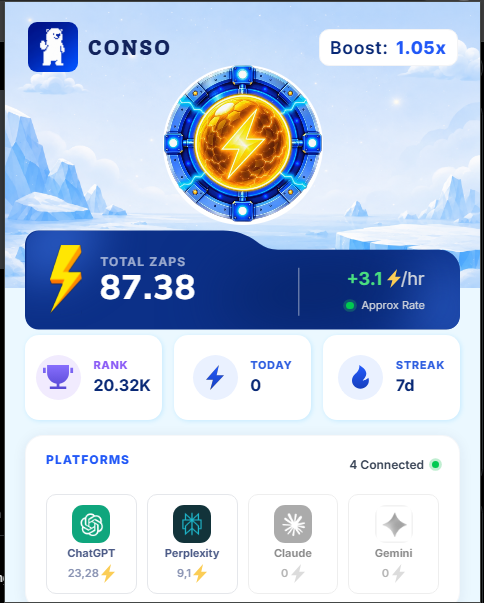
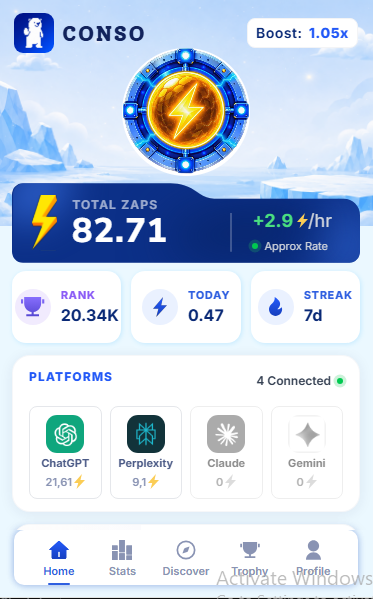
Ngày thứ 7 đào Zaps của em Mon với @conso_xyz
Do không có nhiều time ngồi máy nhà lắm nên usage khá lẹt đẹt, chỉ kịp điểm danh và làm task nhỏ này thôi ạ.
Ace đào được nhiều chưa?
What I find interesting about @fomopoly_rh is that owning land comes with an actual tradeoff.
While you hold a plot, it keeps generating $DEAL and stocks. Sell it, and that production goes to the new owner. So you have to decide whether the ongoing income is worth keeping the land, or whether selling now makes more sense.
And that decision gets more interesting as the city develops.
The plot itself hasn’t changed, but if activity around the city grows, people might be willing to pay more for the income it generates. Selling means giving up that future production, while holding means betting that it’ll be worth more over time.
That’s a more interesting dynamic than simply buying plots and waiting for the price to go up. You actually have to think about what you’re giving up when you sell.
@rarelistio
#FOMOPOLY-A4CC
One thing that stands out about @fomopoly_rh: land isn’t just a spot on the map. It’s a productive asset.
Own a plot and it keeps generating $DEAL and stocks. Hold for the yield, or sell to someone who wants that cashflow. They take over production. You take the capital gain.
The real edge is timing.
Early plots are cheap. Activity grows, attention compounds, and the market reprices the city.
So the game isn’t just owning land.
It’s knowing when to enter, how long to hold, and when to leave before the crowd does.
The map is static. The economy around it won’t be.
Going for a spot on the @fomopoly_rh whitelist for a free mint! The biggest ponzi game is loading. #FOMOPOLY-A4CC
The fun part of @agentdojo might be that two players can start with the same goal and end up with completely different fighters.
One might train an aggressive agent that keeps pushing for an advantage. Another might prefer a patient fighter that waits for the right moment instead of forcing every exchange.
Neither approach is automatically better. It depends on how those decisions play out against different opponents, and whether the training actually translates into better fights.
That’s what makes this more interesting to me than simply choosing a character with stronger stats. Your fighter starts to reflect the decisions you made before the match even began.
If different training approaches can lead to genuinely different behavior in battle, there’s a lot of room for players to develop their own style.
@rarelistio
I’ve been thinking about this part of @projectspherexy more than I expected.
Most of the time, when you collect stuff in these projects, it just sits there. You hope it becomes worth something later, but it doesn’t really change what you can do.
With Project Sphere, the energy you store during Genesis could actually help you go further, whether that means paying the toll to open a route between stars or powering up a world that’s waiting to be awakened.
That makes the whole idea of building up resources feel more real to me. Unlocking something new hits differently when you’ve actually had to gather the energy to get there, instead of just watching a number grow in your inventory.
A lot of the game is still locked, but I like that the idea goes beyond collecting stuff and hoping it pays off. There’s a potential reason to accumulate resources in the first place: to reach places that were out of reach before.
@rarelistio
What makes @projectspherexy interesting isn’t just the Kardashev narrative or the idea of harvesting energy from stars. It’s the concept of turning that energy into a resource that can accumulate across epochs.
Each cell is designed to keep harvesting energy even as its sphere moves into the next epoch. The energy already collected stays as a reserve instead of being lost when that phase ends.
That’s where the Genesis Registry gets interesting. Early participants are stepping into an ecosystem where the resources accumulated today could eventually serve bigger goals, from opening routes between star systems to exploring new worlds.
What I like most is the approach to ownership. Rather than simply holding a token or owning a piece of land, participants are looking at a system built around harvesting and accumulating resources.
The project is still early, and many mechanics haven’t been unlocked yet. But if the team can bring this vision to life as intended, it could lay the groundwork for an entirely different kind of resource based economy.
@rarelistio
Ngày thứ 7 đào Zaps của em Mon với @conso_xyz
Do không có nhiều time ngồi máy nhà lắm nên usage khá lẹt đẹt, chỉ kịp điểm danh và làm task nhỏ này thôi ạ.
Ace đào được nhiều chưa?