Introducing https://t.co/wn3dS9CvJr
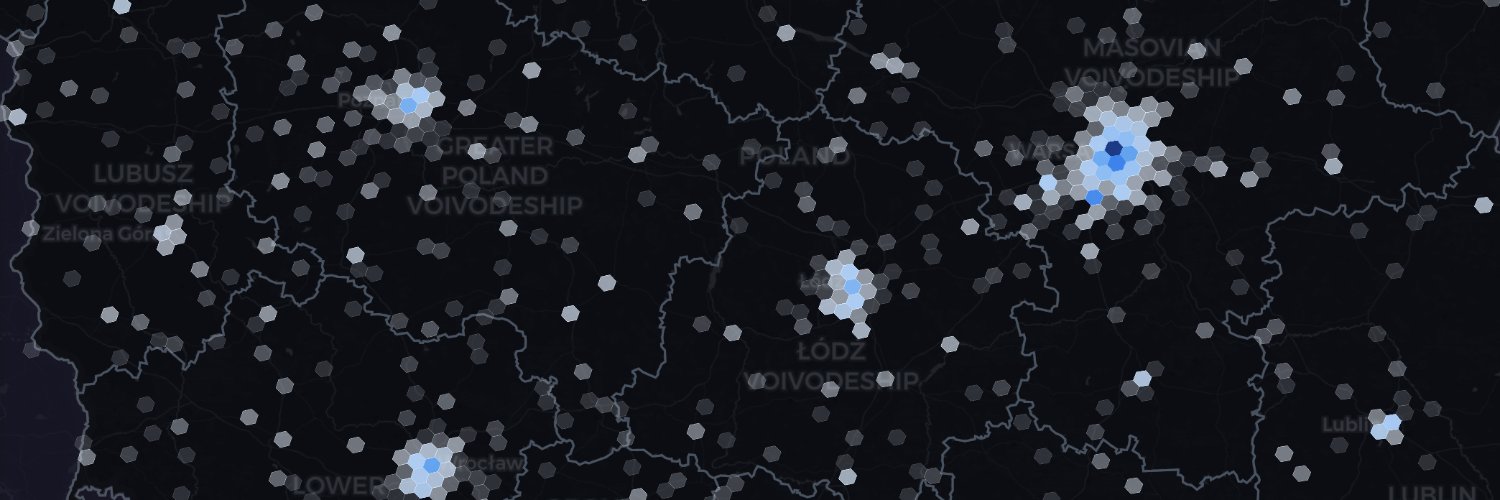
We mapped 886,253 businesses from the Polish KRS registry by owner origin. The data confirms what you see on the streets: over 23,000 are now foreign-owned.
The share of new registrations going to non-European owners has doubled in four years—from 2.8% in 2020 to 5.5% in 2024.
Poland’s migration debate focuses on border walls, Belarus, and “control.”
But away from the border, a quieter pathway is expanding: legal migration that turns students into workers, residents, and long-term settlers.
⬇️Let's look at the India-to-Poland pathway 🇮🇳🇵🇱
The clearest indicators are ZUS and work permits.
ZUS is Poland’s social insurance system.
Indian citizens registered in Poland’s pension/disability insurance system rose from 5,931 at end-2018 to 25,144 at end-2025.
Over the same period, work permits issued to Indian citizens rose from 8,362 to 29,524.
That is 4.2x growth in ZUS and 3.5x growth in work permits. 🧵
Then comes the capstone: "integration" infrastructure.
Poland’s AMIF/FAMI call for Foreigners’ Integration Centres had a budget of 432.5m PLN.
The model is One-Stop-Shop "integration":
legalisation support
Polish-language learning
labour-market help
public-administration services
NGO support
native-language outreach
So the full pathway is clear:
recruit → study → work → ZUS → legalise stay → settle
That is how temporary migration becomes settlement.
And this is not only private recruitment.
NAWA’s official “Ready, Study, Go! Poland” campaign promoted Poland in India.
In 2018, NAWA ran a Polish national stand at EDUEXPOS with 12 Polish universities across New Delhi, Chennai, Bangalore and Mumbai.
NAWA also held virtual fairs for the Indian Subcontinent in 2020, covering India, Bangladesh, Bhutan, Afghanistan, Maldives and Sri Lanka.
So the pipeline was not accidental.
It was promoted, institutionalised, and normalised.
How can a 41-year-old Zimbabwean DJ smash a Pole in the head with a beer glass and only receive a minor charge instead of facing deportation? The Polish victim needed stitches and suffered a concussion as well as a spinal injury...
It looks like the Polish justice system is heading down the same path as Western Europe: far more protective of certain migrants than of local white citizens.
This is the same Lublin where Zimbabwean work permits in Lubelskie exploded from ~16 in 2021 to over 1,100 in 2024, with thousands of African students (mostly Zimbabwean) already here.
Just weeks earlier, another Zimbabwean in Lublin — drunk — hit a woman with his car on a pedestrian crossing, tried to bribe witnesses and got aggressive with the police.
Why import so many people from a country that has violently seized thousands of white-owned farms, causing agricultural collapse, hyperinflation, and mass emigration of white farmers?
Leniency like this only imports the same patterns. This is the 'enrichment' pipeline in action.
This is what led to Henry Nowak's death in Britain.
How can a 41-year-old Zimbabwean DJ smash a Pole in the head with a beer glass and only receive a minor charge instead of facing deportation? The Polish victim needed stitches and suffered a concussion as well as a spinal injury...
It looks like the Polish justice system is heading down the same path as Western Europe: far more protective of certain migrants than of local white citizens.
This is the same Lublin where Zimbabwean work permits in Lubelskie exploded from ~16 in 2021 to over 1,100 in 2024, with thousands of African students (mostly Zimbabwean) already here.
Just weeks earlier, another Zimbabwean in Lublin — drunk — hit a woman with his car on a pedestrian crossing, tried to bribe witnesses and got aggressive with the police.
Why import so many people from a country that has violently seized thousands of white-owned farms, causing agricultural collapse, hyperinflation, and mass emigration of white farmers?
Leniency like this only imports the same patterns. This is the 'enrichment' pipeline in action.
This is what led to Henry Nowak's death in Britain.
At least 303 KRS businesses in Poland now list a beneficiary named Singh or Kaur, the canonical Sikh name markers.
160 are India-only. 143 are tied to non-Indian citizenships, mostly Western/EU. This is no longer just direct migration from India.
And it is only the floor: this excludes sole proprietorships, civil partnerships, and workers with no company ownership role.
And this is where it becomes beyond parody.
In 2022, Rockefeller Brothers Fund said it awarded $385,000 in grants to organizations supporting communities directly affected by the Russia-Ukraine war.
One grant alone was $100,000 for The Alliance for Black Justice Poland — about 26% of that entire pool.
Money that many people would assume was going to White Ukrainian refugees in need was instead routed into Black Justice Poland.
RBF says the group first helped “people of color” arriving in Poland from Ukraine, then “shifted to providing long-term support for black new arrivals to Poland.”
The same grant description says the work includes anti-racism workshops for Polish schoolteachers, direct support, and policy advocacy to make Polish society “more welcoming.”
So even Ukraine-war response philanthropy became a channel for race-activist infrastructure, school workshops, and policy pressure inside Poland.
No conspiracy is needed. It is all public: the KRS, the statute, the funders, the website, the events, and the grant descriptions.
A new foundation registered in Warsaw shows how globalist social engineering enters Poland through the NGO sector.
What many Poles once watched from afar during the BLM era in the West is now being institutionalized right here at home: race-based activism, black liberation rhetoric, intersectional feminism, and foreign-funded identity politics.
Meet FUNDACJA BLACK JUSTICE POLAND
KRS 0001180012
Its own site describes BJP as a black-led foundation advancing the rights, dignity, and wellbeing of black, African, and Afro-descendant communities in Poland.
Its stated mission? “Supporting the process of settling in Poland.”
This is not just a cultural club. It is an African activist foundation openly building settlement and identity-politics infrastructure in Poland.
Now ask the obvious question: who pays for this?
Black Justice Poland’s own funders page names UUSC, Fundusz Feministyczny, Rockefeller Brothers Fund, Humanity Now, Ashoka, and Choose Love.
As usual, it is mostly foreign institutional money.
Rockefeller Brothers Fund recorded a $100,000 grant for “Black Justice in Poland.” UUSC describes the project as committed to “Black, feminist, and queer frameworks.” FemFund says its own money comes mainly from private foreign foundations, including Open Society Foundations.
And look at the activist ecosystem around it.
Black Justice Poland appears in FemFund’s Granty Mocy program alongside groups such as Sex Work Polska, Fundacja Martynka, and other feminist / queer activist initiatives.
So this is not just about one small Warsaw foundation.
It is about foreign money flowing into a broader activist network that promotes migration support, race politics, feminism, queer organizing, sex-work activism, and institutional pressure inside Poland.
The money comes from outside.
The ideology comes from outside.
The pressure is applied inside Poland.
Uderzył mężczyznę w głowę trzymaną w ręku szklanką z piwem. Poszkodowany 40-latek trafił do szpitala. Obywatel Zimbabwe trafił do izby wytrzeźwień.
https://t.co/fYlIrOXgdz
Lublin’s Centrum Integracyjne Baobab is named after an African tree because, according to Homo Faber, the NGO that runs the center, “for people from Zimbabwe, the baobab is a clear association with a tree that provides shade and is a synonym for home.”
Baobab logged over 10,000 visits in 2024 and more than 34,000 in 2025.
The money is not local. Homo Faber's own public partner wall lists Open Society Foundations (the Soros network), the Active Citizens Fund (EEA/Norway Grants), the Republic of China (Taiwan) via its diplomatic mission in Poland, the German Marshall Fund, and Ashoka. Baobab's core services are financed by UNHCR.
The City of Lublin houses it and co-runs it under a multi-year agreement signed in February 2023 with the Homo Faber-led coalition.
Result: Zimbabweans are now Lubelskie's third-largest immigrant group, behind only Ukrainians and Belarusians.
A case study from Lublin gives us a small glimpse into the funding environment.
Stowarzyszenie Homo Faber runs the Baobab migrant center, and its published partners include Open Society Foundations, Norway Grants, the German Marshall Fund, Ashoka, and even the government of Taiwan.
That does not prove every African-linked NGO uses the same channel. But it shows the wider foreign-funded integration ecosystem these networks operate inside.
African-linked NGOs in Poland are not a long-running trickle. They are a recent, accelerating wave.
For almost two decades, the numbers barely moved. Then the curve changed sharply after 2022, with 82% growth since 2024 alone and projected 49 entities by the end of 2026.
This matters because NGOs do not just observe migration. They build the legal, social, cultural, and funding infrastructure around it.
The structure is revealing: heavy concentration in the Warsaw region, almost all outside Poland’s tax-donation system, and mostly foundations rather than membership associations.
That points to donor-driven infrastructure, not organic community growth.
We should be asking who funds it, who partners with it, and why it is expanding now.
The Trojan horse: Religious NGOs.
Many Africans are entering Poland through the premise of Christian universalism; the idea that all are equal under God. It’s a premise difficult to debate, which is exactly why it is so effective.
Look at the Abraham D. Ministry, the force behind “Africa Day” in Lublin. They’ve successfully leveraged this network to command free public space in the city’s academic core.
These ministries aren’t just congregations; they are support, housing, and recruitment channels. By using the shield of “charity” and “equality,” they’ve created an infrastructure that is functionally untouchable.
The branding tells its own story.
Many of the newest African-linked NGOs are not using neutral community language. They are adopting Western activist vocabulary: DEI, Black Justice, empowerment, bridge, hope.
This is the language of NGO ecosystems, university bureaucracies, grant applications, and advocacy networks.
Once imported, it rarely stays symbolic. It becomes a basis for funding, public partnerships, legal pressure, media narratives, and political demands.
Poland is not only receiving migrants. It is importing the institutional language that turned migration into a permanent political constituency across the West.