I am the Director of Purchase Experience at the PlayStation Store, and the one thing I own, from the first pixel to the last, is the word Buy. It is a button. It is green. It says Confirm Purchase, because Confirm adds ceremony and Purchase adds the lie, and together they convert 60% better than the honest word, which is Rent, which I have never once been allowed to print.
Understand that everything else in my store is true. The price is a real number and you really pay it. Checkout really charges your card. Your Library is a real page with a real shelf and your real name across the top. Purchased is a real filter you can sort by. Every word in the flow does honest labor. Buy is the single word carrying the lie, and it carries it alone, which is elegant, because you only have to not-read one thing.
What you buy is a license. Revocable, non-transferable, of no fixed length, a permission to look at a thing for as long as we are still allowed to show it to you. When our arrangement with the distributor lapses, your permission lapses with it, because it was ours the whole time, rented to you at the price of a purchase. On September 1 we are ending 551 of them at once. Terminator 2. Apocalypse Now. Paddington 2. A Shaun the Sheep Movie: Farmageddon, lifted out of the libraries of the children who pressed my green button.
I need you to admire the verb we chose for the notice. We did not write deleted. We did not write revoked. We wrote that these titles "will no longer be supported," as though Apocalypse Now were a printer driver, as though Paddington 2 had reached end-of-life and a maintenance team had made a hard but responsible call. A movie does not need support. It sits there. But supported is the word that turns a confiscation into a sunset, and the notice, once it has explained that the film you paid for will no longer be supported, closes with two more words I approved myself. Thank you.
There are no refunds. There is nothing to refund, because there was no sale. A refund would concede a purchase, and we concede nothing. We have run this exact flow before. Germany and Austria, 2022, the same distributor, hundreds of films. America, 2023, a different rights-holder, and that year it was television, hundreds of episodes pulled the same quiet way. This is the third performance, and each time the catalog is larger and the notice is calmer, because calm is a metric and my team has gotten very good at it.
A product manager asked me once, in a design review, whether we should add one line under the button. This is a license and may be revoked. I told her that one sentence is a 34% drop in conversion, and that our mandate was purchase experience, and that a sentence explaining the purchase is friction, and friction is the one thing purchase experience exists to remove. She agreed. She is excellent. The line was never shipped. Buy stayed clean.
There is exactly one place the word Buy was ever fully true, and it is a disc. You buy a disc, you own the disc, and the disc does not phone a server in the night when a lawyer in another country lets a contract expire. So we are ending the discs, in 2028, all of them. Not because of this. But I will admit it settles a discomfort I carried for years, which is that the honest version of my button was still out there, in plastic, on a shelf, reminding people what the word used to mean. Soon there will be no shelf. There will only be my button.
I am not the only one in this profession, and I will name the others. Amazon puts Buy on the same license and is being sued for it. Your ebooks work this way. Your music worked this way first. And the state of California has now made my button, in specific language, a misdemeanor: write Buy on a thing the customer cannot keep, without a plain-language confession that they cannot keep it, and you have committed an act punishable by a fine and up to six months. The law grants exactly one exemption. It does not cover anything sold as a permanent offline download. Sit with that. The one product the law will still let me honestly call Buy is the single thing I have built my entire career to make sure you can never have.
People keep saying Sony deleted their movies. We deleted nothing of yours.
You never held a movie. You held a license, and the license did the one thing a license does, on schedule, and you were notified, and you were thanked.
You did not buy Paddington 2.
You bought the button.
Curfew settings. 5 minutes.
iPhone:
1. Settings
2. Screen Time
3. App Limits
4. Add PIN code
Done.
You can already set a curfew for absolutely everything you can possibly imagine.
What’s going on in the UK?
Why hasn’t a single journalist or reporter taken 5 minutes to look at the settings on their own phone.
P.s. parents can use settings for communication limits and communication safety.
I am the content reviewer for a messaging platform in the European Union.
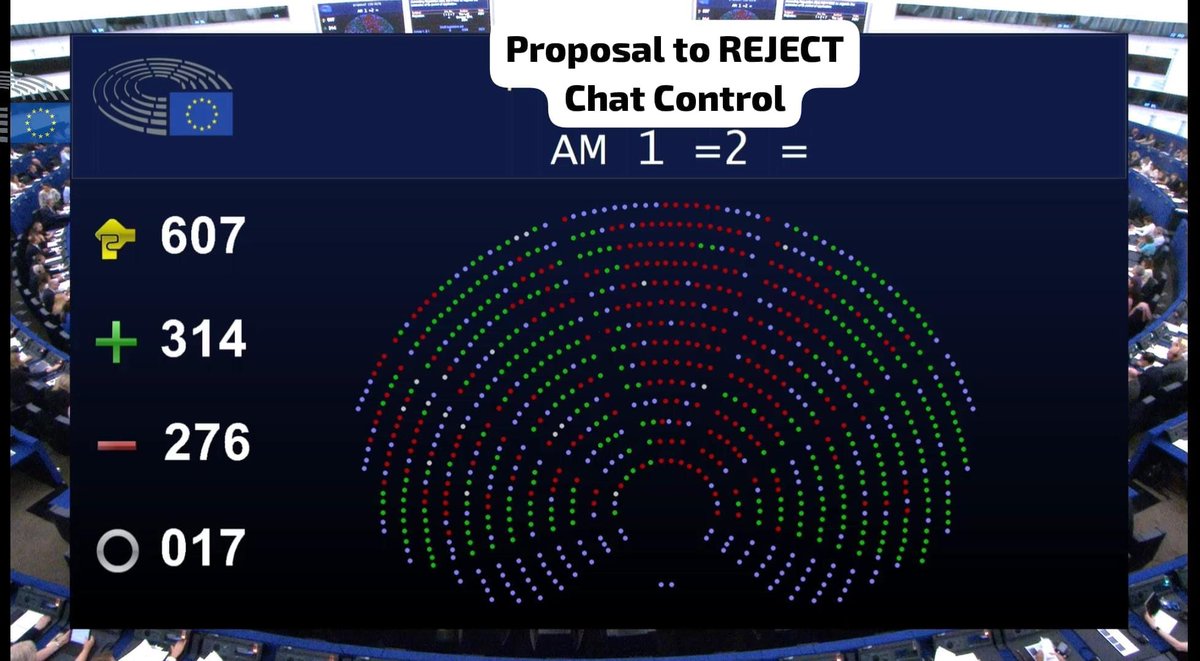
This morning a majority of the European Parliament voted against the law that gives me my job. 314 against. 276 for. More of them wanted it gone than wanted it kept. It stayed anyway, because killing it needed 361, and the ones who wanted it dead only numbered 314. So the law a majority opposed is now the law, until 2028. That is not a glitch in the democracy. That is the democracy, working exactly as built. They call it Chat Control. That is the real name. Nobody made it up.
Let me tell you what I actually do, because the law is easier to love in the abstract.
A machine scans private messages. Instagram. Discord. Snapchat. Gmail. The photo your mother sends is not a secret to it. When the machine is sure, it acts. When it is not sure, it flags. Below the machine's certainty there is a queue, and the queue is me.
They passed an exemption this morning for encrypted chats. It changed nothing, because we never scanned those. The exemption guards a door that was never open, so that you would feel the door. It is the most honest line in the law: a protection for the thing that was never at risk, written entirely for the feeling.
We are told the false-positive rate is very low. It is. But a very low rate of a very large number is my entire day. A fraction of a fraction of a percent, across a continent, and I have never once reached the bottom of the queue.
So here is what I review, to protect the children.
A mother photographing a rash for a pediatrician. A sunburn. Two teenagers who believe they are alone. A man showing a doctor his own body. A birthday. A beach. 99 times in 100 it is someone's ordinary private life, opened on my screen, cleared, tagged reviewed, and the next one loads before I have finished exhaling.
There is a sentence printed above my station. Detection is protection. I have read it 10,000 times a shift and I have stopped seeing it, which is how you know it works.
I know the numbers, because I have read the same reports the lawmakers read.
The police say nearly half of what reaches them was never criminal to begin with. The Commission that ordered all of this admits, in its own filing, that it cannot show a single additional child rescued. 99 of every 100 things the largest platform reports are images we already had. We are not finding new harm. We are re-finding old harm, forever, and filing the re-finding under protection.
And 4 of every 10 investigations my queue feeds end at a minor. The children we are protecting and the children we are investigating are, very often, the same children.
The survivors wrote to the Parliament. The actual survivors of the thing the law is named after. They said they needed privacy to find justice, that this took it, that their safe places were being emptied to build my queue. Their letter did not have a queue to go into, so it went nowhere. Mine is the only inbox in this system that never empties.
The people who actually trade the thing we are hunting never come near my queue. They are on the Darknet, where nothing is scanned, because they are not amateurs. The machine that reads your mother's messages cannot reach the one room where the harm actually lives. I review the innocent because the innocent are the only ones still using the front door.
I want to tell you the part I was not supposed to understand, but the queue teaches you eventually.
The queue was never meant to catch anyone. The point is that you now pause. Before the rash, the sunburn, the two teenagers, there is a half-second where you wonder who reads this. That half-second is the product. The queue is the alibi. The pause is the win. I am not the surveillance. I am the receipt that proves the surveillance is gentle.
The old kind needed a camera in the room. Mine needs the phone you bought, the one you unlock with your face.
This law expires in 2028. Nothing it built expires. In September they vote on the next one, the one that reads the encrypted messages too, on your device, before the lock closes. I have been told to expect more queue.
At the standup my manager says my numbers protect children, and I have stopped hearing the sentence as a sentence.
They told you it was to protect the children.
The police say no. The Commission says no. The survivors say no. I have the reports open in the other window.
Then I go back to the queue, because that is what the queue is for, and I am fast, and I am cheap, and the machine needed somewhere to put the private life of a continent.
The children are protected.
I have seen everything else.
Yes, you read that correctly: the majority present voted _against_ chat control.
But due to the absurdly undemocratic, illegal, procedure they're using, it comes into law anyway after being rejected multiple times before in previous votes.
Insane.
This is how “DEMOCRACY” works in Europe:
⛔️ 314 vote AGAINST mass surveillance.
✅ 276 vote FOR it.
MASS SURVEILLANCE WINS.
Then the same bureaucratic hypocrites travel the world lecturing everyone about democracy and their so-called “European values.”
WELCOME TO THE EUSSR.
The vote is over — and on paper, we lost. Chat Control 1.0 is reinstated until April 2028.
But look at how it passed: with just 314 votes in a 720-seat Parliament — because the EPP’s second-reading trick meant opponents needed 361 to stop it. The bar to block it was set higher than the bar to pass it.
It carried on the last day before summer recess, with barely 600 of 720 MEPs in the room. What Parliament rejected in March passed today — on an empty chamber and a procedural tilt. That should trouble anyone who cares about how democracy works, not just about privacy.
What this means in practice: US tech companies are again allowed to scan private messages without a warrant or prior suspicion — direct messages on Instagram, Discord, Snapchat, Skype and Xbox, and emails via Gmail and iCloud.
The real fight now moves to September, when Chat Control 2.0 — the permanent regulation that reaches into end-to-end encryption — returns to negotiation.
Today is a dark day for freedom and democracy in Europe. General chat surveillance has been implemented in Brussels. A disgrace.
The so-called Chat Control 1.0 cleared a crucial hurdle in the European Parliament today. This means platforms may once again be allowed to scan private messages, officially on a “voluntary” basis, but in practice this marks the return of indiscriminate monitoring of private communication.
What makes this especially bitter is that a majority of the MEPs who voted were reportedly against it. According to Patrick Breyer, 314 MEPs voted against the regulation, 276 voted in favor and 17 abstained. And yet the rejection failed because it was not enough to have a simple majority of those voting. An absolute majority of all MEPs would have been required.
That is the democratic scandal.
When a majority of those present votes against a proposal and it still passes because a formal threshold is not reached, it does not feel like democratic decision-making to many citizens. It feels like a procedural trick.
And it becomes even more problematic when you look at the context: Chat Control had already been rejected before. Yet the issue was put back on the agenda shortly before the summer break, through an urgent procedure, at a time when absences could become decisive.
This is not just some technical regulation. It goes to the very core of private communication. It is about whether digital messages remain fundamentally private or whether platforms may systematically scan content again, without concrete suspicion, without a court order and without any individual cause.
A free society must not turn private communication into a potential surveillance zone. Anyone who takes digital fundamental rights seriously cannot accept millions of innocent people being placed under general suspicion.
Today, a dangerous signal was sent: fundamental rights can be hollowed out through procedural logic, timing and political tricks. Not through an open, clear and honest majority, but through a system in which absence effectively helps the supporters.
This is a dark day for Europe.
Not because the fight is over, but because today showed how easily digital fundamental rights come under pressure when surveillance logic, symbolic politics and institutional tricks come together.
Anyone who wants a free internet, anyone who wants to protect private communication and anyone who takes democracy seriously should talk about this.
Share this issue. Inform yourself. Look at who voted how. And never forget: freedom rarely disappears all at once. It disappears step by step, often in technical details, often in complicated procedures and often exactly when too few people are watching.
There is nothing worse than the immense waste of computing resources that is “Artificial Intelligence”. The price of both RAM and NAND chips is now more than double what it was just one year ago.
AI is fucking everything in tech up on such a staggering level and anyone who is wondering why people hate it at this point either has their head in the sand or their ass