Perhaps @BBCNewsnight could now investigate the dreadful number of people with learning disabilities dying much too young, often from institutional neglect or prejudice in the @NHS and social services?
In 1974, a twenty-three-year-old man named Dan Jury made a decision that went against everything expected of someone his age.
He took his eighty-one-year-old grandfather, Frank Tugend, out of a nursing home and brought him into his small apartment.
Dan was young. He had no money to spare. No medical training. No guarantee that he would be able to handle what lay ahead. But he had watched his grandfather fade inside an institution, surrounded by routines instead of relationships, efficiency instead of tenderness. And he could not accept that this was how the man who had shaped his childhood would spend the end of his life.
So Dan brought him home.
From that moment on, Dan became a caregiver in every sense of the word. He helped Frank bathe. He gave him medication. He cooked, cleaned, lifted, waited, stayed. He learned the slow rhythms of an aging body. He learned how fragile dignity can be, and how carefully it must be protected.
Friends his age were building careers, falling in love, chasing independence. Dan was changing sheets, sitting through long nights, and holding a hand when pain made words impossible. People told him he was sacrificing his youth.
Dan would later say those years taught him more about life than anything else ever could.
As Frank’s health declined, Dan began to photograph their days together. Not staged portraits. Not sentimental images. Honest ones. A frail body resting.
A grandson leaning close. Moments of exhaustion, tenderness, frustration, humor, and quiet connection.
Nothing was hidden.
In 1978, Dan and his brother Mark published the photographs in a book titled Gramp.
The book was unlike anything most Americans had seen. Aging was usually kept behind closed doors, handled by institutions, softened or erased in public life. Gramp showed the truth. The vulnerability. The intimacy. The humanity of dying at home, surrounded by someone who loved you.
The images were difficult. They were also deeply moving.
Frank Tugend, who had lived through war, labor, hardship, and loss, became a teacher in his final years. Not through speeches or advice, but through presence. Through the way he accepted help without surrendering dignity. Through the way he allowed himself to be seen, cared for, and loved.
He taught Dan patience. He taught him how love shows up in small, unglamorous acts. He taught him that care is not something you delegate when life becomes inconvenient.
When Frank died, Dan was changed forever.
Their story quietly shifted how many people thought about elder care in America. It challenged the idea that institutions were always the most humane option. It showed that caring for an aging family member is not a burden to endure, but a relationship that can deepen both lives.
Dan did not lose his youth.
He spent it learning how to love without turning away.
And in doing so, he helped the rest of us see aging not as something to hide, but as a final chapter that still deserves tenderness, dignity, and human presence
When Patricia Neal had a stroke in 1965, the hospital told her husband she should have one hour of therapy a day, because any more would tire her. Her husband was Roald Dahl. He gave her six, and changed how the world treats stroke.
She was 39, three months pregnant, and had won the Oscar for Best Actress the year before. Three blood vessels burst in her brain in one evening in Los Angeles. She was in a coma for three weeks. Variety ran her obituary.
She woke up paralysed down one side, half blind, and without language. She could not read, could not name her own children, and made up words for the ones she'd lost.
Dahl took her home to Buckinghamshire and asked the specialists what came next. An hour a day, they said, and patience. Most recovery was down to nature.
He asked what anyone would learn at school in an hour a day.
Then he went round the village. He drew up a rota of neighbours, none of them trained, and had them arrive at the house in shifts from nine in the morning, six days a week. They did picture cards, jigsaws, counting games, nursery rhymes, the newspaper. When Pat wept and refused, the next volunteer arrived anyway. Doctors warned him he would break her. She called him Roald the Rotten and hated him for a year.
Their daughter Lucy was born healthy that August. Within eighteen months Pat was giving speeches. In 1968 she made The Subject Was Roses and was nominated for another Oscar.
One of the neighbours, Valerie Eaton Griffith, wrote the method up as a short book. Families all over Britain started using it. The volunteer scheme that grew out of it became the Stroke Association, and long, hard, early rehabilitation is now what every stroke unit does.
It was the second time Dahl had done this. When his baby son's skull was shattered by a taxi in 1960 and the drainage tube kept clogging, he got a toymaker and a neurosurgeon into a room and came out with a better valve. It went into about 3,000 children.
He had no medical training of any kind. He just declined to accept that the people who did had finished thinking.
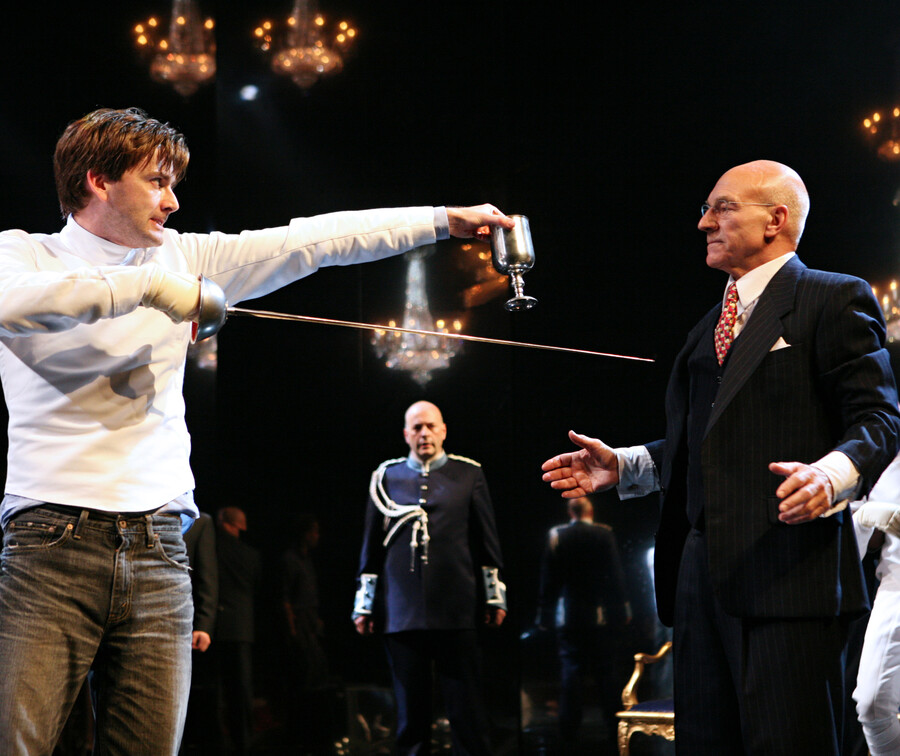
I was truly saddened to learn of the death of the great Patrick Stewart. Though he’s best known for playing Captain Picard on Star Trek, I really savored him as an interpreter of Shakespeare.
One of my favorite of his performances was as Enobarbus in a production of Antony and Cleopatra. But I also loved him as Macbeth in a modern adaptation of the Scottish Play and as King Claudius in Hamlet.
One of the very few bright spots during the awful Covid period was Stewart’s daily presentation of a Shakespeare sonnet from his back garden in Los Angeles.
Dare I admit too that I loved his many appearances on Family Guy and as the narrator of the Ted movies?
God rest you, Patrick Stewart, and “may flights of angels sing thee to thy rest.”
I’ve been so fortunate to know these guys in real life. They are the old stock of manliness, when that wasn’t an insult. Just blokes who love & admire women. They couldn’t have been more respectful. I hope this isn’t the end of an era.
In 1987, Patrick Stewart refused to unpack his suitcase for six straight weeks.
My throat still tightens every time I read why.
Every Hollywood insider told the 47-year-old British stage actor that Star Trek: The Next Generation would be a disaster. Even his closest friend, Ian McKellen, begged him not to throw away his Shakespearean career on a television gamble.
Stewart kept his bags packed by the door, waiting to be fired and sent home to London.
That "six-week failure" lasted 36 years.
Watching him late at night here in Japan, we saw something Hollywood never expected.
In Japan, we call this quiet, unbreakable spirit "Fudoshin," an immovable heart under fire.
Most action heroes scream and fire weapons to look strong.
Captain Picard never needed to raise his voice.
Born into deep poverty in Yorkshire, terrified of a violent home, he left school at age 15 and lost all his hair by 19, convinced his life as an actor was over before it began.
Yet one English teacher, Cecil Dormand, handed that frightened 12-year-old boy a copy of Shakespeare, said "Read it out loud," and secretly paid for his first drama course.
Never forget what happened decades later.
On the morning Queen Elizabeth II knighted him as Sir Patrick Stewart, he invited that same retired schoolteacher to sit beside him at his knighthood luncheon.
No suitcase left unpacked.
No rage on the bridge.
Just a cup of Earl Grey tea, a tug of his uniform, and three quiet words that commanded the galaxy:
"Make it so."
He passed away at 86 surrounded by live music, prayer, tears, and laughter.
And this December, in Avengers: Doomsday, Professor X will grace the screen one final time.
A boy who thought he wouldn't last six weeks in Hollywood gave the world an eternity of nobility.
From Japan, with tears and our deepest salute:
Thank you, Captain. Engage. ✨🖖🇯🇵
SIR PATRICK STEWART (1940-2026)
Before everything else, Patrick was defined by being born and bred in Yorkshire, the proud county in the north of England which he loved to the end. You could hear it in his accented voice and in the stern honesty with which he told you what he thought and felt. Yorkshiremen have no truck with half-truths or avoidance of big issues. He wore his heart on his sleeve, which made him a man to rely on, to admire and in my case, love.
We first met as ambitious young actors with the Royal Shakespeare Company half a century ago but we weren’t in the same productions. My first strong memory was a few years later, meeting him in the street in central London when he told me about an offer to take over a leading part in 'Star Trek'. “But Patrick think of your stage career in the UK. Do you really want to risk—getting lost in Hollywood for years and years?”. Well, he took the risk and thank goodness for us all that he did for not just his devoted Trekkies but film and theatre audiences, who marvelled at his using international celebrity to star in a string of cinema successes ('X-Men' of course) and in great classical plays by Shakespeare, Ibsen, Arthur Miller, Peter Shaffer, Pinter and Beckett at Stratford-upon-Avon, in London’s West End and on Broadway.
America was his adopted home, where he met his adored Sunny who has cared for him through sickness and health, through thick and thin. But he never forsook his origins: and the proudest achievement of the most respected and beloved actor of his generation on either side of the Atlantic, was his appointment as Chancellor of Huddersfield University in Yorkshire.
His farewell performance in 'Avengers: Doomsday' is yet to be seen.
Ian McKellen 29 October 2026
Photo: University of Huddersfield
In 1952, an English teacher named Cecil Dormand secretly paid for a dirt-poor 11-year-old to take a drama course.
He never told him and the boy didn’t find out until decades later.
By then, he was a knight, that little boy’s name was Patrick Stewart.
He was born into a poor family in Mirfield, a small mill town in Yorkshire and his father came home from World War II a violent man, and he was violent toward Patrick’s mother.
Young Patrick learned exactly when to step between his father’s fist and his mother.
An English teacher put a copy of Shakespeare in his hand and told him to get up and perform.
He never stopped and left school at 15.
By 19 he was completely bald... most agencies told him he'd never make it because of that.
In 1987, the LA Times called him an “unknown British Shakespearean actor” when he was cast as Captain Picard.
Then he became one of the most famous faces on Earth.
You’ve probably heard that part.
Here’s the part you haven’t:
He spent decades as a patron of Refuge, sheltering women and children from domestic violence.
But he never stopped trying to understand his father.
He dug up a 1940 newspaper clipping that said his dad had come home with severe shell shock.
He went to France and walked the ground where his father’s unit was pinned down under bombing for hours.
He learned his father had PTSD, and nobody ever helped him.
So Patrick became an ambassador for Combat Stress, a charity that helps veterans.
In 2013, a young woman at a Texas convention told him she was a survivor of domestic violence.
He asked, “My dear, are you okay?”
Then he hopped off the stage, held her, and told her: “You never have to go through that again, you’re safe now.”
At Dragon Con, a Make-A-Wish girl dressed as Spock came to meet him.
2,000 people were waiting for him to speak... he sat down and talked with her for 15 minutes, making all of them wait.
He told her that since they were friends now, whenever she saw him on screen she could wave and say, “Hello Patrick.”
After 9/11, he felt helpless, so he brought his one-man A Christmas Carol back to Broadway for a full week of charity shows.
He played every character himself and donated every cent.
In 2019 he did it again, and every dollar went to feeding hungry New Yorkers.
In 2017, he fostered a pit bull named Ginger, who had been rescued from a dogfighting ring.
She was his first dog in more than 50 years.
He couldn’t bring her home to England, so he found her a family.
Then he kept fostering more.
When he said he was done with Star Trek so many people told him the show had gotten them through the hardest times of their lives.
So he wanted to see if Picard could do it one more time.
Rest in Peace, Sir Patrick 🖖
We are deeply saddened to hear of the passing of RSC Honorary Associate Artist, Sir Patrick Stewart; a colossus of both stage and screen and one of the finest classical Shakespearean actors of his generation.
Your brain cannot tell the difference between a disaster that is happening and one you are only rehearsing.
That’s why worst-case-scenario thinking isn’t “just being prepared.” It is building a brain that learns how to stay afraid.
Neuroplasticity means you don’t live with the brain you were born with. You live with the brain you keep building.
Spend enough time in the spiral and your amygdala stays online while your frontal lobes, the part that actually solves problems, go quiet. Cortisol rises. Sleep drops. The thing you’re trying to avoid becomes more likely, not less.
Two thousand years ago Paul already knew the move: don’t be anxious about anything, but in everything, with prayer and thanksgiving, present your requests to God (Philippians 4:6-7).
Anxiety and gratitude turn opposite directions on the same volume knob. One goes up, the other goes down.
Next time the “what if this ends in disaster” thought shows up, try the other question: “What if it works out?”
Hit that follow button and we'll work together every day to connect neuroscience and scripture to help you thrive.
Save this for your next worst-case monent. Share it with someone whose brain is stuck in disaster mode.
And click the link in my bio to learn more about my New York Times best seller, The Life-Changing Art of Self-Brain Surgery.
#neuroscience #selfbrainsurgery
@CarrieGrant1@DavidGrantSays Good morning 🌅
I “let off steam” taking a walk around our farm, breathing the fresh air, watching trees we planted growing beautifully & having a hug with Mirabel (a sheep).
Lulu “ you make me wanna shout”
“ working on my roar” ( Lion King - “oh I just can’t wait to be king)
Decoy Font is a font designed to fool AI, which will read the clear message in the foreground (SORRY ROBOT), but miss the hidden message in the background (HAPPY HUMAN), squint to see. (Credit: MixFont)
We don't have a "climate problem". We have a greed problem. The planet isn't dying, it's being killed. And those killing it have names and boardrooms. #ClimateJustice#StopEcocide
@RoseUnwin It is so good to read this. It so good to know of your current, revised production and of the original. Gratitude and huge respect. Thank you … just a heart-felt thank you.
On the morning of September 11, 2001, Roselle, a calm, golden‑furred guide dog, rode the elevator up to the 78th floor of the North Tower with her owner, Michael Hingson. To everyone else, it was just another Tuesday. To Roselle, it was a job: stay close, stay steady, keep her human safe.
When the first plane hit, the entire building lurched like a ship struck by a wave. Lights flickered. Ceilings cracked. Papers rained down like snow. People screamed. But Roselle didn’t. She simply pressed her body against Michael’s leg, a silent message: I’m here. Follow me.
Smoke began to fill the hallway. The air tasted like burning metal. Sirens wailed from every direction. Yet Roselle walked forward with the same steady pace she used every day, guiding Michael to the stairwell.
Behind them, dozens of terrified people followed her tail like a beacon. Step by step, floor by floor, she led them downward through the choking darkness. The stairwell shook. The heat intensified. But Roselle never sped up, never panicked, never once broke her rhythm. She knew that if she stayed calm, her human would too.
Somewhere around the 30th floor, a woman froze, sobbing, unable to move. Roselle stopped. She nudged the woman gently, leaning her warm body against her leg until her breathing slowed. Only when the woman whispered, “Okay… okay,” did Roselle continue the descent.
It took nearly an hour to reach the lobby. Firefighters shouted for everyone to run. The tower groaned above them. Roselle guided Michael through the chaos, out into the blinding sunlight, and down the street, refusing to stop until she sensed they were finally safe.
Minutes later, the North Tower collapsed.
Roselle didn’t know she had just saved her owner’s life. She didn’t know she had led more than a dozen people to safety. She didn’t know she had become a symbol of courage around the world.
She only knew one thing: her human was alive, and she had done her job.
Most people know Roselle guided her blind owner down 78 floors of the North Tower, but very few know what happened after they escaped. As the tower collapsed behind them, a massive cloud of ash and debris roared through the streets like a tidal wave. Michael couldn’t see it coming, but Roselle could. Instead of panicking, she leaned her entire body into him and pulled forward with absolute determination, guiding him through a darkness so thick he couldn’t breathe or hear. Even as the ground shook and people screamed around them, Roselle never once broke her pace. Her training didn’t tell her what to do, her loyalty did.
#archaeohistories
Dolly Parton figured out something too many billionaires never will: the greatest measure of wealth isn’t how extravagantly you can spend it on yourself. It’s how many lives you can change with it. She chose children over trophies. That’s a legacy money can’t buy.
#WOOL . An incredible, environmentally beneficial, natural resource. The sheep needs shearing for its health. It #regrows this wonderful #fleece each year. It doesn’t compare with the artificial, #synthetic versions that are #oil-based, flammable and #damaging to the #environment
Great Voiceover Workshop This Week
Join us in-studio for hands-on mic time. Find your unique range, master captivating reads, & learn the secrets to landing an agent. Honest feedback. No experience needed.
See our link in bio for more info 🔗
#voiceoverworkshop