PhD Candidate @Columbia_PolSci | previously @Unibocconi and @LSEMarshall | development & gender | studying how people mobilize to change unpopular social norms
Closing the year with a new paper alert, ahead of print on @The_JOP!
No better team to work with than @msisiri, @dylanwgroves, @BardiaRahmani, guided by the incredible Don Green.
A summary, why this matters and many thank yous!
-https://t.co/MInojf92IT
-https://t.co/uUybVYc4pr
The first field experiment I started working on in grad school is out on @cps_journal!
Incredible team effort with @dylanwgroves, @msisisry, @BardiaRahmani, led by our amazing advisor Don Green.
A summary, why does this matter, and a lot of thank-yous.
https://t.co/9S7CahP8JB
And thank you to the entire field team: there can be no knowledge gained from data without the dedication you have put in every single interview. It has been a pleasure to work with such motivated professionals, who became respected friends.
The enumeration team surveyed more than 1,000 people across 30 hard-to-reach mountain villages. The expertise and support of @poverty_action Tanzania was incredible. Special shout-out to the best leadership by @kyu_gar, Rachel Jones and Zach Isdahl.
It is never redundant to remind ourselves that primary field data are only as good as the dedication each surveyor puts in each interview. We could not get any luckier than to work with the best team since 2018, an invaluable source of insights .. and friendship!
Reaching 92 villages on a motorcycle through the Usambara mountains to test transmitter boundaries was an endeavor few would have taken on with the excitement @dylanwgroves put into it. Thank you for spearheading this project since 2018!
The people. Thank you!
@UZIKWASA and its @panganifm_ have been the backbone of this project, and the best partners possible. We are incredibly thankful to their whole team, especially @1ErickMallya.
If we can check who is going to be treated and who is going to be control, we need no assumptions about balance nor treatment assignment. Not to mention, we learned lots working closely alongside @panganifm_!
But they leave researchers with significant discretion over sampling, measurement, and estimation. Therefore, partnering with @UZIKWASA to plan and design in advance captured the rigor of pre-registration with the obvious benefits of unobtrusive natural experiments.
Natural experiments are wonderful to study media impacts in the real world: while RCTs measure content effects, NEs additionally capture the demand for exposure - measured through patterns of listenership.
Citizens appear eager to tune into new and independent local media stations, and the downstream effects of such exposure can have important implications for political behavior through knowledge and engagement.
Closing the year with a new paper alert, ahead of print on @The_JOP!
No better team to work with than @msisiri, @dylanwgroves, @BardiaRahmani, guided by the incredible Don Green.
A summary, why this matters and many thank yous!
-https://t.co/MInojf92IT
-https://t.co/uUybVYc4pr
We found more idiosyncratic evidence of changes in social attitudes that the station focuses on. It is possible that ingrained attitudes take longer to change or are less likely to be influenced by media programs in the absence of @UZIKWASA’s community outreach.
When we returned almost 2 years later, we found that access to @panganifm_ pulls listeners away from state-owned and entertainment radios, and significantly increases interest in politics and knowledge about current events.
We conducted a baseline survey to confirm that villages inside and outside the new transmission boundary were similar. Then, @panganifm_ turned on the transmitter for good, and we waited.
@panganifm_ received a more powerful transmitter in 2018. They agreed to briefly turn on the transmitter so we could identify the villages that the station would soon reach and pair them with similar villages that lay just outside the new transmission range.
Does gaining access to independent local radio affect people’s interest in and knowledge about politics?
We partnered with @UZIKWASA - an incredible Tanzania-based NGO - and its radio station @panganifm_ to answer this question using a pre-planned natural experiment.
What did we do?
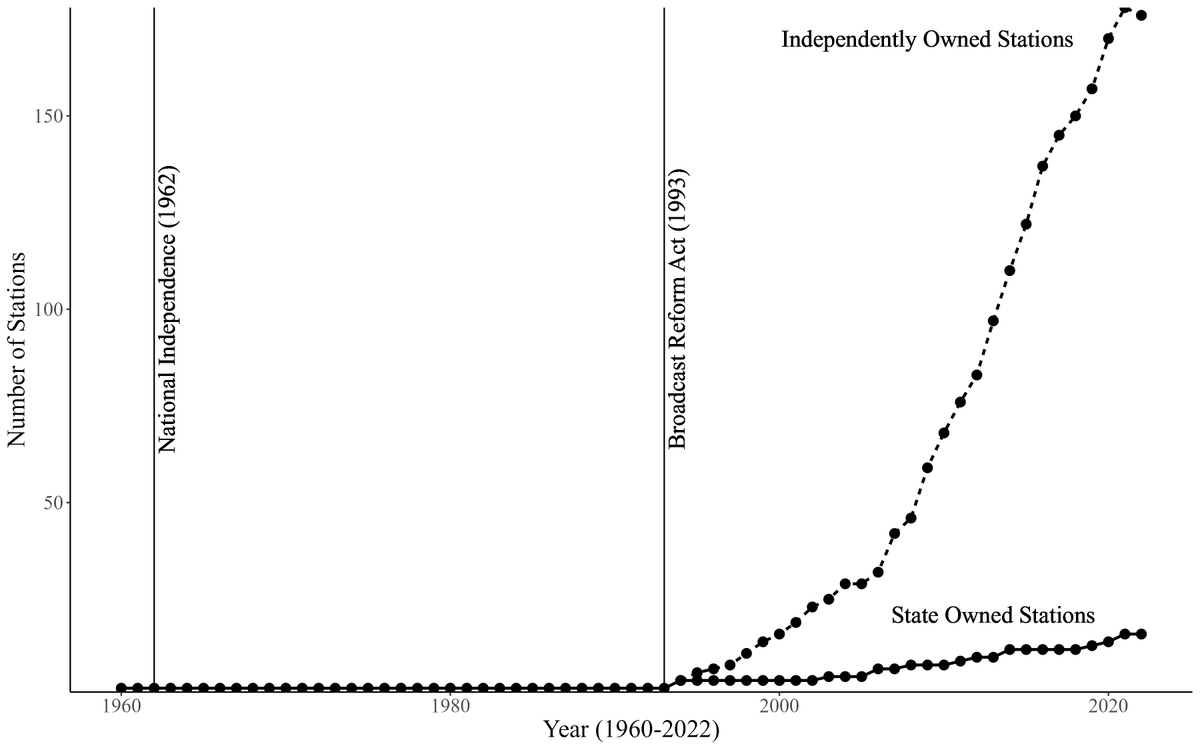
From independence in 1962 until political liberalization in 1993, Tanzanians had access to just one radio channel, notably state-owned. Today, there are more than 200 independently owned ones!