@COLDCARDwallet So let's say someone generated a seed on version 1.5.0Q with 120 dice rolls.
Would a new seed with 1.5.1Q with dice rolls have more randomness?
@americanhodl8 Controversial take but I still might use a CC Q in the future. If you can load it with your own seed words, I don't see a major risk. Thoughts?
Unless @Apple's decision to terminate @craigraw's Apple Developer account is reversed by June 30, all new installs of Sparrow will fail, and development on macOS will end. If you value Sparrow, a repost would help. @AppleSupport
move your company to Austin and all your team members will love you... because they'll save 50% on housing and ~12% on taxes.
Quality of life goes up 35% -- minimum.
Like giving your team a 30-40% raise out of the gate.
note: you will need to let the work remote in July since it's H.A.B. here!
I'm pretty sure this is non-sense. I love PC and if a 5080 GPU made a good AI machine I would do the same.
I'm pretty confident that if you are going to run a powerful LLM locally, you need well over 16GB of vRAM. M5 Mac Studios are going to destroy a PC with a retail GPU.
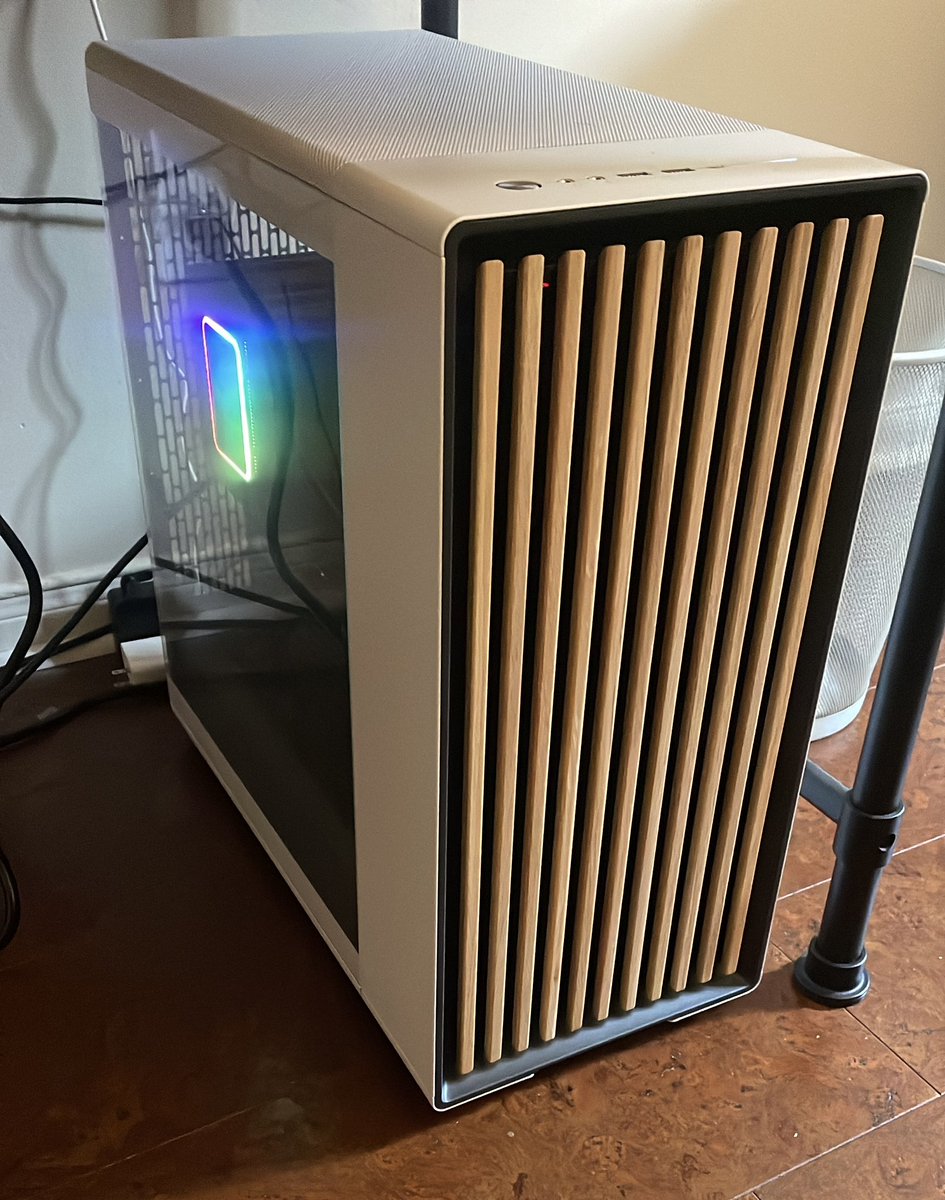
I told the guy at the shop what I was building and he just stared for a second and goes, “what are you building, Skynet?” Introducing ruVultra.
My kids didn’t miss a beat: “yeah, basically.” And once you look at the numbers, it stops sounding like a joke.
I built this entire system by hand, in an evening.
It’s a sovereign AI node. A brain in a box.
Ryzen 9 9950X with 16 cores / 32 threads, tuned with a custom Ubuntu kernel and over clocked thermal profile pushing toward ~6GHz burst behavior.
With AVX-512, each core processes wide chunks of data at once, so vector comparisons, filtering, and boundary detection happen in parallel, not sequentially. The CPU becomes a real-time reasoning engine, not just a coordinator.
Then the GPU takes over when needed. An RTX 5080 with ~10,000+ CUDA cores running in the ~2.5–3.0GHz range, handling dense math, embeddings, and batch workloads. It’s a split system: CPU for structure, GPU for intensity.
Compared to a high-end Mac mini or even a Studio, you’re looking at 5–10x faster performance on real AI workloads. Not just because of raw power, but because of architecture. No shared memory bottleneck, no abstraction layers, full CUDA access, full control over scheduling and memory.
This machine doesn’t wait on anything.
You’ve got 128GB of RAM now, which keeps most working sets local, but there’s room to grow that to 1TB of RAM (estimated at $30k), turning it into a true in-memory system. Same with storage, plenty of headroom for multiple additional TB of NVMe, extending your dataset without killing performance.
At roughly a $10k budget, you’re sitting in a sweet spot. Not cluster-scale, but powerful enough to behave like one node of a serious system. You can run meaningful local workloads, test ideas end to end, and iterate without waiting on the cloud.
#Alert for anyone using #OpenClaw, you will ultimately have your gateway break if you ask your agent to make changes to the openclaw.json
Tip: tell the agent to always run the config file through the doctor to validate before restarting.