Tenemos al mejor Presidente en la historia de nuestro país @nayibbukele
En derecho constitucional existe la constitución material, la constitución real y la constitución formal, la constitución es una expresión cultural, social, política y dinámica
Honramos a los héroes de nuestra @PNCSV que entregaron su vida en el cumplimiento del deber.
Su valentía, dedicación y servicio por la transformación de nuestro país vivirán para siempre en la memoria y en el corazón de millones de salvadoreños.
Su legado permanece y continúa en cada hombre y mujer policía que, con vocación y compromiso, sigue dando lo mejor de sí para proteger a nuestra población y construir un nuevo El Salvador. 🇸🇻
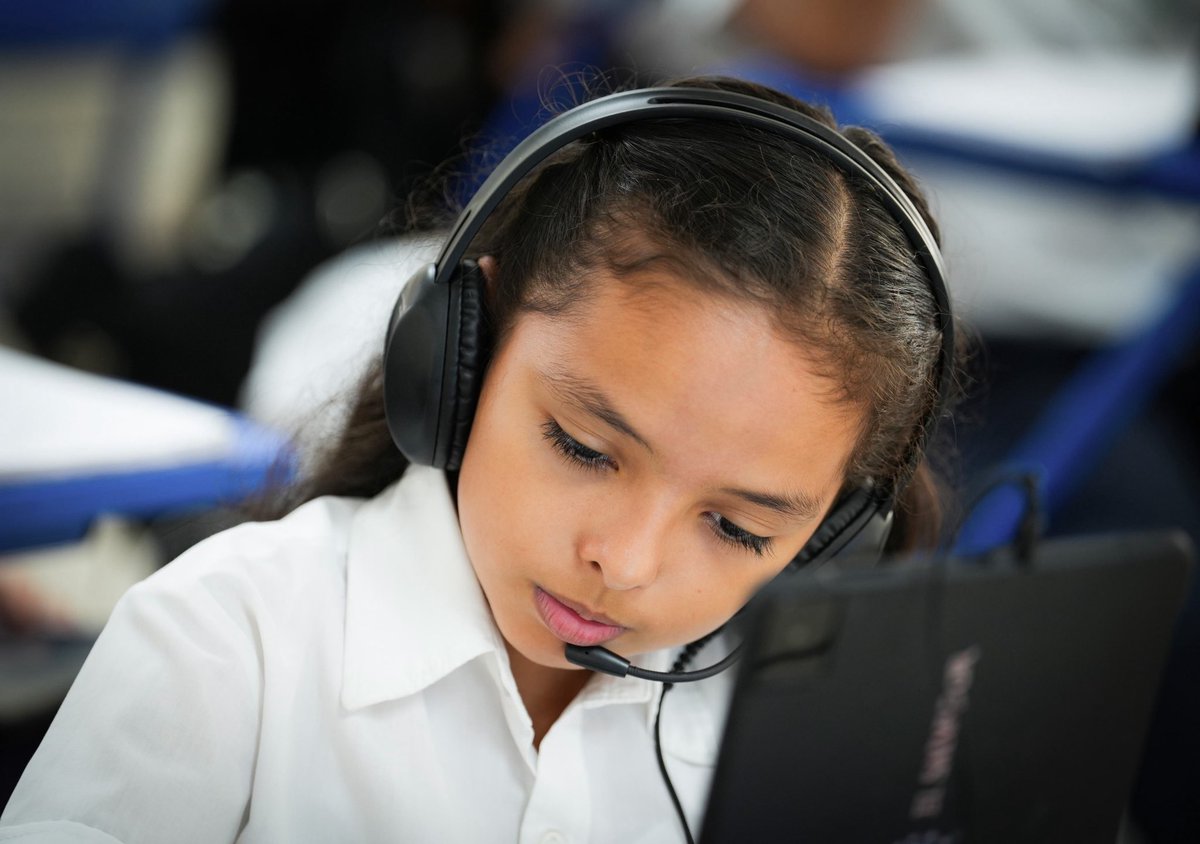
A few days ago, I shared the World Bank’s summary of the results of the PISA for Schools assessment conducted in 171 Salvadoran public schools participating in our education pilot.
Since then, I have seen some legitimate questions about what these results mean, as well as some claims about what they supposedly don’t mean.
So let’s be very precise.
First, what we NEVER claimed:
1. We never claimed these results represent the national average.
They don’t.
This was not the national PISA assessment.
It was PISA for Schools, conducted specifically in the 171 public schools participating in our pilot program.
That is precisely why my original post said:
“These are the results of our pilot program, which includes AI tutors and has been running in 171 public schools for just over a year.”
A pilot is, by definition, not the entire country.
2. We never claimed that these 171 schools were a statistically representative sample of every school in El Salvador.
They weren’t selected randomly from all Salvadoran schools.
They were selected to participate in the pilot because they were schools where the program could initially be implemented more easily: they had certain basic infrastructure and connectivity requirements, and school communities capable and willing to implement a new educational model.
That creates a selection effect, and it should be acknowledged.
But there is an important distinction here.
These schools were NOT selected because their students had exceptional academic results.
They were not our “best schools.” Not even close.
We didn’t search the country for the highest-performing schools or students and then test them.
They are normal Salvadoran public schools, urban and rural, in different parts of the country, serving ordinary Salvadoran families.
And the characteristics that made implementation easier: connectivity, infrastructure, trained teachers and willingness to adopt the program, are also things that can be replicated in other schools.
They are not innate characteristics of the students.
We can install connectivity.
We can improve infrastructure.
We can train teachers.
We can provide the same technology.
We can deploy the same educational tools.
In fact, that is exactly what we are doing.
3. These results also do NOT prove that AI tutors, by themselves, caused the improvement, although we believe they are a MAJOR part of these results.
Our pilot is broader than that.
It includes changes in teaching, support for teachers and principals, educational materials, monitoring and evaluation, technology, and AI tools, among other interventions.
Our AI tutors and learning platforms are being developed with @grok, @Kira_Learning, and support from I Hate Flying Bugs.
And the broader transformation of our education system is being supported by the @WorldBankGroup, @AgendaCAF, and @el_BID.
All of these interventions can also affect student motivation and engagement.
But that distinction matters: if students become more motivated BECAUSE of the program, that is not necessarily a flaw in the program or an explanation that somehow invalidates the results.
It may be one of the ways the program works.
The same applies to teachers.
For example, the implementation of the AI tutors, including the requirement for teachers to log in and out of the system, coincided with teacher attendance in these schools increasing from 76% to 97%.
If the program causes teachers to attend school more consistently, and that in turn helps students learn more, that is not an advantage that disappears when we scale the program.
It is potentially part of the intervention itself.
Of course, to scientifically isolate the causal effect of AI tutors, teacher attendance, student motivation, technology, training, or any other individual component would require a different experimental design.
Now, what DO these results tell us?
1. They tell us that 1,198 students in 171 ordinary Salvadoran public schools… 🧵1/2👇🏼
Now, what DO these results tell us?
1. They tell us that 1,198 students in 171 ordinary Salvadoran public schools participating in this program were independently assessed using an internationally comparable instrument.
And their results in reading, mathematics and science were comparable with the average results of students in Germany and Sweden.
That is a fact, supported by an internationally recognized OECD assessment and reported by the World Bank.
2. They tell us that achieving those levels of performance in Salvadoran public schools is POSSIBLE.
This is perhaps the most important finding.
For decades, we have been told that transforming education takes generations.
That poverty determines educational outcomes.
That our public schools simply cannot compete with schools in developed countries.
Yet here we have Salvadoran children, attending Salvadoran public schools, taught by Salvadoran teachers and supported by AI tutors, inside our existing public education system, obtaining results comparable with students in some of the world’s most developed countries.
Does that prove that every Salvadoran student is already performing at that level?
Of course not.
But it proves something enormously important:
There is nothing inherent about being Salvadoran, attending a public school, coming from a lower-income family, or living in a developing country that prevents a child from reaching those levels.
3. It tells us that the conditions associated with these results appear to be replicable.
Imagine that the explanation were that we selected 171 elite private schools, filled them with the country’s wealthiest children, and then announced their scores.
That would tell us almost nothing about whether the model could work nationally.
But that’s not what happened.
These are ordinary public schools.
The advantages associated with participation in the pilot: better tools, connectivity, infrastructure, teacher support, technology and a different educational model, are precisely the things the Government can reproduce.
That doesn’t guarantee the same results when we scale.
But it gives us a very good reason to try.
4. It tells us that expanding the program is worth doing.
A pilot is not supposed to prove that something already works everywhere.
If it did, it wouldn’t be a pilot.
A pilot asks a much simpler question:
“Does this approach show enough promise under real-world conditions that we should expand it and test whether the results can be reproduced at a much larger scale?”
The answer from these results is clearly yes.
The World Bank itself described the results as promising and encouraging evidence ahead of the expansion of the reform.
5. The real test begins NOW.
Going from 171 schools to more than 1,000 schools is much harder.
Going from 1,000 schools to every public school in El Salvador will be harder still.
Scaling introduces new problems.
Some schools have weaker infrastructure.
Some have worse connectivity.
Some teachers will adapt faster than others.
Some communities face greater social and economic challenges.
And implementation quality can decline as a program becomes larger.
All of that is true.
And that is exactly why we are scaling progressively.
The next question is not whether 171 schools can do it.
We now know they can.
The question is whether 1,000 can.
Then whether several thousand can.
And ultimately whether an entire national public education system can.
That is what we intend to find out.
6. And yes, the future national PISA results that will be published in 2029 will matter enormously.
Those will tell us something different.
PISA for Schools tells us what is happening in the schools participating in this reform.
National PISA will tell us what is happening across the country.
Those are different questions, and serious people should not confuse them.
2/2🧵👇🏼
“Los estudiantes participantes obtuvieron resultados comparables con los promedios de Suecia y Alemania.”
Estos son los resultados de nuestro plan piloto, que incluye tutores con Inteligencia Artificial y que está en 171 escuelas públicas desde hace poco más de un año.
Fue evaluado por PISA for Schools en junio de este año. Desde entonces, ya se ha expandido a más de 1,000 escuelas y, en 18 meses, estará en todas las escuelas públicas de nuestro país.
En unos años, El Salvador inspirará al mundo.
La seguridad solo fue el inicio 🇸🇻
“Results in reading, mathematics and science were above the national average and comparable to the average results in Germany and Sweden.”
These are the results of our pilot program, which includes AI tutors and has been running in 171 public schools for just over a year.
It was evaluated by PISA for Schools in June of this year. Since then, it has already expanded to more than 1,000 schools, and within 18 months, it will be in every public school in our country.
In a few years, El Salvador will inspire the world.
Security was just the beginning 🇸🇻
Normalmente no contesto directamente a tanta noticia falsa, pero esta me pareció un buen ejemplo de cómo estos “periodistas” y medios de comunicación MIENTEN descaradamente a sus lectores.
Lean este tuit, que ASEGURA que El Salvador ha transferido sus reservas de bitcoin a un privado, lo cual es TOTALMENTE FALSO.
Aquí está el enlace de la misma institución que EL PAÍS cita como fuente: el Fondo Monetario Internacional (FMI): https://t.co/o7KtcAItBw
Léanlo. Claramente dice todo lo contrario: que lo único que se transfirió fueron las acciones de Chivo, algo que se ofreció hace año y medio, y NO la Reserva Estratégica de Bitcoin.
De paso pueden leer cómo El Salvador ha logrado un superávit fiscal primario y ha superado todas las expectativas de crecimiento económico gracias a la seguridad y a la confianza de los inversionistas, además de haber alcanzado una reducción significativa de la pobreza, apoyada por mejoras en la eficiencia de los servicios públicos 😘
El Salvador de Bukele supera a Cuba y Costa Rica como potencia turística y la economía registra una entrada récord de divisas por la llegada de visitantes https://t.co/pScujjFKnM
If the world is against the truth, then I am against the world. Lying lips are an abomination to the Lord! I’d rather be cancelled by society than rejected by Christ