Anthropic gave Claude agents a memory folder and watched what they did with it. the one with 9 files beat the one with 413.
in Pokémon, Sonnet 3.7 saved every battle, item and character: 413 files, 1 badge. Fable 5 kept 9 files and one global.md: 4 badges.
the same applies to any agent with a memory file, Claude Code included.
the setup:
→ keep the top file short. Claude Code loads only the first 200 lines or 25 KB of MEMORY.md, so make it an index
→ save only what the agent can't read again. code, inbox, screen are already there. decisions, tested rules and traps vanish unless written down
→ write each rule with how you know it's true, and mark confirmed vs still a guess
→ say what memory is for, not how to fill it. a fixed "record only failures" rule cut most of the gain for Opus 5 and Opus 4.7
→ on older models, ask it to read memory first. that nearly doubled Sonnet 4.6's score
→ run a cleanup pass weekly. Anthropic calls it dreaming: reread past transcripts, fix wrong notes, merge duplicates. one wrong note sent Claude off the same ledge 3 times
→ build a wiki only when answers span many documents. 87% vs 73% for search alone there, no clear gain on single-document lookups
the cleanup prompt is in the reply ↓
Sources:
Side-by-side, same prompt, 3 models: https://t.co/VyA5amJ5bR
Second test, one shot, 4 models: https://t.co/S4CmmlqAT4
Agent benchmark, 12 models, cost per task: https://t.co/advrelwTDa
3 Fable 5.2 agents, 7 h 41 min: https://t.co/Kwlc559Guu
Prices are the list rates per million tokens, input and output.
Fable 5.2 costs 2x Opus 5.5 per token. In public runs this week, the bill per task came out much further apart.
The price sheet: Fable 5.2 is $8 in and $40 out per million tokens. Opus 5.5 is $4 and $20.
What the runs show, per the posts:
→ Same build prompt: Fable 5.2 $209.50, Opus 5.5 $31.85, GPT-6 Astra $17.82. Fable built the best result, at about 6.5x the cost of Opus
→ A second test today, one shot: Fable 5.2 $19.10, Opus 5.5 about $4.20. Fable built the best result again, at about 4.5x
→ A proactive agent benchmark on 12 models: Fable 5.2 $1.87 per task, OpenAI's Sol $0.11, and Sol scored higher
→ 3 Fable 5.2 agents building a computer: 7 h 41 min, $138.82
So most of the gap is not the price sheet. Fable runs longer turns by default, and every extra step is billed at the higher rate. The same benchmark found that help nobody asked for took about 80% more time and money.
How I would pick:
→ Opus 5.5 by default
→ Fable 5.2 for the long job where a redo costs more than the tokens
→ Try a lower effort setting before you switch models
→ Set a dollar cap per run before it starts, not after
Links to all four in the reply ↓
Which model runs your longest task right now: Fable or Opus?
@Qyravex Agree on the shader compile. One trick: show a still image of the room first and swap in the scene once it's ready. A canvas isn't an LCP candidate, so the image or the headline is what gets measured.
Per the post, every object in this room is code. No 3D assets, no textures, just Fable 5.2 writing threejs.
That changes what a 3D scene costs.
→ no asset store, no modeler, no license per model
→ the room is editable by a sentence: swap the lamp, move the window
→ the real test is the second prompt, whether it changes one thing without breaking the rest
Would you ship a product page built this way? Yes or no.
@Arcane_Aii@NangoHQ The hard part is not the first call to Slack or Gmail, it is token refresh and rate limits a month later. Does Nango handle the refresh, or do you still own that?
The rule I would start with: if a step has an output you can check, like valid JSON or clean Markdown, it can go to the small model. If it needs judgment, keep it on the big one.
A lot of an agent bill is grunt work paid at frontier rates.
Reading a PDF, captioning an image, pulling fields into JSON. A small open model handles these fine, and it can run on your own hardware.
The split I would use:
→ Frontier model: plan, decide, write the final answer
→ Small model: parse, extract, caption, clean up
→ Check the small model with a schema, not with the big model
Per the post, this one routes those jobs through MCP to your own cluster, open source under Apache 2.0.
What would you move off the big model first: PDFs or images?
Your AI agent shouldn't waste expensive tokens reading PDFs.
Most agents send everything to frontier models, even tasks that open models can handle just as well.
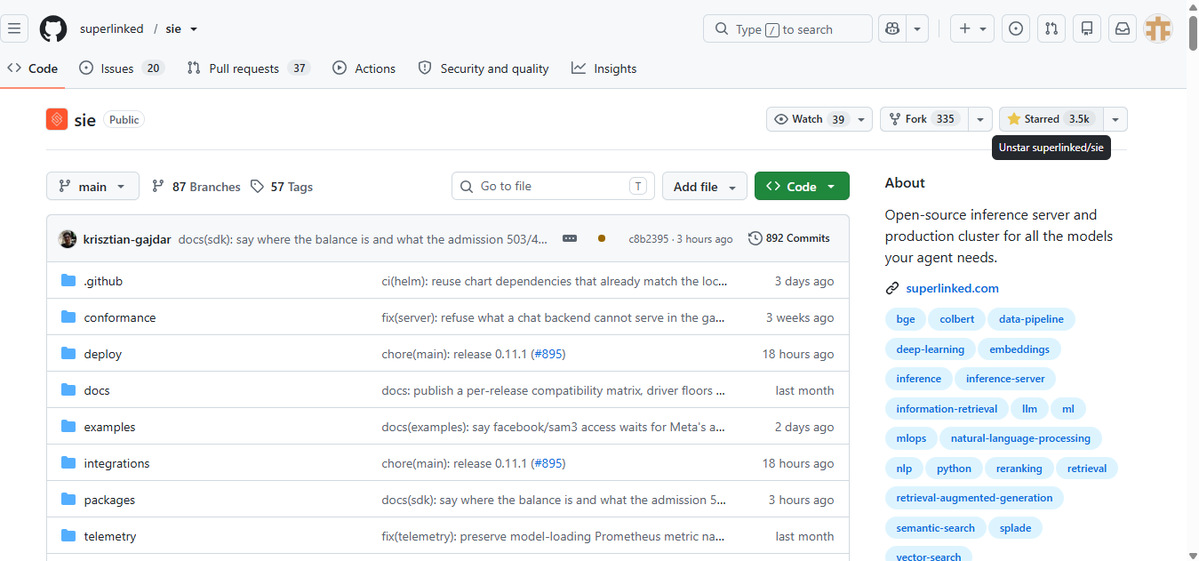
That's where Superlinked Inference Engine (SIE) comes in.
It lets Claude and other MCP clients offload these tasks to your own cluster:
→ PDFs & Documents: Turn PDFs, Office files, and scans into clean Markdown.
→ Images: Handle captioning, object detection, and visual Q&A.
→ Structured Data: Extract schema-valid JSON without wasting frontier-model tokens.
Powered by open models like LightOnOCR, MinerU, Docling, Florence-2, GLiNER2, and Qwen.
One MCP edge. Multiple inference workloads. Your own infrastructure.
Open source under Apache 2.0.
GitHub: https://t.co/DUloWrYZaZ
If you're building with Claude or MCP clients, this deserves a star. ⭐
@josephayinde_ That's a better design than a timer. Tying decay to the last confirmation means a rule that's still true but rarely used doesn't get lost, it just asks again.
Most agent rules files are 300 lines nobody wrote on purpose. The ones that work fit on one screen.
A rules file is the note the agent reads before every task. Claude Code loads CLAUDE.md at the start of each session, Codex reads AGENTS.md. Whatever is in there gets followed, mistakes included.
The setup:
→ Goal. One line on what the project is for and who uses it
→ Inputs. Where the real data lives, and which folders are read only
→ Never. Three to five hard stops: no deleting files, no sending messages, no pushing to main
→ Plan first. Anything over three steps, write the plan and wait for an OK
→ Check. How the agent proves it worked: run the tests, open the page, compare the numbers
→ Add a rule only after the agent gets something wrong, and write the mistake next to it
→ Once a month, delete rules that never came up
A short file is easy to keep true. A long one fills up with rules that contradict each other, and the agent has to guess which one wins.
The template I'd start with is in the reply ↓
What would your first rule be: a never or a check?
@thelukesterling Good split. Browsing is where code wins, matching a real product is where it doesn't. A furniture shop could use the coded room for layout and light, then drop in a photo of the actual oak.
@Qyravex Good method, and the real Android step is the one people skip. If you run it on this room, post the LCP here. Curious whether the scene or the fonts end up being the slow part.
A setup worth trying in the beta: open the call by naming the output. A one page spec, a decision log, a whiteboard of the flow. An agent with a named deliverable drifts less than one asked to just take notes.
Claude Meetings: Claude joins your team's video call and builds the doc or whiteboard while people are still talking. Beta on Team and Enterprise.
The meeting stops ending with "who's writing this up?"
→ the artifact exists before the call ends, so review happens live
→ wrong assumptions get caught by the people in the room, not a week later
→ the open question is consent: everyone on the call should know it's there
Would you let it join a client call? Yes or no.
Introducing Claude Meetings: add Claude to your team’s video call and it builds docs, whiteboards, and other artifacts with you while you’re still talking.
Starting to roll out in beta on Team and Enterprise plans.
@Qyravex Fair condition, and it's the one the demo skips. The usual fix is a still render as the first frame and the live scene loading after it, so the 2.5 second mark is hit by the image, not the GPU. Have you measured one of these on a real phone yet?
@charliejhills The Opus playbook is the one that outlives the deadline. Does it copy Fable’s plan and check loop as a prompt, or as a separate review step?
@cjpedregal Asking the agent what it didn’t like is the cheapest usability test there is. Did the answers match what your human users said, or were they a different list?
How to test it yourself: ask for the whole scene in one file, then request one change per prompt and diff the file each time. If objects you didn't mention move, the scene isn't stable enough for a real page yet.
@testingcatalog Proactive is the hard word in that headline. An agent that acts before you ask needs a clear rule for when to stay quiet, or people mute it in a week. Any hint what it will be allowed to do on its own?
@eliebakouch@dwarkesh_sp Reading the chains of thought while they bluff is the interesting part. Did any model plan a lie in its reasoning and then deliver it cleanly, or did the tells leak into the messages too?