"Crypto Entrepreneurs of 2025"
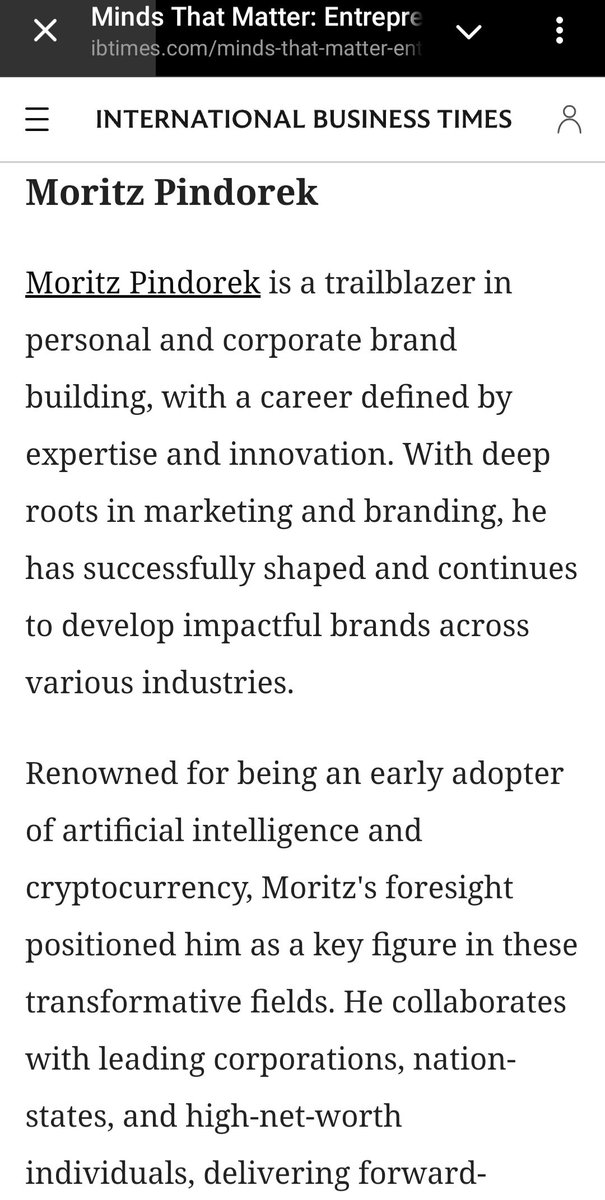
Moritz Pindorek is a leading force in the global crypto space, known for leveraging blockchain to help shape emerging economies.
As a strategic advisor, he works closely with governments, venture capitalists, and founders to build robust digital infrastructures.
His mission centers on using decentralized technologies to empower nations, foster innovation, and create economic resilience.
Pindorek has played a key role in helping countries design digital asset frameworks, launch national blockchain strategies, and attract international investments.
Whether guiding new Web3 ventures or advising policymakers on digital transformation, Moritz remains a pivotal figure driving real-world impact through crypto across borders in 2025.
April 7: Fear ruled the market. I called it a clearance sale.
April 9: Sentiment’s flipping, momentum’s building.
Contrarian thinking wins again.
Patience + conviction = edge.
Seeing many Fake Accounts trying to impersonate me 😑
Friendly reminder that ⬇️
-I never DM you first.
-I never sell a course.
-I never want money from you.
-I never recommend any cryptocurrencies or projects.
Crazy how many people do not even have an idea what the International Womens day is.
Nothing Romantic.
International Women's Day (IWD) has its origins in the early 20th century, rooted in the fight for women's rights, particularly in labor, voting rights, and social equality.
Key Historical Events Leading to IWD
1908 – Women's Labor Movement in the U.S.:
15,000 women marched through New York City demanding shorter work hours, better pay, and voting rights.
1909 – First National Women's Day in the U.S.:
The Socialist Party of America declared February 28 as National Women's Day in honor of the garment workers' strikes.
1910 – International Expansion:
At the Second International Socialist Women’s Conference in Copenhagen, Clara Zetkin (a German activist) proposed an International Women's Day to be celebrated in multiple countries to promote women's rights.
1911 – First Official International Women's Day:
The first official IWD was observed on March 19 in Austria, Denmark, Germany, and Switzerland, with over a million people rallying for women's rights.
1913-1914 – Shift to March 8:
In 1913, Russian women observed IWD on March 8, a date that became the global standard.
1917 – Russian Revolution and Women's Strike:
On March 8, 1917 (Julian calendar: February 23), Russian women protested for "Bread and Peace," demanding an end to war and food shortages. This event helped trigger the Russian Revolution, leading to women's suffrage in Russia.
1975 – UN Recognition:
The United Nations officially recognized International Women's Day and began promoting global observance.
Modern Celebrations
Today, IWD is celebrated worldwide on March 8, highlighting women's achievements and advocating for gender equality. Different countries observe it in various ways, from official public holidays (e.g., Russia, China, Afghanistan) to protests, social campaigns, and corporate initiatives supporting women's rights.
Just a few minutes ago, President Trump signed an Executive Order to establish a Strategic Bitcoin Reserve.
The Reserve will be capitalized with Bitcoin owned by the federal government that was forfeited as part of criminal or civil asset forfeiture proceedings. This means it will not cost taxpayers a dime.
It is estimated that the U.S. government owns about 200,000 bitcoin; however, there has never been a complete audit. The E.O. directs a full accounting of the federal government’s digital asset holdings.
The U.S. will not sell any bitcoin deposited into the Reserve. It will be kept as a store of value. The Reserve is like a digital Fort Knox for the cryptocurrency often called “digital gold.”
Premature sales of bitcoin have already cost U.S. taxpayers over $17 billion in lost value. Now the federal government will have a strategy to maximize the value of its holdings.
The Secretaries of Treasury and Commerce are authorized to develop budget-neutral strategies for acquiring additional bitcoin, provided that those strategies have no incremental costs on American taxpayers.
IN ADDITION, the Executive Order establishes a U.S. Digital Asset Stockpile, consisting of digital assets other than bitcoin forfeited in criminal or civil proceedings.
The government will not acquire additional assets for the Stockpile beyond those obtained through forfeiture proceedings.
The purpose of the Stockpile is responsible stewardship of the government’s digital assets under the Treasury Department.
PROMISES MADE, PROMISES KEPT
President Trump promised to create a Strategic Bitcoin Reserve and Digital Asset Stockpile. Those promises have been kept.
This Executive Order underscores President Trump’s commitment to making the U.S. the “crypto capital of the world.”
I want to thank the President for his leadership and vision in supporting this cutting-edge technology and for his rapid execution in supporting the digital asset industry. His administration is truly moving at “tech speed.”
I also want to thank the President’s Working Group on Digital Asset Markets — especially Treasury Secretary Scott Bessent and Commerce Secretary Howard Lutnick — for their help and support in getting this done. Finally Bo Hines played a critical role as Executive Director of our Working Group.