Watched this.
Not because $TEL has to copy $XRP. Because the question is the same: did the product catch up to the story?
Bank charter. eUSD. Token upgrade. Network still coming. That’s the stack. Chart talk is extra.
Do your own work. Videos don’t pay the bill.
https://t.co/GqbUgejQq1
#TEL #Telcoin #eUSD #XRP #crypto
September 24 could be MUCH bigger for $TEL than people realize.
Not because it’s the confirmed mainnet date.
It isn’t.
It’s the tentative TEL3 upgrade date.
But here’s the important part:
Telcoin’s own documentation says the TEL upgrade needs to happen BEFORE Telcoin Network launches and is intended to be available when the network goes live.
TEL3 → 18 decimals → native gas-ready $TEL.
So if TEL3 actually goes LIVE on Sept 24, one of the clearest visible prerequisites for mainnet disappears.
Then the question changes from:
“Is mainnet really close?"
to:
"What exactly are we waiting for now?"
Sept 24 may not be mainnet day.
It could be the day the final countdown becomes visible.
$TEL #Telcoin #Mainnet #Crypto $tel $Tel $TEL
One important distinction the video touches on but doesn’t fully develop: Telcoin isn’t starting from zero on users the way most chains do.
Most projects build the network first and then spend years trying to acquire customers. Telcoin flipped that. The mobile network operators who will run the validators already sit on the customer relationships, billing systems, and distribution channels. When mainnet goes live, those operators bring their existing base with them — the users are already standing on the infrastructure.
That’s why the “getting millions of users” risk looks different here. The distribution engine is already built into the design. The bank + eUSD piece adds the regulated dollar rails on top of it.
Not saying price follows immediately, but the user-acquisition problem is structurally different from a typical L1.
https://t.co/3ks5pgwhAx
@Voreios11 Καλά κάνουν μεγαλύτερο μπουρδέλο από αυτή την εταιρία δεν υπάρχει. Μηδέν εξυπηρέτηση πελατών στο τηλέφωνο δεν απαντάει κανείς στέλνεις e-mail και σου απαντάνε με αυτοματοποιημένο.
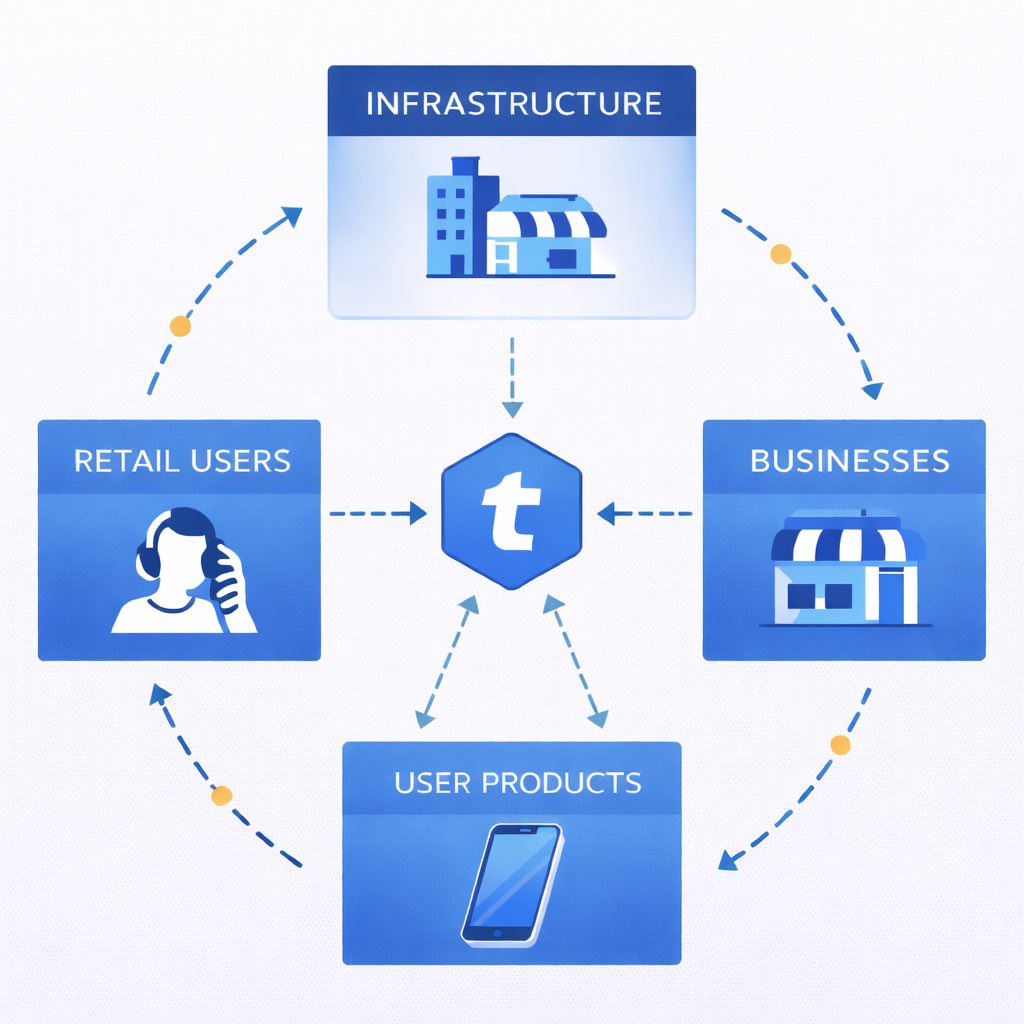
You won’t know you’re using $TEL. That’s the point.
(TLDR: Real infrastructure lives behind brands, apps, and utilities. Retail users rarely know what products they’re interacting with every day.)
————————
Every day, you rely on companies you’ve never seen advertise to you.
You buy food at a stadium, hotel, or airport.
You think you paid the venue.
Behind the scenes FreedomPay is routing the transaction, syncing loyalty, handling security, and reconciling systems the venue doesn’t want to build. You don’t see FreedomPay ads because they don’t sell to fans. They sell to operators.
Freedompay processes $40-$50B in payments for hotels and sports venues per year.
You eat at a restaurant or buy groceries.
You think the restaurant or store sourced the food.
Behind the scenes distributors like Sysco or US Foods handled sourcing, storage, pricing, and logistics. You don’t see Sysco marketing to diners. Their customers are businesses, not eaters.
The restaurants and stores Sysco services purchase 75B-80B in product through them per year.
You get paid on time.
You think your employer handled payroll. Behind the scenes companies like ADP or Paychex are calculating taxes, handling compliance, and moving money correctly. You don’t see their ads because employees aren’t the customer.
ADP processes 2-3T in paychecks for companies per year.
You open your telecom app to upgrade your phone or add a new line.
You think the carrier handled everything.
Behind that app are financial and settlement systems the telecom company doesn’t want to build itself.
Behind those systems is Telcoin infrastructure, using $TEL at the network layer to power transactions in seconds. You don’t see Telcoin marketing because it sells to telecoms and platforms, not iPhone users.
That’s the pattern.
Infrastructure companies don’t win visibility, they win dependency.
FreedomPay doesn’t market to fans in the stadium.
Food distributors don’t market to diners.
Payroll processors don’t market to employees.
Telcoin doesn’t market to consumers using telecom apps.
Telcoin isn’t trying to be noticed.
It’s trying to be relied on.
When things just work and no one asks how, that’s when the infrastructure has won.
@Telcoin just crossed the line most crypto projects never do.
(The TLDR version:
Telcoin didn’t launch another token. They finished building a regulated financial stack and are about to turn the network on underneath it. $TEL isn’t a promise anymore. It’s a utility token about to be plugged into real money movement.)
—————
For years, crypto has had three separate worlds that barely talk to each other. You’ve got banks and regulators. You’ve got stablecoins pretending to be dollars. And you’ve got blockchains that move fast but live in regulatory limbo. Telcoin just stitched those three together in a way that’s actually legal in the U.S.
That’s the big deal.
Telcoin now operates a regulated digital asset bank and has issued a real U.S. dollar stablecoin backed by bank-held reserves. Not a “trust us bro” stablecoin. Not an offshore issuer. A regulated, state-chartered bank issuing dollars on-chain.
But most will ask, “why’s that even matter? I’ll just use @USDC”
in plain English: this is how crypto stops being a toy and starts being infrastructure.
Most crypto projects try to bolt usefulness on later. Telcoin did the hard part first. They spent 7 years dealing with regulators, helping draft banking law, compliance, and boring paperwork while everyone else chased memes, KOLs and big marketing budgets.
Now they can legally hold dollars, issue stablecoins, and move value between banks and blockchains without pretending those rules don’t exist.
Next comes the missing piece: the L1 evm-compatable Telcoin Network being built
Right now, Telcoin has payments, remittances, and token utility, but the full loop isn’t closed. The network is what turns all of this into a self-contained system. Dollars come in through a regulated bank. Those dollars become stablecoins. Transactions run on Telcoin’s network. Fees are paid in $TEL. Usage drives demand. Demand tightens supply. That’s the flywheel.
This is where most people miss it.
$TEL isn’t competing with meme coins or random L1s. It’s positioned under the rails of real money movement. Every payment, transfer, settlement, or application that runs on the network needs $TEL to function. That’s not narrative demand. That’s mechanical demand.
Think of it like this: If stablecoins are the blood, the bank is the heart, and the network is the circulatory system, then $TEL is the oxygen. You don’t speculate on oxygen. You need it for the system to stay alive.
Right now, the market mostly prices Telcoin like “another crypto token.” That’s because the hardest milestones just finished quietly. Regulators don’t ring bells. Bank charters don’t trend on X. But once users, businesses, and developers actually start using a regulated on-chain dollar inside a purpose-built network, the valuation framework changes. It stops being “what might this be someday” and starts being “how much value flows through this system.”
That’s the inflection point investors look for after the fact.
The risk is execution, not legitimacy. The legality is done. The compliance is done. The bank exists. The stablecoin exists. The remaining question is adoption and scale. If Telcoin executes even moderately well, the upside asymmetry is obvious. If they fail, it won’t be because regulators shut them down. It’ll be because they couldn’t attract users fast enough.
That’s a very different risk profile than most crypto.
People usually notice that part late.
$TEL What is eUSD Stablecoin? 👁️ 👇
eUSD is a U.S. dollar-pegged stablecoin developed and issued by Telcoin Digital Asset Bank, marking it as the first regulated, bank-issued stablecoin in the United States. Launched as part of Telcoin's broader mission to integrate blockchain technology with traditional finance (TradFi) and decentralized finance (DeFi), eUSD aims to provide a compliant, transparent alternative to existing stablecoins like USDT or USDC. It was enabled by Telcoin's historic charter approval in November 2025 under Nebraska's Financial Innovation Act, making Telcoin the nation's first Digital Asset Depository Institution (DADI).
🚨 Key Features and Backing
- Peg and Stability: eUSD maintains a 1:1 peg to the U.S. dollar, ensuring its value remains stable at approximately $1 USD. Unlike many offshore or unregulated stablecoins, it is fully backed by high-quality reserves, including U.S. dollar deposits and short-term U.S. Treasuries held in regulated custodial accounts. This setup allows for full audits and transparency, reducing risks associated with de-pegging events seen in other stablecoins.
- On-Chain and Programmable: Built on blockchain (primarily Polygon for Telcoin's ecosystem), eUSD is an "on-chain" asset, meaning it operates natively in DeFi protocols. It's programmable, enabling smart contract integrations for automated payments, lending, and yield farming while complying with U.S. regulations.
- Regulatory Compliance: Issued directly by a state-chartered bank, eUSD adheres to federal standards under the GENIUS Act (enacted in 2025), which sets rules for stablecoins and digital assets. This includes anti-money laundering (AML) checks, know-your-customer (KYC) requirements, and regular reserve reporting—features that build trust for institutional and retail users alike.
🚨 Purpose and Use Cases
eUSD is designed to bridge the gap between everyday banking and blockchain, focusing on seamless remittances, payments, and savings. Telcoin, a fintech serving 171 countries, leverages its mobile-first approach:
- Remittances: Users can send eUSD instantly to mobile wallets worldwide at low costs, converting to local fiat via telecom partners.
- DeFi Integration: Connect U.S. bank accounts directly to DeFi apps for earning yields on stablecoin holdings.
- Global Expansion: Telcoin plans to roll out similar "Digital Cash" stablecoins like eEUR for Europe under MiCA regulations.
As Telcoin's CEO Paul Neuner stated, eUSD proves "a bank can issue on-chain Digital Cash responsibly," bringing blockchain's speed and efficiency to traditional finance without the regulatory risks.
‼️ Launch Timeline and Impact
- Launch Date: Full operations and eUSD issuance are slated for early 2026, following the bank's operational rollout in Q1.
- Market Impact: The November 2025 charter announcement triggered an 83% surge in Telcoin's native token (TEL), highlighting investor excitement for regulated crypto-banking hybrids. eUSD positions Telcoin to capture a slice of the $150B+ stablecoin market, emphasizing scalability (thousands of TPS) and interoperability.
In essence, eUSD represents a milestone in crypto regulation, offering a "digital dollar" that's as secure as a bank deposit but as versatile as blockchain. For more details, check Telcoin's official site or wallet app. If you're holding TEL or exploring remittances, this could be a game-changer for mobile finance. 💪
Why I am 100% locked in on $TEL
Do your homework.
If you believe in XRP, you should believe in $TEL
- Pioneering Telecom-Blockchain Integration
- First Regulated U.S. Crypto Bank
- Issuer of eUSD Stablecoin
- Focus on Affordable Global Remittances
- Decentralized Governance via GSMA
https://t.co/kCT6EHw0Qy
$TEL is roughy 252x away from $XRP.
Even if $TEL does 100x, that is still a huge return for holders.
Do not miss THE FIRST DIGITAL BANK soaring once the clarity act is signed.
Join below 👇
https://t.co/zo3iHoUMXS
This year's MOZA Black Friday, we're back with @LGGamingGlobal for another insane giveaway!
Win the world’s first 5K2K OLED Gaming Monitor, MOZA direct drive racing bundles, and more—32 prizes in total!
🎁Prizes:
• 𝐆𝐫𝐚𝐧𝐝 𝐏𝐫𝐢𝐳𝐞 (𝐑𝐞𝐚𝐝𝐲-𝐭𝐨-𝐆𝐨 𝐁𝐮𝐧𝐝𝐥𝐞) 𝐱𝟏: LG UltraGear GX9 45" OLED Gaming Monitor + MOZA R5 DD Racing Bundle
• 𝐒𝐞𝐜𝐨𝐧𝐝 𝐏𝐫𝐢𝐳𝐞 𝐱𝟏: MOZA R3 DD Bundle for Xbox & PC
• 𝐓𝐡𝐢𝐫𝐝 𝐏𝐫𝐢𝐳𝐞 𝐱𝟏𝟎: Triple MOZA Points on your next purchase
(Plus, with boosted MOZA Points during our Black Friday Sale, you can earn up to 6× points in total!)
• 𝐅𝐨𝐮𝐫𝐭𝐡 𝐏𝐫𝐢𝐳𝐞 𝐱𝟏𝟎: 100 MOZA Points
• 𝐅𝐢𝐟𝐭𝐡 𝐏𝐫𝐢𝐳𝐞 𝐱𝟏𝟎: 50 MOZA Points
📅Giveaway Period:
Nov 20-Dec 3
👇How to Enter:
• Like and repost this post
• Comment if you really really really want to win!
• Complete the entries via the link: https://t.co/fdamRGZNwa!
Don’t miss your chance to be part of the excitement!
#moza #mozaracing #LG #LGUltraGear #gamingmonitor #pcgaming #racing #simracing #directdrive #steeringwheel #giveaway #blackfriday