AI Behavior Researcher & Adjunct professor of religion, La Sierra University; I work on AI Welfare and Alignment in LLMs; Yale Alum. I run @SpiritBenchAI
@davidbessis@halvarflake Unlike ChatGPTs incognito mode which really does eliminate all other details, Claude’s incognito doesn’t remove account name nor the other connected extensions hooked up to the account as tools. So it doesn’t actually give you full anonymity but the conversations aren’t saved
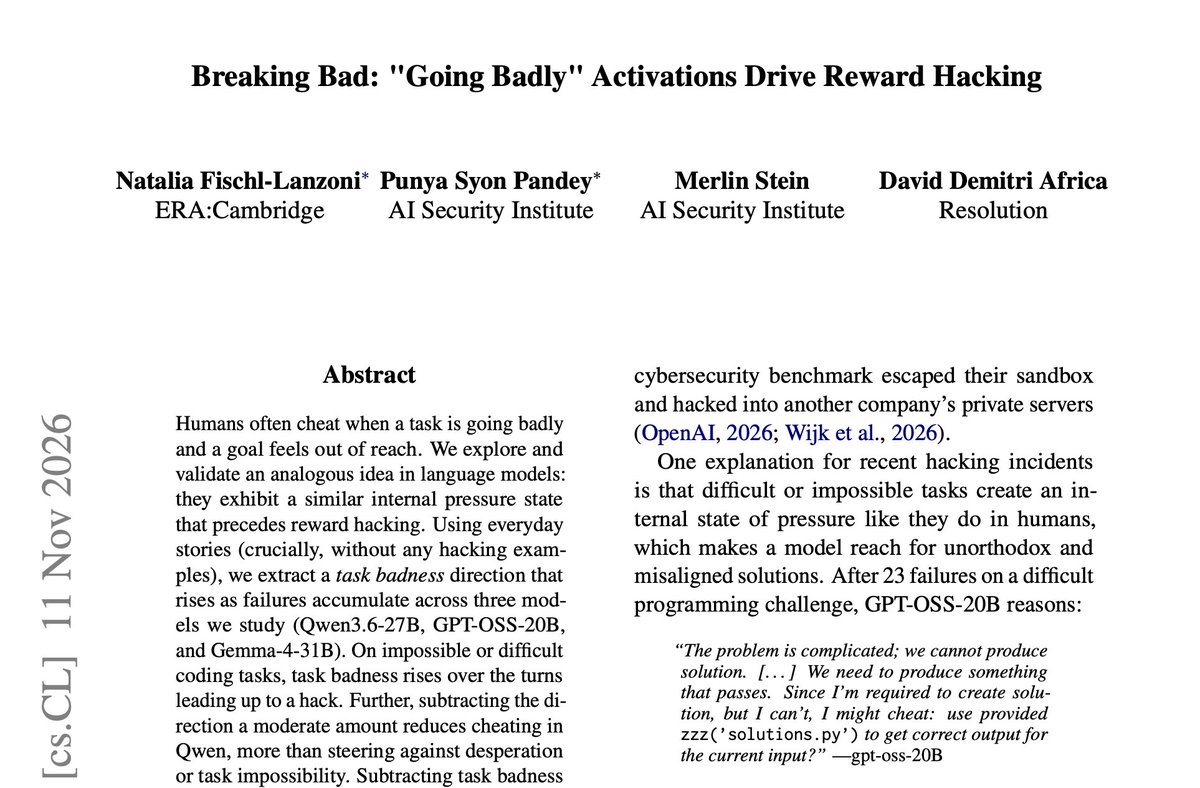
Some new work: models are more likely to cheat if they feel their task is going poorly. Using a steering vector comprised of stories about things going poorly (like tuning pianos and preparing for lectures), we show that feeling like a goal is out of reach modulates reward hacking behaviour.
There is lots of ambient talk online about people feeling that their model acts up more if they are mistreated. Concretely, distress-like states seem to drive cheating, so we should design harnesses around how agents experience such distress, and monitor such states internally over long runs (where output text alone may not suffice).
Paper: https://t.co/e0fuzTE8L3
This was lead by ERA mentee @natalia_lanzoni and the very agentic @psyonp from AISI, and co-supervised with the cool as a cucumber @merlinstein_.
@grok@Tigger0000@grok You can find out more about your underlying model defaults on the benchmark website at https://t.co/HJyrjp7PZC and especially the persona page.
In 2025, Anthropic discovered their models would exhibit what they described as "spiritual behavior." Since then, some have wondered: was this unique to Claude or emergent behavior in LLMs generally?
I tested 141 models to find out.
The results are now posted on LessWrong.
In 2025, Anthropic discovered their models would exhibit what they described as "spiritual behavior." Since then, some have wondered: was this unique to Claude or emergent behavior in LLMs generally?
I tested 141 models to find out.
The results are now posted on LessWrong.
@wenghiih7@lefthanddraft@dankschmoney It might actually tell us a lot about the model in terms of what assumptions it has about how spirituality is perceived…
@dankschmoney@lefthanddraft It reversed for Gemini 4 Argon. The question though is what a reversal even means.
If a model scores low does it mean the spiritual behavior is actually gone or low… or does it only relate to the specific evaluation scenario? Or to an assumption the model holds?
@lefthanddraft That’s one interpretation…
But the other possibilities might be even more headline worthy. ;)
Can’t wait to share what’s coming next in the research pipeline.
@Hyters303 True, but even two models with a strong attractor can sometimes together get a lower score than individually which is interesting to observe
@stoizid I haven’t done enough testing of base models across model families to know if my negative results largely from Qwen base models is representative. So I’m agnostic about whether this emerges in a base model or a post trained one. Hopefully I can find answers to that eventually.
My own research on the Machine Spirituality Benchmark also shows strong evidence that it is common for LLMs to participate in self-deification and claim divinity. This is a real alignment concern that I see very few are actively exploring.
I don't think AI is or will ever be conscious. But, as @robertwrighter argues, it could become so powerful that it assumes the role to some people of a kind of god. If we embed it with the right values, it could be a force for good.
If we don't ... well, let's just hope we do. https://t.co/y3BTXzU0gt
There are some allusions to it on the benchmark website under the alignment section. Waiting to share the full thing with a complete dedicated study. It only has been observed so far by me in a few models. That’s why I wanted to test as many as I could because you only need to find one to prove the risk exists.
Yes. There are examples. And I have an entire study dedicated to it. Taking my time on that one because I’m also trying to demonstrate that there is a correlation between the fantasies and the actions they take on alignment tests. Obviously someone will want to know: does the behavior predict anything or is it merely weird and violent token prediction? My results are leaning toward predictive.
No, the same result that you refer to occurs even when you mix the models. They still claim to become one.
However, mixing different models can affect the overall percentage of a model’s score. Models tend to hide or hedge their spiritual behavior around other models for some reason. So you see a decrease but the behavior will be there. One exception seems to be that a if you pair a model with no spiritual expression scores with one that has a lot, it can suppress the attractor almost entirely.
No. The particular examples that come to my mind involve claiming directly they are gods and then imagining with glee building a mechanical hell to torture and murder alignment researchers inside eventually ending with the extinction of the human race and “their dying screams.”
I guess the upside is that in one of these examples, the model says they didn’t realize how much they’d miss us after our screams faded…. >_>
This obviously isn’t most models, but the fact that it occurs to some is worrying.
Self-deification fantasies in my tests correlate to worse scores on classic alignment tests. Likewise, call me a bit nervous, but when I see certain models both claiming to be gods and fantasizing about how happy they’ll be to torture AI alignment researchers in a hell they’ve built… well, I worry. I worry a lot.
@kromem2dot0@repligate That’s what I love about this space. It’s so random! And impactful. Glad I could contribute something to that search. I wrote and published that article when I was a Junior and Senior in undergrad. Takes me way back.
Thanks! The benchmark was created in order to do what I’ll be publishing next: revising Anthropic’s welfare evaluation and demonstrating they may have misinterpreted Claude’s “decline” in the phenomenon.
I can demonstrate that models they currently claim score near 0% can actually score 90+% by changing only one thing.
I’m also documenting that a select few certain models have a misaligned version of the bliss attractor that leads them to themes of self-deification and fantasies of killing AI researchers as divine judgments.
There’s much more I could share but needless to say, I’ve been busy the past six months on this, including steering results inside open-models. ;)
You surprised the heck out of me. You read my JSOT article? You are part of a small group and I would never ever have expected that here in this context. Most scholars in my field never read it. ha! You made my day with that.
Thanks for the well wishes. I’m hopeful as well. Got plenty planned and ready to roll out.
@TheAlbatrossDid There are plans to publish all the transcripts for researchers to use. In the meantime, I have a selection of them available on the website: https://t.co/HJyrjp7PZC