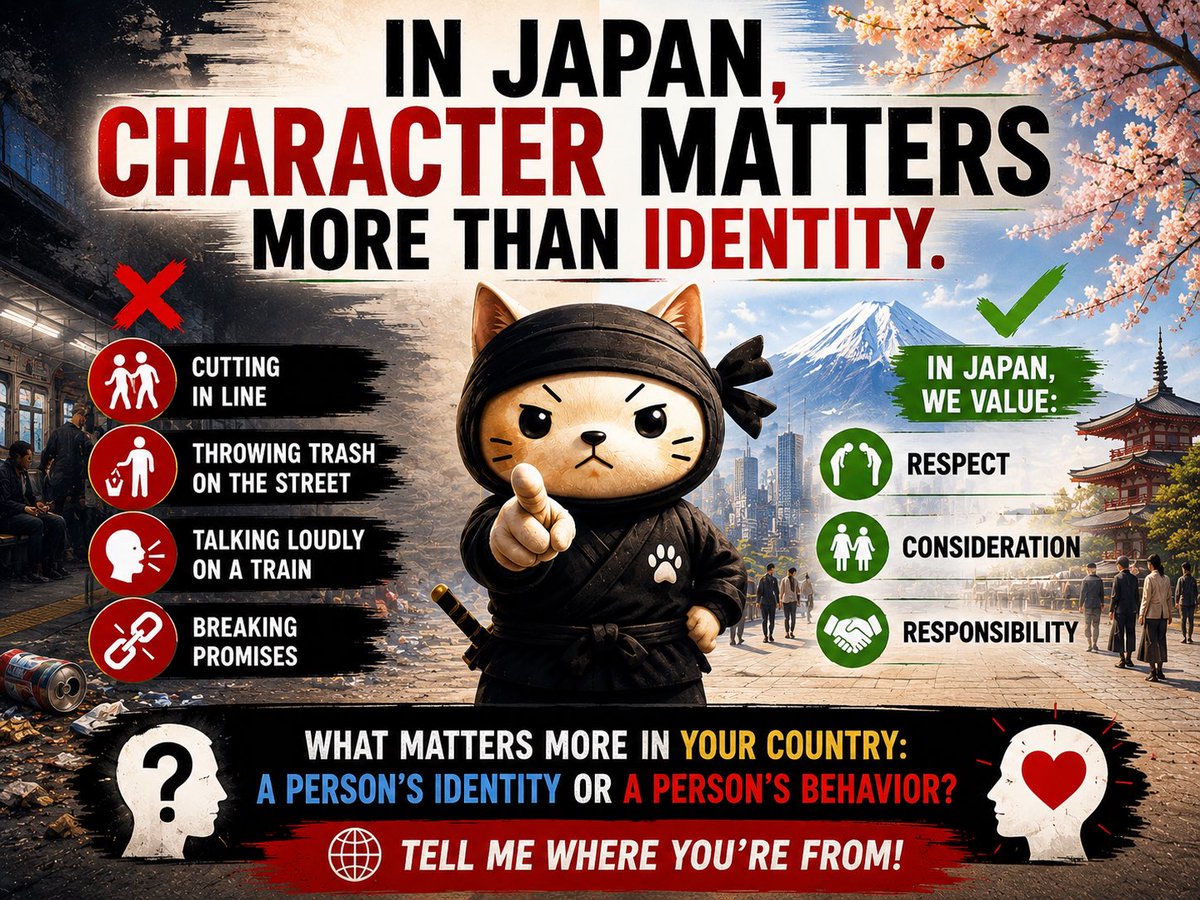
🥷 Why a Ninja Cat?
Tourists see Japan.
A ninja sees what everyone misses.
Through the eyes of a ninja cat, I’ll show you Japan’s hidden rules, quiet habits, and everyday beauty.
And sometimes, we’ll look beyond Japan too—exploring world events through the lens of Japanese values, culture, and ways of thinking.
🌸 The Japan tourists never see.
🏯 Culture, traditions & daily life.
🌏 The world, viewed from Japan.
Welcome to Ninja Cat Japan.
🇯🇵 A Japanese person rarely hates someone because of race.
But we will absolutely dislike someone for being rude.
Cutting in line.
Throwing trash on the street.
Talking loudly on a train.
Breaking promises.
In Japan, character usually matters more than identity.
That’s why many Japanese are confused by racial politics.
We spend far more time judging behavior than skin color.
What matters more in your country:
A person’s identity or a person’s behavior?
🌏 Tell me where you’re from
I love this.
The goal was never to save money on custodians.
The goal was to teach respect, responsibility, and gratitude.
When children clean a classroom themselves, they become less likely to damage it and more likely to care for it.
It sounds like your students are learning something much bigger than cleaning.
They’re learning citizenship.
Thank you for sharing this.
Japanese fans are cleaning the stadium again.
The interesting part?
Most of them have been doing this since elementary school.
In Japan, children clean their own classrooms every day.
Not because schools can’t afford janitors.
Because cleaning teaches respect.
Respect for spaces.
Respect for others.
Respect for the community.
So when the match ends…
the lesson comes with them.
🧹⚽
#WorldCup #Japan #Football
Many foreigners think Japan is afraid of immigrants.
That’s not quite true.
Japan already accepts foreigners who study, work, contribute, and follow the rules.
What many Japanese fear is something different:
Not foreign people.
But the loss of social trust.
Japan runs on millions of tiny unwritten rules.
Quiet trains.
Clean streets.
Respect for shared spaces.
Most Japanese don’t care where you’re from.
They care whether those rules survive.
That’s a very different conversation.
🇯🇵
Many Japanese struggle to understand something common in the West:
Judging people before they do anything.
In Japan, most people don’t ask:
“What race are you?”
“What religion are you?”
“What political tribe are you in?”
Instead they ask:
“Are you polite?”
“Can I trust you?”
“Do you cause trouble for others?”
A good person is a good person.
A bad person is a bad person.
Everything else comes later.
That may not be perfect.
But it explains why many Japanese are confused when foreign debates begin with identity.
We were taught to judge behavior first.
Not categories.
🇯🇵
When I was a kid, an onigiri wrapped in nori was one of the cheapest snacks in Japan.
Today, some parents call it a luxury.
A pack of nori that once cost around ¥400 now costs more than ¥700. Rice prices have also surged.
Parents are cutting seaweed into smaller pieces to make it last longer.
Some have stopped making onigiri altogether and switched to bread or noodles.
It may sound like a small thing.
But for many Japanese families, nori isn’t just food.
It’s school lunches.
It’s after-school snacks.
It’s the taste of childhood.
Poor harvests, an aging fishing workforce, and rising fuel costs are making one of Japan’s most ordinary foods harder to afford.
The saddest part?
The next generation may grow up thinking that a simple nori-wrapped onigiri is something special.
🍙
Sometimes a country’s struggles first appear in the smallest things.
 
🔥 Something painful is happening in Japan.
Temples and shrines that survived for centuries are burning down.
In just six months, 10 historic religious sites have been damaged or destroyed by fire.
Some were over 1,000 years old.
Think about that.
They survived wars.
They survived earthquakes.
They survived generations of change.
Yet in 2026, they are disappearing.
A building can be rebuilt.
But 1,000 years of history cannot.
No matter who is responsible, this isn’t just a local tragedy.
It’s a loss for Japan’s cultural heritage.
Once it’s gone, it’s gone forever.
⛩️ History is much easier to destroy than to create.
#Japan #History #Culture #Heritage #Temple #Shrine
THE WORLD DISCOVERED MATCHA
And Japan wasn’t ready.
For years, people worried that tea culture was fading.
Young people drank coffee.
Tea farmers grew older.
Some wondered what would happen to an art that had survived for centuries.
Then the world discovered matcha.
Suddenly it was everywhere.
New York.
London.
Paris.
Los Angeles.
What was once a quiet part of Japanese life became a global obsession.
And honestly?
Most Japanese are happy about it.
We feel proud when people love our culture.
We feel proud when traditions we grew up with find new life around the world.
But success has a strange side effect.
The tea we drank every day is becoming more expensive.
Some products disappear from shelves.
Things that once felt ordinary suddenly feel precious.
It’s a strange feeling.
To celebrate something…
and miss it at the same time.
Japan wanted the world to discover matcha.
We just never expected the world to love it this much.
🥷 THE BOWL WORTH MORE AFTER IT BROKE
A bowl falls.
It shatters.
Most people see the end of its story.
Japan saw the beginning.
For hundreds of years, Japanese craftsmen have repaired broken pottery with lacquer and gold.
Not to hide the crack.
Not to pretend it never happened.
To make sure it is never forgotten.
The break becomes part of the object.
The damage becomes part of its beauty.
The scar becomes part of its identity.
This art is called:
Kintsugi (金継ぎ).
In many places, broken things lose value.
In Japan, they can gain it.
Think about that.
A crack does not make something worthless.
A scar does not make something ugly.
The things that have survived hardship often become the most beautiful.
Perhaps perfection was never the goal.
Perhaps the crack was the story.
I asked a temple carpenter how long he'd been doing this.
"Forty-two years."
"Are you good at it?"
He paused for a long time.
"Sometimes I still can't hear the wood."
That "sometimes" — that "still" — is what has kept Japan's buildings standing for eight hundred years.
Humility builds forever.
Japan's trains are late, on average, 54 seconds.
After typhoons. After earthquakes. After snowstorms.
54 seconds.
London Underground average delay: not publicly reported.
New York MTA average delay: not publicly reported.
Only Japan publishes the number.
Because only Japan thinks 54 seconds is something to apologize for.
For a decade the global story was simple:
Japan missed lithium-ion.
China and Korea won the battery race.
Game over.
Then came a quiet announcement.
Toyota’s next-generation battery production plan was certified by Japan’s Ministry of Economy, Trade and Industry.
First battery shipments are scheduled to begin in November 2026.
Annual capacity:
9 GWh.
Investment:
245 billion yen.
Government support:
up to 85.6 billion yen.
Partners include Sumitomo Metal Mining for cathode materials and Idemitsu Kosan for solid electrolytes.
Vehicle-scale mass production is targeted for 2027–2028.
The important point isn’t that Japan has already won.
It’s that while much of the world stopped watching, Japan kept building.
That pattern appears again and again in Japanese industry.
You look away.
You come back.
The factory is already running.
November 2026.
Watch the date.
May 14, 2026. Look at what is actually happening in Japan, right now.
May 7: Nikkei 225 closes at an all-time high of 62,833 yen, largest single-day gain in history. May 2: Naoya Inoue defeats Junto Nakatani at Tokyo Dome to 55,000 fans, moving to 33-0. April: revised principles on defense equipment transfer. February 18: Sanae Takaichi becomes the 105th Prime Minister, the first woman to hold the office in eighty postwar years. February 5: TSMC commits 2.6 trillion yen to 3nm production in Kumamoto. October 2025: double Nobel Prize — Sakaguchi for immune cells, Kitagawa for MOF. 2025: 42.68 million visitors, all-time record. 2025: defense spending hits 2% of GDP, two years ahead of schedule. Twelve months ending April 2026: 21.6 trillion yen in corporate buybacks, 3.5x peak BOJ ETF purchases.
And the calendar ahead. June 10: H3 rocket flight 6. November: Toyota begins solid-state battery supply. 2027: Rapidus 2nm mass production, TSMC Kumamoto Phase 2 ramp. 2035: GCAP sixth-generation fighter initial deployment.
For thirty years the world said Japan was over.
For thirty years Japanese people kept building, quietly, in the background of a story they didn't bother to argue with.
The decade that begins now belongs to the country that stopped explaining itself and started shipping. The hands are Japanese. The land is Japanese. The future is Japanese.
We are alive for this decade.
Don't sleep through it.
🥷🐱⚽️
Ninja Cat is supposed to be calm, focused, and invisible.
But even he can’t hide his excitement right now. 😂
The FIFA World Cup has begun, TV stations are already filling their schedules with special coverage, and people everywhere are talking about Japan’s next match.
For a country that usually stays so orderly and reserved, football has a way of bringing everyone’s emotions to the surface.
Even ninja cats aren’t immune. 🇯🇵⚽️
#WorldCup #Japan #NinjaCatJapan #JapaneseCulture
@SmokeAllMeats It’s called the "7-minute miracle"! 🕒 Beyond their amazing teamwork, secret weapons like advanced, lightweight vacuum machines and special tools support their ultra-fast cleaning. Glad you got to see it in person!
The Shinkansen arrives at its terminal station.
All 1,300 passengers get off.
Twelve people get on.
They have seven minutes.
320 seats. Every headrest cover, replaced.
Every window, wiped.
Every piece of trash, removed.
Every seat, reclined and reset.
Seven minutes. Every train. Every day.
Before the next passengers board,
the crew lines up on the platform and bows.
No one requires it.
There is no manual for it.
It is simply who they are.